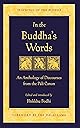

This landmark collection is the definitive introduction to the Buddha's teachings - in his own words. The American scholar-monk Bhikkhu Bodhi, whose voluminous translations have won widespread acclaim, here presents selected discourses of the Buddha from the Pali Canon, the earliest record of what the Buddha taught. Divided into ten thematic chapters, In the Buddha's Words reveals the full scope of the Buddha's discourses, from family life and marriage to renunciation and the path of insight. A concise, informative introduction precedes each chapter, guiding the reader toward a deeper understanding of the texts that follow. In the Buddha's Words allows even readers unacquainted with Buddhism to grasp the significance of the Buddha's contributions to our world heritage. Taken as a whole, these texts bear eloquent testimony to the breadth and intelligence of the Buddha's teachings, and point the way to an ancient yet ever-vital path. Students and seekers alike will find this systematic presentation indispensable. Review: One Of A Kind Book - Researchers believe that "The Buddha" ( a term meaning "The Awakened One" ) was an actual man named Siddhartha Gautama that lived in India over 2,600 years ago. His teachings were passed down for several centuries after his death via an oral tradition until they were written down on collections of palm leaves. These are stored in the Sutta Pitaka of the Pali Canon, the texts of the oldest surviving form of Buddhism known as Theravada. The Sutta Pitaka consists of 5 "Nikayas" or books/collections. These collection are thousands of pages long, contain much repetitive content and have only been translated into English as of the 19th century. Translations into English are still being perfected as ancient Pali and modern English are extremely different languages. In other words, the reader who wants to read the Buddhist message for him/herself has the daunting task of combing through several large, expensive, repetitious volumes of translations that may not be clear to a modern reader. "In the Buddha's Words: An Anthology of Discourses from the Pali Canon" is an anthology of the Buddha's teachings compiled by Bhikkhu Bodhi. Bhikkhu Bodhi was born in New York City in 1944 as Jeffrey Block. He is an American Theravada Buddhist monk. Bhikkhu Bodhi has translated large portions of the Pali Canon himself and is a native English speaker. His goal in compiling his anthology is to make the Buddha's message more accessible to the ordinary person and to encourage the ordinary person to read the Pali Canon themselves. To this end, he has chosen what he thinks are the most essential of the Buddha's discourses. Bhikkhu Bodhi has also put these suttas ( discourses from the Buddha ) into a logical order by subject in his anthology -- something which doesn't exist in the Pali Canon, which is a scattered, repetitious collection of separate talks. Bhikkhu Bodhi further aids the reader by reducing the repetition of phrases in the translations ( left over from the oral tradition ) and Bhikkhu Bodhi introduces each section with some extremely helpful essays on the suttas that follow. The result is an easy to understand, scholarly anthology that gives the reader a sense of what can be found in the Sutta Pitaka in regards to the essentials of the Buddha's message - without having to make the larger investment of going through the significantly more voluminous, repetitious and expensive English translations of these collections. This book will likely not be enjoyable to people whose exposure to Buddhism has been a mixture of inspirational poetry, psychological analysis and elements borrowed from other spiritual traditions. People who are uncomfortable reading text that is more "religious" will find those elements in this collection. Bhikkhu Bodhi has striven to given an honest snap shot of what someone can expect to find in translations of the Pali Canon. That snap shot includes the presence of preternatural beings, mythical realms and what is commonly known in the West as "reincarnation". If you have limited tolerance for reading such things, this book isn't for you. This book can also be dry in many sections. It isn't a book that can be read, or understood by reading through it in many large chunks while laying on a couch after a taxing day. My recommendation would be to read it a tiny bit of time, sitting up and during your best hours to get the most out of it. I was surprised to see that a copies of the "The Peg" (Ani Sutta, Samyutta Nikaya XX.7), "The Unconjecturable" (Acintita Sutta, Anguttara Nikaya IV.77) and "To Sivaka" (Moliyasivaka Sutta, Samyutta Nikaya XXXVI.21) suttas (discourses from the Buddha ) were not included in this anthology. These suttas state that the Buddha knew his teachings would get distorted over time, that the Buddha believed that ordinary people could not explain the details of their current situation by tracing their karma ( kamma ) and that not all situations a person encounters in their lives are the result of karma. These are extremely important ideas and it is a bit strange that they are not included in an anthology of essential teachings attributed to the Buddha himself. As stated previously, a big problem for those seeking to understand Buddhism directly from the original texts is that these texts haven't been translated very well into English. English and Pali are just very different languages. The modern world is also very different from the ancient world from where the texts came. Given that Bhikkhu Bodhi is an American and a native English speaker I had different expectations for these translations than what I read. As an example, throughout the anthology the root causes of "suffering" are listed as being "greed, hatred and delusion". The terms in quotes are not the only possible English translations. The English translations are technically correct, but I believe the terms used hold extreme connotations to the contemporary English speaker which rob the Buddhist message of its meaning and relevance to contemporary life. Many people interpret "suffering" as agony, "greed" as extreme desire, "hatred" as an extremely strong emotion and "delusion" as close to being insane. Other translators have stated that the Pali word "dukha", commonly translated as "suffering" really refers to any dissatisfactory feeling from a vague sense of things not being the best as they could be on one end, to flat out agony on the other end. So, an alternate translation like this one is possible: "The root cause of feelings of unhappiness, distress or suffering come from desire, aversion or being ignorant to the nature of life." To me, that speaks to me much more as a modern person and seems relevant to many more of my experiences than: "The roots of suffering are greed, hatred and delusion". The alternative translation doesn't come off as a recycled puritanism of which I want no part of as a secular person. There are a number of other examples of alternative translations like this one. I'm not a scholar of any kind and Bhikkhu Bodhi is. As an expert who has devoted his life to Buddhism I wouldn't be surprised to learn Bhikkhu Bodhi is correct in his translation choices. I'm just saying my preference would have been for the other choices and I think that will be true for many people interested in this book. I believe this book to be a first of its kind in what does and how well it does it. I heartily encourage anyone with an interest in Buddhism to endure the shortcomings of the book. Read it in little bits every day, read the whole thing and talk to people about it. Such an investment will keep coming back to you for the rest of your life. Review: Already Dog-Eared! - Even a casual student of literature and philosophy would find the text of the Pali Canon striking. Here is the original form of the parable regarding the blind men who encounter the different parts of an elephant and form widely divergent and strongly held opinions on what an elephant is like. I've heard this parable told in many contexts for all my life but never realized that Buddha was the first to use it 2500 years ago. Many other images will grab the mind as one pages through this wonderful translation. On one page, Buddha grabs a handful of leaves and asks his listeners which was more numerous, the leaves in his hand or the leaves still on the trees in the surrounding grove. When they gave the obvious answer, he tells them that the leaves overhead are like the knowledge that Buddha knows, but the leaves in his hand are like the knowledge that Buddha is teaching, because he is only teaching what is relevant and beneficial for the spiritual life and what will lead directly to Enlightenment. On the facing page, the reader will find an equally striking metaphor of a steep precipice used to show the pitfalls of a life lived without spiritual reflection or striving towards enlightenment. I love the way the translator includes a chart of such striking images in the back of the book so that it is easy to look these up again. The translator has tried to be faithful and accurate to the text, sometimes with no regard for the music of the language when read aloud. When dealing with something like this, I will vote for clear English over beautiful English! The scholarly merits of this work is enhanced by an excellent organization of the material and by the notes that precede each chapter. I frequently found myself reading the chapters, than turning back to the notes for a more complete understanding of what I was reading. The passages of poetry do, by and large, succeed as poetry in English which is a notable accomplishment of translation in and of itself. A translator faces many difficulties especially when trying to translate a traditional text into a modern language and context. The translator discusses some of these in his General Introduction and it is important that the reader not skip this in a big hurry to get to the text itself. The main thing that the reader must understand is how the translator deals with the frequent repetitive sections in which the same thing may be said five times over. Here the first and last sections are given in full and the repeating sections are represented by "...". This can take a little getting used to but I found this to be a good method. It was better practice to mentally put in what was taken out rather than to be mentally skipping multiple lines. I would recommend this book to persons of a philosophical mind set in general or to English-speaking seekers of Enlightenment in particular. This is a book that repays those who spend time with it. I have had it only since September 2009 and as I write this review in December of the same year I note that my copy already has many dog-ears and double dog-ears where I have folded down a page so as to be able to easily revisit a passage. I am not normally so rough with my books but as the song says, you only hurt the ones you love.
| Best Sellers Rank | #129,789 in Kindle Store ( See Top 100 in Kindle Store ) #1 in Theravada Buddhism (Books) #2 in Buddhist Sacred Writings (Books) #7 in Theravada Buddhism (Kindle Store) |
R**R
One Of A Kind Book
Researchers believe that "The Buddha" ( a term meaning "The Awakened One" ) was an actual man named Siddhartha Gautama that lived in India over 2,600 years ago. His teachings were passed down for several centuries after his death via an oral tradition until they were written down on collections of palm leaves. These are stored in the Sutta Pitaka of the Pali Canon, the texts of the oldest surviving form of Buddhism known as Theravada. The Sutta Pitaka consists of 5 "Nikayas" or books/collections. These collection are thousands of pages long, contain much repetitive content and have only been translated into English as of the 19th century. Translations into English are still being perfected as ancient Pali and modern English are extremely different languages. In other words, the reader who wants to read the Buddhist message for him/herself has the daunting task of combing through several large, expensive, repetitious volumes of translations that may not be clear to a modern reader. "In the Buddha's Words: An Anthology of Discourses from the Pali Canon" is an anthology of the Buddha's teachings compiled by Bhikkhu Bodhi. Bhikkhu Bodhi was born in New York City in 1944 as Jeffrey Block. He is an American Theravada Buddhist monk. Bhikkhu Bodhi has translated large portions of the Pali Canon himself and is a native English speaker. His goal in compiling his anthology is to make the Buddha's message more accessible to the ordinary person and to encourage the ordinary person to read the Pali Canon themselves. To this end, he has chosen what he thinks are the most essential of the Buddha's discourses. Bhikkhu Bodhi has also put these suttas ( discourses from the Buddha ) into a logical order by subject in his anthology -- something which doesn't exist in the Pali Canon, which is a scattered, repetitious collection of separate talks. Bhikkhu Bodhi further aids the reader by reducing the repetition of phrases in the translations ( left over from the oral tradition ) and Bhikkhu Bodhi introduces each section with some extremely helpful essays on the suttas that follow. The result is an easy to understand, scholarly anthology that gives the reader a sense of what can be found in the Sutta Pitaka in regards to the essentials of the Buddha's message - without having to make the larger investment of going through the significantly more voluminous, repetitious and expensive English translations of these collections. This book will likely not be enjoyable to people whose exposure to Buddhism has been a mixture of inspirational poetry, psychological analysis and elements borrowed from other spiritual traditions. People who are uncomfortable reading text that is more "religious" will find those elements in this collection. Bhikkhu Bodhi has striven to given an honest snap shot of what someone can expect to find in translations of the Pali Canon. That snap shot includes the presence of preternatural beings, mythical realms and what is commonly known in the West as "reincarnation". If you have limited tolerance for reading such things, this book isn't for you. This book can also be dry in many sections. It isn't a book that can be read, or understood by reading through it in many large chunks while laying on a couch after a taxing day. My recommendation would be to read it a tiny bit of time, sitting up and during your best hours to get the most out of it. I was surprised to see that a copies of the "The Peg" (Ani Sutta, Samyutta Nikaya XX.7), "The Unconjecturable" (Acintita Sutta, Anguttara Nikaya IV.77) and "To Sivaka" (Moliyasivaka Sutta, Samyutta Nikaya XXXVI.21) suttas (discourses from the Buddha ) were not included in this anthology. These suttas state that the Buddha knew his teachings would get distorted over time, that the Buddha believed that ordinary people could not explain the details of their current situation by tracing their karma ( kamma ) and that not all situations a person encounters in their lives are the result of karma. These are extremely important ideas and it is a bit strange that they are not included in an anthology of essential teachings attributed to the Buddha himself. As stated previously, a big problem for those seeking to understand Buddhism directly from the original texts is that these texts haven't been translated very well into English. English and Pali are just very different languages. The modern world is also very different from the ancient world from where the texts came. Given that Bhikkhu Bodhi is an American and a native English speaker I had different expectations for these translations than what I read. As an example, throughout the anthology the root causes of "suffering" are listed as being "greed, hatred and delusion". The terms in quotes are not the only possible English translations. The English translations are technically correct, but I believe the terms used hold extreme connotations to the contemporary English speaker which rob the Buddhist message of its meaning and relevance to contemporary life. Many people interpret "suffering" as agony, "greed" as extreme desire, "hatred" as an extremely strong emotion and "delusion" as close to being insane. Other translators have stated that the Pali word "dukha", commonly translated as "suffering" really refers to any dissatisfactory feeling from a vague sense of things not being the best as they could be on one end, to flat out agony on the other end. So, an alternate translation like this one is possible: "The root cause of feelings of unhappiness, distress or suffering come from desire, aversion or being ignorant to the nature of life." To me, that speaks to me much more as a modern person and seems relevant to many more of my experiences than: "The roots of suffering are greed, hatred and delusion". The alternative translation doesn't come off as a recycled puritanism of which I want no part of as a secular person. There are a number of other examples of alternative translations like this one. I'm not a scholar of any kind and Bhikkhu Bodhi is. As an expert who has devoted his life to Buddhism I wouldn't be surprised to learn Bhikkhu Bodhi is correct in his translation choices. I'm just saying my preference would have been for the other choices and I think that will be true for many people interested in this book. I believe this book to be a first of its kind in what does and how well it does it. I heartily encourage anyone with an interest in Buddhism to endure the shortcomings of the book. Read it in little bits every day, read the whole thing and talk to people about it. Such an investment will keep coming back to you for the rest of your life.
M**N
Already Dog-Eared!
Even a casual student of literature and philosophy would find the text of the Pali Canon striking. Here is the original form of the parable regarding the blind men who encounter the different parts of an elephant and form widely divergent and strongly held opinions on what an elephant is like. I've heard this parable told in many contexts for all my life but never realized that Buddha was the first to use it 2500 years ago. Many other images will grab the mind as one pages through this wonderful translation. On one page, Buddha grabs a handful of leaves and asks his listeners which was more numerous, the leaves in his hand or the leaves still on the trees in the surrounding grove. When they gave the obvious answer, he tells them that the leaves overhead are like the knowledge that Buddha knows, but the leaves in his hand are like the knowledge that Buddha is teaching, because he is only teaching what is relevant and beneficial for the spiritual life and what will lead directly to Enlightenment. On the facing page, the reader will find an equally striking metaphor of a steep precipice used to show the pitfalls of a life lived without spiritual reflection or striving towards enlightenment. I love the way the translator includes a chart of such striking images in the back of the book so that it is easy to look these up again. The translator has tried to be faithful and accurate to the text, sometimes with no regard for the music of the language when read aloud. When dealing with something like this, I will vote for clear English over beautiful English! The scholarly merits of this work is enhanced by an excellent organization of the material and by the notes that precede each chapter. I frequently found myself reading the chapters, than turning back to the notes for a more complete understanding of what I was reading. The passages of poetry do, by and large, succeed as poetry in English which is a notable accomplishment of translation in and of itself. A translator faces many difficulties especially when trying to translate a traditional text into a modern language and context. The translator discusses some of these in his General Introduction and it is important that the reader not skip this in a big hurry to get to the text itself. The main thing that the reader must understand is how the translator deals with the frequent repetitive sections in which the same thing may be said five times over. Here the first and last sections are given in full and the repeating sections are represented by "...". This can take a little getting used to but I found this to be a good method. It was better practice to mentally put in what was taken out rather than to be mentally skipping multiple lines. I would recommend this book to persons of a philosophical mind set in general or to English-speaking seekers of Enlightenment in particular. This is a book that repays those who spend time with it. I have had it only since September 2009 and as I write this review in December of the same year I note that my copy already has many dog-ears and double dog-ears where I have folded down a page so as to be able to easily revisit a passage. I am not normally so rough with my books but as the song says, you only hurt the ones you love.
C**S
The Original Buddhist Scriptures
The editor, an American Theravada Buddhist monk, has compiled readable translations of the Pali canon -- the original Buddhist scriptures, written in the language of the Buddha himself. The scriptures are categorized by the editor according to theme, and each section includes an illuminating introduction and discussion by the editor. As the editor himself notes, the Pali canon can occasionally make for tedious reading -- the canon emerged out of an oral tradition, and includes the heavy use of repetition that is necessary in such a tradition. That said, it is interesting to be able to read the texts that sit at the foundation of Buddhism.
N**L
the key to reality
no exaggeration. i wasted YEARS on other new forms of buddhism: vajrayana developed up to 1,200 years after buddhas death, zen developed up to 900 years after buddhas death, and others (pure land doesn't even count as it's not about awakening, but going to a very late invented buddhist realm AFTER death based on faith in a very late invented "amitabha buddha"). do these other forms work? not for me! maybe they do for others. but the bottom line is that the original teachings are just that: the original. they are laid out in a step by step frame to lead one to awakening. bodhi has compiled many here to make them very simple and straightforward (otherwise one must read hundreds of pages to get the step by step feel as they are recorded in massive volumes, very spread out. totally worth it though, i have all of his translations). whereas zen is totally reliant on teachings of individual zen masters and the same goes for vajrayana (ie. the practice is not recorded in full in their respective scriptures for said schools). if you try to just read all the mahayana scriptures (all written after the original scriptures were recorded) without reading any works by teachers of those sects or having an actual teacher, you will be lost in a mass of contradictions and confusion. for example if you read the lankavatara sutra you will learn vague ideas about meditating, then read the infinite life sutras and you will think you should be praying to amitabha, then read vajrayana stuff and you will think you should be praying to tibetan gods, practicing dream yoga, and spinning prayer wheels. the original teachings are reliant on THE BUDDHA'S teachings which are internally consistent and not confusing. they are about morality, meditation to still and gladden the mind (culminating in equanimity and higher states), and finally reflection on reality in order to see through it's constructs. they do not teach any other practices or worship of any "buddhas" or "gods", and there is no conflict from one sutta (sanskrit: sutra) to another. sounds like the right choice to me! i didn't even know this was the original teachings. this is a collection of texts from the oldest known record of the buddha's teachings (other than the agamas which are preserved in chinese and are of numerous schools and therefore less consistent, some as old as this, some newer, some of unknown origin, and so on), without these, there would be no buddhism. this is from the pali canon or pali tipitaka from the oldest surviving school the theravada. years and years i spent practicing versions of buddhism with little fruit. then i discovered the original and had rapid progress. it's a tried and true system. i have seen through reality on multiple occasions now. this book is indispensable. with this and some supplementary commentaries and maybe some web reading on jhana practice and insight reflection one could easily start to have great progress. final note: if you dedicate your life to some other tradition under a competent teacher, you MIGHT have some success. like go ordain in a zen monastery or at the very least spend a LOT of time with a zen teacher. i really don't know and i don't want to totally knock other traditions as supposedly they work if you take it that far. but if you are practicing mostly alone like most westerners, go with the original works by the buddha himself and commentaries and supplementary teachings on those works. this isn't just me talking either, 99% of zen and vajrayana teachers will tell you that you MUST have a teacher to progress. most theravada will say the same, but using the scriptures as your teacher is a viable and realistic option as long as you are diligent! whereas you cannot simply read mahayana/vajrayana scriptures and walk away with any kind of consistent or complete practice methodology.
B**R
Well written, not for everyone
This is one of the few books I allowed myself to not finish (generally I have a "you start, you finish" policy,) because I just found it too depressing. If there is a hellfire and brimstone side to Buddhism, then you'll find the equivalent of it here. It was a pretty stark change for someone like me who mostly knows 'mindfulness' from more uplifting, positive psychology contexts. There is a lot of focus on the dangers of samsara and the general undesirability of an unexamined 'worldly' life, including warning stories about people who work and work to be incarnated in blissful realms for countless eons, only to be reincarnated as animals right after that for preserving one small flaw in their worldview and such. For some, such tails might be inspiration to practice hard, for me, they were just disheartening and made 'practice' seem like an impossible task - winning a universal Olympic medal time two billion! I still gave it four stars because it appears to be well researched and the format is clear and easy to follow - it's just a matter of knowing if you're the right audience for this book or not. It's more stern and 'tough love' than uplifting and heart opening, to my mind.
A**S
A perfect introduction to Buddhism
Something you might not know, if you're a westerner like myself, is that the Buddha's words were not written down until around 100 years after his death. Similar to the way we received the Vedas, dedicated monks devoted much of their lives repeating, memorizing and teaching the Buddha's discourses in a systematic way, until they were actually written down. Another thing. While Buddha did teach a step by step process for attaining enlightenment, this was not captured and codified in any single book of the Pali Canon. Thanks to Bhikkhu Bodhi for the uninitiated there is now a straight line drawn between the various teachings and doctrines to spell it out from A-Z. He has arranged parts of the various other books to create a concise, "This is way" abridgement. The book is quite repetitive due to the various memorization techniques employed by those early disciples. And yet that also lends a meditative quality to the book as well. If you're looking to dip your toe in the water of Buddhism, and you prefer reading sources that are as close to the horses mouth as possible, I don't think you'll find a better book than this.
C**E
Comprehensive and progressively ordered selections from the Sutta Pitaka
This is the most recent of several Pali-only anthologies of Buddhist texts I've read, the other two being Word of the Buddha and Path To Deliverance, both by the famous German monk Nyanatiloka. (The latter is especially good.) This one is easily the most comprehensive. For those of you who find the suttas tough going on account of their lack of thematic organization, this book will be a godsend. As Bhikkhu Bodhi explains in the introduction, the idea for it had its genesis in a series of lectures he gave on the Majjhima Nikaya. His goal therein was to arrange materials from simplest to most profound, giving a progressive, graded course of theoretical and practical instruction. He then decided to turn that approach to the Sutta Pitaka as a whole. The result is the present work. The specifics of this structure are as follows, where each number refers to a part of the book: 1.The Buddha's description of the human condition 2.The nature of the Buddha and his attainment 3.How to approach the Dhamma 4.How the Dhamma contributes to happiness in this life 5.How it can contribute to happiness in future rebirths 6.The Dhamma on why renunciation is the safest course to take (the perils of samsara) 7.The nature of the path to liberation 8.How to master the mind 9.The nature of transcendent wisdom 10.Stages of realization Each of these sections is prefaced with a substantial introduction by Bhikkhu Bodhi, and some of these are surprisingly good. (I have often felt a little sour toward BB's writing because he is such a slave to the Commentaries and tends to express himself with a slightly stilted, pompous air.) I was especially impressed by his introduction to part 3 ("Approaching the Dhamma"), which is, in effect, an essay on the place and nature of faith (saddha) in the Buddha's teaching. I think anyone, no matter how knowledgeable, can benefit from these pages (81ff). It is especially useful as a contrast to Christian notions of faith. So who would benefit most from this book? I think beginning students would especially be served by it, or at least those who have until now subsisted mainly on a diet of secondary texts and haven't yet plunged into the jungle of the suttas. This book is excellent for providing an orientation, and if read two or three times so that one really becomes familiar with the passages contained therein, when the passages are finally encountered in their full form it should prove very rewarding. But then, anyone who wants a refresher, or a different manner of presentation from, say, the four noble truths and the three-fold training (sila, samadhi, paññ'), will also benefit.
F**E
MASTERFUL
Must have, must read for all serious Dhamma followers. Great compendium of all the most essential suttas. This is a great way to warm up to the 5 huge nikayas of the Sutta Pitaka, also translated and explained masterfully by Bhikkhu Bodhi
J**N
Recomendable
Genial antología de los textos pali. Presentación claramente estructurada. Da una visión global y al mismo tiempo razonablemente detallada de las enseñanzas de Buda. Los comentarios del autor antes de cada capítulo son claros y didácticos. El libro es extenso y fiel al Tipitaka, y quizás invita a no ser leído rápidamente. A mi me resultó enormemente inspirador. Muy recomendable.
八**人
パーリ経典のすぐれたハンドブック
膨大なパーリ三蔵のうち、とくに教学あるいは実践上重要なガイダンスとなる経典を含む中部経典について、主要経典の正確な翻訳をもとに、エッセンスを項目ごとにまとめて、さらに親切な平易な英語による解説をつけている。本書の著者のビック・ボディ(比丘菩提)は、アメリカ人の上座部僧侶で、学僧としてのみならず、指導者としても著名である。中部経典の全英訳も出版している著者ならではの著作であり、索引も網羅的できわめてすぐれている。瞑想家のためには、「再生」とは?「涅槃」とは?というキーワードについて、中途半端な入門書で迷うよりも、まずは本書にあたってみることが有益であると考える。まさに「仏陀のことばでは」という出版社の姿勢を高く評価したい。
F**E
Excelente
Excelente. Uma ótima antologia de discursos do Buda. Para quem quer compactar as milhares de páginas de sutras proferidos por Buda, em uma sequência coerente e prática. Recomendado.
L**S
The Best Introductory Book to Buddhism Available
Bhikku Bodhi breaks down Buddhism into a digestible and easy to understand, yet detail, form. This book explores Buddhism, its key concepts and the life of the Buddha through an examination of the Pali Canon, the oldest extant canonical Buddhist collection of texts. Truly the best introductory book into Buddhism, its key concepts and the life of Gautama that's available. If I could rate it higher than 5 stars I would.
D**.
Mucho a un precio muy bajo
Me encanto el libro, casí como la bilbia staviravadhin, aunque con guiños a la teoría de shunyata, me encanto, el libro para complementar las enseñazas principiantes de un maestro por excelencia
Trustpilot
3 days ago
2 days ago