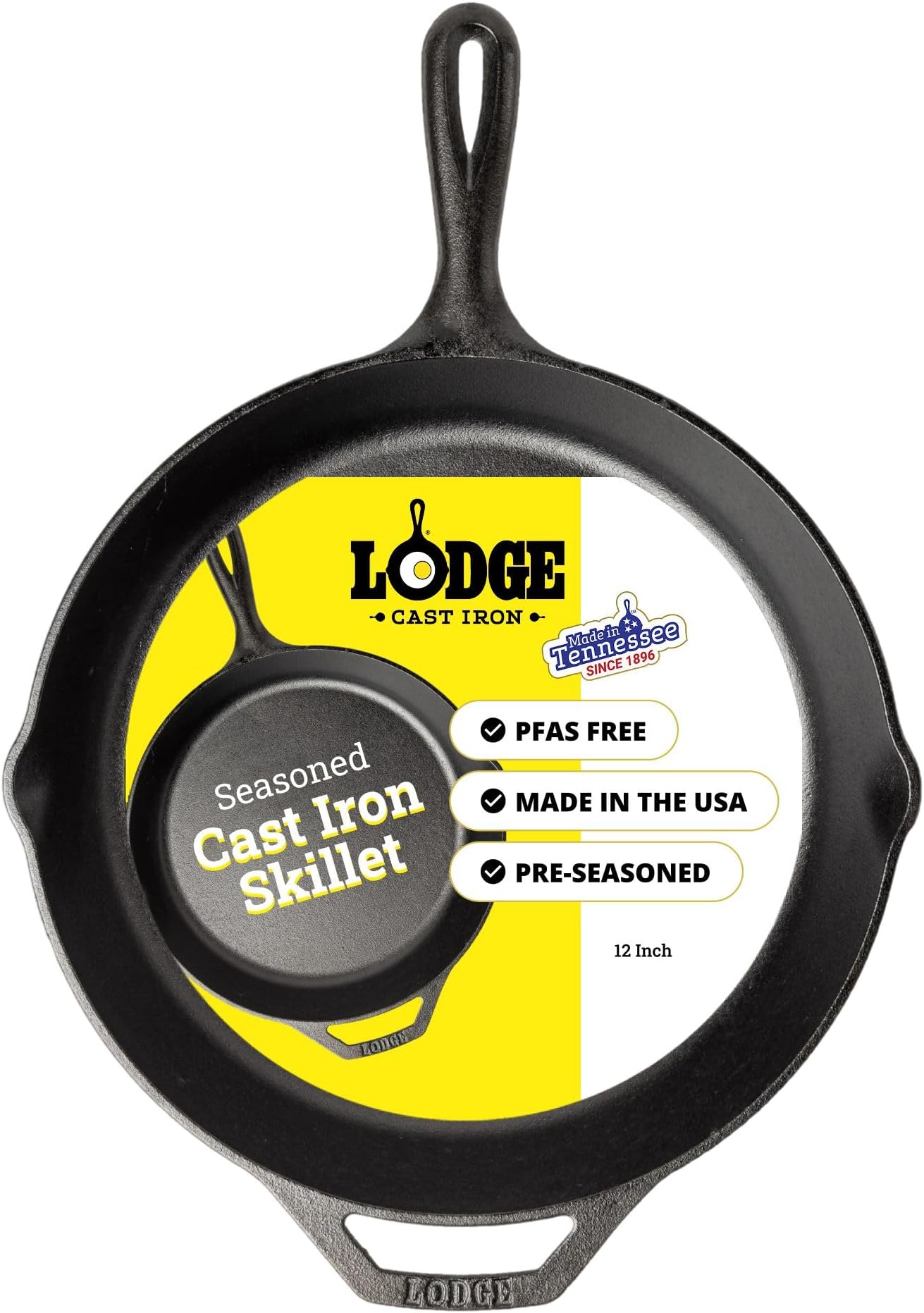

Pre-Seasoned Cast Iron Skillet, PFAS-Free, 12 Inches
Product ID: 1160999
Details
- BrandLodge
- Capacity5 ml
- ColorBlack
- Materialcast-iron
- Special FeatureMade without
🔥Superior heat retention
♻️PFAS-free, non-toxic
🛡️Durable cast iron build
Desertcart purchases this item on your behalf and handles shipping, customs, and support to Croatia.
🔥 Elevate your kitchen game with the skillet that never quits!
The Lodge Pre-Seasoned 12-inch Cast Iron Skillet offers exceptional heat retention and durability, crafted from non-toxic, PFAS-free cast iron. Pre-seasoned for a natural non-stick finish, it’s oven-safe, stovetop compatible, and perfect for everything from everyday meals to outdoor cooking adventures. Made in the USA with a lifetime warranty, this skillet is a timeless kitchen essential designed to improve with every use.


| ASIN | B00006JSUB |
| Additional Features | Made without PFOA or PTFE |
| Best Sellers Rank | #1,909 in Kitchen & Dining ( See Top 100 in Kitchen & Dining ) #25 in Skillets |
| Brand | Lodge |
| Brand Name | Lodge |
| Capacity | 5 ml |
| Coating Description | Cast Iron |
| Color | Black |
| Compatible Devices | Gas |
| Customer Reviews | 4.7 out of 5 stars 9,062 Reviews |
| Global Trade Identification Number | 00075536301006, 04517751708179, 30075536301007 |
| Handle Material | Cast Iron |
| Included Components | Skillet |
| Item Highlight | Non-Toxic & Naturally Non-Stick Cast Iron Pan, Compatible with Oven, Stove, Grill & Campfire, Made in USA |
| Item Type Name | Miniature Skillet |
| Item Weight | 3.58 kg |
| Manufacturer | Lodge |
| Manufacturer Part Number | FBA_1033502000010 |
| Manufacturer Warranty Description | Lifetime |
| Material | cast-iron |
| Material Type | cast-iron |
| Maximum Temperature | 500 °F |
| Metal Type | cast iron |
| Model Name | Cast Iron Skillet |
| Model Number | Miniature Skillet |
| Number of Items | 1 |
| Number of Packs | 1 |
| Product Care Instructions | Hand Wash Only, Oven Safe |
| Recommended Uses For Product | cooking, frying, baking, serving a variety of dishes |
| Shape | Round |
| Special Feature | Made without PFOA or PTFE |
| Specific Uses For Product | versatile cooking, family meals, camping, grilling, and oven use |
| UPC | 720698828624 085404391671 075536301006 075536014005 077344751271 075536301198 844819016254 |
| Unit Count | 1 Feet |
K**E
Lodge 12-Inch Cast Iron Skillet: PFAS-Free, Durable, and Built for a Lifetime of Cooking
The Lodge 12-Inch Pre-Seasoned Cast Iron Skillet is a kitchen workhorse that delivers exceptional performance, durability, and versatility at an affordable price. Whether you're searing steaks, frying eggs, baking cornbread, or cooking over a campfire, this skillet handles it all with ease. The pre-seasoned surface arrives ready to use and only gets better over time, developing a naturally non-stick finish with regular cooking. Unlike many modern cookware options, it's completely PFAS-free and free from synthetic coatings, providing peace of mind for anyone looking to avoid potentially harmful chemicals in the kitchen. One of its biggest strengths is heat retention. The skillet heats evenly and stays hot, making it ideal for achieving restaurant-quality sears and golden-brown crusts. It also transitions seamlessly from stovetop to oven, adding even more versatility to meal preparation. While cast iron is heavier than traditional cookware and requires simple maintenance like drying thoroughly and occasional seasoning, the benefits far outweigh the extra effort. Its rugged construction is built to last for generations, making it a long-term investment rather than a disposable kitchen tool. Pros: -Naturally non-stick with continued use -PFAS-free and non-toxic cooking surface -Outstanding heat retention and even cooking -Oven-safe and compatible with all cooktops, including induction -Extremely durable and built to last for decades Cons: -Heavy compared to aluminum or stainless steel pans -Requires basic maintenance to prevent rust -Handle can get very hot during cooking Overall If you're looking for a dependable, chemical-free skillet that can handle virtually any cooking task, the Lodge 12-Inch Cast Iron Skillet is an excellent choice. Its durability, cooking performance, and value make it one of the best cast iron pans available for both beginners and experienced home cooks.
L**E
LOVE it
I read the negative reviews before I bought, and they made nervous. Now that I've used mine, though, I don't understand how anyone could have a problem with this pan. As you can see from my photo, it is nonstick for frying chicken and then glazing it right in the pan. Even better, it makes food taste so good. Fried, baked, seared, whatever you do with it. And, face it, you are eating what you cook in, so best make it something your body needs anyway. This is a large pan, and it is heavy. If you have weakness in your arms for some reasons, get a smaller iron skillet. But I'm an old lady and I have no problem with it. It does have two handles, after all. I reseasoned the pan before use by rubbing shortening on the entire thing and turning it upside down (baking sheet on rack below) in a 450° oven for four hours, then letting it gradually cool as the oven cooled. Beautiful black finish. No sticking. I usually use wood utensils, though my pic shows an old leftover silicone one, but you can use metal. A couple of words to the wise: the handles will get as hot as the pan itself. Use potholders or oven mitts. Don't soak it or let it air dry. Heat it on your burner until it is dry. Don't wipe it with a towel or rag. You will get bits of lint that will burn and stick. Reseason if the bottom gets scratched or scraped or the shine wears off. The bottom is not flat and smooth, nor does it need to be. A little bit of texture from a sand casting gives somewhere for oil to bubble beneath your food so that you get nicely browned oven- or stovetop-fried food or crispy pizza crusts. (Cut back the oil for cornbread or brownies.) I've used cast iron all of my life, and a lot of it was Lodge.
E**N
Great Pan!
Great pan!! Easy to clean, even cooking, heavy, well-made and makes a great pizza! It is easy to use, a little heavy but it is cast iron so it should be. It is stable and the depth is perfect for my needs.
M**N
Heavy but works good
**** UPDATE 2 **** I'm still learning how to use this wonderful pan. I've stopped cleaning it out in the sink. I just leave it on the burner and clean it in place regardless of what I did with it. I use Pam spray (not the old kind that leaves a residue), butter or olive oil while cooking, wipe it out with dry and wet paper towels immediately after removing the food, and recoat with spray and leave it on the burner to cool. In most cases I can clean the pan so quickly my food is still hot when I sit down to eat. I now use it about as often as my nonstick skillet, although it's horses for courses. If you broil steaks indoors in winter, try this: Lay some foil in the pan and shape it to fit. Remove the foil. Heat the pan on the burner until the oil starts to smoke. Drop in the foil, drop in a steak or two and put the pan under the oven broiler. Turn the steak as usual. The steak cooks similar to how it would on a gas grill and cleanup is a matter of just lifting out the foil. Bend the foil to drizzle the accumulated juices over the steak. UPDATE*** I've grown to like this pan more and more. I now cook meals in it. For example, at breakfast you can cook eggs, hash browns and bacon at the same time. It's all about the timing of when each ingredient goes in. If you are diligent about keeping it well-oiled and don't put food in until it's pre-heated, the pan behaves as if it were non-stick. I wish the main handle was longer. The pan is so heavy it's hard to move around when cleaning. It's much easier to clean if you do it while it's still warm. I pretty much have to leave it on the stove and wipe it out with a bunch of wet paper towels. ORIGINAL REVIEW I bought this after getting frustrated trying to cook sea scallops in a regular pan and not getting a good sear. This is the kind of pan you need for searing meats on a stove or in an oven. It's got a rough texture finish inside. Be sure it's hot and has oil or butter on it before adding food to prevent sticking. It cleans easily with just water and a sponge if you let it soak for a little while. If you clean it with soap you need to heat it and rub oil on it to restore the seasoning coat that prevents the food from welding onto it. It's really heavy! Imagine holding a skillet with sand in it. They've added on a handgrip on the opposite side of the handle so you can use two hands. If the pan is warm (and it stays warm long after you turn off the burner) you'll need potholders on both hands to move it to the sink for soaking or cleaning. I'm still experimenting with it, but I think it makes a great addition to the kitchen. I use it much less often than my non-stick Circulon skillet, but it lets me do things I never could before and that's sparking my creative juices.
E**R
Nice heavy cast-iron skillet, requires some (minimal) maintenance, but will become a favorite!
I purchased this pre-seasoned skillet as a shower gift, but have used the Lodge brand Dutch oven and other Lodge skillets. While I didn't cook in this particular one, I did receive it at home and was able to look at it prior to wrapping; this was exactly as expected in terms of weight, thickness and style. In general, Lodge pieces are sturdy, well made, and very easy to maintain with some minimal care. If you haven't cooked with cast iron, you're in for a treat, especially if you have a gas stove. Cast iron pans are the workhorse of the kitchen - and a favorite tool of mine. They're terrific for frying, searing, sauteeing, roasting, and baking - you can pretty much do most of your cooking (both on the stove top and in the oven) in one cast iron pan! While not coated with non-stick Teflon, with seasoning they become nearly non-stick. These are easy to clean, so don't let this deter you from purchasing if you're considering it; the 12-inch skillet is one of my preferred cooking pans, as it is so versatile. One of my favorite articles on cast iron can be found at Serious Eats: http://www.seriouseats.com/2014/11/the-truth-about-cast-iron.html, which I highly recommend; it gets into the science behind cast iron and dispels a number of the myths surrounding it. Some simple, easy-to-follow care instructions (taken directly from the article): 1. Season it when you get it. Even pre-seasoned cast iron can do with some extra protection. To season your pan, heat it up on the stovetop until its smoking hot, then rub a little oil into it and let it cool. Repeat this process a few times and you're good to go. Seasoning is actually not a thin layer of oil, it's a thin layer of polymerized oil, a key distinction. In a properly seasoned cast iron pan, one that has been rubbed with oil and heated repeatedly, the oil has already broken down into a plastic-like substance that has bonded to the surface of the metal. This is what gives well-seasoned cast iron its non-stick properties, and as the material is no longer actually an oil, the surfactants in dish soap should not affect it. Go ahead and soap it up and scrub it out. 2. Clean it after each use. Clean your pan thoroughly after each use by washing it with soap and water and scrubbing out any gunk or debris from the bottom. I use the scrubby side of a sponge for this. The one thing you shouldn't do? Let it soak in the sink. Try to minimize the time it takes from when you start cleaning to when you dry and re-season your pan. If that means letting it sit on the stovetop until dinner is done, so be it. 3. Re-season it. Rinse out any excess soap with water, then place the skillet over a burner set to high heat. When most of the water inside the skillet has dried out, add a half teaspoon of a neutral oil like vegetable, canola, flaxseed, or shortening. Rub it around with a paper towel. Continue heating the pan until it just starts to smoke then give it one more good rub. Let it cool and you're done. 4. Fry and Sear in it. The best way to keep your seasoning maintained? Just use your pan a lot! The more you fry, sear, or bake in it, the better that seasoning will become. 5. Don't let it stay wet. Water is the natural enemy of iron and letting even a drop of water sit in your pan when you put it away can lead to a rust spot. Not the end of the world, but rust will require a little scrubbing and reseasoning. I always dry out my pan with a paper towel and coat it with a tiny amount of oil before storage. As I mentioned, I am a huge fan of cast iron - I have many vintage cast iron Griswold pans that I love, and several formerly rusty pans that I've restored. Lodge is a good brand, well-made and will serve you well with a minimal amount of care, and will quickly become a favorite in your kitchen!
S**G
Great cast iron skillet
TL;DR version - The skillet is awesome, it cooks everything from dutch babies to searing meat without any sticking or hot spots. No kitchen is complete without a cast iron skillet. ------ Now that's out of the way, if you haven't cooked with cast iron you're missing out, and you've also got a lot to learn, so here's a crash course to help figure out if this skillet is right for you. Advantages of cast iron: * cast iron has a high density, thus is retains heat extremely well * it's great at distributing even heat * properly seasoned cast iron can perform with the best non-stick pans * they are built to last longer than you, many are passed down generation to generation * you could rearrange a home intruder's face with a good swing of a cast iron pan Disadvantages of cast iron: * unseasoned cast iron will rust quicker than you imagine * takes longer to heat up than your nonstick or steel * will probably crack if thermally shocked or dropped * they are heavier than any other type of cooking vessel A lot of the disadvantages of cast iron are easily addressable with a bit of common sense. First and foremost, cast iron has to be completely seasoned. This means the cooking surface, the bottom, the handle, everything. The good news is, this is pretty easy to do and the more you use the pan the better your seasoning gets. Seasoning your cookware: There are many discussions as to how to properly season cast iron. A recent post on lifehacker sums them up best. Basically what everyone agrees on is the vessel is covered in a layer of fat, and is put under high heat until the fat polymerizes. You let the pan cool, and repeat until you have multiple thin layers of polymerized fat. The discrepancies are what type of fat to use, the baking temp/time, and the best practices to maintain your seasoning. Traditionalists will argue that lard is best, because that's the way it always has been done. I've seasoned with bacon fat, and I'm a big fan of it. It satisfies the inner animal in me and makes me feel I'm cooking in the manliest way possible without putting a whole animal into a fire - not that I'm insecure about such things. I've also seasoned with vegetable oil, and found that it produces almost identical performance that lard does. The food science crowd suggests using flax seed oil, because it polymerizes easiest. I haven't had a chance to try seasoning with flax seed oil, but it's what I plan on doing after my next move in a few months. Another point to bring up, is that cast iron used to be offered polished and unpolished. The Lodge skillet comes unpolished, meaning it has a textured surface. I think before I do the flax seed oil seasoning, I will likely use a dremel/sandpaper to smooth the cooking surface purely for aesthetic purposes to flaunt that I take care of my cookware. Polished cast iron does offer the benefit of more exposed internal pores, so the seasoning sticks better, but I've never had an issue seasoning so this point is moot. I've done both high heat and medium heat for seasoning, and I find that the hotter the oven the better the seasoning. If you fail to season above 350f, you will likely end up with a browned pan that is slightly sticky because the fat didn't form a polymer, and will make you leave an unnecessary low star Amazon review and never know the benefits of cast iron. My suggestion is scrub the skillet with steel wool and soap until the water runs clear and you're sure there's no soap remaining on the cast iron. Dry the skillet completely, and cover with oil; make sure you get the handles, bottom, and top. Place a cookie sheet below the oven rack to catch any drips so you don't burn the house down. Heat the oven to 400f to 500f and put the skillet in there and bake for an hour - not including the preheating time. Putting it in a cold oven may be unnecessary, however this is the thermal shock downfall I mentioned earlier. It's better to get into the habit of avoiding massive temperature changes so you can pass the skillet down to your children's children. After the hour, shut off the oven and allow the skillet to cook down. This initial seasoning layer isn't quite ready for primetime, if you were to cook something with tomatoes, lemons, vinegar you could very well screw it all up because of the low PH reacting to the thin layer of fat polymer and possibly penetrating all the way to the cast iron. Too much science for me, so to be on the safe side if I'm going to be using the oven with temperatures in excess of 375f I make sure the cast iron gets another layer of fat and gets re-seasoned. Usually after about 3 or 4 trips to the oven, it could withstand just about anything. Now that you're seasoned, how do you not screw this up? First and foremost, I use metal utensils on it because it inevitably makes it easier to clean if stuff isn't stuck to it for very long. Providing you're not trying drill for oil through the pan, the polymer should be hard enough to not flake off and ruin your day. Next, make sure you invest in a large thing of salt. I don't think it's anything chemical about salt that allows it to clean the pan, but it's an edible scouring powder. I've read that because we generally don't use dish soaps that contain lye, they should be gentle enough to use on cast iron. I cannot confirm or deny this, because I find just using salt and a bit of oil to make a paste works just as well. Get a paper towel and polish down the dried bits of food until it resembles how it started. It may not have the same shine, but you should be completely drying the skillet and applying a real thin coat of oil to it. There's your shine. It's important to continuously use the skillet to maintain the coat. This doesn't mean every night, but treat yourself to a steak for dinner or pannekoeken for breakfast once a week - your skillet and taste buds will thank you.
T**M
Your Grandmother knew best, and she was right.
Cast iron skillets, and Dutch Ovens are probably the most versatile pans you can own; it's a fact that fights have actually broken out in families over who is going to inherit the heirloom cast iron cookware after a loved one passes. Lodge Manufacturing, in South Pittsburg, Tennessee produces some of the last cast iron pieces to actually be made in America. They also happen to make the best in the world. They produce the only type of skillet I've seen that can go from the stovetop, right into the oven, and then onto the table. In addition, these pans can be used with great success over an open fire while camping, something no other cookware can do. Since this skillet comes preseasoned, you get to skip the job of seasoning the pan before it's first use. However, if you don't maintain this preseasoning, you'll have to reapply a new coat. Seasoning cast iron is a very simple process, the instructions that follow apply to any piece of cast iron cookware needing seasoned. First, heat the oven to 400 degrees, then, using your hands, coat the iron pan inside and out, including the handle, with SOLID SHORTENING ONLY, such as Crisco(not butter flavored), or even lard. Then bake it, upside down, on the upper oven rack for an hour. Line the ovens bottom rack with alumnium foil and you'll catch the drippings that fall as the shortening melts and gets absorbed by the iron. Then allow the pan to cool before attempting to handle it again. If your oven has a hooded fan, you will want to run it to remove the fumes and odors caused by the melting shortening. That's all there is to it. You can also do this process outside in a gas grill, or even a charcoal grill so long as it has a cover. Afterward, you will want to fry fatty foods such as bacon, fried chicken, or fish in your newly seasoned pan, as these types of oily foods help to reinforce the new seasoning you've just applied. After a round of frying bacon or chicken, your skillet will be ready for virtually anything else you want to cook in it. This skillet will quickly become the most frequently used pan in your kitchen, and that's a good thing because the more you use it, the more seasoning you're actually applying to the iron. Some have complained that they have lost a small area of the seasoning in their pan, and have had to remove the rest of the seasoning by hand before reapplying the Chriso and baking process. Actually, you can follow the steps above and be just fine. If, for some reason though, you have to remove all the seasoning, simply put the pan upside down in the oven and run the oven through the cleaning cycle once, then allow the oven and pan to cool. The skillet will come out like the day it was made, but you must wash, dry, and reseason it right then and there. Doing so will prevent rust, which is one of the few real dangers to cast iron. Two other dangers include, never adding or running cold water into a hot iron skillet or Dutch Oven because the sudden temperature change will cause the pan to crack. And finally, NEVER, under any circumstances, wash a cast iron pan in a dishwasher. Dishwasher soap is strong enough to remove even the oldest seasoning and the steamy, humid environment created during the drying cycle will then cause the pan to rust. Clean all cast iron pieces by hand with hot water and a stiff bristled brush, NO SOAP EVER, and then dry the piece right after washing using a paper towel. You can then apply a very light shot of cooking spray, inside and out, to protect the pans seasoning; paper towels are helpful in spreading the spray over the pans entire surface. I realize this has been a rather long review, but I hope the various instructions listed above are helpful to first time buyers/users of cast iron cookware. Finally, for first time buyers, I recommend purchasing the Lodge Preseasoned 3 skillet set which includes a 6", 8", and a 10" skillet, in addition to this 12 inch pan. Together, whether cooking in the kitchen or over an open fire while camping, these 4 skillets will give you the versatility of cooking for one person or the entire family. You will also want to get a Lodge Preseasoned Iron Lid and a regular splatter screen for this skillet because they raise the potential uses of the pan even more. I've used cast iron for years, and it really is the way to go. If you consider the cost of other types of cookware, and how long it will last when compared to cast iron, you really can't go wrong with purchasing 3 or 4 pieces for your everyday use. Remember too, that your kids, and their kids in turn, will be using these pans long after you're gone. With a probable service life of more than one hundred years, I'm sure you won't be disappointed.
M**C
A well-seasoned cast iron skillet is as non-stick as you can get
In response to the nay-sayers who claim the rougher surface of the Lodge cast iron skillet makes it difficult to achieve a non-stick seasoning: I received my Lodge 12-inch skillet as a gift in April of 2011 (five and a half months ago as I write this). I spent one Saturday morning enhancing the seasoning by giving it four additional coats of seasoning: I coated the pan with a light rub of generic store-brand vegetable oil, cooked it in the oven at 425 degrees F for 60 minutes, let it cool off for 30 minutes, then gave it another coating and cooked it at 425 again, a total of four times. The pan is a wonderful black color and the surface is slick. Even though it's not as flat and smooth as an antique Griswold skillet, the Lodge pan will take anything I throw at it, and cleanup is a breeze. As I write this, in the past week alone I've used it to sear burgers at the highest temperature of my electric stove range (after preheating it in the oven at 500 degrees); I cooked a Chicago deep-dish pizza in it, letting the dough bake and rise in the pan and cutting it with a metal chef's knife ; I've covered it with the Lodge Logic 12-Inch Iron Cover and cooked pork chops and apple slices to the point where the meat pulled away from the bone and I didn't need a knife to cut it; I seared and fried six pieces of chicken in it with only 1/8 inch of peanut oil, searing it on the stovetop first then cooking it in the oven at 350 degrees; and today I used it as a baking pan to make a 12-inch diameter chocolate cake for my neighbors' kids. I used metal utensils, including the chef's knife. Nothing has stuck to the pan and the seasoning is taking everything, showing no more than a few scratches from where the pizza was cut. Only the seasoning was scratched; the iron surface itself hasn't even been touched. The scratches will be filled in and covered over with additional seasoning as I continue to use the pan, they will not be there forever. Each time I clean it, I simply use a green rough scrubbing pad under warm-to-hot running water; everything has come off with no sticking at all. After washing the pan out, I dry it on the stovetop with the burner on a low-to-medium heat for 15 minutes, then when the pan is bone-dry I turn it off, let it cool for ten minutes, then give it another light coating of vegetable oil. This skillet is a champion, and I've only been using it for less than six months. That's the way to get a solid non-stick seasoning on your Lodge cast iron skillet -- you don't have to sand the surface down, and you don't have to use fancier oils like flaxseed oil (which has been shown to be no more effective than regular vegetable oil for seasoning cast iron). All you need to do is use your pan regularly, and it will reward you with the legendary black non-stick patina that cast iron is known for. This is a pan that will cook anything and everything. Every kitchen needs at least one of these.
N**C
Fabulous Pan
This pan really is a revelation. We have various good non-stick pans but none of them could properly sear meat. This pan retains so much heat that it doesn't drop the temperature at all when you put the meat in. In fact to clean it I pour in a glass of water (after allowing it to cool after cooking) and it boils it instantly. The pan is really easy to clean. Just rub it with oil and it won't rust. Perfect steak, seared and rare. I should have bought one years ago.
D**Z
Solid pan likely to last for decades to come.
It took a while to get the handle of it, but you just can't go wrong with cast iron. I'm absolutely in love with it! I purchased the silicone gripper, which is nice to have, but I think it's difficult to pour the contents one-handed with it, and I find myself using a towel instead more often than not. I've managed to get it to be more non-stick than my old non-stick pan with a few rounds of seasoning (a slight pain in the ass) but the maintenance and repairability are simply something I wouldn't trade. Do note that caring for it is more involved than caring for a stainless steel pan, but I find that the sear is unmatched, and the temperature doesn't really drop when adding food, which is amazing.
C**H
Very happy and perfect size for average stove top
Great size, and cooks pretty evenly when warmed up first. Very happy with it. Pancakes did not stick 😊
S**R
Best Skillet
Good product at a great price. Extremely durable and easy to use. Best Cast Iron Skillet in the market
L**A
C’est top!
Je suis très contente de mon achat!
Trustpilot
2 months ago
4 days ago