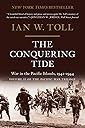
The Conquering Tide – War in the Pacific Islands, 1942–1944: 2 (Pacific War Trilogy)
Product ID: 117664498
Desertcart purchases this item on your behalf and handles shipping, customs, and support to Croatia.
Buy The Conquering Tide – War in the Pacific Islands, 1942–1944 (Pacific War Trilogy): 2 Illustrated by Toll, Ian W. (ISBN: 9780393353204) from desertcart's Book Store. Everyday low prices and free delivery on eligible orders. Review: The best Pacific theatre book around. - Second in the series of three books. And as was the case with the first book. I can't reccomend this enough. If you are looking for a series of books that explain the Pacific theatre of war, whilst being highly readable. Then look no further. You won't find anything better. Review: A Tour de Force - This book is an absolute gem, focusing on the Pacific Island and naval battles from 1942-44. There's 200 pages alone on the Guadalcanal campaign, and the 5 major naval battles that took place around it in the Solomon Islands. Then the author focuses on the Gilbert and Marshall Islands, the US raid on Truk which has been forgotten, and ends with the landings on Saipan and Guam, with an excellent account of the large battle of the Philippine Sea, also known as the Marianas Turkey Shoot. I feel that the author focuses more on the naval aspects of the Pacific Theater, rather than the actual battles of the land campaigns on the islands. The book reads more like a novel than a non fiction book, and its written so it is easily understood, with some politics included. Overall the book was a page turner and is certainly one of the best books on the US campaigns in the Pacific in World War 2. I look forward to the third volume, as this is the second volume of Ian W Toll's Pacific trilogy.

| Best Sellers Rank | 192,521 in Books ( See Top 100 in Books ) 20,200 in History (Books) 43,083 in Society, Politics & Philosophy |
| Book 2 of 3 | Pacific War Trilogy |
| Customer reviews | 4.8 4.8 out of 5 stars (6,253) |
| Dimensions | 15.49 x 3.81 x 23.37 cm |
| Edition | Illustrated |
| ISBN-10 | 0393353206 |
| ISBN-13 | 978-0393353204 |
| Item weight | 1.05 kg |
| Language | English |
| Print length | 688 pages |
| Publication date | 18 Oct. 2016 |
| Publisher | W. W. Norton & Company |
G**T
The best Pacific theatre book around.
Second in the series of three books. And as was the case with the first book. I can't reccomend this enough. If you are looking for a series of books that explain the Pacific theatre of war, whilst being highly readable. Then look no further. You won't find anything better.
G**Y
A Tour de Force
This book is an absolute gem, focusing on the Pacific Island and naval battles from 1942-44. There's 200 pages alone on the Guadalcanal campaign, and the 5 major naval battles that took place around it in the Solomon Islands. Then the author focuses on the Gilbert and Marshall Islands, the US raid on Truk which has been forgotten, and ends with the landings on Saipan and Guam, with an excellent account of the large battle of the Philippine Sea, also known as the Marianas Turkey Shoot. I feel that the author focuses more on the naval aspects of the Pacific Theater, rather than the actual battles of the land campaigns on the islands. The book reads more like a novel than a non fiction book, and its written so it is easily understood, with some politics included. Overall the book was a page turner and is certainly one of the best books on the US campaigns in the Pacific in World War 2. I look forward to the third volume, as this is the second volume of Ian W Toll's Pacific trilogy.
T**M
Outstanding
Simply the best writing on the pacific war, period. If you’re interested in this subject, it’s a must have
J**R
Ian W Toll appears to be a much better balanced writer on these issues than some others I ...
An excellant book. The first two hundred pages, covering Guadanal and the Solomon Islands were especially interesting as I sailed in those waters as a young man in various cargo boats and the book highlighted much of what had happened over those same waters I had been in. Above the personal level, much of it is elsewhere, but, to have it put together in a single volume is excellant. Ian W Toll appears to be a much better balanced writer on these issues than some others I could name but would recommend Phillips Payson O'Brien `How the War was Won' for greater depth as regards the elements of Japanese industrial capacity, supply and manpower problems. Toll is doing a different job than O'Brian, and this is not to deride Toll, O'Brian adds an enlargement of a single aspect of the war. Cannot wait to read the final volume, unfortunately, does not appear to be available from high street Bookships in this Country. Shame, as Six Frigates was.
N**S
Fantastic books.
These books are so well written and researched, I’d really recommend. I can’t wait for the last one to be out on paperback. Can’t remember the last time I read a military history book that was so hard to put down. Tony never had the makings of a varsity athlete.
A**B
Great read
This is the second book of the trilogy fascinating read telling me things I didn't already know new knowledge great write
B**S
An informative historical view of the war in the east.
I am still reading this book. It is well written, interesting and explains very well the developments that took place after Pearl Harbor.
G**M
Excellent resource
A well written, informative narrative of the Pacific War from 1942 to 1944 that has enough detail to provide you with a good description of this area of the Second World War. Good maps also help you to understand where the battles were located. Great read. If you want a book on the Pacific War during this period then look no further.
B**A
Die Toll-Trilogie ist sehr sehr toll geschrieben und auch gut Vorformierte erfahren interessante Neuigkeiten. Es ist zu dem ein Genuss zu lesen und trotz der Länge ohne nennenswerte Längen. Eigentlich 6 Sterne.
D**R
Impossible de poser le livre
F**R
This book is the second book in a 3-part series on WW II’s Pacific War. The first book (Pacific Crucible) was excellent. This second book is also excellent. It covers the period from Guadalcanal to the Great Marianas Turkey Shoot. (I have not yet read the third and final book, Twilight of the Gods.) This book, like the first book, writes about the war from a fairly high level and with a broad perspective. So, in addition to covering the battles themselves, there are discussions on the war planning, the island spotters reporting from Japanese-held islands, the impact of logistics, the use of radar, the superiority of Japanese torpedoes (and the huge inferiority of American torpedoes), the death of Yamamoto, the wartime expansion of Pearl Harbor facilities, American-Australian relations, the island-hopping strategy (e.g., avoiding well defended islands such as Rabaul), America sending experienced flyers back home to train newer flyers, American submarine warfare against Japan’s maritime supply line, Japan’s propaganda machine, etc. And, of course, the book presents both American and Japanese perspectives (though there is more information presented from the American perspective). War planning might sound like a boring topic to some readers, but it wasn’t (to me, anyway). For example, the “Germany first” policy was discussed, as it impacted decisions regarding the allocation of resources for the Pacific War campaign. Though prioritizing Germany, most leaders understood that the less resources the USA allocated to the Pacific War early in the war, the more time Japan would have to prepare the defenses of their conquered island territories (in anticipation of eventual American attack). Also, the longer it took ground forces to re-capture an island, the longer naval support forces had to stay nearby, thus increasing the threat of attack by enemy submarines. And tactical planning changed as well since the many American ground force casualties at Tarawa meant tactics had to change if future Tarawa’s were to be avoided. Guadalcanal was initially fought from a position of rough parity between military forces. But by the time the American advance reached the Marianas, America’s armed forces were mostly dominating the seas and controlling the air over the battlefields because of the greatly increased number of ships and the newer and more capable naval aircraft. The USA as an “arsenal of democracy” was clearly responsible for such a massive fleet expansion, though the book mostly just mentions it in passing (perhaps because that would better be the subject for a book on economics). Bottom Line: Interesting, important, well written history. Note: I’m 78 years old; so by now, I’ve read many WW II history books. Initially, I was concerned these books might simply repeat what I already knew. Turned out, no concern. These books did an excellent job presenting a lot of material and showing how decisions and events combined together to result in initial Japanese successes and, later, a faltering Japanese situation.
M**N
Best history of the naval war in the Pacific!
M**I
The Conquering Tide: War in the Pacific Islands, 1942-1944 is the second in Ian W. Toll's planned trilogy on World War II in the Pacific and picks up where the excellent first book in the trilogy, Pacific Crucible: War at Sea in the Pacific 1941-1942 left off. In Pacific Crucible, Toll chose a central premise - hubris and contempt - and wove the story of the early part of World War II in the Pacific around it. In The Conquering Tide he's done the same thing. "But the American military leadership, thrust unexpectedly into war in 1941, was largely unprepared to function in an integrated high command." Toll brings up the central premise of The Conquering Tide right at the beginning of Chapter 1: interservice rivalry. Initially, it's interservice rivalry between the Navy and War Departments but throughout the book you can see it as well between the Navy and Marine Corps, between the Marine Corps and the Army, and between regions of the Pacific Theater. Rivalry isn't limited to the American's either; the Japanese suffer from interservice rivalry and to worse ends than the Americans. Luckily, there were personalities within the American leadership that were able to overcome rivalries and work together to attain victories. The Japanese were unable to do the same and that was one of the reasons their war began to unravel. "In subsequent operations of 1942 and 1943, north and south of the equator, planners had been forced to work against oppressive deadlines and commanders had been forced to rely on deficient or awkward logistics. But the Americans had always appeared before they were anticipated, and the Japanese had been obliged to fight earlier than they would have liked." Another theme that runs through The Conquering Tide is a defense of Admiral Ernest J. King's aggressive strategy in the Pacific. Not always appreciated and agreed with by subordinates and allies, King pursued an aggressive strategy in the Pacific. Others thought he was moving too quickly and before forces were ready, but King realized that the Japanese were no better off. By moving quickly and early, King's strategy resulted in Japanese held islands being attacked before they had the opportunity to strengthen defenses even further. No doubt, had the Americans waited until they were more ready to attack, the Japanese defenses would been stronger than those encountered and the battles would have been harder and the casualties higher. Throughout The Conquering Tide, we see the fortunes of the Americans and the Japanese change. The resources and manufacturing capability of the Americans do nothing but build while the resources and manufacturing capabilities of the Japanese shrink. Toll looks at this from both the military and domestic perspectives for both countries. Throughout the battles and campaigns, the Japanese lose equipment and manpower that they simply don't have the resources and capability to replace all the while losing access to resources they don't have at home through the loss of their merchant shipping to American submarines. While this story has been told many times before in a plethora of other books, Toll's book bears reading. Most books on World War II work from the Allies' perspective, not surprising since they were the victors, but Toll tells the story of the Pacific from both sides. He includes the perspectives of command level and field level leadership as well as the perspective of individual sailors, marines, soldiers, and airmen. He doesn't limit the narrative to military operations either, he also uses the perspective of the home front. I thought his description of San Francisco as a war city was a good segue into the story of the USS Wahoo and was very interested in how the fortunes of war effected the Japanese population. Toll's writing style is vivid and descriptive and he brings personalities to life by getting into their minds and thought processes. I gave Pacific Crucible five stars and The Conquering Tide is just as good - another five star book. I can't wait until the third book in this trilogy!
Trustpilot
1 day ago
1 month ago