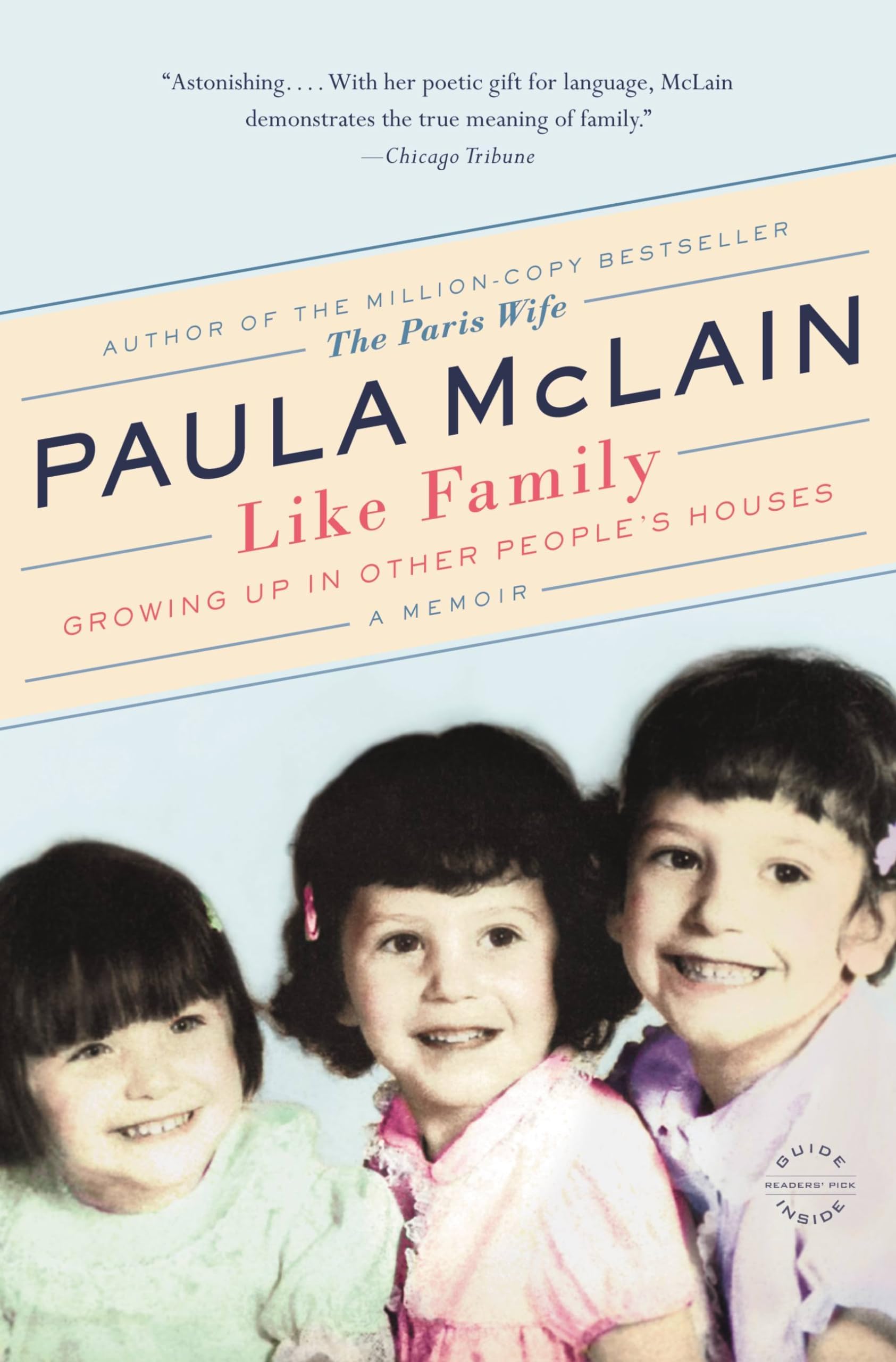
Like Family: Growing Up in Other People's Houses, a Memoir
Product ID: 12403272
An astonishing memoir from the author of The Paris Wife and When the Stars Go Dark , detailing the years Paula McLain and her two sisters spent as foster children after being abandoned by both parents in California in the early 1970s. "Demonstrates the true meaning of family." — Chicago Tribune As wards of the State, the sisters spent the next 14 years moving from foster home to foster home. The dislocations, confusions, and odd pleasures of an unrooted life form the basis of one of the most compelling memoirs in recent years. A book the tradition of Jo Ann Beard's The Boys of My Youth and Mary Karr's The Liar's Club . McLain's beautiful writing and limber voice capture the intense loneliness, sadness, and determination of a young girl both on her own and responsible, with her siblings, for staying together as a family. Review: Inspirational Journey - What constitutes a family? Biological connections that are severed early on? Or the strangers who provide a kind of care for years, with no connection other than the physical proximity of living in the same house? The author describes her journey through the foster care system in Fresno County in the 1970s and 1980s, and as she mentioned streets and places within the city and its surrounding areas, it all resonated with me. I had spent almost those same years as a social worker for Fresno County, and while I had not crossed paths with her or her sisters, Teresa and Penny, I could relate to much of what she wrote. However, my perspective came from the “other side” of the story. The side that represented the system, which I can readily acknowledge to be broken. Or at least severely damaged. I had heard similar stories from the children in care, but in this author’s case, she kept most things secret. She did mention telling a neighbor some of her experiences, only to be dismissed. As the years passed, there were good times for the sisters, and there were seemingly ordinary coming-of-age moments, but the lack of an emotional connection to a parent was keenly absent. The sisters did share a strong bond with each other that lasted through their time in care…and afterwards, when they finally reconnected with their biological mother. But again, physical proximity seemed to be the main connection between the long absent mother and the sisters. Like Family: Growing Up in Other People's Houses, a Memoir was an all too familiar tale to those of us who have worked in the system. Reading this story from a real life “graduate” of that system was inspirational. It is a testament to the author’s strength and resilience that she made it through to the other side, and can now share what she has learned along the way. 5 stars. Review: well written, seemingly objective - This memoir is a well written, seemingly objective account of what it was like growing up as a foster child, albeit a child with two sisters who went with her to each foster home, four in all. Her Dad put her in the foster system, but she maintained contact with her birth relatives, even being taken to spend one weekend a month with her grandmother at one period. She later got to live with her father and former babysitter, whom she loved, for 3 months before the father was arrested. To my surprise, only one of the foster homes was motivated by money; Paula was already an adult when, after overhearing a conversation, it occurred to her that money might be a motivation for fostering. Paula did not suffer any kind of material privation, just the opposite, until passing out of the system, and putting herself through college. In one home she suffered sexual abuse which led to bed wetting and nightmares, although it was not the worst kind of sexual abuse. From age 8 on, she and her sisters were with one family. The “mother” clearly had major issues, had strict rules which did not always make any sense, could be abusive, and was never in the least loving. The “father” was close to being a real father until Paula’s adolescence, when they grew apart: at that time he developed some sexual interest in the sisters, and once tried to French kiss Paula under the guise of instructing her. Whether this was the whole problem was not clear; perhaps the fact that he did not advocate for them with his wife came to play a role, or even the kind of teenage rebellion which is not uncommon. It is sad that the “father” did not receive more of an emotional reward. When Paula moved to Michigan, she saw him for the last time when she came over to “borrow” a suitcase, and he had previously given her and a sister $500 when they needed rent money. The sisters were not always close. Paula later reflects: “I realized how misguided I had been to feel, for a decade or more, so separate from my sisters. Every time I had to endure a sleepless first night in another new room, I could, because a few feet away, or behind a thin wall, my sisters were curled.” While the sisters seemed to have turned out well, and apparently close, the lack of love and sense of belonging still “haunted” Paula as an adult. I would have hoped for even more of an epilogue than there was (the epilogue was not named as such). I can add one fact: when Paula was 48 she was vacationing with one of sisters and the sister’s finance (this came up because the fiancée recommended to Paula a non-fiction book which inspired her novel “Circling the Sun”, a novel I enjoyed).
| Best Sellers Rank | #426,471 in Books ( See Top 100 in Books ) #164 in Adoption (Books) #437 in Social Work (Books) #588 in Dysfunctional Families (Books) |
| Customer Reviews | 4.0 out of 5 stars 760 Reviews |
L**W
Inspirational Journey
What constitutes a family? Biological connections that are severed early on? Or the strangers who provide a kind of care for years, with no connection other than the physical proximity of living in the same house? The author describes her journey through the foster care system in Fresno County in the 1970s and 1980s, and as she mentioned streets and places within the city and its surrounding areas, it all resonated with me. I had spent almost those same years as a social worker for Fresno County, and while I had not crossed paths with her or her sisters, Teresa and Penny, I could relate to much of what she wrote. However, my perspective came from the “other side” of the story. The side that represented the system, which I can readily acknowledge to be broken. Or at least severely damaged. I had heard similar stories from the children in care, but in this author’s case, she kept most things secret. She did mention telling a neighbor some of her experiences, only to be dismissed. As the years passed, there were good times for the sisters, and there were seemingly ordinary coming-of-age moments, but the lack of an emotional connection to a parent was keenly absent. The sisters did share a strong bond with each other that lasted through their time in care…and afterwards, when they finally reconnected with their biological mother. But again, physical proximity seemed to be the main connection between the long absent mother and the sisters. Like Family: Growing Up in Other People's Houses, a Memoir was an all too familiar tale to those of us who have worked in the system. Reading this story from a real life “graduate” of that system was inspirational. It is a testament to the author’s strength and resilience that she made it through to the other side, and can now share what she has learned along the way. 5 stars.
A**1
well written, seemingly objective
This memoir is a well written, seemingly objective account of what it was like growing up as a foster child, albeit a child with two sisters who went with her to each foster home, four in all. Her Dad put her in the foster system, but she maintained contact with her birth relatives, even being taken to spend one weekend a month with her grandmother at one period. She later got to live with her father and former babysitter, whom she loved, for 3 months before the father was arrested. To my surprise, only one of the foster homes was motivated by money; Paula was already an adult when, after overhearing a conversation, it occurred to her that money might be a motivation for fostering. Paula did not suffer any kind of material privation, just the opposite, until passing out of the system, and putting herself through college. In one home she suffered sexual abuse which led to bed wetting and nightmares, although it was not the worst kind of sexual abuse. From age 8 on, she and her sisters were with one family. The “mother” clearly had major issues, had strict rules which did not always make any sense, could be abusive, and was never in the least loving. The “father” was close to being a real father until Paula’s adolescence, when they grew apart: at that time he developed some sexual interest in the sisters, and once tried to French kiss Paula under the guise of instructing her. Whether this was the whole problem was not clear; perhaps the fact that he did not advocate for them with his wife came to play a role, or even the kind of teenage rebellion which is not uncommon. It is sad that the “father” did not receive more of an emotional reward. When Paula moved to Michigan, she saw him for the last time when she came over to “borrow” a suitcase, and he had previously given her and a sister $500 when they needed rent money. The sisters were not always close. Paula later reflects: “I realized how misguided I had been to feel, for a decade or more, so separate from my sisters. Every time I had to endure a sleepless first night in another new room, I could, because a few feet away, or behind a thin wall, my sisters were curled.” While the sisters seemed to have turned out well, and apparently close, the lack of love and sense of belonging still “haunted” Paula as an adult. I would have hoped for even more of an epilogue than there was (the epilogue was not named as such). I can add one fact: when Paula was 48 she was vacationing with one of sisters and the sister’s finance (this came up because the fiancée recommended to Paula a non-fiction book which inspired her novel “Circling the Sun”, a novel I enjoyed).
A**R
Great Childhood Reminiscences, but Doesn't Really Come Together
I loved the first 80 or so pages of this memoir, and I hope I'm not doing it a disservice by only assigning 3 (really 3 and a half!) stars. It is well-written and rich in detail about a Fresno childhood in the 1970s and 80s. But the subtitle, Growing Up in Other People's Houses, leads you to believe that the foster-care journey will continue throughout the author's childhood -- or at least, throughout the book! In fact, it's over for her by age 8, when she and her sisters find a family that raises them to adulthood. And although McLain is superb at recalling her feelings and attitudes as a child, she never really tackles the larger questions about her final foster family, as well as about her birth mother. The first few chapters describe the three sisters' rocky and rapid progress through a series of unsatisfactory foster homes, following the separate disappearances of their mother and father when the oldest of the three children is just 4 or 5. The pain and loneliness and sheer embarrassment of walking into a new house with new rules and a new dynamic are beautifully described by McLain. The three sisters' closeness and their very limited understanding of what is happening (they must leave one idyllic home because, they are told, their foster parents have to move for work, but later the girls realize that they haven't moved at all, and never learn what happened) are evoked perfectly by McLain. But once the girls find their final placement, with an offbeat couple who buy the girls horses, take them on trips, and generally act like parents (or so it seems to the reader), McLain is less successful at describing why she and her sisters never really feel at home. The foster mother is a rather remote German woman, but the father is a very involved, fun parent who is always launching new projects and schemes. As the girls grow, we learn a lot about their typically tumultuous adolescent years, but we never get why things are so bad with the foster parents that McLain leaves at 19 and never sees them again, not even returning when they are dying. Yet this seems the very heart of the problem of foster care: the inability to bond, after being shunted around too much. And it would seem to be exactly what McLain is trying to communicate in this memoir. The other issue is her relationship with her birth mother, who returns after the children are out of high school and just beginning life on their own. Predictably, they all reunite to try to make a life together. But we don't really know, behind anecdotal incidents, what that relationship turned out to be. The final pages describe each of the sisters' relationship with her mother as McLain sees it, but we're never shown it, so it doesn't feel real to us. I enjoyed this book tremendously and think it needed to be written, but I wish the second half had been as illuminating and detailed as the first.
M**Y
Remarkable memoir
Paula McLain is a very skilled and articulate author. I did not want to put this book down. McLain recaptured her unique life journey and experiences so vividly I was her throughout the story. I think this book should be required reading in middle and high school, for anyone having anything to do with foster care, including all professionals dealing with foster children. Psychology and communication also need to be taught in all grades at developmentally appropriate levels. Many children are not getting this at home. Thank you Paula McLain for writing this book. I have read five of McLain's books and found each one to present a world of its own and each one fascinating.
J**S
A Child's Voice
Many times memoirs take on a heavy, philosophical tone. They are so insightful that we lose the fresh, honest conveying memories. The story may be about a young child, but the writing is too mature or preachy - not in this book. Paula's young voice, fears, and dreams came through in a simple, childlike voice. The little things mattered - bedspreads, a tone of voice, hugs or lack of. The littlest of things matter most to children. For some, they mean everything - life, love, who they are. This is a sad story that is told in honest and simple terms. It is powerful without being wordy. It's a touching tale about one girl trying to find a place to belong.
D**N
swallowed by a great spinning machine that consumes children
While memoir is not usually my first choice, this tale of a little girl and her sisters was captivating. I read into the wee hours as Paula McLain's prose fell away to reveal a reconstituted 70s California - just as I remember it- complete with rotary phones, red Kool-aid, and station wagons, but this time presented from the unique perspective of an abandoned child. Abandoned by biological family, swallowed by a great spinning machine that consumes children, then spits them out "where the marble had stopped on the parent roulette wheel", this is the vivid account of an odyssey home. I have to admit- I was very hesitant to read this book: I was concerned I would spend the night awake in wide-eyed horror, forever scarred by the images of three baby girls spiritually and psychologically disfigured- mangled irreparably- as they navigated their way through landscapes populated with monsters and broken people. In fact, I was pretty much convinced that the risk/reward ratio didn't support reading it, until I downloaded a free sample on my Kindle and was hooked- then it could have gone all Stephen King-y; It didn't matter. I was all in. I strongly recommend this book. I also recommend starting this book when you can stay up all night.
B**M
Good Read
This was a good book about a family of three foster children, who managed to stay together throughout their childhood. The story was told by the middle child - a sad story, but told in an upbeat way. They were hardy kids, probably because they were allowed to stay together. It would have been interesting to have read the same story from the perspective of the foster parents who raised them - several families. They were a lively bunch..the kids, that is.
E**F
Disappointing memoir for an otherwise excellent novelist
I got this book without reading a sample- something I usually do before buying a book. I so liked McLain's novel about Beryl Markum that I just ordered her autobiography. It is about her childhood, being bounced from foster home to foster home with her 2sisters, after her mother just took off and while her father was in and out of jail. Unfortunately, the writing is not stellar, and she jumps around when talking about the different foster homes,so it gets confusing. She failed to make me care about her and her sisters. I won't finish it
C**L
Hopeful memoir, a great read
I love Paula McLain's work and have read most of her books. This was an honest, well-crafted account of her childhood and the family characters she lives with. Touching, shocking and humorous in turn I wanted to know how things turned out for the little girl and her sisters. Great use of dialogue too. Confirms my opinion that this author really knows her craft.
N**D
I really liked this book
Heartbreak and loss clad in beautiful prose. And the sense that even winning through, not going delinquent after years of foster care, is still mot good, not normal.
S**A
A powerful memoir
Paula McLain has an unique gift for language, every book written by her is a a pleasure to read
H**R
Absolutely a must read.
Every social worker who works with foster placement must read this book.
H**R
Five Stars
Lovely
Trustpilot
3 days ago
3 weeks ago