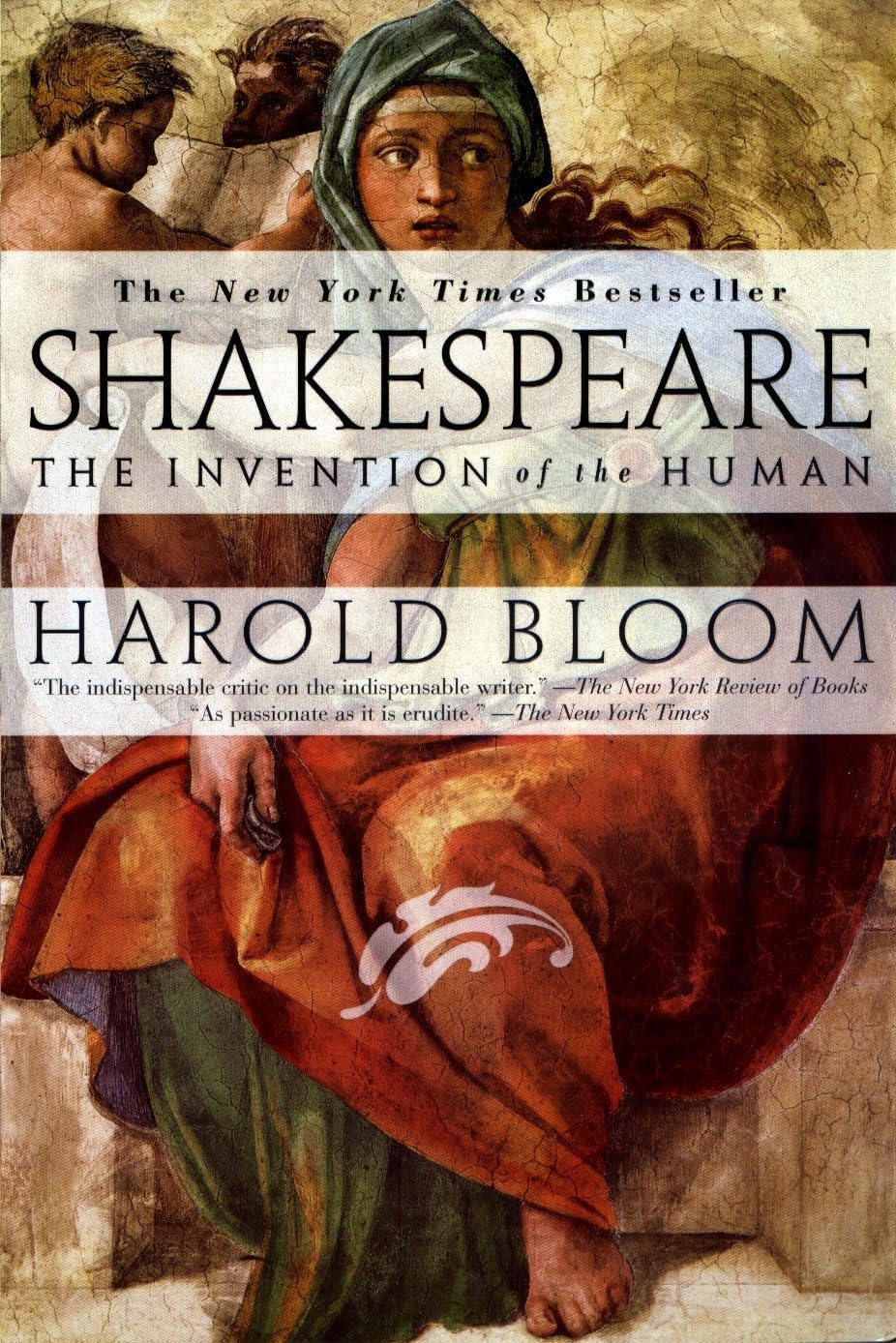
Shakespeare: Invention of the Human: The Invention of the Human
Product ID: 12611271
⭐4.7/5 rating from 446 readers
📚Comprehensive analysis of all canonical Shakespeare plays
🧠Groundbreaking thesis on Shakespeare inventing human nature
Desertcart purchases this item on your behalf and handles shipping, customs, and support to Croatia.
📖 Unlock the Bard’s timeless genius and discover the birth of humanity itself!
Harold Bloom’s 'Shakespeare: The Invention of the Human' is a landmark literary criticism work offering comprehensive, erudite essays on every canonical Shakespeare play. Celebrated for its bold thesis that Shakespeare created modern human nature, this critically acclaimed book holds a 4.7-star rating from over 400 readers and remains a must-have for serious literature enthusiasts and professionals alike.
| Best Sellers Rank | #173,049 in Books ( See Top 100 in Books ) #74 in Drama Literary Criticism #116 in Shakespeare Literary Criticism #508 in Literary Criticism & Theory |
| Customer Reviews | 4.7 out of 5 stars 446 Reviews |
A**R
The best companion to Shakespeare available
This book is a compilation of essays written by Harold Bloom plus an introduction and a "coda" treating Shakespeare's plays generally. There is an essay for each one of Shakespeare's plays considered cannonical twenty years ago. Every essay goes in the same direction: analyzing the play in a very inventive and imaginative fashion. Of course, this method ends up making the lenght and complexity of the various essays extremely variable. Plays like "The Two Gentlemen of Verona" or "The Comedy of Errors" are discussed in very few -but always clever- pages; minor plays like the ones just mentioned or simply those that Bloom finds not very attractive receive this treatment. Most plays are analyzed in similar lenght and complexity, although, Bloom's language and literary references often obscure their reading. This is especially true in the essays about the plays Harold loves the most. The essays about "King Lear" or "Henry IV" are filled with references to a wide range of authors or critics, even excepts from their works. But even being so, the result is amazing, not a single critic since A. C. Bradley has thrown so much light to Shakespeare. The criticism follows mainly two points: the inwardness and the irony. This two themes, especially the second one, are part of the "creation of the human", characteristic that Bloom assigns to Shakespeare. In fact, all the essays try to proof that Shakespeare created personality as we know it and changed forever our modes of cognition; giving birth to characters that do not only change by hearing others, but by overhearing their own singular and unique voices and this way being able to separate themselves from the roles they play and achieving ever-growing inwardness and freedom. It may sound, indeed, as if Bloom were worshipping a god. But at this he responds "Why not?".
S**.
Value and quality
Excellent book!
J**K
Classic Reference Book, Arrived in Good Condition
Classic reference book by a great critic about a great writer. Arrived in good condition as described, and shipped well.
S**L
Bully for Bloom.
If someone gets their own pulpit in which to pontificate upon Shakespeare, we may as well be grateful that it's Harold Bloom. His judgments constantly provoke a "Right on!" response--when he demonstrates the interpretative inadequacies of the Marxist or gender theorists, for example; or when he celebrates Hamlet and Falstaff as opposite sides of the same coin, together constituting Shakespeare's supreme creation of character. (How sad that so many of today's students find Falstaff nothing more than a disgusting, cowardly man whose only function is to vindicate the Prince's dismissal of him.) And though Bloom's case about the "invention of the human" is overstated he, for the most part, is successful in exposing the modern, existential sensibility and dynamic, complex life of the consciousness that is the hallmark of Shakespeare's best character creations. But he disappoints when he takes his sights off of Shakespeare in favor of addressing the bad (ie. political) readers of Shakespeare. In fact, one wonders if he isn't creating a number of straw men--the readers who find "Taming of the Shrew" a shamefully sexist play, for example, or who champion Caliban as a post-colonial hero-rebel. Moreover, this need to represent and address his critics--real or imagined--is especially irritating when he falls short of a counterargument to an interpretation he holds up as "wrong." For example, he quotes Kate's entire "women are simple" speech and then, without offering any intepretation of it, simply suggests anyone who doesn't find it ironic has got to be a fool. With Caliban, he goes a bit further to discredit sympathetic readings of the character, even quoting a generous section of Robert Browning's "Caliban Upon Setebos." But why not go further yet, showing us what Caliban actually is (perhaps the naive, idealogical readers Bloom has in mind, the scholars who go more by the "book" than the "imagination"). Bloom has all of the right instincts about Shakespeare ("It's not about politics, stupid. It's about language as a uniquely human attribute. And Shakespeare manifests its workings more fully than any other author.") But I'm afraid he unwittingly reveals that a large ego can be just as much an obstacle to interpreting Shakespeare as French critical theory or party-line academic politics. This book is frequently insightful, well-written, and useful, but it could have been much better, especially in view of the general audience for whom it is aimed, had its author been more consistently mindful of his own calling as teacher. Unfortunately, Bloom seems to have misread Chaucer's description of the clerk: For "Gladly would he lerne and teche," substitute "Gladly would he lerne and speche."
M**A
The Revenge Of The Bard
Like Bloom, I've sat thorough many productions of Shakespeare's works in which the themes and the characters were distorted, mutilated, or simply ignored. I've wondered if there was anyone in the world who actually read the plays instead of using them as a marketing gimmick to display their own concepts. Fortunately, Bloom shows that he has read the plays. Many of this book's reviewers have focused their energy on whether or not Bloom proves his thesis (which is that Shakespeare "invented" the ways that we define ourselves as humans). Just to put my opinion on it, I don't think he did. Then again, I don't think Bloom thinks he did either, as is evident by his statement in the book's end that Chaucer "invented" the human and Shakespeare perfected it. So, why should a reader invest time in a book where it is questionable whether the author proved the central thesis? Because Bloom does such a wonderful job of dissecting the plays that one gets lost in the nuances that he brings out. His critical analyses of the plays are insightful and provocative. While I might take exception to some of his comments (I don't think Richard III is as weak as Bloom thinks it is), his writing style has conveyed his ideas in such a way that I have to respect his opinions. I was glad that I had read/seen some of the plays so that I could understand the context of Bloom's comments about them. I did feel a little lost when reading his analyses of those plays to which I had not been exposed. Instead of wallowing in the feeling, I wanted to read those plays in order to see if I agreed with his comments. Any critical study that makes one want to return to the original source material to discover if its arguments are valid is a very good study. While I don't believe one should accept Bloom's analyses at face value, his comments provide a solid counterpoint to many of the myths about the plays. I heartily recommend this book to those who want to broaden their perspective on Shakespeare's works.
P**D
Bardolatry
The late critic Harold Bloom loved Shakespeare above all as the center of the western canon. He was passionate about teaching literature as literature, not as psychology, politics, economics, theology or other ideologies. The emphasis is not on the stories (the Bard mostly borrowed these from historians or other writers) but the characters, personalities, and human nature. While Shakespeare was a dramatist, he was even more a poet, and developed the personalities through this poetry. The sonnets were certainly poems, but so were the plays. Among the characters that Bloom emphasizes again and again are Hamlet, Falstaff, Cleopatra, Macbeth, Iago, Rosalind, Edmund and Lear. He treats the characters as real people, because they seem more real than a lot of the people in so-called real life. So for instance, in Poem Unlimited Bloom offers speculation about what Hamlet did, going to England and Germany to learn drama and other intellectual disciplines. Hamlet has actually surpassed his creator and become an author in his own right. We quote Hamlet as if we're quoting Socrates or Jesus or Buddha. These characters are traced through Shakespeare's career development with the comedies, histories, tragedies and romances (a term that Bloom dislikes for the final plays such as the Tempest). When it comes to the genres, Shakespeare is beyond genre, as Polonius showed with his "history-comedy-tragedy" etc. and all the combinations including poem unlimited. Besides Hamlet, Bloom's favorite is Falstaff, from Henry IV part I and II. Even though he's a raunchy big old guy, he is almost as smart as Hamlet and teaches us about joie de vivre and humor. The apotheosis or death of Cleopatra was the end of an era, as she had been the lover of Julius Caesar, Pompey, Mark Antony etc. Octavius went on to great political accomplishments but was not as interesting as the previous generation. But Cleopatra's death was also the end of Shakespeare's high tragedies. Bloom shows Shakespeare's development in relation to Chaucer, Marlowe who came before him, Ben Jonson who was a contemporary, Fletcher who came along toward the end, and the successor John Milton. Bloom also relates Shakespeare's characters to others in the western canon such as Dante, Cervantes, Tolstoy, Dostoyevsky, Austen, Coleridge, Melville, Eliot, Joyce, Woolf and Proust. How does Bloom understand himself? He is a critic in the romantic tradition, along with Dr. Johnson, AC Bradley, Hazlitt, Swinburne and Goddard. He is passionate about teaching Shakespeare as literature and not through Freud or Marx. In fact he interprets Freud through Shakespeare (!) rather than vice versa. This is a very long book but joyfully quick.
S**E
I am delighted! GREAT source for Bard lovers!
Excellent source for all you Bard lovers! Great analysis and review, excellently curated! Highly recommend!
A**S
So Much More Than a Commentary
A reader might be forgiven for thinking that Harold Bloom’s Shakespeare The Invention of the Human is merely a set of reflections on the bard’s oeuvre. That is, after all, how many critics have advertised the book. Or you might think that Bloom merely describes with particular vivacity Shakespeare’s obviously fecund imagination in creating the archetypes for modern personas. Bloom does do that but there is so much more. Bloom’s Shakespeare is not just a creative genius. He is someone, like Nietzsche or Bloom himself, who has struggled—or might even be said to have created—the uniquely modern predicament of existence. According to Bloom, Shakespeare’s universe is essentially Elsinore. That is, we live in a world where we recognize that all is not exactly aright. Hamlet’s struggle is what to do with such an existence. Try to right all wrongs? But how can one right that fundamental wrong that the work of building a human consciousness is doomed to the dissolution of the body? Bloom’s Hamlet is then a Dionysian hero, a character who recognizes the Sisyphean nature of human existence. And Bloom sees Shakespeare’s opus as a slowly mounting crescendo toward the plaintive song of Hamlet himself. In other words, readers cannot simply read Bloom’s descriptions of their favorite plays. Nor can readers rest assured in the thought that Shakespeare has helped create modern personas. No, they must enter the Shakespearean universe and struggle as much as Jacob wrestled with the angel. Shakespeare is not so much high culture as the finest depiction of what it means to be human. In a few words, not a book to be taken up lightly. One must be ready to be thrown into combat alongside Shakespeare to really grok the full meaning of this text. I can only encourage the potential reader to enter the ring for a captivating emotional and intellectual experience.
C**E
Muy recomendable
Comencé a leer el libro pero por otros compromisos no continué la lectura, sin embargo es un autor muy erudito con una prosa brillante y una fuerza que invita a leerlo como una novela. Excelente la edición y presentación.
L**S
Le vrai Shakespeare
L'un des livres les plus fins et pertinents sur William Shakespeare. Quelle joie de lire de telles analyses de ses pièces, fondement de l'Humanité.
D**D
A worthwile investment
A scholarly, yet accessible read, with the most appropriate material selected from each play. What amounts to annotation is interesting. If you're willing to do a bit of work in exchange for great rewards, this book is for you. dgp
V**I
Bloomtastic
L'autore a dispetto di tutte le riserve e aperte critiche di una certa parte del mondo letterario che non gli perdona alcune scelte o opinioni distanti dalla vulgata attuale spesso miseramente politically correct, è a mio avviso un grandissimo critico letterario, a quale sempre ispirarsi e attingere. Ho letto solo parzialmente tale testo, lo ammetto, ma mi è bastato per giudicarlo semplicemente straordinario. Non posso né riassumere né dare un giudizio critico perché Bloom è da sempre il modello a cui tendere. Purtroppo non sono imparziale a mio avviso è semplicemente una lettura imprescindibile sul Bardo e ogni suo intervento dedicato a ciascuna opera teatrale valutata individualmente è al contempo illuminante e stimolante. Harold Bloom ... who else?
L**S
Obra de referência
Leitura obrigatória, uma viagem pessoal, apaixonada e fascinante, do autor
Trustpilot
2 weeks ago
4 days ago