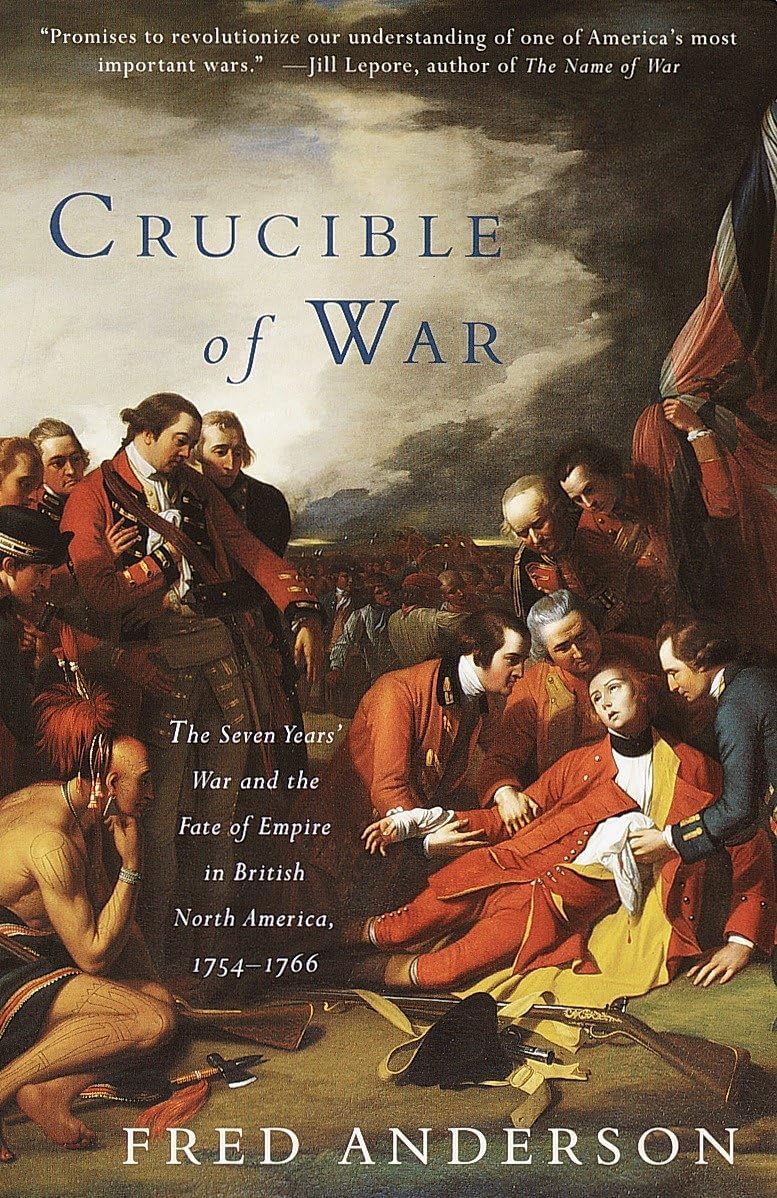
Crucible of War: The Seven Years' War and the Fate of Empire in British North America, 1754-1766 (Vintage)
Product ID: 1348690
Desertcart purchases this item on your behalf and handles shipping, customs, and support to Croatia.
In this vivid and compelling narrative, the Seven Years' War–long seen as a mere backdrop to the American Revolution–takes on a whole new significance. Relating the history of the war as it developed, Anderson shows how the complex array of forces brought into conflict helped both to create Britain’s empire and to sow the seeds of its eventual dissolution. Beginning with a skirmish in the Pennsylvania backcountry involving an inexperienced George Washington, the Iroquois chief Tanaghrisson, and the ill-fated French emissary Jumonville, Anderson reveals a chain of events that would lead to world conflagration. Weaving together the military, economic, and political motives of the participants with unforgettable portraits of Washington, William Pitt, Montcalm, and many others, Anderson brings a fresh perspective to one of America’s most important wars, demonstrating how the forces unleashed there would irrevocably change the politics of empire in North America. Review: An important book for gaining a broad perspective of the Seven Years War in North America - Fred Anderson does a superb job of summing up The Seven Years War in North America from the British and Colonial perspective in Crucible of War. With an immense amount of material on the subject he has compressed the subject into one book, which the meat of spans almost 750 pages. The book covers the prelude to the war, the war, and the aftermath of the fighting. While covering The Seven Years War Anderson argues the importance of the war to American history. He points to all the actions that started the Colonists on the road to war for The American War for Independence. The cultural differences between the Colonials and the Redcoats are brought to light showing how the seeds of dissent were sown. Anderson shows how early actions in the war fostered misperceptions in Parliament on the nature of the Colonists. Early failures in the Colonial Governments hampered the war effort leaving Parliament with the notion that the Americans were not willing to help in the defense of a war that the Americans had started, and was being fought on American soil. Anderson covers the war from the strategic and operational perspectives and focus strongly on the politics and politicians that influenced the British war effort. Very little is mentioned of anything at a tactical level. A great deal is discussed on the logistics as well. The book falls well into the realm of "new military history". With little on individual heroics and valor this book is written more for someone looking for a military history perspective and less of an appeal to a military enthusiast. The final pages in the book discuss the aftermath of the war, connecting the actions and perceptions brought forward from the war into the various Acts that Parliament passed to try to avoid falling into financial ruin. Anderson gives an unbiased approach to this portion of the book, as he does to the rest of it, when he covers Parliament's perspective. Another reviewer believes that Anderson had an American bias, I have to disagree. As an American I came away with a better understanding of why the Parliament made the choices they did in reference the Acts. Parliament did not understand how much money the Colonial governments put into the war effort and believed they had bared the entire financial burden for the war. With that belief they felt it was only fair for the Colonists to support the crown by paying for the portion of a larger Army that would need to stay in America to protect Colonies from French attempts to retake land lost, though that never occurred and the Army stirred dissent in the end. I think he could have done a better job of showing differences between the Natives, Colonial and English perspectives on who actually won the war and how those perspectives effected British policy (preventing settlement west of the Appalachians), Native actions (Pontiac's Rebellion for Colonial encroachment on Native lands) and Colonial response (anger over the inability to settle lands that were believed to be won in battle). The length of the book is not long enough to go into much depth on any particular area and I don't think it was meant too, excessive depth would have greatly expanded the book's length. It is an excellent book to get a broad understanding of the war, so many books cover portions of the war and the readers do not really understand all of the influences affecting particular campaigns or battles. For any historian starting to research The Seven Years War in North America this book is an excellent first book, which should be followed by other books that provide more depth on specific battles, campaigns and political or military leaders. The book relies on a larger amount of secondary material, but Anderson also uses a great deal of primary sources. He doesn't have a bibliography, but he quotes sources in his end notes. The book would have been a little better had he used footnotes as opposed to endnotes, but it makes for a cleaner read for someone who is interested in the information he provides and not his sources. This leads me to believe that Anderson might have hoped for an audience much wider than the historical community. I have read some of the negative critiques on this book and think they were undeserving. I believe many of the people reading the book were expecting more of an old school military history, which focuses on the battles and military leaders and less on the social and political influences affecting the war. The book does not give a detailed account of the French or Native perspectives. It touches on their perspective in areas where it needs to. It also touches on the events in Europe, India, the West Indies and the Philippines to give some needed perspective. The title of the book, The Fate of Empire in British North America, should make it clear where the perspective is focusing. There are several other books that focus on the Native perspective along with the French perspective that should be read in order to get a complete understanding of the war. I do not think that Anderson downplayed any important personnel, the book wasn't intended to go into the detail some people would like for specific influential people, there just wasn't the space to cover the entire span of the war and keep that much information manageable in one book. This book reads well and Anderson successfully shows that The Seven Years War was just as important in American history as the American War for Independence. The Seven Years War caused the differences leading to the later war and brought France and Spain to the aid of the Colonists, without which they could never have won. Military equipment, in particular gunpowder, was not manufactured in America and it had to be brought in from Europe. France and Spain aided the Colonists for the sole purpose of avenging their losses in The Seven Years War, not to support the Colonial cause. I strongly recommend this book to anyone wanting to learn more on The Seven Years War and American history. It will open the eyes of those who thought the "French and Indian War" was an insignificant skirmish with little value to American history. The Glorious Cause by Robert Middlekauff is a good follow up to this book to gain a broad look on the American War for Independence. Review: Superb narrative history of the Seven Years' War. - "Crucible of War" is a sumptuously written, richly textured, and scholarly narrative history of the Seven Years' War (more commonly known to Americans as the French and Indian War.) Authored by Fred Anderson, Associate Professor of History at the University of Colorado, Boulder, "Crucible of War" is the first major study of the Seven Years' War since "Montcalm and Wolfe," Francis Parkman's classic account of the war, written in 1884. It is, in my view, of equal historical and literary quality as its esteemed predecessor. "Crucible of War" is notable not only for its exquisite prose and tremendous scholarship, but also because it takes an historically less traditional approach to the French and Indian War than most previous accounts. The author argues persuasively that this was actually a world war involving Britain, France, Spain, and other European powers. The war in North America was the spark that ignited this worldwide conflict, and the effects of the war in the New World were especially significant because they ended in France's decisive defeat, and a "dramatic rearrangement of the balance of power in Europe and North America alike." The immediate catalyst for the Seven Years' War was the dispute between Britain and France over the Ohio Valley, a dispute which came to a head in 1754 when George Washington led a small force of Virginia militia into the area around present-day Pittsburgh, Pennsylvania, to drive out the French. Unsuccessful in his mission, Washington unknowingly engaged the French in the first battle of a war which would ultimately deprive France of her North American empire. From 1754 through 1758, the British suffered a succession of humiliating defeats at the hands of the French and her Indian allies. During this period, Britain had also drifted into a general European war with France, and suffered a string defeats in Europe as well. The turning point in British fortunes actually came in 1757. William Pitt, a Minister of the British government, changed British colonial policy, which treated the colonies as "subordinate jurisdictions," to one which treated the colonies as allies in a struggle against a common foe. He also began the process of replacing inept military commanders with more professional ones - men like James Wolfe and Sir Jeffrey Amherst. Pitt's efforts paid tremendous dividends during 1759 - the Annus Mirabilis - the "Year of Miracles" - when British fortunes were permanently reversed with stunning victories in North America and in Europe. Anderson's narrative accounts of the war's major military and political battles are very well written and intriguing; however, I found the most fascinating aspect of this book to be how Anderson treats the years after the war, and the effects of those years on later events. The author counters a widely held historical view that many key events which occurred after the war - from 1763 to 1766, when the book closes - were precursors to an inevitable American Revolution. Instead, Anderson sees the historical events of the 1760s as an unanticipated shift in relations between Britain and her colonies, the result of a nation trying to regain control over subjects in the New World. Neither Britain nor her colonies could have foretold the coming of an American Revolution; nor did either side desire such a conflict. The historical events which we Americans now understand as being seminal to the ultimate independence of the United States are viewed in this book as a natural evolution in relations between Britain her colonies. "Crucible of War" is an exceptionally well written book - perhaps one of the very best works of American history I've read in recent years! Anderson has imbued his work with tremendous scholarship. As I read it, I was constantly amazed at how easily Anderson was able to convey facts about all aspects of the war. With great facility, he moves the reader from military events in North America to battles in Europe; from the internal politics of Indian tribes and colonial governments, to the inner workings of British and French government ministries. Anderson's painstaking research, and keen eye for historical detail are obvious throughout this book, much to the benefit of the reader. "Crucible of War" is a book of outstanding scholarship, and "must read" for anyone interested in American history.

| Best Sellers Rank | #25,196 in Books ( See Top 100 in Books ) #24 in U.S. Colonial Period History #26 in French History (Books) #53 in Great Britain History (Books) |
| Customer Reviews | 4.6 out of 5 stars 853 Reviews |
W**I
An important book for gaining a broad perspective of the Seven Years War in North America
Fred Anderson does a superb job of summing up The Seven Years War in North America from the British and Colonial perspective in Crucible of War. With an immense amount of material on the subject he has compressed the subject into one book, which the meat of spans almost 750 pages. The book covers the prelude to the war, the war, and the aftermath of the fighting. While covering The Seven Years War Anderson argues the importance of the war to American history. He points to all the actions that started the Colonists on the road to war for The American War for Independence. The cultural differences between the Colonials and the Redcoats are brought to light showing how the seeds of dissent were sown. Anderson shows how early actions in the war fostered misperceptions in Parliament on the nature of the Colonists. Early failures in the Colonial Governments hampered the war effort leaving Parliament with the notion that the Americans were not willing to help in the defense of a war that the Americans had started, and was being fought on American soil. Anderson covers the war from the strategic and operational perspectives and focus strongly on the politics and politicians that influenced the British war effort. Very little is mentioned of anything at a tactical level. A great deal is discussed on the logistics as well. The book falls well into the realm of "new military history". With little on individual heroics and valor this book is written more for someone looking for a military history perspective and less of an appeal to a military enthusiast. The final pages in the book discuss the aftermath of the war, connecting the actions and perceptions brought forward from the war into the various Acts that Parliament passed to try to avoid falling into financial ruin. Anderson gives an unbiased approach to this portion of the book, as he does to the rest of it, when he covers Parliament's perspective. Another reviewer believes that Anderson had an American bias, I have to disagree. As an American I came away with a better understanding of why the Parliament made the choices they did in reference the Acts. Parliament did not understand how much money the Colonial governments put into the war effort and believed they had bared the entire financial burden for the war. With that belief they felt it was only fair for the Colonists to support the crown by paying for the portion of a larger Army that would need to stay in America to protect Colonies from French attempts to retake land lost, though that never occurred and the Army stirred dissent in the end. I think he could have done a better job of showing differences between the Natives, Colonial and English perspectives on who actually won the war and how those perspectives effected British policy (preventing settlement west of the Appalachians), Native actions (Pontiac's Rebellion for Colonial encroachment on Native lands) and Colonial response (anger over the inability to settle lands that were believed to be won in battle). The length of the book is not long enough to go into much depth on any particular area and I don't think it was meant too, excessive depth would have greatly expanded the book's length. It is an excellent book to get a broad understanding of the war, so many books cover portions of the war and the readers do not really understand all of the influences affecting particular campaigns or battles. For any historian starting to research The Seven Years War in North America this book is an excellent first book, which should be followed by other books that provide more depth on specific battles, campaigns and political or military leaders. The book relies on a larger amount of secondary material, but Anderson also uses a great deal of primary sources. He doesn't have a bibliography, but he quotes sources in his end notes. The book would have been a little better had he used footnotes as opposed to endnotes, but it makes for a cleaner read for someone who is interested in the information he provides and not his sources. This leads me to believe that Anderson might have hoped for an audience much wider than the historical community. I have read some of the negative critiques on this book and think they were undeserving. I believe many of the people reading the book were expecting more of an old school military history, which focuses on the battles and military leaders and less on the social and political influences affecting the war. The book does not give a detailed account of the French or Native perspectives. It touches on their perspective in areas where it needs to. It also touches on the events in Europe, India, the West Indies and the Philippines to give some needed perspective. The title of the book, The Fate of Empire in British North America, should make it clear where the perspective is focusing. There are several other books that focus on the Native perspective along with the French perspective that should be read in order to get a complete understanding of the war. I do not think that Anderson downplayed any important personnel, the book wasn't intended to go into the detail some people would like for specific influential people, there just wasn't the space to cover the entire span of the war and keep that much information manageable in one book. This book reads well and Anderson successfully shows that The Seven Years War was just as important in American history as the American War for Independence. The Seven Years War caused the differences leading to the later war and brought France and Spain to the aid of the Colonists, without which they could never have won. Military equipment, in particular gunpowder, was not manufactured in America and it had to be brought in from Europe. France and Spain aided the Colonists for the sole purpose of avenging their losses in The Seven Years War, not to support the Colonial cause. I strongly recommend this book to anyone wanting to learn more on The Seven Years War and American history. It will open the eyes of those who thought the "French and Indian War" was an insignificant skirmish with little value to American history. The Glorious Cause by Robert Middlekauff is a good follow up to this book to gain a broad look on the American War for Independence.
M**S
Superb narrative history of the Seven Years' War.
"Crucible of War" is a sumptuously written, richly textured, and scholarly narrative history of the Seven Years' War (more commonly known to Americans as the French and Indian War.) Authored by Fred Anderson, Associate Professor of History at the University of Colorado, Boulder, "Crucible of War" is the first major study of the Seven Years' War since "Montcalm and Wolfe," Francis Parkman's classic account of the war, written in 1884. It is, in my view, of equal historical and literary quality as its esteemed predecessor. "Crucible of War" is notable not only for its exquisite prose and tremendous scholarship, but also because it takes an historically less traditional approach to the French and Indian War than most previous accounts. The author argues persuasively that this was actually a world war involving Britain, France, Spain, and other European powers. The war in North America was the spark that ignited this worldwide conflict, and the effects of the war in the New World were especially significant because they ended in France's decisive defeat, and a "dramatic rearrangement of the balance of power in Europe and North America alike." The immediate catalyst for the Seven Years' War was the dispute between Britain and France over the Ohio Valley, a dispute which came to a head in 1754 when George Washington led a small force of Virginia militia into the area around present-day Pittsburgh, Pennsylvania, to drive out the French. Unsuccessful in his mission, Washington unknowingly engaged the French in the first battle of a war which would ultimately deprive France of her North American empire. From 1754 through 1758, the British suffered a succession of humiliating defeats at the hands of the French and her Indian allies. During this period, Britain had also drifted into a general European war with France, and suffered a string defeats in Europe as well. The turning point in British fortunes actually came in 1757. William Pitt, a Minister of the British government, changed British colonial policy, which treated the colonies as "subordinate jurisdictions," to one which treated the colonies as allies in a struggle against a common foe. He also began the process of replacing inept military commanders with more professional ones - men like James Wolfe and Sir Jeffrey Amherst. Pitt's efforts paid tremendous dividends during 1759 - the Annus Mirabilis - the "Year of Miracles" - when British fortunes were permanently reversed with stunning victories in North America and in Europe. Anderson's narrative accounts of the war's major military and political battles are very well written and intriguing; however, I found the most fascinating aspect of this book to be how Anderson treats the years after the war, and the effects of those years on later events. The author counters a widely held historical view that many key events which occurred after the war - from 1763 to 1766, when the book closes - were precursors to an inevitable American Revolution. Instead, Anderson sees the historical events of the 1760s as an unanticipated shift in relations between Britain and her colonies, the result of a nation trying to regain control over subjects in the New World. Neither Britain nor her colonies could have foretold the coming of an American Revolution; nor did either side desire such a conflict. The historical events which we Americans now understand as being seminal to the ultimate independence of the United States are viewed in this book as a natural evolution in relations between Britain her colonies. "Crucible of War" is an exceptionally well written book - perhaps one of the very best works of American history I've read in recent years! Anderson has imbued his work with tremendous scholarship. As I read it, I was constantly amazed at how easily Anderson was able to convey facts about all aspects of the war. With great facility, he moves the reader from military events in North America to battles in Europe; from the internal politics of Indian tribes and colonial governments, to the inner workings of British and French government ministries. Anderson's painstaking research, and keen eye for historical detail are obvious throughout this book, much to the benefit of the reader. "Crucible of War" is a book of outstanding scholarship, and "must read" for anyone interested in American history.
K**R
A Very Good Account of the Seven Years War
This a long and exhaustive book on the Seven Years War and the aftermath of it that helped shape the American Revolution. No doubt the author ,Fred Anderson, knows his stuff. This is a very detailed account of what brought about the Seven Years War, the actual war itself and all of its major players and then the aftermath of British control of North America and their imposition of The Stamp Act and Quartering Act. One big thing Anderson did was detailed accounts of the Indian part of the war and what role they played. This was very interesting to me as I knew very little about the war itself. This is a very good book but it is long. You can easily get bogged down in it with all of the events and names that are run by you. If you want a full account of American history, though, you should read this book about the beginnings of what America eventually came to be.
J**N
PRIMARY CONFLICT
As I explained in my last few posts, a short while ago, I decided to do a straight reading up on the history of my country. Not by a series of biographies or of any particular event; but a simple march through the ages exploring all the eras of the United States of America. The biggest challenge is to find books that try their best to explore from multiple perspectives in order to avoid just one narrow view, without at the same time surrendering a general narrative that is both readable and enjoyable. After finishing Jill Lepore's book on King Phillip's War, I decided to move on to Fred Anderson's book covering what we in America call the French and Indian War. The book looks at the major actors in the British and French Empires, and the Iroquois Confederacy and how this conflict changed them from top to bottom. Like many wars, especially European Wars in the seventeenth and eighteenth century, the conflict covered in this work is known by two names. Anglo-American colonials tended to name their wars after their kings and queens. The colonists had named the War of Austrian Succession,'King George's War', and created a problem because King George II was still on the throne. They needed a new name for the conflict that Europe would call the Seven-Years' War. The name the Anglo-American colonists came up with was: 'the French and Indian War'. Fred Anderson's reason for producing this book is that the place we historians assign the French and Indian War in the historical narrative, he argues, is as the simple prologue of the American Revolutionary War. With this book, Anderson brings the America's most forgotten and--arguably--most important war, to the forefront to be study on its own terms and not as the inevitable beginning of a different conflict. Prior to this war, the two great colonial powers in North America were the British and French Empires. These empires were populated by colonists who were strongly identified with their imperial connections and a powerful Native American Nation in the Iroquois Confederacy that was able to provide a buffer and power broker between the two powers. After this conflict the French would be vanquished and the British would be left with an empire that was most ungovernable and the Iroquois would be set on the beginning of their fall from power. When I was in college, I, who had always been a history buff, felt I had strong understanding of World War II. Then in my Western Civilization II class with Parker Albee, we spent some time going over World War I. I remember thinking--as if a light had gone off in my head--'I understand why World War II happened better now.' Prior, all I had known of World War I had been some of its aftermath that helped lead to World War II, but nothing in real strong detail. I now view World War I and World War II almost as the different chapters in the same historic event. Having read this book I feel the same way about my understanding of the French and Indian War and the American Revolutionary War, as I did with my earlier reevaluations on World War I and World War II. I realize that this may sound the opposite of Anderson's intentions; however, I want to stress that reading this book you understand the French and Indian War as its own event but it still increases your understanding of the American Revolution. One of the biggest things that stood out in my mind while reading this book was how some of the politics that led to the American Revolution against Britain during the late 1760s and 1770s were foreshadowed by the early events of the French and Indian War. The Earl of Loudoun, who was the commander in chief of the British armies in America, made several attempts to command the colonial governors and legislatures as if they were his colonels. His actions and the massive attempts to resist them by the colonial Anglo-Americans strongly resembled what was to come a decade later. Fortunately for the British cause in this war, William Pitt, who was a strong believer in the colonial subjects British rights, relived Loudoun of his command and set the colonial relations to rights. "By mid-December 1757, Pitt knew that if the American assemblies were to be transformed from centers of resistance into sources of men and money, he would have to reverse entirely the course of colonial policy. Instead of treating the colonies like subordinate jurisdictions and requiring them to finance the war effort by forced contributions to a common fund, Pitt resolved to treat them like allies, offering subsidies to encourage their assemblies to aid in the conquest of New France. Rather than continuing to demand that civil authority, in the persons of colonial governors and legislatures, submit to military power in the person of His Majesty's commander in chief, Pitt resolved to withhold from Loudoun's successor direct authority over the provinces. In the future, as always in the past, the governors would receive their instructions directly from the secretary of state for the Southern Department. By this new grant (or more properly, restoration) of autonomy to the provinces, by offering inducements to cooperation rather than by seeking to compel union among them, Pitt hoped to create a patriotic enthusiasm that had not been much in evidence since 1756."p.214 In this book Anderson masterfully moves his readers from one military theater on the frontiers North America to another on continental Europe, he also cross-cuts from one political scene to another. While reading this book, the reader will go from the court of King George II to the assemblies of the American colonies, to military headquarters of Fredrick the Great, to the Massachusetts colonial militia. Yet it never becomes confusing making the reader feel out of place, Anderson's narrative flows smoothly from one event and theater to another without missing a beat. I highly recommend this work to anyone it is really exceptional book. Fred Anderson takes a highly difficult and at times confusing subject and lays it out rather neatly making it easy for his readers to understand this war that had so much impact on the modern world.
P**N
An American Thucydides
I must confess that I rarely write reviews of history books because I'm not familiar with the primary sources (except some urban history), so I always feel like I can't truly evaluate what I read. Fred Anderson's Crucible of War, however, has so impressed me that I'm shedding my usual reluctance. Anderson's introduction makes it clear that he wanted to change the view of people like myself, who basically dismissed the French and Indian War as a sort of dull, poorly written prequel to the American Revolution -- a view I inherited from my history teachers, a view that I hadn't bothered to correct for many years because going off to college also marked the end of my obsessive reading of military history. Anderson argues that in fact the French and Indian War had a far more dramatic impact on world history than the American Revolution, the kind of argument that makes the revisionism of global history, which challenges traditional perspectives of history by providing the larger context, so provocative and fun. Although skimpy on India, Anderson's story ties together frontier scalpings, naval battles, political backstabbing in London and the Virginian House of Burgesses, and Silesian battlefields into one enormous coherent tapestry. (Coherent, that is, to us: Anderson repeatedly argues that participants misunderstood the events in which they participated, most spectacularly the British military leadership in North America who failed to appreciate the role of Indians in the outcome of campaigns.) With his broad perspective, Anderson makes the case, for instance, that it wasn't the Battle of Quebec that cost the French Canada but their defeat in Quiberon Bay. Indeed, this book provides such a convincing God's eye perspective on events war that even though I now am much more interested in the war, I feel like Anderson so thoroughly grasped the essence of it that reading anything else would be a letdown and at least slightly inaccurate. It's not simply that Anderson has the big picture down. The descriptions of battles are quite vivid, particularly of the Battle of Quebec, which was, in Anderson's telling, one of the most insane battles ever fought, with every irrational decision followed by a mistake on the other side, ultimately leading to an almost comically improbable outcome, leading Anderson to name the chapter after John Steinbeck's novel In Dubious Battle. Likewise, once you get acclimatized to all the ministerial names, it's fascinating to see the interplay of the London politicking and the events in North America and continental Europe. And, although there are a few rough sentences here and there, this book is a far cry from the dry writing of many professional historians, who seem to feel it a personal mission to render our fascinating past as lifeless as possible. The opening lines of the prologue give a sense of this book: "The rain has fallen all night, a steady, miserable rain; and when at least the light grew to the point that he could see his troops, George Washington realized that seven of them were lost in the forest, God knew where." The book is also lavished with maps and plates. The editors must have realized that they had gold in their hands and threw aside their usual compunction to be cheap as they allowed Anderson to, for example, include `Scenographia Americana', a series of contemporary drawings about the war. They knew that everyone interested in the war would read the book even without them, but apparently didn't begrudge the expense of including additional prints. And I've long been vaguely familiar with the famous painting of the death of Wolfe --- or was it Montcalm in the painting? This book has the two paintings side by side, explaining how one was a fanciful imitation of the other, which abruptly explained the confusion. Now, there are some problems with the layout of the paperback edition. Usually, Amazon reviews give me a very precise sense of what I order but I was taken back when I opened the box. I prefer old library hard covers, so I'm slightly oblivious to advances in new book technologies and this might just be something new, but I've never seen a trade paperback with these dimensions. It's unusually narrow. I was afraid that I was going to break the spine by opening the book enough to read near the inner margins, but I quickly started treating it with reverence so that wasn't a problem. Instead, the narrowness of the pages meant that the maps and plates were so small that they were too difficult, if not impossible, to read, particularly all the contemporary ink drawings, which tended to be crowded with detail. It felt like the plates should have been printed in landscape and not portrait format and the main North American maps reduced to one large foldout version. As a result of the limited utility of the maps, I found myself using Google Earth to make sense of some of the geography. (I strongly recommend doing this for the chapter on the Battle of Quebec. Tilt the map heavily to see the impact of the cliffs.) My gut feeling is that the layout isn't a problem with the hard cover and I would appreciate it if anyone who has handled that edition would drop a comment. I would recommend this book not just to those interested in the American colonies or military history but to anyone who appreciates a well written book. (And I'm not prone to hyperbole: I've written twice as many two-star reviews as five-star ones.)
D**H
So THAT'S how it all started!
Like most Americans, I barely remember anyone mentioning the French and Indian War when I was in school. The focus of American history classes seemed to jump from the Pilgrims straight into the Revolution. On the subject of 1776, I finished high school with the impression that some people in wigs and tight pants were suddenly imbued with a few high-minded ideas from the likes of Locke and Rousseau, which inspired them to rise up and smite the brutish British. Of course the real story isn't anywhere near as simple, and is far more interesting. We have university professor Fred Anderson to thank for putting together what is, as far as I know, not only the most comprehensive treatment to date of the war that fundamentally shaped the future of America as an English-speaking continent, but also the most readable. The upshot was that France was expelled, allowing the British to spread their culture and ideas of representative government from sea to shining sea. This war, and other events of the period, also set into motion the events that would lead to the American Revolution two decades later. Seeds were sewn here, including the beginnings of disillusionment with the British system on the part of heretofore loyal subjects like George Washington and Benjamin Franklin, as well as the insistence of King George III and some equally bull-headed members of Parliament that the colonies should repay the Crown for helping them defeat the French. (The colonists weren't necessarily completely opposed to the principle of some kind of repayment, but they did want some say in the legislature that imposed such a burden.) Anderson does the wonderful trick of making this all come alive through his straight-forward prose, vivid character sketches, and story-telling skills. He also puts the war and the period into context: the long-running struggle in Europe between the French and English, and all the tangled alliances that flowed therefrom. A brilliant British prime minister by the name of Pitt recognized that the America of the 1750s was but one more theatre of that struggle, and opened his country's treasury and reserves of manpower to ensure that Britain prevailed. The French, to their great detriment, understood the truth too late. France's return to the continent 20 years later to assist its former foes, including George Washington, in their struggle for independence was inspired not by any love of Americans or of independence, but by their desire for revenge against the English. It is all made clear here by Prof. Anderson in a compelling narrative that appears to be supported by a good deal of fresh scholarship, especially about the crucial role in the struggle of the American Indians. Highly recommended to anyone looking for a good understanding of a critical turning point in American history, a prelude to 1776.
H**N
Despite its shortcomings, it is a fantastic book
Fred Anderson's "The Crucible of War" is an absolutely fantastic book about the French and Indian War. Make sure to read the short preface. In it Anderson describes a scene in which colonel George Washington's scouting party is ambushed by Indians, and just as Washington's group is about to head back, an Indian chief swings a tommahawk into the skull of a injured fighter, literally spilling out brains, in which the Indian chief washes his hands. Thus colonel George Washington helped start a world-wide conflict called the Seven Years War, Anderson explains. It doesn't get any more gripping than that. I was immediately shocked upon reading such a gory opening statement, and I couldn't put the book down afterwards. Despite the fact that it is loaded with factual material and a slower read, the read itself is fascinating. Don't let the fact that the book spends the first 500 pages going through, step by step, the battles that comprised this conflict scare you off. Anderson seems to weave into each small chapter a deeper meaning or tell how each battle fit into the larger scheme of things. He makes a fascinating study of the way battles were conducted in the day. And attached to the battles as the conflict goes on, is a running commentary of the larger picture of what was going on in the colonies, Britain, France, and the rest of Europe. The factual information and research are top rate, and the writing is tops, too. The war itself was definitely part of a larger conflict going on in Europe, and, once again, Anderson concisely and poignantly explains this aspect. For instance, Britain decided that the best way to battle the French in Europe, decrease the pressure on their own shores, to attack the French's weakest side, was to go after the French empire outside of Europe. In this manner, the North American French and Indian War was part of the greater European conflict. This is precisely the problem Thomas Paine was writing about and a major reason he argued in favor of severing the colonies from the British Empire. I'm a little more ambivalent about commenting on the last 250 pages, which are totally different. After 500 pages of military and political/military information, he goes into the aftereffects of the war in the colonies and the British Empire, particularly, he describes the severe financial strain the War cause the British and how they dealt with it-mainly they tried to extract money from the colonies-thus, the Stamp Act and other controversies which lead to our War of Independence. I enjoyed the second part, but it could easily have been a second book, the content and character of the subject matter was so different. In the front of the book, Anderson has about 8 perfectly detailed maps of the colonies and Canada and period maps of Europe. For the battles that took place here, I constantly referred back to these maps. Following the action geographically on a map helped tremendously. Anderson's description of who the Indians were and the war from their viewpoint was also fascinating. They seemed to be much more complex than I expected. Lastly, a prior commentator mentions that Anderson neglects the French side of the War. The French always seem to be the bad boys, never the innocent victims. I wondered about this as I read. He may have a point.
G**R
The Catton Of The French And Indian War
A couple of years ago I read Fred Anderson’s The War That Made America: A Short History of the French and Indian War. It was well written and I knew that soon or later I would read its parent volume, Crucible of War: The Seven Years' War and the Fate of Empire in British North America, 1754-1766. Crucible is a big book, 700 plus pages of text plus many more of notes. Casual readers or high school students would probably be better off with The War That Made America, but serious history readers should invest in Crucible. Both the military and political portions of the worldwide conflict were traced, but, although Anderson took note of other parts of the war, he concentrated on the battle for America and England’s conduct of it. His final thesis was that the Seven Years War, not the subsequent American Revolution, was the pivotal event of the 1700s. Many patriotic US citizens might balk at that idea, but Anderson laid out a convincing explanation for his statement. By war’s end Britain had expanded her holdings to the point that she no longer had enough resources to control her new conquests in America. As a result control of the colonies began slipping from London’s grip in the book’s closing chapters and change was coming one way or another. Some might feel that Anderson neglected certain events or people involved; I thought he was too dismissive of Robert Rogers and his famous Rangers. It has been a quarter century since Crucible was published and as far as I know, it still stands as the best modern account of the French and Indian war. Walter R. Borneman’s The French And Indian War: Deciding The Fate Of America, although adequate, simply lacked Anderson’s breadth and depth. I give Crucible four and a half stars.
C**N
Auf seine Weise einzigartig!
Dass der siebenjährige Krieg der erste Weltkrieg der Geschichte darstellte, ist ein Gemeinplatz, nur: In Deutschland weiß man wenig über den amerikanischen und indischen Kriegsschauplatz. Mir war nur aus den Lederstrumpf-Erzahlungen der Kampf der Franzosen und Irokesen gegen die englischen Kolonien und insbesondere die Geschichte von Fort William Henry bekannt. Hier wird sehr umfangreich und im Detail der dazu gehörige Kontext geschildert. Zunächst erfährt der Leser einiges über den bemerkenswerten Zustand der Neuenglandkolonien, die mit einander rivalisierend und einer Politik finstersten Provinzialismus' verpflichtet, dennoch ein gewaltiges wirtschaftliches und soziales Potenzial darstellten. Beeindruckend ist auch der Zusammenprall mit der englischen Militärkultur, die ihre eigenen Reglements anpassen muss, um im Wald- und Buschkrieg vor allem mit den Indianern mithalten zu können. Bspw. war in der Armee des 18 Jhr. der gezielte Schuss auf einen Gegner verpönt, man gab nur kollektive Salven ab. Im harten Kampf mit den Franzosen wurden aber zum ersten Mal Scharfschützen in die Armee integriert. Der Autor schildert aber nicht nur das lokale Geschehen im Grenzgebiet zum heutigen Kanada und zum Ohio, sondern vor allem auch die Details der englischen Politik, wo Pitt der Ältere mit überwältigendem Weitblick einen Richtungswechsel im zunächst desaströs verlaufenden Krieg einleitet und damit den englischen Truppen den Weg zum Sieg bahnt. Sein politisches Ende mit dem Herrschaftsantritt des labilen George III ist ein Daram eigener Art. Die vorliegende Darstellung bezieht aber auch ganz andere Schauplätze mit ein: Auch die Eroberung Havannas und Guadeloupes werden beschrieben und man erfährt zumindest einen kleinen Ausblick auf die Taten Clives in in Indien. So wechseln buchstäblich spannend packende Episoden mit ideenreichen Darstellungen, die die historischen Strukturen sorgfältig vor dem Leser aufdecken: Für mich war vor allem neu, dass die französische Armee praktisch auf dem Seeweg, nicht aber dem Landweg bezwungen wurde. Das Buch erklärt schließlich beeindruckend die Grundlagen des späteren Konflikts zwischen Kolonien und Mutterland, der zum amerikanischen Bürgerkrieg führt und nimmt die ersten Auseinandersetzungen vorweg. Für dieses Werk sollte sich der Interessierte wirklich Zeit nehmen, weil es das historische Geschehen wie kaum ein zweites veranschaulicht und auf höchstem Niveau unterhält.
O**N
The Best History of the French and Indian War
Anderson's book is certainly the best recent history of the French and Indian War. The book provides a narrative overview of the struggle across North America, and makes reference to the progress of the war in Europe. Anderson also discusses the impact of the war on the British Empire and the attempts at reform which led to the Stamp Act of 1765. Anderson builds on his many years of research to present a masterful narrative, accessible to both professional historians and the general reader. The emphasis is on military history, politics and diplomacy, and the book is perhaps slightly weak on social history and Native American history--though these are both discussed in the book. However, if you want a single, detailed, (832 pages) book on the Seven Years' War in North America, this is it.
J**T
A wealth of information for developing understanding of the American Revolution
Anyone with interest in the American Revolution beyond the standard propaganda should read this book. One can not adequately understand the events of 1775-76 and the Revolutionary War without more than a cursory knowledge of the events in North America that led up to that war, and in particular the Seven Years War (French and Indian War).
A**O
Un capolavoro
Recensisco il libro pur non avendone ancora conclusa la lettura, ma posso comunque formulare un giudizio. Il libro racconta le vicende della guerra dei Sette Anni, con particolare riferimento al teatro nordamericano. Il testo è eccezionalmente documentato, scritto in maniera avvincente ed ha una narrazione scorrevole e agevolmente comprensibile anche per i non madrelingua inglese. Lo consiglio a chi è interessato alla materia e a chi abbia almeno un'infarinatura di storia americana; leggerlo da zero potrebbe essere faticoso.
C**N
Livro espetacular, mas não se engane ...
O Livro de Fred Anderson " Cruicible of War: ..." é simplesmente fantástico, com diversos mapas e uma escrita leve apesar da dificuldade do conteúdo. Entretanto, se a procura for um livro que explique e narre a Guerra dos Sete Anos na Europa, passe longe deste, porque o foco é essencialmente a guerra na America e a sua influência na Revolução Americana.
Trustpilot
2 weeks ago
2 weeks ago