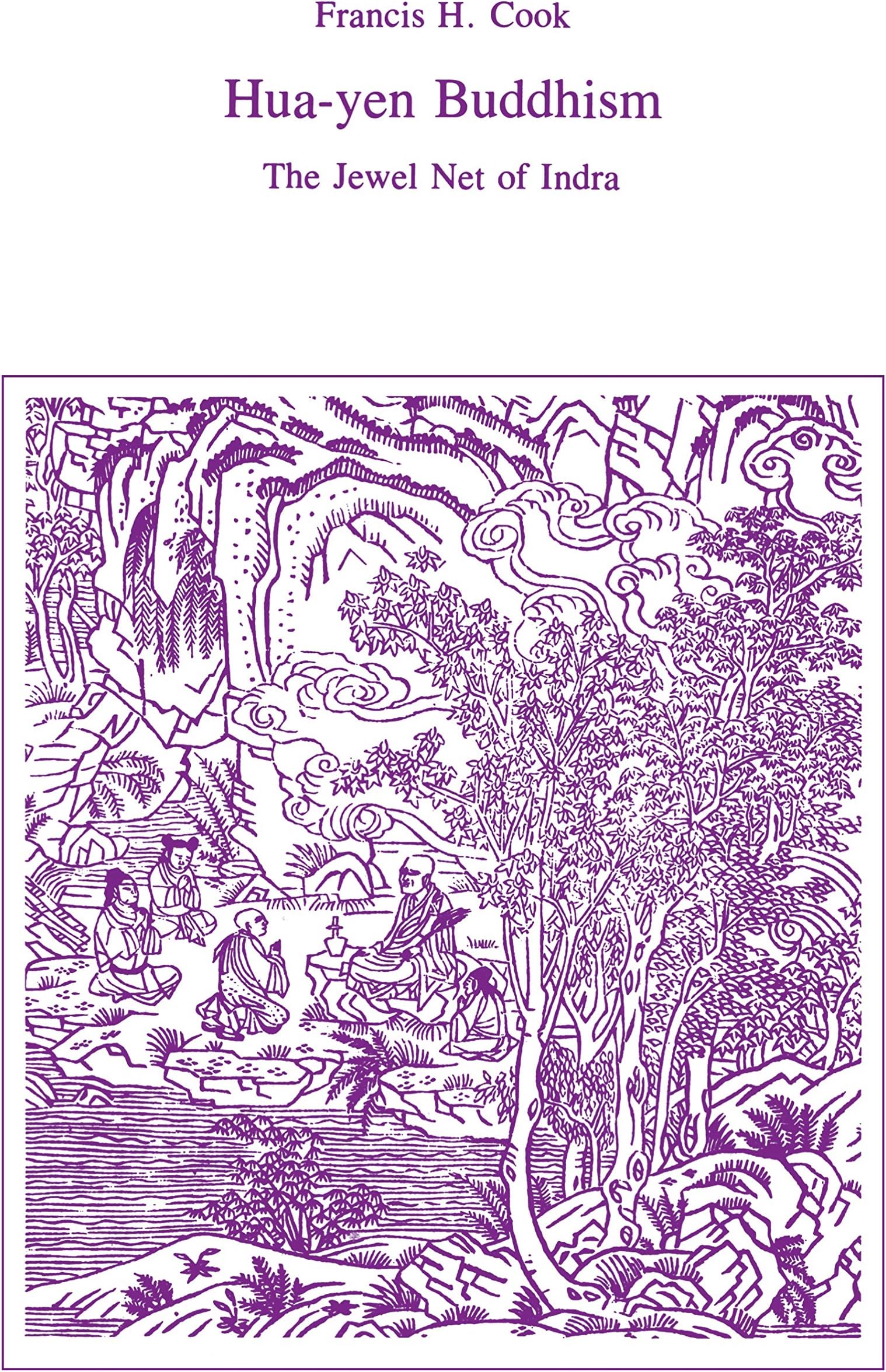
Hua-Yen Buddhism: The Jewel Net of Indra (Iaswr Series) (Volume 0)
Product ID: 14968975
🌐Bridges Eastern philosophy & modern thought
📚Deep philosophical treatise
🕉️Explores advanced Buddhist concepts
Desertcart purchases this item on your behalf and handles shipping, customs, and support to Croatia.
🕉️ Elevate your mind with the cosmic web of Hua-Yen wisdom!
This used book offers a rigorous yet accessible exploration of Hua-Yen Buddhism, regarded as the pinnacle of Chinese Buddhist philosophy. Authored by Francis Dojun Cook, a respected scholar and Zen practitioner, it delves deeply into complex doctrines like emptiness and interdependence, bridging ancient teachings with modern philosophical discourse. Ideal for advanced students and professionals seeking intellectual enrichment and a connection to a sophisticated spiritual tradition.
| Best Sellers Rank | #466,064 in Books ( See Top 100 in Books ) #205 in Buddhist Sacred Writings (Books) #387 in Religious Ethics (Books) #403 in Buddhist Rituals & Practice (Books) |
| Customer Reviews | 4.5 out of 5 stars 40 Reviews |
J**Y
Best Intro to HuaYen Thought
This book, well-known to most English-speaking fans of Buddhism, served as a follow-up to Garma C.C. Chang's pioneering book on Hua-Yen (Huayan) entitled the "Buddhist Teaching of Totality". Both of these books (especially Chang's) served to introduce the sophisticated Hua-Yen School's system of thought to English-speaking audiences on a non-scholarly level, and should be applauded for this pioneering effort. Although both books were meant to target non-scholars as well as scholars, the complexity of Hua-Yen thought makes this a rather daunting task (and not just for lay folks!). Francis "Dojun" Cook needs no introduction to fans of Buddhism, having written several fine books on Japanese Zen master Dogen's thought as well as this book and various articles on Hua-Yen. All are highly recommended reading. Cook combines the rare combination of scholar and practitioner, the latter a result of being a zen practitioner for many years. This gives a practical (or "practice-oriented") edge to his writing that is often missing in scholarly works. As another reviewer noted, there is an old Chinese saying that the summit in historical Buddhist study would ideally be "Hua-Yen for theory; Chan for practice", and Cook certainly appears to embody both sides. Cook's book is evidently an outgrowth of his early interest in Hua-Yen as evidenced by his PhD thesis: "Fa-Tsang's Treatise on the Five Doctrines: An Annotated Translation". Indeed, Cook makes much use of this particular treatise (in Chinese: Huayan Wujiao Zhang) in his "Jewel Net" book, going into detail to elaborate on Fa-Tsang's/Fazang's metaphors such as a house -together with each part such as rafters, roof, etc.- displaying an interdependence and interpenetration of parts and whole (or "universal" and "particular"), and also the unobstructed interpenetration of each part with each other part (Chinese: shishi wuai fajie: a novel teaching of the Hua-Yen school). Heady stuff, especially how this totality vs. individual illuminates traditional Mahayana doctrines such as "emptiness" and "co-origination" in novel ways. Fazang, the so-called "3rd Patriarch" of Hua-Yen (although some suspect he was actually the primary synthesizer of Hua-Yen doctrines as a system), was a brilliant thinker and it shows in his efforts to utilize appropriate metaphors (not all his) of complex Hua-Yen teachings- the familiar "Indra's Net", the "Golden Lion", the house and rafters, etc.- I simply don't have space to wade into Hua-Yen teachings here, and there is plenty of literature now out on Hua-Yen that folks can refer to. As for Fazang, he evidently wasn't just a perceptive thinker, but also a reported miracle-worker (who isn't in ancient Chinese philosophy?) and who also had a shrewd political eye, judging from his popularity with Empress Wu Zhao, who naturally sought support for her rule from Buddhist doctrines. By anyone's standards, Fazang is a hugely important figure in classical Chinese philosophy. As for Hua-Yen thought in general, readers of both books by Chang and Cook might want to go further and explore some modern scholarship in this area. Well-known scholar Steven Odin, for instance, has contrasted traditional Hua-Yen teachings on time vs. contemporary Process metaphysics, and the resultant dialogue has been interesting. On other topics, Cook himself disagrees with Garma Chang's description of "emptiness", the latter displaying too much of a subjective interpretation of the traditional "Mind-only" doctrine, according to Cook, who favors a more objective interpretation of "Mind". So there's plenty of room for scholarly debate there. Another reviewer also mentioned the innovations the Chinese brought to the older Indian doctrine of emptiness; Cook mentions the Chinese re-vamping of this doctrine in the book and elsewhere. The Chinese image enlarged the Indian description from a largely negative one, emphasizing the inconsequential nature of phenomena, to a more robust image, where phenomena are the "fullness" of totality because of being empty- hence, each side emphasized a different aspect of emptiness. These changes by different cultures on standard Buddhist doctrines are also the subject of scholarly discussion, which readers can wade into (at their own peril)... At any rate, needless to say, the Hua-Yen books by Chang and Cook largely set the stage for Hua-Yen thought to become more familiar to Western audiences. For that, each deserves five stars for giving the public an entrance into this difficult material. Readers, I hope your chops for abstract thought are in place here, you'll need it for penetrating the abstruse Hua-Yen universe. But hey, effort like that is what life is all about :-)
D**M
The Best Explanation of the Concept of Emptiness
The Buddhist concept of Emptiness or "Shunyata" in Sanskrit is a pretty advanced concept in Buddhism, and can be really daunting for new Buddhists, or scholars. This book details the philosophy of a Chinese Buddhist school (long extinct) called the Hua-Yen or "Flower Garland" school after the sutra of the same name. The Hua-Yen was a school that explored Buddhism through high philosophy and explored Emptiness like no other school of Buddhism ever has. This book really takes the reader deep, deep into the philosophy behind Emptiness and can be a challenging read. From my own experience though, having been a Buddhist for years, I finally understood Emptiness after reading this book about halfway. Having understood Emptiness, much else in Buddhism became much more clear. That right there gives this book 5 starts. To reiterate, this book is not for new Buddhists but rather for philosophers or Buddhists who already have a strong familiarity with Mahayana Buddhism. If you are one of these folks, don't pass up the great work done here.
S**I
Gives you the keys to understand Hua-yen and its importance to Zen.
I have read three commentaries on the Avatamsaka Sutra, "Entrance into the realm of reality" (the others were by Cleary and Chang) and this is by far the best. The late Francis Dojun Cook was both an academic and a practitioner of Zen. If you haven't read Cook's books you are in for a treat. This book was written for those who practice zen (and those who just want to understand Hua-Yen) who want to know more about Hua-Yen philosophy which was very important to many of the zen ancestors who passed the Dharma down to our own time. Dogen Zenji's writings draw heavily on Hua-Yen thought and reading this book will give you many insights into his thought. I can't recommend this book too much.
J**T
Thought Provoking
Hua-yen, or Flowering Ornament, is a fascinating yet overlooked system of Buddhist thought in which Francis H. Cook addresses with a special admiration and thoroughness. Hua-yen teaches the four Dharmahatu, or four ways of viewing reality: All Dharmas are seen as separate events, all events express the absolute, events and essence interpenetrate, all events interpenetrate. Cook fastidiously addresses this subject through the image of the jeweled net of Indra because it is what Hua-yen has been founded on and it symbolizes a cosmos in which there is an infinitely repeated interrelationship among all the members. (One thing contains all other existing things, and all existing things contain that one thing.) Cook writes,“Far away in the heavenly abode of the great god Indra, there is a wonderful net...it stretches out infinitely.” A single jewel hangs at each eye of the net, the jewels are as infinite as the net itself. “If we now arbitrarily select on of these jewels for inspection...we discover that in its polished surface there are reflected all the other jewels in the net. Not only that, but each of the jewels reflected in this one jewel is also a reflection of all the other jewels.” To further explain this image, Cook uses the analogy of a rafter in a building: The building would not exist as a building if it weren't for the rafter thus the rafter, as one piece has the full power of causing the building. Yet, the rafter would not have the functionality of a rafter if it weren't for its function as part of the building, thus the building also has full power of causing the part. As an absolute truth neither building nor rafter have a function separate from one another; Both the whole and the part are dependent on one another for their very identity – in that knowledge, both the rafter and the building are identical because they are dependent. If we look deeply into the net, we can see the value of every part or piece of the cosmos and the value of the cosmos as a whole. I suspect that Cooks writing itself was strongly influenced by the image of Indra's jeweled net (He strings wise philosophical jewels among strands of interconnected thought provoking words.) ...after all words are dependent on sentences and sentences are dependent on words. So, in considering the analogy of the rafter and the building, if one part truly does have the value of the whole and if I could pick one part of Cook's book to exemplify the whole book, the rafter, so to speak, I would choose the very last two sentences in the very last paragraph which reads: “It is not just that “we are all in it” together. We all are it, rising and falling as one living body."
J**S
Indra's net explained!
Buddhism at its finest. It is concise, clear and straight to the point. It is an introduction to hua-yen but not to biddhism in general, which is a relief if you are educated on it and are tired of the ocean of introductory texts.
H**U
A zen Treasure
Wow, Just reading the first 50 pages has been worth the price. The author writes clear and in simple language. I know this text is considered to be for advanced Buddhist students but I found it quite clear and easy. One must sit down and be still as the print is only a light black and small font but I am excited to get farther into it. Thanks,
M**S
Illuminating
I can’t say enough good things about this book. A beautiful perspective of the affirmative aspect of of emptiness/dependent origination, in turn, showing the fullness and truly powerful effect of this doctrine. Thorough, illuminating, and ultimately inspiring.
T**N
Beautifully written. Incredibly dense material made understandable.
I've read it once and now starting a second read. Beautiful and clear. A layperson can understand this. Some experience of meditation will make it a whole lot better. It will inspire one to meditate. The "Chinese mind" has given humanity a remarkable gift. Francis Cook has given it to us.
K**R
The content is brilliant and beautifully expresed but the book production is wanting
The content is brilliant and beautifully expresed but the book production is wanting. The print is small and feint in places. It looks like a facsimilie edition. I've just ordered the original 1977 hardback edition via Sierra Nevada Books. The print has to be clearer than this edition. I hope it is.
E**D
Hua-Yen is must philosophy for every thinking being!
I gave only 4 stars for it is a bit lengthy and repetitive, otherwise flawless and greatly inspiring! Hua-Yen is the 'philosophy of Zen', words added to the enlightened experience of oneness/equality and intercausation/interpenetration of all phenomena.
A**I
A new look at buddhist doctrines from an ancient and venerable chinese buddhist school.
A terrific book that is worth reading from someone wanting to (re)discover and appreciate a very important buddhist school that has so far received little attention from both the large public and the various buddhist communities around the world.
Trustpilot
3 weeks ago
3 weeks ago