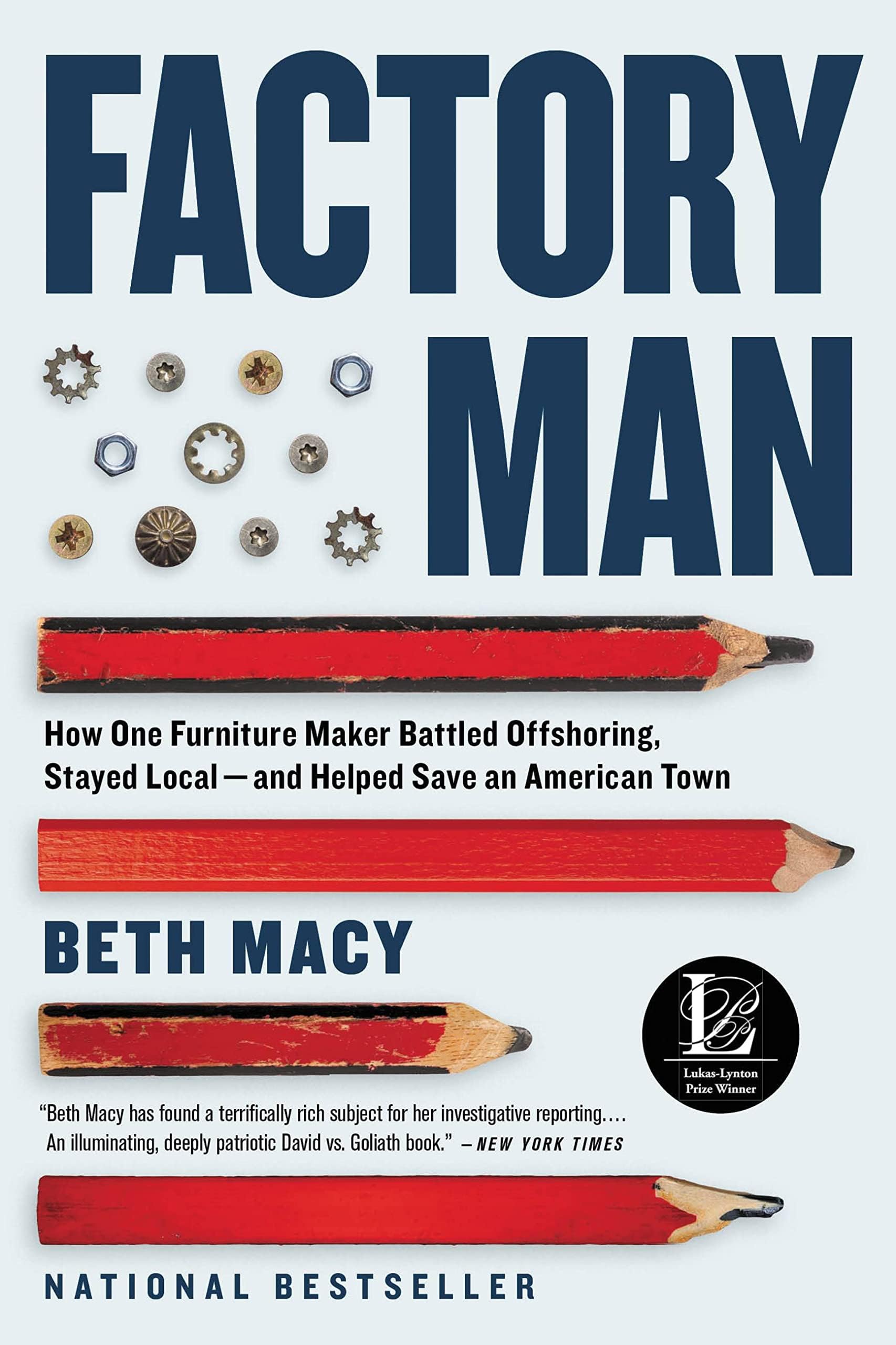
Factory Man: How One Furniture Maker Battled Offshoring, Stayed Local - and Helped Save an American Town
Product ID: 15291753
Desertcart purchases this item on your behalf and handles shipping, customs, and support to Croatia.
The instant New York Times bestseller about one man's battle to save hundreds of jobs by demonstrating the greatness of American business. The Bassett Furniture Company was once the world's biggest wood furniture manufacturer. Run by the same powerful Virginia family for generations, it was also the center of life in Bassett, Virginia. But beginning in the 1980s, the first waves of Asian competition hit, and ultimately Bassett was forced to send its production overseas. One man fought back: John Bassett III, a shrewd and determined third-generation factory man, now chairman of Vaughan-Bassett Furniture Co, which employs more than 700 Virginians and has sales of more than $90 million. In Factory Man , Beth Macy brings to life Bassett's deeply personal furniture and family story, along with a host of characters from an industry that was as cutthroat as it was colorful. As she shows how he uses legal maneuvers, factory efficiencies, and sheer grit and cunning to save hundreds of jobs, she also reveals the truth about modern industry in America. Review: Full of insight - A fascinating story that has been meticulously chronicled. Macy expertly blends raw history and story telling. She is the journalistic heir to JBIII. What a wonderful read. Review: Inspiring story of how some of our jobs were saved - When I first read about and heard about this book, I was sure I wanted to read it. I live in Southside Virginia. Before I moved here, DuPont and Tultex had closed. Since I’ve lived here, I’ve seen the closings of all the major companies that made this area the manufacturing powerhouse it was. Now that’ve read the book, I would highly recommend it as an explanation for how American jobs were handed over to foreign interests. We rolled over and played dead. The really good parts: Beth Macy did an excellent job of going step-by-step through what happened to the furniture industry that built this area, both in its heyday and in its capitulation to Asian manufacturing. Finally, someone talked about the out-sourcing of American jobs remembering the people who were hurt by them. These are people who will never have a job that good again before they retire. They were trained for factory work that doesn’t exist anymore. If they want a job that pays almost as well as the one they lost, they have to leave the area. Thousands already have. If other Americans think it isn’t coming to their towns, they’re wrong. Ms. Macy rightfully takes to task the economists in their ivory towers. They talk about the consumer getting a better deal by having cheaper products available to them. This kind of short-sighted thinking does not consider a major factor in this equation—consumers have to have jobs in order to consume. No job, no buying the cheap products that put them out of work. No buying, slow economy that takes a long time to recover. This ought to sound familiar to anyone listening to economic news these days. Even more telling was the comment made by the Asian who marveled that American capitalists would do anything for a buck, including give away their manufacturing knowledge and jobs. He said once they had these things, they wouldn’t be stupid enough to give them up. I appreciated her declaring at the beginning of the book her own biases—she was the daughter of factory workers in Ohio and had seen her own parents put out of work when the jobs were taken somewhere else. She acknowledged that she liked some of the main characters in the book more than others, including her admiration for John D. Bassett, III, the book’s main character. She pointedly remembered the folks others wouldn’t have remembered—the factory workers, especially the black ones, and the domestic workers of the factory owners. My one and only complaint was at the beginning of the book, when she talks about the history of the extended Bassett family, she put in every piece of gossip she was told. Macy wrote that the curator of the Bassett Heritage Center told her to. However, I thought she should have exercised a little more judgment. Some pieces of extended family history were just hurtful to no particular end. Some details were tawdry and unnecessary. That said, I would highly recommend the rest of the book.




| Best Sellers Rank | #152,237 in Books ( See Top 100 in Books ) #6 in Outsourcing (Books) #12 in Manufacturing Industry (Books) #13 in Industrial Relations Business |
| Customer Reviews | 4.4 out of 5 stars 950 Reviews |
M**I
Full of insight
A fascinating story that has been meticulously chronicled. Macy expertly blends raw history and story telling. She is the journalistic heir to JBIII. What a wonderful read.
L**A
Inspiring story of how some of our jobs were saved
When I first read about and heard about this book, I was sure I wanted to read it. I live in Southside Virginia. Before I moved here, DuPont and Tultex had closed. Since I’ve lived here, I’ve seen the closings of all the major companies that made this area the manufacturing powerhouse it was. Now that’ve read the book, I would highly recommend it as an explanation for how American jobs were handed over to foreign interests. We rolled over and played dead. The really good parts: Beth Macy did an excellent job of going step-by-step through what happened to the furniture industry that built this area, both in its heyday and in its capitulation to Asian manufacturing. Finally, someone talked about the out-sourcing of American jobs remembering the people who were hurt by them. These are people who will never have a job that good again before they retire. They were trained for factory work that doesn’t exist anymore. If they want a job that pays almost as well as the one they lost, they have to leave the area. Thousands already have. If other Americans think it isn’t coming to their towns, they’re wrong. Ms. Macy rightfully takes to task the economists in their ivory towers. They talk about the consumer getting a better deal by having cheaper products available to them. This kind of short-sighted thinking does not consider a major factor in this equation—consumers have to have jobs in order to consume. No job, no buying the cheap products that put them out of work. No buying, slow economy that takes a long time to recover. This ought to sound familiar to anyone listening to economic news these days. Even more telling was the comment made by the Asian who marveled that American capitalists would do anything for a buck, including give away their manufacturing knowledge and jobs. He said once they had these things, they wouldn’t be stupid enough to give them up. I appreciated her declaring at the beginning of the book her own biases—she was the daughter of factory workers in Ohio and had seen her own parents put out of work when the jobs were taken somewhere else. She acknowledged that she liked some of the main characters in the book more than others, including her admiration for John D. Bassett, III, the book’s main character. She pointedly remembered the folks others wouldn’t have remembered—the factory workers, especially the black ones, and the domestic workers of the factory owners. My one and only complaint was at the beginning of the book, when she talks about the history of the extended Bassett family, she put in every piece of gossip she was told. Macy wrote that the curator of the Bassett Heritage Center told her to. However, I thought she should have exercised a little more judgment. Some pieces of extended family history were just hurtful to no particular end. Some details were tawdry and unnecessary. That said, I would highly recommend the rest of the book.
C**S
Factory Man: How One Furniture Maker Battled Offshore, Stayed Local
Factory Man about Bassett, Virginia..actually about the Bassett family who at one time was Bassett, Virginia is a spell bounding read. I love the way Beth Macy built the town from the ground up with each family generation. The history of the family members and their drive to make something of the family and the town could be about many towns in America but this story is about the farm land and farmers along with slaves becoming furniture businesses on an international level. The family did not always agree on who was to run the different furniture factories...cousins and in-laws against blood-born Bassetts were often at odds with each other which made this read like fiction. The town of Bassett became a boom town due to good management and a love for the business and dedication to the workers. The workers were also dedicated to the business since money was good and no longer days in the hot sun and rain raising cotton in the fields. The mansions were built on the hill away from Smith River enough to get out of the flood plain but within seeing distance of the factories and the smokestacks. The railroad was built through Basset and this added to the prosperity. Wood was plentiful in the hills surrounding the county and life became better for all living within the area....until along came the Japanese, the Chinese, the Vietnamese, etc. who could buy the wood, have it shipped and make the furniture ad ship back to the US for a much less price...Whoa be gone one factory, then two, then three...workers lost their jobs; poverty set in for many in Bassett and surrounding furniture producing areas. It became a political game to keep making furniture in America and JBIII was the man to get it done. He is a funny, determined, goal-driven man with a fight on his hands. A truly great character in the history of the furniture business and Bassett, Virginia. This is a marvelous history book written by a newspaper woman who get to the heart of the furniture business and the family. YOU will love this book if you like to read stories about our nation's road to prosperity, industry and family legends. I got my book downloaded onto my Kindle from Amazon. Get yours now and then look at the bottom or back of your furniture to see where it was made.
A**H
Saving American business
Fascinating account of international business as told through one southern American company! The first half of the book covers southern history after the civil war, both the good and the bad, concentrating on one family business. The second half covers the company’s fight to compete against world trade!
E**H
If you can get past all of the unnecessary details, there are some good parts in it
Unless you are from that part of the country or really vitally engaged with the furniture industry, it's my opinion that this book will be a bit difficult to finish or even stay interested throughout. There was also a lot of gossip about the personal lives of people that I wasn't given enough of a reason to care about before reading intimate details about them, so it fell flat and those details felt intrusive at worst and unnecessary at best. Well researched - yes, absolutely. The author did her homework. I generally enjoy non-fiction books better than fiction. But this one was hard to finish it and, while there was some good content in it about American industry, I could have lived without all of the peripheral details that didn't add to the story line. Too many people were dragged into the book, both muddying and diluting the theme, as well as the understanding of the main characters.
J**K
Engaging and Informative. Loved it!
I read this book with my book club and did not expect to like it (I like fiction!). A couple of our members had heard Beth Macy speak at an event and talked the rest of us into it. However, I became hooked with the first two pages! It is beautifully written and organized, with an incredible amount of investigative reporting. I now finally understand the true meaning of globalization -- a term I was familiar with but didn't really understand in terms of what it meant to individual Americans who have lost their manufacturing jobs and the factories that were built with blood, sweat, and tears over generations. Beth Macy is obviously passionate about the subject matter and interviewed people from the lowest level to the top. The book dragged a bit in a couple of the early chapters as she developed the hierarchy of the Bassett family and its generational employees, but it was necessary to the story. It makes me proud that there are still corporate Americans left (at least one anyway) who are willing to put everything on the line to keep their people employed. Hats off to JDBIII and to Beth Macy for telling his story in such an engaging way. Makes me proud to be a fellow Virginian!
R**N
Wow, amazing story.
Extraordinary story of an American industry being eradicated by low cost foreign competition. It needs to be told and retold. The style of writing is a little tough at times, bouncing around a lot, but it is interesting and straightforward.
W**R
This is my country’ land of the impoverished many
‘Yes it’s happened. America is not the country it once was, how has that happened; have we moved forward into a new better existence or hopelessly lost our way? Beth Macy’s story of the battle to save an industry in the age of Globalization is a masterful telling of the ten years of demise of factory after factory as imports replace Appalachia’s hold on furniture production that had in turn taken down Michigan and New England. Her tale can easily be shifted to almost all manufacturing sectors of the American economy. Its uniqueness is the focus on one man who, as some have said, gave China the middle finger. “Between 2001 and 2012, 63,300 American factories closed their doors and five million American factory jobs went away. During that same time, China’s manufacturing base ballooned to the tune of 14.1 million new jobs.” “But we didn’t have to close ’em all.” A sad reality, in August 2013 the Associated Press announced new data showing that four in five American adults will face poverty during their lifetimes. It was one of the first national news articles … that directly connected growing poverty to the increasingly globalized economy and the destruction of factory jobs. Beth Macy focuses on one industry and one region but the beauty of her telling is that you see the statistical occurrence as affecting people in all the ways it can; the owners taking their stock options as value increased and employment fell and moving on happily marketing imports, to the unemployed watching their towns and lives disintegrate. Her hero is John D. Bassett III, JBIII as he becomes, and that is a story well told; a man who saves most of his firm and reorganizes the resistance to Asian ‘dumping’ winning compensation that enabled many to survive and restructure their trade despite resistance from all who were finding acceptance wiser and profitable. Unfortunately it is not a How To manual, the damaged for most is done the horse has bolted the barn, but good reading by any standard. Selected one of ten best books of 2014 by a Times’ reviewer and others. Don’t miss it. A quote on the concept called Comparative Advantage you may have been drilled on in Econ I A: “To most economists, factory work was a throwback. It was still okay to work in health care, retail, recreation, insurance, hotels, and haircuts. But it wasn’t cool anymore to actually make stuff.” In 2012, there were 1.75 billion cell phones made in the world— and not one was manufactured in the United States.
M**E
La globalisation comme si vous y étiez
Un ouvrage qui étudie le cas de l'industrie du meuble américain, à travers l'histoire courageuse d'un héritier d'entreprise qui sauva son usine, et un peu sa région, en bataillant dur pour améliorer la compétitivité de son outil de travail, mais surtout en dénonçant le dumping chinois et obtenant des compensations financières, face à l'opposition des importateurs. Une enquête de terrain très formatrice.
M**Z
Good experience
Good experience.
P**L
Important topic
Very well written
L**R
very well written and well researched story. The second ...
very well written and well researched story. The second part of the book is both exciting and very factual. A must read for those of us connected with the US furniture Industry and it's near total destruction of imports from China.
Trustpilot
2 weeks ago
3 days ago