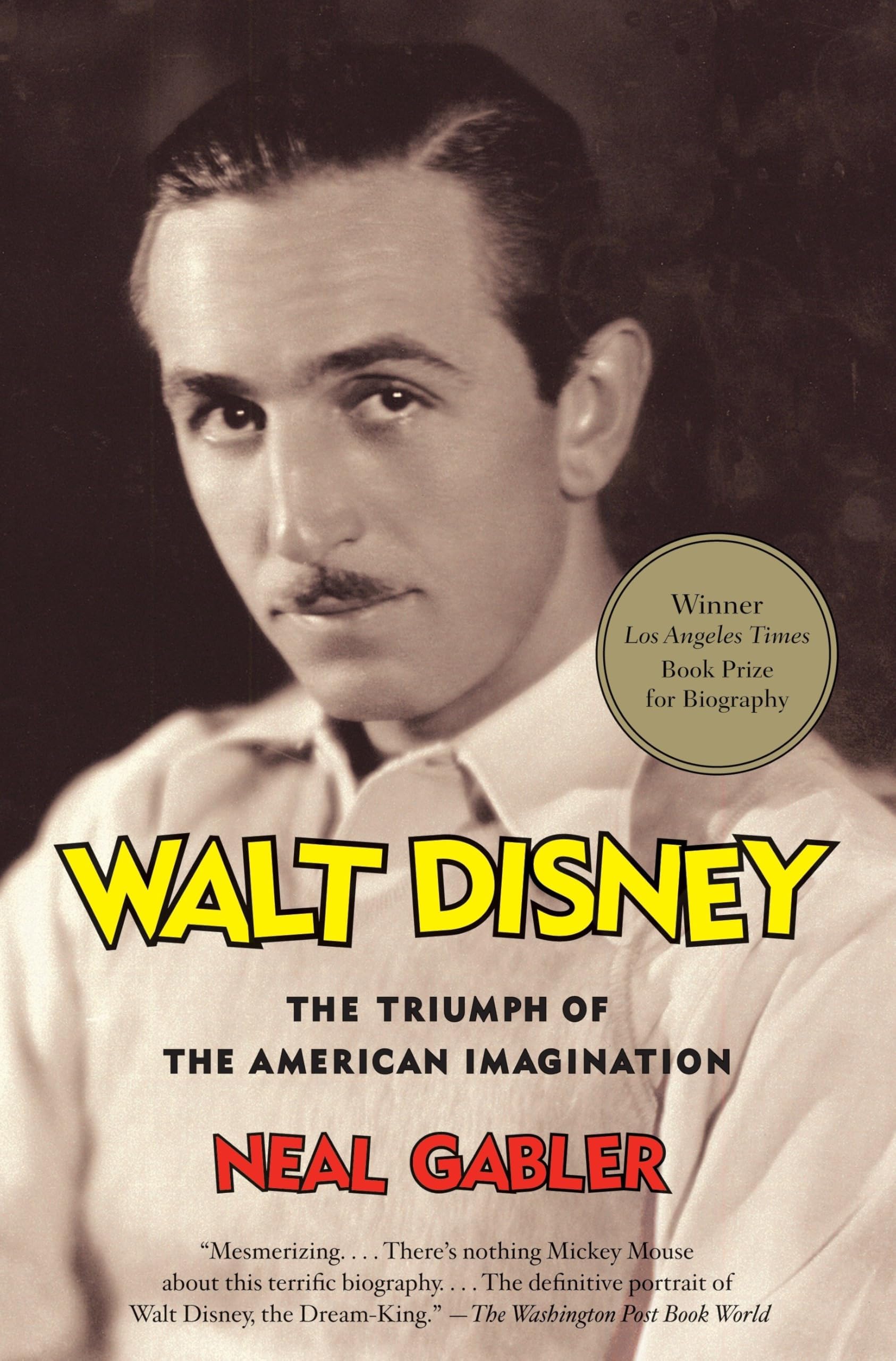
Walt Disney: The Triumph of the American Imagination
Product ID: 1608905
🎬Covers Disney’s full entertainment empire
🏆Award-winning biography
📚600+ pages of deep dive
Desertcart purchases this item on your behalf and handles shipping, customs, and support to Croatia.
🎥 Unlock the magic behind the man who redefined imagination.
This extensively researched biography by Neal Gabler chronicles Walt Disney’s transformative journey from a small-town dreamer to a pioneering entertainment mogul. Spanning over 600 pages, it offers an award-winning, balanced exploration of Disney’s artistic innovations, business acumen, and cultural impact, making it essential reading for anyone fascinated by creativity, leadership, and American cultural history.


| Best Sellers Rank | #52,594 in Books ( See Top 100 in Books ) #11 in Movie Director Biographies #56 in Art of Film & Video #148 in Actor & Entertainer Biographies |
| Customer Reviews | 4.6 out of 5 stars 1,070 Reviews |
T**W
Walt Disney, or: How to Create an American Mythology
Ever since I purchased this book and began eagerly devouring it, I've debated whether I am qualified to write a review for it, or conversely, whether I may be uniquely UN-qualified, and should recuse myself due to bias. You see, my family's mythology is deeply intertwined with that of the late Mr. Disney. I was born in Marceline, MO, Disney's boyhood home, the small Midwestern railroad town which, as I was told growing up and the book clearly relates, formed the foundation for so much of his character, outlook, and artistic vision. The town really is a great slice of small-town American life, even to this day. My parents grew up and got married there, my Father and grandparents are buried there, and I still visit it when I get the chance, which isn't nearly often enough. For those and many other reasons, the Disney mythology deeply resonates with me. But, with as much objectivity as I could muster, I decided to go for it. I apologize for the long back story, but it's an integral part of my review and is what inspired me to write, so it bore mentioning. Neal Gabler's "Walt Disney: The Triumph of the American Imagination" is a fascinating, absorbing, and detail-filled examination of the life of a man who not only desired to re-create his own earlier, idealized rural (translation: Marceline) experiences, but who expanded that vision to the rest of the world through his pioneering work in both animation and entertainment. Nothing is missed: Walt's early and (perhaps even over-dramatized) difficult childhood; The creation of the Disney studio and it's early successes including Mickey Mouse, one of the world's most recognized artistic and commercial symbols; the animated triumph of Snow White and the Seven Dwarves; the devastating animator's strike of 1941, and the post-war metamorphosis from cutting edge folk artist to corporate defender of cold-war conservatism and "right-wing" values. Gabler manages to portray the whole story in a disarming and captivating, straight-forward, one would almost say, mid-western, tone that I for one can certainly relate to. The resultant impact that Disney (and the huge mega-corporation he almost single-handedly created) has had on society, culture, and even politics has been mixed to say the least, and the book argues, successfully I think, that there is no clear-cut, clean and simplistic answer to the question, was it for good or ill? Ironic, considering that black and white, good versus evil simplicity versus shaded, ambiguous and complex meaning were recurring themes throughout his artistic life, and by extension, that of our country, more relevant than ever in this day and age. I found the book to be very balanced, with equal credence given to both sides of that coin. Occasionally, I found myself getting bogged down in the pedantic details of the development of the animation and the inner dynamics of the company. But they weren't too overwhelming, and in the end, they were both necessary and complementary to the main story of Disney's life. In fact, the book works on several levels: in-depth biography, socio-cultural exposition, artistic history lesson, and to boot, a damned interesting business read. For me, in the end analysis, I was able to capture, or really re-capture through reading this fine book, a sense of my own childhood as seen through my family experiences in literally THE small-town America (once I got that Main Street, USA in both Disneyland and Disney World were modeled after his youthful memories of Main Street in Marceline, it all became clear). The idea that a substantial part of my world-view was shaped by watching Disney movies as a kid and heck, even as an adult, and the way Disney created an alternative universe, simplistic or not, that one can escape to (or do we live in it at least partially today?) is compelling. The book captures all of these ideas and more. I think that anyone, regardless of their connection to the Disney story, would feel the same, and that is the mark of a good book, now isn't it? Finally, a shout-out: To my Aunt Erma, who still lives in that wonderful small town, I love you, Aunt Erma! Please be kind if you read, this is my first book review! Randy Blew
D**Y
Tremendously Detailed Biography of Walt Disney: a Man of Great Vision, a Risk Taker and a Success
If you ever wanted to know virtually everything about Walt Disney and the Disney company, this is the book for you. The author has almost overwhelming detail of Walt's early upbringing and difficult life to his unfortunate early death while in the middle of planning out Disney World and Epcot. This book is not for the light reader on the subject, the biography is massive with over 600 pages not counting the notes and index. But you will come away from the book adoring the man that never stopped planning and making improvements from not just the way cartoons were drawn but by making them more artistic, utilizing new techniques and cameras with an analyzing eye for detail. Often on the brink of bankruptcy, Walt, with the huge contribution of brother Roy, continued to make improved products equiring outstanding loans throughout much of his career. Betrayed initially by a film distributor who not only stole, legally, Disney's Oswald character and stole many of his staff, Disney and his top artist Ub Iwerks, develop the life changing Mickey Mouse. But as Gabler tells the story, Disney's studio grows and so do the risks with perhaps the greatest risk at that time, Snow White, the first full length animation film. What almost seems like a pattern, Walt continues to make improvements, hire increased staff and take out loans as he produces more, works staff long hours to put out a higher quality package. The book also provides a sobering view of Disney as sometimes the pressure was too great for the great story teller and the advent of unions and the need for stock sales along with bankers starting to provide over sight leads to greater restrictions and frustration but then Disney thrives with less costly non-cartoon films such as Davey Crocket that become quite a rage along with the Mickey Mouse TV show and eventually his plan for Disneyland that was an attempt to fulfill his boyhood dreams of his small town life in Marceline, Missouri. Fascinating detail on such things as Ub Iwerks as the actual artist who drew the early Mickey, the need for Donald Duck as a charcter to offset the corporate wholesomeness now required of the mouse, Roy Disney who held the finances together to allow Walt to plunge on and and Disney's plan for developing not only Disney World with modern monorails but Epcot. The sad end of the book of course is Walt's death of cancer that is well hinted very early on by references to a hacking cough many years before. What is really unfortunate was Walt Disney's plan for Epcot that was never completely fullfilled that was to be more of a town with living areas for Disney employees creating a village concept that is actually being realized in many communities today (office parks with stores, landscapped lakes, and condos or apartments). Regretfully as Roy Disney said, the great plans for Epcot died with Walt. Primarily because Walt reached higher and higher, his ultimate plans with stringent notation to detail crerated a fascinating entertainment industry.
L**E
Excellent book on the life of Walt Disney
Having seen the terrific American Experience (PBS) two-parter on Walt Disney's life, I was interested to know more. This biography is very thorough and even handed, not skimming on criticism where it's due. We often forget that Walt Disney was a man before the name came to represent things. What we learn is that Walt Disney came from very little, never made it out of high school, and despite a few amazing successes, struggled to keep his studio alive following movies that failed at the box office. That those same movies are now considered classics that are integral parts of almost every Americans' childhood makes it almost unbelievable that they nearly ran Walt Disney out of the business of animation. All we know is the vast empire that exists today, but it's only because Walt Disney kept pushing forward in his desire to amuse and delight his inner boy in a way that also appealed to the broad need of most of us to have our stunted, immature selves likewise entertained with singing animals and amusement park fantasy lands. Neal Gabler does a great job capturing the boy, the man, the boy-man, and the man-child. Among fascinating personal details are Walt's distant relationship with his father, his somewhat naive idea of women including a marriage that seemed more convenient than passionate, but was faithfully maintained to the end of his life, Walt's warm and cold relationship with his brother and business partner Roy, and the death of his mother, for which he blamed himself. Gabler also touches on accusations often heard about Walt Disney of being a bad boss, a racist, and a Nazi sympathizer. Although he doesn't give Walt a pass, he does make sure to remind readers of the context of the times Disney lived in, and that there were no standards for animation and film workers as movies were just starting to find their feet in the 1920s and 30s. As a film history through one man's life, this book also reminds us that Disney innovated things we take for granted now-- things like sync sound in cartoons, color animation, camera animation stands that allowed depth of field, and storyboards. The world of movie animation would be very different if not for Walt Disney and the talent he fostered in his studio.
G**L
WALT'S WORLD -Not always living the dream!
We talk about someone as being in their own world -well if there was ever a person who spent most of their life in their own private world it's Walt Disney. Just looking at the reviews for this one book on him, you can see just how divided people are. To this day, Walt is held in the same reverance as a saint. A perfect man who never did anything wrong or hurt anyone. So when any author let alone Neal Gabler, tries to flesh out the man beyond his carefully crafted immaculate image -well it's seen as something unholy and something they used to call "un-american". Neal Gabler's book is quite a defining work, as researched and written. Gabler had the backing of Walt's immediate relatives namely Dianne Disney Miller (Walt's oldest and only biological daughter) and her husband Ron Miller. Now not to jump too far ahead, there is a complete dividing rift between Walt's side of the family and his brother Roy. That said, well you'll find that out in the book, but Dianne disowned Gabler for not painting her father as a complete saint. You have to remember of course, that she saw and grew up with a man who was her loving and devoted father. He raised her as a princess with a life of great wealth and privilege. She didn't have to work for him, like her husband Ron Miller. Walt Disney never praised any of his artists or employees and he certainly didn't believe in giving due credit either. There was only one single shining star at the Disney studio -and it wasn't Mickey Mouse! Walt Disney was unique in that as one of his animator's once said -"He had a genius for using someone elses genius." You'll discover that early on in the book, when you read about Ub Iwerks -the "hand" behind the mouse. When you see the famed "nine old men" on various DVD's and documentaries talking about Walt, it's all about praise and inspiration. But in private, that is talking with an author, you get to hear the real story, warts and all. Every great person has a real story and Walt Disney is a great man. But we don't have to have revisionist and edited history to remind us of that. No other Hollywood studio keeps it's one and only star and principle asset, so wrapped in devine illusion and mythology. They even delete the names of prominent and skilled artists who struck the studio in the 1941 strike. The studio has even fallen victim to political correctness, by deleting all mention of "Song Of The South", let alone having pulled it from US distribution for the last twenty years. The more you know about someone or something the better, but only if there's room for discussion and not a dictatorial public relations campaign style reference. Gabler's book is a good read and he likes and admires Walt Disney -he just also happens to point out, that he did have a lot of other geniuses around to help him become and stay such an ever illuminant star!
N**N
Look Auntie! They're Paying me to Draw Pictures! They're Paying me to Draw Pictures!
Walt Disney has become a legendary character of the twentieth century. So much was written about him, and so much was inaccurate, that the legends often attained a currency that was not deserved. How many times have we heard that he was frozen? Gabler (who was the first of Walt's biographers to work with rare Disney family records) opens the book with this statement (it's not true.) The truth is much more interesting than that. Disney was an optimistic, hardworking go-getter with an astounding capacity for concentration who fell in love with the early twentieth century's high technology--motion pictures. Motion pictures drawn by hand. He had the perseverance to start over again every time he failed artistically and financially. And fail he did. This is one of the most unlikely success stories ever told, since the Disney Brothers studio was working in a marginal field (animation) in a minor city (Kansas, then Hollywood, when the animation studios were all in New York), and attempting to make it as an independent producer just as the big studios were forming, eliminating independent competition in all but a few areas by 1928. He made it because he had the unfashionable idea that quality would out, he had a tremendous amount of luck and he knew how to make appealing entertainment(Mickey Mouse was NOT the first successful character he created). Disney also had a real genius for hiring talented people. A surprising number of remarkable artists started with him in Kansas City, others were trained right on the studio lot. Mr. Gabler's book is readable and contains much new information. Who would have thought that Charlie Chaplin was, at one time, Snow White's Prince? Chaplin, one of the few independent producers left by 1936, loaned his books for MODERN TIMES to the Disneys to help them ask fair prices for their landmark feature. For Disney's weak spot was running the business--he once actually forgot to add on the profit to the budget for a job in Kansas City, and was forced to work for cost of materials, with no salary for him or his animators! The 1941 strike by his artists was seen as a personal betrayal--but this strike can be predicted when you read about that early project. The Dream was the goal but (as an old cartoon states) coal is still somewhat important. Disney had his head in the clouds, and his brother Roy, who played the father's role to his sibling since childhood, was a major reason why Walt's feet were kept on the ground. It was a fine parntership and this is really a dual biography. The truth about Disney is not sensational or scandalous--just refreshing after decades of inaccuracy and outright fabrication that somehow passed for fact. The weakest part of the book is Gabler's attempts to psychoanalyze Walt's obsession with animation production as a desire to control his world. Of course he controlled his world. This is what all artists do. We animators love creating characters that APPEAR to think and move for themselves. They are really just an expression of our own sentiments and desires; we create life. That's what animation means. It's wonderful being able to control every aspect of the film's production-to be leading man, leading woman, and sets as well! Disney is hardly exceptional in this respect and the psychological insights don't ring true for me. As one other animator told me, Disney was remarkable because 'he was the only man in the world who ever got 500 artists to work together in one building without KILLING each other!" Buy this book.
J**.
Supercalifragilisticexpiadocious biography!!
Neal Gabler's biography of Walt Disney, who created so much of American iconic popular culture is really worth reading. And it's a book that grabs you like any good Disney movie and leaves you with images you can't forget. Only in this case, it's not mermaids, princesses or big-eared mice, it's images of America at the very turn of the 20th Century, the birth of film and the birth of, really, popular culture. And Walt Disney, who came from humble Midwestern origins, had the drive and talent to find his passion and transmit that to the masses. The story starts out with Disney's father, a hard, cheerless man who yet was restless and sought to follow his dreams, albeit unsuccessfully. Time and again, chance and probably his temperament (not a nice guy) would take him close to success and then deliver a stinging blow. His own personality was pretty mean and a less-driven and let's say, optimistic person than Walt Disney would have been crushed. But none of Disney's early hardships (including literally being driven away from school to work a harsh paper route and other gigs for his father, who constantly took his money and kept it "lest you spend it unwisely." The tail end of World War One and a short spell in France as an ambulance mechanic and driver gave Disney the space to find work as a cartoonist and commercial artist. His rise to creating an empire of entertainment and experiences that persists robustly to this day is right out of Horatio Alger and also uniquely his. If you are interested in entertainment, or American History of the 20th Century or just love biography, you should read this. I really couldn't put it down for a minute. Well-written and filled with facts and stories you may never have imagined could be part of the Disney story. A must-read.
D**O
Worth it
Love how the cover doesn't stay bent after opening. Very flexible. I enjoyed the read too. Wish it explained more of the planning of Disneyland, like it did with the making of Snow White. Sometimes I felt like information could have been condensed it certain areas. Glad I read it.
M**I
The Many Faces of Walt
I brought the Kindle Edition of Neil Gabler's biography of Walt Disney after seeing the paperback edition of the book prominently displayed at one of the stores at Disney's California Adventure at Disneyland. I was surprised to learn that Gabler's biography is considered too critical by Disney loyalists and Disney's own family members. However, I thought it was an excellent and engrossing book that is not only a biography of Walt Disney, but a shrewd and well-written history of the Disney Studios. Walt had a hard-scrabble upbringing and a hyper-critical father Elias Disney, who was also a financial failure (this was also the case with the studio heads described in Gabler's other book, "An Empire of Their Own: How the Jews Invented Hollywood.") Walt used his artistic talent and gift for salesmanship to create an alternate universe for himself via animation and eventually, live-action films and the theme parks. Beneath his avuncular public persona, Walt Disney was a hard-driving and merciless boss. I once worked in a union animation studio and Gabler's stories about Walt's harsh treatment of his staff gibes with the stories about Walt that have survived over the years on the animators' grapevine. Walt treated his staff the same his father Elias had treated him. Gabler's chapter on the 1941 strike at the Disney Studios is the best account I've read. Walt and his brother Roy were crazily inflexible with the strikers.The Bank of America (the studio's creditor) had to step in and threaten to pull the financial plug on the studio if they didn't bargain with the strikers. Walt's vindictive behavior cost him some of his best animators. His narcissism wounded, Walt drifted politically to the right and adopted an even more hostile attitude to his employees. Fortunately, he was often off traveling either with Roy or his wife Lillian, so his staff got a break. But Walt was a loving father, grandfather and good-enough husband who stayed in a difficult marriage. Gabler captures Walt's emotionally flawed and simultaneously creatively engaged character. Gabler's strength also is that he is not as Disney-centric as other biographers and can place Walt and the Disney Studios into the larger cultural perspective of the overall Hollywood studio system.
J**O
Sensacional
Impecavelmente detalhada e completa! Biografia inspiradora e bem escrita. Leitura obrigatória para que aprecia a obra deste gênio. Muito Motivadora .
D**A
Worth Every Penny!!
What surprises me the most is - how come this biography of unmatchable stature is not in the list of the Best Biographies Ever? Had no idea of this Biography even a few months ago. By chance I read two other books related to Disney - Bob Iger's "The Ride of a Lifetime" and then "Be Our Guest." The information I read about the person Walt Disney made me interested to know him more and this I found this very book and ordered in scecptically as it was relatively expensive and also not much known. But, I'm more than overwhelmed with this stately Biography of a man who change many of my inherent notions about the best of the CEOs ever and moreover about what all someone can achieve from whatever meagre background and adverse situations in life against all odds from all ends in life and livelihood. Read it. And recommend it to anyone looking for one of the Must Read Biographies Ever!!
A**T
Outstanding biography
Meticulously researched, exquisitely written. Gabler is clearly a professional writer who has gone to great lengths to give his reader a detailed-as-possible rendition of Walt Disney's life and work. The length of this book may be offsetting for some - and it was indeed exasperating at times - yet I personally found it to be difficult to stop reading and became genuinely addicted to "the story" of this American icon. I have read no other biographies of Walt Disney, but I cannot imagine there is a better one out there. Highly recommended.
M**Y
Very entertaining and highly informative.
Really comprehensive autobiography of Walt Disney. Amazing story of a inventive mind that changed Hollywood and the world. Also learn a lot about the animation business and how it developed.
D**D
Very detailed.
I really wanted a comprehensive book and I got it. I admit it too a while to read such is the detail. Sometimes I wish a little more of Walt's nose for creativity would seep through. But the business dealings, the endless sense of failure, the relentless innovation all came through. One of my fav books.
Trustpilot
4 days ago
3 weeks ago