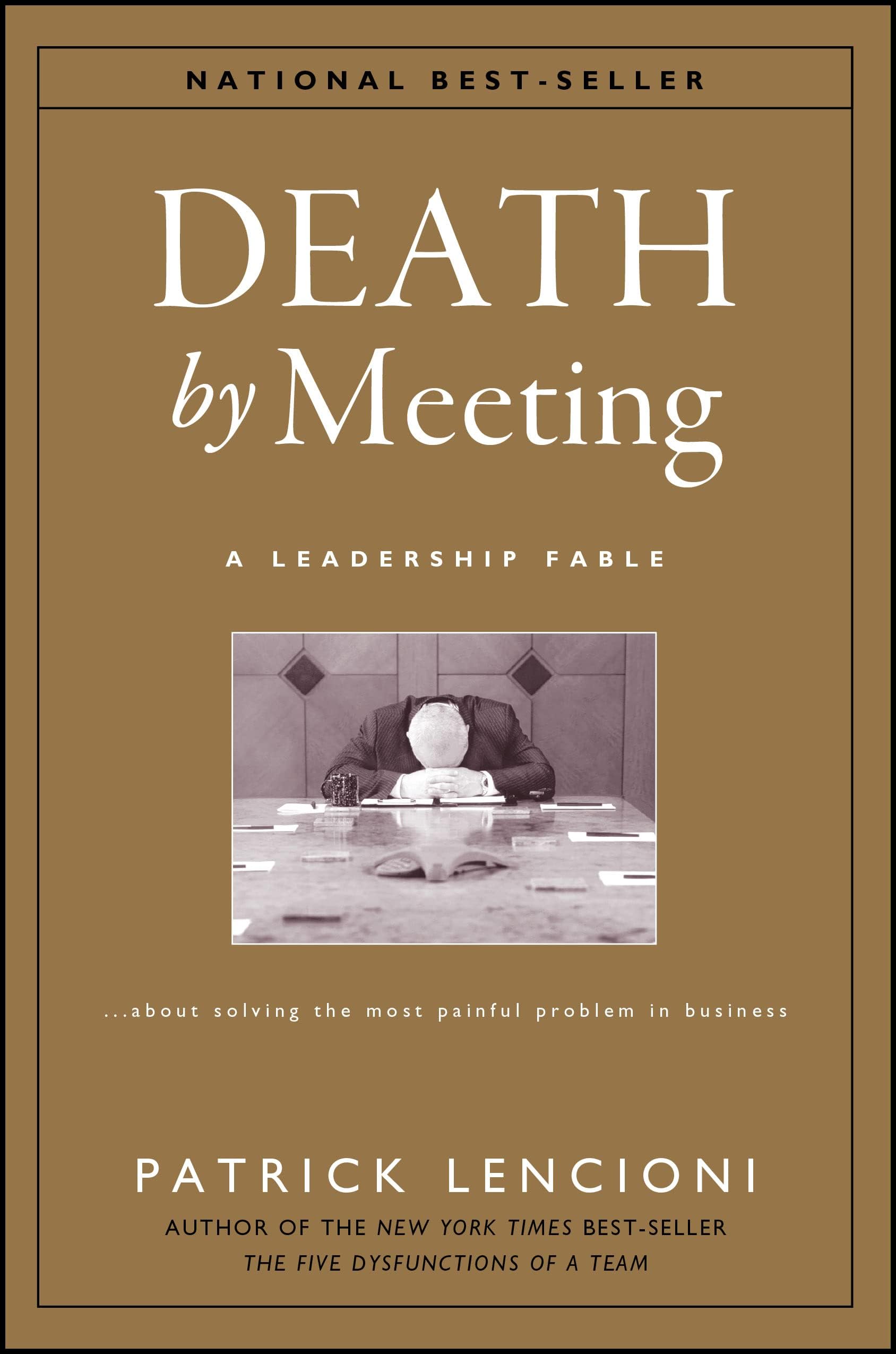
Death by Meeting: A Leadership Fable...About Solving the Most Painful Problem in Business (J-B Lencioni Series)
Product ID: 1704765
Desertcart purchases this item on your behalf and handles shipping, customs, and support to Croatia.
A straightforward framework for creating engaging and exciting business meetings Casey McDaniel had never been so nervous in his life. In just ten minutes, The Meeting, as it would forever be known, would begin. Casey had every reason to believe that his performance over the next two hours would determine the fate of his career, his financial future, and the company he had built from scratch. “How could my life have unraveled so quickly?” he wondered. In his latest page-turning work of business fiction, best-selling author Patrick Lencioni provides readers with another powerful and thought-provoking book, this one centered around a cure for the most painful yet underestimated problem of modern business: bad meetings. And what he suggests is both simple and revolutionary. Casey McDaniel, the founder and CEO of Yip Software, is in the midst of a problem he created, but one he doesn’t know how to solve. And he doesn’t know where or who to turn to for advice. His staff can’t help him; they’re as dumbfounded as he is by their tortuous meetings. Then an unlikely advisor, Will Peterson, enters Casey’s world. When he proposes an unconventional, even radical, approach to solving the meeting problem, Casey is just desperate enough to listen. As in his other books, Lencioni provides a framework for his groundbreaking model, and makes it applicable to the real world. Death by Meeting is nothing short of a blueprint for leaders who want to eliminate waste and frustration among their teams and create environments of engagement and passion. Review: The Myth of Too Many Meetings - This is easy to admit--I cannot improve on Patrick Lencioni's fast-reading, get-the-four-big-ideas-immediately book. So, I'll just quote him in this review. But first...here's a Pop Quiz! Everyone stand up. OK...now remain standing if your job requires you to attend at least one meeting a week. OK...now remain standing if you are in a minimum of five meetings a week (staff meeting, one-on-one meetings, etc.). I know...everyone is still standing. But now...remain standing if you have ever read a book, attended a workshop, viewed a webinar or had coaching on effective meetings management. (Anyone still standing?) My top book pick in my "Meetings Bucket" is this book--but I've never fully reviewed it here. So...listen to Lencioni talk about "Sneaker Time" (pages 251-252): "Most executives I know spend hours sending email, leaving voice mail, and roaming the halls to clarify issues that should have been made clear during a meeting in the first place. But no one accounts for this the way they do when they add up time spent in meetings. "I have no doubt that sneaker time is the most subtle, dangerous, and underestimated black hole in corporate America. To understand it, it is helpful to take a quick look at the basic geometry of an executive team within the context of an organization. "Consider that an executive team with just seven people has twenty-one combinations of one-to-one relationships that have to be maintained in order to keep people on the same page. That alone is next to impossible for a human being to track. "But when you consider the dozens of employees down throughout the organization who report to those seven and who need to be on the same page with one another, the communication challenge increases dramatically, as does the potential for wasting time and energy. And so, when we fail to get clarity and alignment during meetings, we set in motion a colossal wave of human activity as executives and their direct reports scramble to figure out what everyone else is doing and why. "Remarkably, because sneaker time is mixed in with everything else we do during the day, we fail to see it as a single category of wasted time. It never ceases to amaze me when I see executives checking their watches at the end of a meeting and lobbying the CEO for it to end so they can `go do some real work.' In so many cases, the `real work' they're referring to is going back to their offices to respond to e-mail and voice mail that they've received only because so many people are confused about what needs to be done. "It's as if the executives are saying, 'Can we wrap this up so I can run around and explain to people what I never explained to them after the last meeting?' It is at once shocking and understandable that intelligent people cannot see the correlation between failing to take the time to get clarity, closure, and buy-in during a meeting, and the time required to clean up after themselves as a result." Whoa! That hits close to home! Good stuff. So get the book, read his leadership fable (in the classic Lencioni style) and begin religiously implementing his four kinds of meetings: 1) Daily Check-in, 2) Weekly Tactical, 3) Monthly Strategic and 4) Quarterly Off-site Review. Review: Thumb and Half up for "Death by Meeting" - Every person dreads meetings and anything to do with them. However, Patrick Lencioni intuitively creates a make-believe company, Yip, and turns it into a modern day story of a humble leader having to come to grips with the modern cut-throat business world. Lencioni creates a business that is respectful in every aspect, except for their Monday morning staff meetings. Lencioni notes that some of the most crucial decisions are made in staff meetings, so they ultimately need to have structure and leadership, yet allow every person to participate and have a vote. Lencioni points out that weekly meetings with a time limit do not allow enough time or the opportunity to resolve all office and corporate issues. He then proceeds to break meetings into four categories: Daily Check-Ins, Weekly Tactical, Monthly Strategic, and Quarterly Off-Site Review. At the end of the story, Lencioni then applies his thesis to real-world business meetings. He tells how any business can benefit from daily, weekly, monthly, and off-site meetings in reality. Any CEO, manager, business owner, or employee could benefit from reading this book. It puts into perspective how people feel when asked to share their feelings in a meeting, and the book stresses that expressing your opinion is not `attacking' another person's point of view, but may help to realize a problem not foreseen. Overall, I feel like Lencioni's book could definitely help to fix any problems a company is having with meetings, but with the right people to implement and enforce them; which is where I feel the book is lacking. Lencioni tells the steps to make meetings more interesting and successful, but does not give pointers on how really implement this to reality, not all companies will fit the scenario of Yip. Nonetheless, I feel that "Death by Meeting" was an interesting read with overall helpful advice on how to put a little pep into a meeting, and make it productive






| Best Sellers Rank | #14,566 in Books ( See Top 100 in Books ) #11 in Running Meetings & Presentations (Books) #32 in Communication Skills #44 in Workplace Culture (Books) |
| Customer Reviews | 4.5 out of 5 stars 2,556 Reviews |
J**N
The Myth of Too Many Meetings
This is easy to admit--I cannot improve on Patrick Lencioni's fast-reading, get-the-four-big-ideas-immediately book. So, I'll just quote him in this review. But first...here's a Pop Quiz! Everyone stand up. OK...now remain standing if your job requires you to attend at least one meeting a week. OK...now remain standing if you are in a minimum of five meetings a week (staff meeting, one-on-one meetings, etc.). I know...everyone is still standing. But now...remain standing if you have ever read a book, attended a workshop, viewed a webinar or had coaching on effective meetings management. (Anyone still standing?) My top book pick in my "Meetings Bucket" is this book--but I've never fully reviewed it here. So...listen to Lencioni talk about "Sneaker Time" (pages 251-252): "Most executives I know spend hours sending email, leaving voice mail, and roaming the halls to clarify issues that should have been made clear during a meeting in the first place. But no one accounts for this the way they do when they add up time spent in meetings. "I have no doubt that sneaker time is the most subtle, dangerous, and underestimated black hole in corporate America. To understand it, it is helpful to take a quick look at the basic geometry of an executive team within the context of an organization. "Consider that an executive team with just seven people has twenty-one combinations of one-to-one relationships that have to be maintained in order to keep people on the same page. That alone is next to impossible for a human being to track. "But when you consider the dozens of employees down throughout the organization who report to those seven and who need to be on the same page with one another, the communication challenge increases dramatically, as does the potential for wasting time and energy. And so, when we fail to get clarity and alignment during meetings, we set in motion a colossal wave of human activity as executives and their direct reports scramble to figure out what everyone else is doing and why. "Remarkably, because sneaker time is mixed in with everything else we do during the day, we fail to see it as a single category of wasted time. It never ceases to amaze me when I see executives checking their watches at the end of a meeting and lobbying the CEO for it to end so they can `go do some real work.' In so many cases, the `real work' they're referring to is going back to their offices to respond to e-mail and voice mail that they've received only because so many people are confused about what needs to be done. "It's as if the executives are saying, 'Can we wrap this up so I can run around and explain to people what I never explained to them after the last meeting?' It is at once shocking and understandable that intelligent people cannot see the correlation between failing to take the time to get clarity, closure, and buy-in during a meeting, and the time required to clean up after themselves as a result." Whoa! That hits close to home! Good stuff. So get the book, read his leadership fable (in the classic Lencioni style) and begin religiously implementing his four kinds of meetings: 1) Daily Check-in, 2) Weekly Tactical, 3) Monthly Strategic and 4) Quarterly Off-site Review.
R**U
Thumb and Half up for "Death by Meeting"
Every person dreads meetings and anything to do with them. However, Patrick Lencioni intuitively creates a make-believe company, Yip, and turns it into a modern day story of a humble leader having to come to grips with the modern cut-throat business world. Lencioni creates a business that is respectful in every aspect, except for their Monday morning staff meetings. Lencioni notes that some of the most crucial decisions are made in staff meetings, so they ultimately need to have structure and leadership, yet allow every person to participate and have a vote. Lencioni points out that weekly meetings with a time limit do not allow enough time or the opportunity to resolve all office and corporate issues. He then proceeds to break meetings into four categories: Daily Check-Ins, Weekly Tactical, Monthly Strategic, and Quarterly Off-Site Review. At the end of the story, Lencioni then applies his thesis to real-world business meetings. He tells how any business can benefit from daily, weekly, monthly, and off-site meetings in reality. Any CEO, manager, business owner, or employee could benefit from reading this book. It puts into perspective how people feel when asked to share their feelings in a meeting, and the book stresses that expressing your opinion is not `attacking' another person's point of view, but may help to realize a problem not foreseen. Overall, I feel like Lencioni's book could definitely help to fix any problems a company is having with meetings, but with the right people to implement and enforce them; which is where I feel the book is lacking. Lencioni tells the steps to make meetings more interesting and successful, but does not give pointers on how really implement this to reality, not all companies will fit the scenario of Yip. Nonetheless, I feel that "Death by Meeting" was an interesting read with overall helpful advice on how to put a little pep into a meeting, and make it productive
C**N
A powerful tool for every leader, by Patrick Lencioni
This is the first book of 2011 for me (though I actually started it in the last two days of 2010.) I LOVED it! I should probably disclose that I am a big fan of this author and his series of "leadership fables." I have learned a lot about business leadership from his writings, even though my current context is slightly removed from an Executive Leadership Team. In this powerful and easy to read book, Lencioni addresses the subject of a leader's responsibility to conduct effective meetings; further, he takes time to define what they are. With practical assistance and many examples drawn from the "fable," Lencioni challenged me personally to examine my preconceptions and responsibilities about the place and purpose of meetings. Due to wrapping the business principle in a "leadership fable," the book is difficult to put down. One can almost anticipate the next turn and can certainly identify with some of the "drama" in the story. At the same time, the reader is certain to be surprised and challenged by the author's observations about "context" and how that affects a meeting. I walked away...a bit ashamed at my own lack of development in this area. Unfortunately, I don't think I am alone...since many leaders I know struggle in the same area. I strongly recommend this book to anyone desiring to become better in this critical area of business.
L**H
engaging read with real solutions
The first part of the book written as a novel pulls you in and illustrates the points addressed in the later section. Very unique in the word of business books. Highly recommended.
A**R
easy to read and assimilate
Absolutely loved reading this. The fable was easy to follow and kept you engaged. The executive summary at the end is top-notch. I do wish that the PDF that was supposed to be downloadable on the website was easy to access. I was unable to find it. Loved the book.
L**X
A pretty good read, an even better audiobook...
This book was very informative, the writer's approach to an otherwise dry subject was refreshing and helped to move the reader through the process of discovery learning. I recommend this book to any reader who is tired of the drudgery of ineffective meetings. I gave this book 4 stars only because I felt the narrative started off a bit slow, but I think I understand the reasoning behind it. I think the author wanted to build a back story that connected you to the central character of the book and draw the reader into the journey. In this was the reader is taken through the main characters thought processes. This ended up being a useful teaching tool, but one that made the process of getting to the point a bit drawn out. In all I recommend this book the meeting guide at the was a good add.
K**T
Fair price
Purchased as a gift and was less expensive on Amazon than other places. I have not read it but the recipient was pleased.
B**E
Business novel about meetings
Death by Meeting is another one of the Patrick Lencioni's business novels (the most well-known one probably being The Five Dysfunctions of a Team: A Leadership Fable (J-B Lencioni Series) Like other Lencioni books, it starts with a imaginary story where Lencioni's principles are used and ends with a short summary of the theory and point he tries to make. The first 200 pages cover the story about Casey who is a CEO of a computer games company. The company does well, but has a problem with their meetings which are boring, slow and useless. The company is bought and Casey's job is in trouble unless he fixes the meetings. He hires Will who brings in new ideas and compares meetings to making movies. Stealing ideas from making good movies and TV series, he gradually helps improve the meetings at the company and tada! Casey keeps his job. The last 40 pages cover the three principles for fixing bad meetings. The first being a lack of conflict (resonating his work from Five Dysfunctions). Within meetings people should express their viewpoints and argue to learn and finally agree and make decisions. The second is purpose or context. Lencioni argues that most meetings try to solve too much problems and should focus. Each meeting should have a different purpose and stick to that. The rhythm in which you have the meetings will depend on its purpose. The last problem he describes is that meetings have such a bad name that people are preventing them. He argues meeting IS work and that they shouldn't be prevented ... but fixed. All in all, Death by Meeting was an enjoyable book if you like Lencioni's style of writing business novels. He makes good points. I disagreed with his opinion on still having to have the one leader because consensus decisions are bad, but other than that most of the points he makes are relevant and valid. If you enjoyed five dysfunctions, then this is recommended. Otherwise, its just ok. I've been doubting between rating it 3 or 4 stars. 4 stars since I do enjoy business novels including this one. 3 stars because 260 pages for the points he is making is a little bit much :)It could be made in about 50 pages probably. In the end, I decided to go with 3 stars.
C**S
Every leader and meeting participant must read this!
Best way to get advice regarding meetings and companies, I buy it for all my bosses along the line. I love the way he tells a story rather than scientifically prove on a very dry way what to do and why. Love the fact that he approves of emotions - which so many of meetings lack and therefore so many of the meetings lack of solution... Wholeheartedly recommend this book whether you want to read it as a simple novel or learning how to make meetings matter - either way, it is great fun to read!
C**P
Einfache und schlagkräftig
Ich bin durch Zufall über dieses Buch gestolpert. Die Konzepte darin sind leicht zu implementieren. Meine Kollegen in der Geschäftsleitung habe ich das Hörbuch gegeben und in der Woche darauf haben wir bereits die Umsetzung begonnen. Resultat nach nur drei Wochen: Viel fokussiertere Meetings, Zeit für Diskussion wo nötig, mehr Freude im Büro! Das Buch selbst ist packend geschrieben und auch für Leute gemacht, die sich nicht gern ewig mit den Theorien von Universitätsprofessoren auseinandersetzen (...und selbst die wenigen praktikablen Dinge herausfiltern) wollen. Absolut empfehlenswert.
R**E
Another great book from Lencioni
A fun and educational book about meetings. Why do we need them? How do we improve them? How can we engage employees and leaders during meetings? A must read for every manager.
A**R
Lenchione is awsome
Great book, and so true, even though I haven't been able to implement everything, it has helped to at least understand more about what meetings should have.
S**N
Five Stars
Very Apt and useful
Trustpilot
1 month ago
2 weeks ago