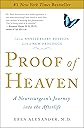

Desertcart purchases this item on your behalf and handles shipping, customs, and support to Croatia.
📖 Unlock the ultimate mind-body-spirit revelation before everyone else does!
Proof of Heaven is the #1 New York Times bestselling paperback by neurosurgeon Dr. Eben Alexander, who shares his extraordinary near-death experience during a coma caused by a rare brain illness. This scientifically grounded memoir challenges materialistic views by revealing a profound journey into the afterlife, blending neuroscience with spirituality. With over 25,000 reviews averaging 4.4 stars, it’s a top-ranked book in Science & Religion and Reincarnation categories, inspiring readers to explore consciousness beyond conventional limits.


| Best Sellers Rank | #3,961 in Books ( See Top 100 in Books ) #2 in R&B & Soul Artist Biographies #3 in Science & Religion (Books) #4 in Reincarnation (Books) |
| Customer Reviews | 4.4 out of 5 stars 25,519 Reviews |
M**H
A book that deserves a 2nd read!!!
I have been awaiting this book's publication for months and I just finished reading it, and couldn't get back to amazon to give my 5 stars. I am an avid reader, but this is my first comment on Amazon, the reasoning for this is that I fully want to support the message of this book. I am glad I can read a well written book on NDE from a direct experiencer who can intelligently explain this amazing phenomenon to simple folks like me. I am interested in spirituality, my place here on earth, and the mystery of the universal force, but I want to understand the truth from a spiritual and intellectual place without any materialistic religious dogma attached to it. NDE's like Dr. Eben Alexander do this for me. There is authenticity in his experience, you only have to watch his video on the Bioethics forum to see that (which got me interested in his book in the first place). Obviously reading a book can never be the same as experiencing the majesty of what he experienced, but he encourages you to explore it on your own if you are invested in such an exploration. In critique of his book many (online publications) have focused sarcastically on the butterflies and orbs as angels, etc. To me descriptions like these point to the fact that he is stating his experience authentically as he experienced it, not as he should have to be more palatable to the so called "skeptics" and intellectual community. Reality of a blind person is different that the reality of a person who can see and experience the grandness of this earth. Similarly, Dr. Alexander has experienced another type of grand reality that is a real, but because most of the human population is "blind" to this reality (including me), we choose to deny its existence even when it's as real as earthly reality. And when someone like the author points to this reality, we choose to attack him and his body of work with sarcasm instead of authentic skepticism and inquiry. Simply, what I love about a book like this is that his experience is authenticating that neither the material reality (I believe it if I see it and prove it) espoused by the scientific community is 100% correct neither the religious bodies' material-spritualistic view (My way is the only way) correct. There is a third way which values both the temporal material existence of the body and timeless spiritual existence of the self, and this reality is personal as each NDEer experiences his own unique reality in this other realm. One-time read to grasp the concepts is not enough, I will be re-reading this book. I am appreciate Dr. Alexander's efforts to bring this book to us and the courage it takes to do so. I am glad the universe choose such a perfect subject for exploration of this truth and I am glad a major publication house picked it up to give it further credence. I can feel his struggle to explain what he experienced with limited language at his disposal, can you imagine reading a translated book or watching a foreign movie with subtitles - so much is lost in translation- that's why I appreciate this author's efforts. In my personal critique of the book, I have to say that discourse with God "Om" could have been explained in more detail- it leaves one wanting for more or not fully satisfied. More details were needed, as Dr. Alexander pointed out that much was explained to him in this realm- well that doesn't come forth in the book. So, I have agree with others who reviewed the book that it's "good but lacking". Also I think the possible arguments listed at the end for why this was an NDE not a brain produced phenomenon, the book should have gone into it with supporting evidence to make it into a more complete case for NDE and put forth a good argument for the skeptics.
P**R
Beyond Science and Religion...Endorsement and Support from another NDE survivor
As someone who has experienced an NDE, and struggled with many of the same things that Eben discusses here, I am not surprised at the response that many are having to this book. To say "people who have NDE experiences often find the telling of their story, while trying to impart the information they receive during their experience, a difficult task," would be an understatement as vast as the universe. The clinical aspects of Dr. Alexander's experience are what make this story unique, along with his outright conversion from a "Scientific Reductionist" to someone who sees clearly that consciousness and the vast majority of "what is," are found outside of our space/time universe and current medical or science books. To get the most out of any book on NDEs, and especially one that intertwines a very personal journey to find family and self, you must start with an open mind and heart. Unfortunately, those who have already hardened their views on both sides of the spectrums of Science and Religion, will dismiss much of what anyone writes on this topic, because it doesn't fit their narrow, dogmatic view of the world. Even worse, it forces them to look outside of their safe little boxes, and take the effort to learn, while being open to the possibility that current models of both science and faith are a good starting point, but not the ENTIRE answer. Einstein's quote at the beginning of the chapter "A Final Dilemma" says it best... "I must be willing to give up what I am in order to become what I will be." Whether you begin as a Christian, a Buddhist, Quantum Physicist or a simple seeker of knowledge beyond current understanding, moving outside of the constructs of your current ways of thinking is imperative to discovery. Fundamentalism, whether it be religious or scientific, is really no different than intellectual bigotry, closed to expanded thoughts, or encompassing new ways of looking for expanded information. Eben's book embraces both worlds, and does so gracefully, without discounting any specific ideology. Eben's experience was certainly deeper, and far more expansive than most I have read (including my own NDE). I do agree that the lack of detail about his time in "heaven" (a term that I find limiting) is frustrating to a point. And yet, the need to spend much of this book on the technical side of his coma, his quest and victory regarding his family (past and present), as well as touching on the scientific aspects of the current science regarding external consciousness, make this short book an excellent jumping-off point for deeper study and discussion. And there's the rub... After experiencing my own NDE (in 1996), I spent almost two obsessive years trying in vain to "connect the dots of knowledge imparted to me," before putting it all back "in a box" so that I could get on with living my life. Through a series of events over the past two years, I find myself very much back into "telling the story." I now realize that no book, video, or movie is able to even scratch the surface of answering the great questions of life after death, consciousness, and how they all relate to quantum theory. Expecting "the answers" from a book of this size and configuration is naïve and lazy at best. There is a reason that the section in this book called "Reading List" is expansive. Much has been written on this topic from both the spiritual and scientific approach. If you are a true seeker of the truth, you will not start or end your journey for knowledge with Eben's book. Instead, you will appreciate the facts of his experience, the unique medical reality of his coma, and the amazing revelations about family, love and the eternal nature of consciousness, as the BEGINNING of the journey to true understanding. While this book in not an expansive, all-inclusive answer to the melding of Science and Religion, I give it 5 stars for being an important, unique story, bringing focus to the need for a global change in the perception and understanding of reality, consciousness and the interconnectedness of everything in creation.
M**N
Interesting Perspective
While I have to disagree with the title Proof of Heaven that this book was actually not proof of heaven, I found the premise and the experience shared in this book quite fascinating. Dr. Alexander talks about his experiences while in a coma from a serious bacterial meningitis attack that is quite rare and shuts down the neo-cortex of the brain, the part that makes us, basically, human, and puts him in a coma he was not expected to live through or return from. He shares his vivid memories of experiences he had in a place outside of this realm of existence, memories of acceptance, love, inclusiveness, connectedness, peace, calm and so many good things. The main point that of love, unconditional and overwhelming, in a way that isn't even able to be expressed on this world. Dr. Alexander considers this absolute proof of God and Heaven, where I see it as proof that there is something after this life, but not necessarily the religious versions of God and Heaven as we have been told in the Bible or through other religious upbringings. I find the concept of unconditional love fascinating, and somewhat comforting, and I definitely like the perspective of life of some sort, existence and consciousness of some sort, after this body fades away, especially now that I have been diagnosed with a terminal illness, and thinking about death and dying is something that has come to my mind sooner than it would for most people. I enjoyed his personal stories about his journey. I appreciated his honesty about how he was not really a believer prior to this experience, that he was a staunch man of science, to a point, and how this changed that. I like the way he now weaves these two things--the science and the faith--together to be a better doctor and a better person. I like that he provides other resources and information for the reader to read, to consider, and to decide for themselves what they think happened. I went to many of his other resources and read them and even saw him in some video where he was interviewed about his experiences. It's all very compelling... and again, somewhat comforting, especially to me. See, I have a terminal illness, and I know my death is more imminent than I had original expected it to be... life and death, this life and the afterlife, have both been big on my mind. This book did provide me some comfort, some feeling that there might be something else out there beyond this. I think I needed that. At the same time, there was some compelling stories that tied some things in his life together in a way that seems only able to happen outside of this realm. You'll have to read his story to learn more about it. If you're interested, but not sure about buying the book, look him up online and read some of the places where he talks about near death experiences with others who have had them too. Fascinating stuff, and it might help you make up your mind if this is something you want to consider buying or not. I consider it money well spent, if for nothing but the fascination factor. If you're not a believer, this book might make you think about an afterlife differently. If you are a believer, I think this book can really reenforce your faith. If you're a skeptic, you might still find this book fascinating in what it shares about how to live your life now. I think it's well worth considering and picking this one up to read, and he tells the story in a compelling way. There is enough technical and medical/scientific information to make you feel informed, but not so much it's bogged down. And there is enough personal anecdote and experience to feel you're reading a story too. Good balance.
M**K
A Portal to an area of the soul that is still little understood
PROOF OF HEAVEN is a very well written book. One must suspect that editor Ptolemy Tompkins played a strong role in the structure and writing of this book. I say that because one would not expect a neurologist to have the skills to write a breezy, colorful account of his near death experience. An account that is a joy to read. Whatever, this book is another addition to the growing list of books in which authors describe the memories of what they experienced during a state of unconsciousness. In this author's case, that state lasted for roughly six days. The cause was a serious case of E. coli meningitis, and the patient nearly died. The author goes to great lengths of effort to establish that the story of his illness and his recovery is absolutely true. And, I for one, think he told it the way it really happened. What we learn is that our author had a long history of participating in the medical profession, and, for virtually his entire medical career, had been associated with very prestigious institutions of medicine, including Harvard Medical School. He is also author, or co-author, of many articles pertaining to the field of neurology. In the early pages of his book, he begins to describe in words (his best efforts) what he remembers of the experiences he had during a time that his outer brain layers were totally inactive. I won't try to use medical terms for this occurrence. His experiences were not an exact parallel to those of others who have also told of near death experiences. But, perhaps that makes his account all the more interesting. His story, and the many similar accounts, show that a world exists that is on a higher level than the dream world we experience as we sleep, or the world of daydreams, that we all occasionally enter, when we are awake. It is a world that is in many ways "very real." Now clearly, the author believed that, during this short time of six days, several times he entered heaven and indeed was in the presence of God (Om), His quotes, "The (false) suspicion that we can somehow be separated from God is the root of every form of anxiety in the Universe, and the cure for it - which I received partially within the Gateway and completely within the core - was the knowledge that nothing can tear us from God, ...." (Chapter 14) and, "I did not just believe in God: I knew God" (Chapter 32) shows us that he believed that he had indeed had a meeting with God Himself. So, we perhaps tend to say to ourselves, "If his experience was on a much higher level than a dream, then his perception that he met God must be correct." But, recall that Christopher Columbus believed that he had discovered India, and the fact that his boats were real and his crewmen were real and the wind was real did not change the fact that his conclusions were all wrong. So, we must be careful totally believing, or totally disbelieving, the visions that Eben Alexander experienced. What seems most obvious is that he does his best in his book to describe his experiences during his state of unconsciousness. And his memories show us that we humans must, in the years ahead, push farther into this shadowy area of human knowledge. Another quote also gives us insight into Alexander's spiritual happening. "The Spinning Melody - up to then my ticket into these higher regions - would no longer take me there. The gates of Heaven were closed." And, "On the day that the doors of Heaven were closed to me, I felt a sense of sadness unlike any I'd ever known." (Chapter 22). Thus, clearly we meet a man who recalls an experience of entering heaven. But, as we consider this book, and others that tell similar stories of entering heaven (for example, "Heaven is for Real"), we must consider that a great revelation is available to us in the form of the Christian New Testament. In that book, we learn that the kingdom of heaven does not allow souls that have sin in them to enter heaven. This is made obvious to us in that we are shown a God who is now busily working to destroy the sin in the souls of our Universe. And when he succeeds, "clean" souls will be brought into the real heaven. Now clearly, if souls that are sinful could enter heaven there would be no reason for God's efforts to cleanse us all of this thing called sin. So it becomes apparent that these near death experiences, while much more "solid" than our night dreams, often even involving clairvoyance and other paranormal phenomena, are not the ultimate thing that our souls can expect to someday experience when we enter heaven. A last quote, "....Om knows what we have forgotten, and understands the terrible burden it is to live with amnesia of the Divine for even a moment. (Chaper15). Here we can see clearly, again, that our author experienced something that was to him a true meeting with God. And his view, after his near death experience, is that he, and others, at some time in the past have enjoyed a closeness with God. This view conflicts, of course, with many scriptures of the New Testament. I will mention that a book I recently downloaded at no cost presents nearly every scripture in the Bible that discusses the subject of entry into heaven. Many members of Sunday school groups have been sending a flyer around the whole country listing the days when this book can again be downloaded free. I suggest to those who may read and enjoy Proof of Heaven that they should follow with a careful reading of Heaven is in Your Future (DuRocher). That book is not a quick reading experience, but it is down to earth and focused on an almost new age view of the Christian scriptures. Those who like books detailing near death experiences will probably enjoy it because it is not a dry old school view of the meaning of the Christian Bible. It will be free again, according to the email flyer I just received, on Sunday September 22nd, and Sunday September 29th (Amazon Book Store). Download it on your computer and compare it to these new age books. It will be a task that will "strain the brain." But, it will be fun.
R**B
Review of Proof of Heaven by Eden Alexander III, M.D.
Proof of Heaven was both interesting and surprisingly suspenseful; I always looked forward to picking it up and continuing my reading. The author is an impeccably educated and highly respected neurosurgeon who had been adopted and followed in the professional footsteps of his adoptive father; had been an experienced shy diver in college; married and had children; longed to meet his birth family and finally did; somehow contracted a very rare bacterial meningitis; and while moving toward death in a coma, claims to have gone to heaven where he met God, an angel, and had other unquestionably (for him) heavenly experiences that he lived to share with others, asserting that collectively they represent "the single most real experience of my life." A fascinating and gripping story!--but that said, it's time to take a close look at the author's claim, namely, that there is "Heaven" after death, or more generically, that consciousness survives death. I think it not unreasonable--indeed, fundamental--to require of someone who insists his or her experience proves consciousness survives bodily death both to have died and subsequently to have returned to life sometime prior to making such an assertion. Any claim to have experienced death and to know what occurs after it without having first died would seem absurd on its very face. Indeed, initially Alexander claims to have died: "My experience showed me that the death of the body and the brain are not the end of consciousness, that human experience continues beyond the grave." (I think it premature to claim having experienced "death of the body" if one's respiratory, circulatory, and digestive systems are functioning, and only the nervous system is damaged--however severely.) So, I could only shake my head in wonderment when he claimed later not to have died but to have had a NEAR death experience (NDE). Throughout, he refers to his experience as an NDE and compares the experiences of other NDE survivors to his own, noting--until nearly the end of his book--that his NDE was similar to those recounted by other NDE survivors save their meeting deceased relatives and reviewing their life's good and bad actions: "I experienced none of these events, and taken all together they demonstrate the single most unusual aspect of my NDE." Then, in a patently self-contradictory statement, he writes, "At the risk of oversimplifying, I was allowed to die harder, and travel deeper, than almost all NDE subjects before me." With a sentence like that, I don't think he need worry about oversimplifying. So, we have an author claiming to know what happens to consciousness after death based on his own experience of death even though he repeatedly admits that he had not died at any time prior to his claim. For me, this turns his assertion of having entered the foyer of heavenly life into evidence that, at most, he had arrived only at the derriere of his earthly life. My second quandary is the medium responsible for his right to claim he was in heaven, namely, sensing and feeling: While in what he calls the "Realm of the Earthworm's-Eye View," he notes, "...gradually this sense of deep, timeless, boundaryless immersion gave way to something else: a feeling like I wasn't really part of this subterranean world at all, but trapped in it." A little further down, he writes, "I heard an occasional dull roar," and, "the movement round me became less visual and more tactile...," and, "then I became aware of a smell." Later, after he had passed through the portal of heaven, he was told something by an angel, and her "message flooded me with a vast and crazy sensation of relief." When he's in the Core (of heaven), he writes, "Seeing and hearing were not separate in this place where I now was. I could hear the visual beauty of the silvery bodies of those scintillating beings above, and I could see [sic] the surging, joyful perfection of what they sang." It's curious to me that sensation, however modified his seeing and hearing were in heaven, were, nonetheless, one of his modes of knowing. This would make earthly hearing and seeing weak analogues of their heavenly counterparts, but more remarkably, not only our consciousness survives death, but also our senses! This implies that the material organs of sight and hearing are not essential to these capabilities. We do know that we can hear music in our mind that we are not hearing with our ears and see things in our mind that are not present to our eyes under two conditions: we're dreaming, or we've consciously induced them. But Alexander insists he is not dreaming and others are generating the sounds, sights, and smells. Although his claim fits his theory of post-death consciousness, he never died, and for those of us who are still pre-dead, a dreaming or inducing explanation is simpler and less fantastical. Also, we do know that physical eyes and ears are essential to earthly seeing and hearing under either of the main concepts of the body-mind relationship: that we are a mind (soul, spirit) trapped in a body and finally freed of it upon death, or we exist as an inseparable body-mind unity. Under the first condition, there would have to be some plausible theory to explain how the soul retains senses once it's left the body. Under the second condition, body and soul exist only as an integrated entity, at death extinguishing together. A related problem, advanced by his description of consciousness after death, is duality--or, if you will, the multiplicity of separately distinguishable beings/things/experiences in the post-death realm. Alexander's heaven eliminates the ego but retains distinct beings outside himself (for example, he doesn't claim to be God or the angle). Okay, maybe he wants to suggest that none of these separate and distinct beings have an ego, but something has to account for his recognizing that they (perceivable beings, music, smells, visuals of various kinds) are real and are not just his projections. Maybe they exist like thoughts, perceptibly existing immaterial objects. The only problem with this is that we conjure our thoughts, and subconscious mechanisms conjure our dreams. I'm sure Alexander is not suggesting that his heaven is populated by conjured images--and he insists they're not dreams--but I don't see how he can escape the conundrum. Celestial existence for Alexander often seems conceptually similar to earthly experience, differing primarily in quality and seeming often little more than exquisite extensions of ordinary life. He does write, "The blurring of the boundary between my awareness and the realm around me went so far at times that I became the entire universe." What is surprising about this statement is the "at times." At one point in my life, I was an intermittent TMer. After several years of erratic adherence to my meditation practice, I routinely experienced extended periods non-dualistic absorption into a unitary bliss, timelessness, spacelessness, even occasional out-of-body consciousness. Thus, "at times" I had earthly experiences that were not dissimilar to what he describes as a peak heavenly experience--and I didn't have to die to experience them, making me wonder just how other-worldly they are. Alexander states that "up there" there's no emotional distinction between "inside" and "outside" because changes of "mood" experienced there are so vast as to include and affect both the mood feeler and his or her surroundings simultaneously. Commenting further on emotions, he writes, "All the human emotions are present [in heaven]...." Does he really want to assert that greed, avarice, lust, hate, and other such emotions reside with love in God's paradise? This completely contradicts other statements about the heavenly environment. He does mention evil, as necessary for there to be free will, which is required "for us to become what God longer for us to be." However, he does not raise the issue of moral behavior as a prerequisite for heaven or as even affecting one's access to or enjoyment of heaven. Should I ever enter Alexander's rapture, I hope not to attend a dance and see Mother Theresa grinding with Adolph Hitler. But maybe I will, given that "in the larger picture love was overwhelmingly dominant, and it would ultimately be triumphant" over evil. Finally, the author's recitation of numerous failed attempts to explain his mental states while in a coma go only so far as demonstrating that extremely rare phenomena are less susceptible to explanation than are common ones. I hardly think that such a recognition would startle anyone. So, at best, I see Proof of Heaven as an engaging addition to NDE literature and at worst, an unsupported, indeed self-contradictory and sloppily analyzed, claim to a reality that fails to meet even the most obvious precondition: One has actually to die, not just come close to it, before earning the right to assert the post-death condition of consciousness. Of course, my concern about basing a belief in an afterlife on Alexander's experience while in a coma is irrelevant to whether or not there is an afterlife. I just don't think Proof of Heaven gets us any closer to proving it than we were with former NDE accounts. He may have been "allowed to die harder" than previous NDEers, but like them, he didn't die. I think he should have remained more the scientist upon coming out of his coma and considered his experience as evidence of what the brain may still do after the cranial cortex is compromised. Rather than counting on eternal consciousness, I think we should work on coming to terms with death's being the close of our one and only, randomly engendered, and unrepeatable existence. If we awake to having been mistaken and find ourselves in another dimension, nothing will be lost. If we don't awaken in paradise, we will not grieve it. In the meantime, we won't violate the knowable and will experience how precious, fleeting, and irreplaceable life is--ours and that of all other beings. It might be easier to have compassion for one another, if we don't presume that upon death we're whisked off to "a better place" where we'll all be reunited in bliss.
R**E
Greatly Shortens the Leap of Faith
Proof of Heaven by Eben Alexander, which is now 26 weeks on the NYT best seller list, is an autobiographical account of the near death experience (NDE) of a 60 year old neurosurgeon who taught at Harvard for 15 years and achieved high success in many professional publications, over 200 conference talks, and in surgical practice. A dedicated scientist who heard several NDEs from his patients during his long practice, he assumed that these experiences were mere symptoms of the dead or near dead brain. He contracted an extremely rare (1 in 10 million) bacterial meningitis which put him in a (Biblically suggestive) 7 day coma with a completely "dead" neocortex, which is the large part of the brain responsible for all conscious experience and much more. All previous cases lasting half as long as his affliction resulted either in death or a permanent vegetative state. Leaving aside for the moment the momentous question of whether his astonishing NDE was a mere biological symptom, the book is gripping as (1) a medical documentary and (2) an odyssey. Just as it's fun to read The Odyssey, The Aeneid, Dante's Inferno, and Milton's Paradise Lost (Eben's experience has striking parallels with Paradise Lost especially), Eben's book is worth reading as one of the greatest visionary stories of all time. His NDE was similar to most others, but amplified by the putative total flat-line of his neocortex. Unlike other NDE's, he had no memory of who he was during his visions, presumably because of his completely disabled neocortex. His consciousness was literally selfless and pure and went further and more vividly into a transcendent state of knowledge than all other documented NDEs. His experience of the divine is surely one of the most compelling ever narrated. He points out that prior to his NDE he was not really a skeptic of NDEs, for true skeptics at least read about what they are skeptical of, and prior to writing down his visions, he never read anything on the topic, for his scientific mindset was firmly entrenched and cursorily explained NDEs. Dedicated skeptics of this book have one major and one minor criticism in their favor. The major criticism is that he does not address a rebuttal by one neurosurgeon reviewer: that his visions could have occurred when his brain was reviving from the coma. The minor point, which I arrived at, is that, though he apparently achieved a miraculous, indeed the only, case of complete mental recovery, perhaps he does not admit that the 2 months recovery time he claimed was needed to regain all of his medical knowledge was in fact never complete, and he realized he must earn money in another way. After getting to know this person through the book and interviews, one would have to be an awfully enthusiastic conspiracy theorist to believe the minor criticism. Eben's appendix about the medical science that could explain his visions mitigates the major criticism but does not invalidate it. Faith always requires a leap from evidence. All evidence of the divine is circumstantial at best. (I'm haunted by the consistency with which the best of such evidence remains so precisely circumstantial). My broad reading in quantum physics, in the empirically established prescience in predator-prey and other animal interactions, and in the few well-documented paranormal events, leaves my scientific mind disposed to believe that Eben's NDE was indeed an encounter with a dimension of our universe that abuts the one us mortals experience, and that after death we will go to that dimension. In a clash of titans, Einstein debated Neils Bohr for several years over the implications of established facts that had already proven the validity of quantum mechanics. As one physicist framed this debate, "Upon its outcome rested the entire enterprise of science, and its triumph over superstition, religion, and magic." Over years, in papers and at preeminent conferences, the debate swung one way and the other, with apparent victories undermined by a subsequent argument. In the end, Einstein, pale and shaking, conceded victory to Bohr. Since that monumental defeat of "the last great classical physicist," science has reclaimed some of the battlefield it lost that day. But it did so at the expense of accepting proven postulates, like Bell's Theorem and the role of the observer, that, when actually read and understood as much as laymen can, are just as incredible as the claims that NDEs are visits to another dimension of the universe. Accepting those proven postulates--and not to accept them is to dismiss science--opens doors to accepting NDEs as proof of other dimensions of consciousness that await the expiration of our short little lives here. After reading this book, one has the option of assigning a probability that NDEs are visits to another dimension of the universe. Until now, this is what I've done with NDEs and several post-quantum cosmogonies. But the impact of this book on me was to force a decision 100% one way or the other. I chose to believe that Eben's NDE was a visit to the afterlife. I always remain open to new information that could change my mind, but for now I'm all in. Once all in, the implications are vast and deep in how one responds to life--life including death--and for me that journey has just begun. ~Rob Laporte Greenfield, MA
M**N
Refreshing, Renewing and Revitalizing
Having read dozens of books about near-death experiences (NDEs) and other phenomena strongly suggesting the survival of consciousness after death, I didn't read this book in search of "proof" of "heaven." I had already come to the conclusion that the evidence for survival, if not providing absolute proof, at least meets the "beyond a reasonable doubt" standard of our legal system. However, just as the orthodox religious person needs to renew his or her faith by reading his/her "good book" over and over again and then attending weekly services to hear someone discuss the teachings of the book - discussions probably heard dozens of times before - I find a certain renewal and revitalization in reading newer accounts of NDEs. Yes, the stories are often similar, as one might expect them to be if they are to be considered evidential, but there is usually enough variety to make the stories interesting, informative, intriguing, and inspirational, what I call the "four I's." This book exceeded my expectations, for each of those four I's. Because Dr. Eben Alexander, the author and experiencer, is a neurosurgeon who was for the most part a materialist with little interest in the subject of NDEs before his own NDE, this story has even more credibility than most, although the pseudoskeptics, in all their wisdom, were attempting to discredit the author as delusional and the victim of wishful thinking even before the book was released. "Like many other scientific skeptics, I refused to even review the data relevant to the questions concerning these phenomena," Alexander tells of his own pre-NDE mindset. "I prejudged the data, and those providing it, because my limited perspective failed to provide the foggiest notion of how such things might actually happen." He now sees such people "who know the truth without needing to look at the facts" as willfully ignorant. "Brilliant, vibrant, ecstatic, stunning," Alexander describes the "new world" he found himself in after his physical body and brain completely shut down, admitting, as so many others have, that human language and ideas fail when one attempts to translate celestial visions and experiences into terrestrial imagery and verbiage. "We taint, with out insufficient descriptions, their truly awesome nature," he offers, stressing his belief that what he experienced was "more real than the house I sat in, more real than the logs burning in the fireplace." Alexander examines the usual NDE debunking theories, including endogenous glutamate blockade, REM intrusion, "DMT dump," the "reboot phenomenon," and "feigned-death" strategies, dismissing them one by one. Everything he experienced suggested higher, not lower, brain functioning. "The more I read of the `scientific' explanations of what NDEs are, the more I was shocked by their transparent flimsiness," he states, going on to say that after studying the subject matter following his NDE, he began to realize his was "a technically near-impeccable near-death experience." In one of the final chapters, Alexander tells of stories he had heard from patients before his experience - stories which he wrote off as fantasy, but which he now saw very possibly real. He also mentions a very interesting story related to him by one of his colleagues involving "terminal lucidity," in which the colleague's dying father, who had been demented, became lucid and in last moments alive. In his 1974 Pulitzer prize-winning book, "The Denial of Death," anthropologist Ernest Becker stated that the fear of death haunts the human mind like nothing else. Most people deal with this fear by repressing it - burying it deep in the subconscious and busying themselves with mundane activities. And then, one day, perhaps when it becomes apparent that their days are numbered, those repressed anxieties relating to death begin welling up into the consciousness. They proceed to live their final years under a dark and increasingly foreboding shadow. For the most part, the muddled information provided by orthodox religion offers little relief, little comfort. But books like this one serve to erase that fear and allow the person to embrace death, living his or her final years with a certain optimism. I am grateful to Dr. Alexander for writing it and intend to buy a few extra copies to give as Christmas presents.
M**H
Provocative but with some questions remaining
I won't rehash the content of the book as that has been done in other reviews and elsewhere. Nor am I particularly concerned with the style of the book, how well it is put together, and so on. Rather, I want to focus on issues of how convincing is this "proof of heaven." (Note: I am a pediatrician so have some background in infectious diseases and neurology, but those are not my areas of expertise.) I see no reason to dismiss the account out of hand, whether as a fabrication or hallucination. Assuming that the publishers have done basic fact checking (that the author is who he claims to be, that he experienced such an illness, etc.), Dr. Alexander is a competent, rational, educated person with no obvious reason to make up the story. He is also an expert on many aspects of brain function. Still, as with any first-person narrative, it would make sense to investigate further, checking with other witnesses and any documents including medical records. One important factual question would be when Dr. Alexander first spoke to another person about his NDE. I am open to the possibility that the experience reflects reality (a world "above"), and even hope that it does. I do have some concerns, which I mention not to discredit it, but to point out areas which should make us cautious about leaping to the conclusion that it is in fact a "Proof of Heaven." First and most important is the question of when the experience occurred. The author simply assumes throughout the book that it happened during the coma, but what evidence is there for that? Assuming that it did happen during the coma, how could he know that since he was not aware of the external world and able to correlate the timing of the NDE with outside events? It seems that, from a this-worldly point of view, he would not have been able to remember or reconstruct the experience until he had recovered from the coma; by then, how could he know that it occurred while he was comatose rather than in an in-between state? Consider this possibility: the patient is indeed deeply comatose, with no higher brain functions. At some point, the brain recovers enough to regain consciousness, but is still in a dysfunctional state whether from drugs, ICU psychosis, sensory deprivation, or whatever. Alexander himself points out that after a brief period of lucidity, he was "crazy." The NDE could have occurred during the early awakening or later, stormy period, and have been retrojected into the past. The author mentions something like this as the "reboot " hypothesis, only to discount it with, "But this seems most unlikely given the intricacies and interactivity of my elaborate recollections." I agree that it seems hard to imagine a sick, rebooting brain creating such detail and meaning from scratch, but I'm not sure it is less plausible than the alternative that the experience was real. The second question is whether Dr. Alexander's brain was truly incapable of creating the NDE. He emphasizes repeatedly that his neocortex was non-functional. It was "out of the picture," "inoperative," "down," essentially "absent," "damaged," "off," and even "devoured" by the bacteria (this last not being an accurate description scientifically). Perhaps so, but I would like to hear more evidence. Alexander is a neurosurgeon, so should have a very good idea of how clinical states correlate with brain activity, but he does not go into detail. Given the depth of the coma and the consideration of whether he was beyond recovery, were not brain-function studies done? Was the cortex metabolizing glucose, being perfused by blood, electrically active at all? These are basic questions and could be simply answered if the tests were performed. It seems intuitive that the brain cannot produce such a conscious experience unless the neocortex is functioning at least somewhat normally, but how well is this established? I am not at all familiar with the NDE literature, so the answer may already be known, but it would be good to have it spelled out. Since the book is meant for a popular audience, the absence of such detail is quite understandable, but that doesn't mean it can be ignored. Another question is how Alexander's NDE compares with reports by users of hallucinogens. Are there enough dissimilarities to let us be reasonably sure that drugs or the "DMT dump" or "endogenous glutamate blockade" hypotheses he mentions were not responsible? The author believes those could not have caused his experience because his cortex was zapped, but if that issue is put aside, could those mind-bending factors have accounted for the nature of his NDE? Finally, a tiny red flag popped into my head when Alexander presented a particular, patented method of meditation as a way to achieve something like his NDE: "I believe Hemi-Sync has enabled me to return to a realm similar to that which I visited deep in coma, but without having to be deathly ill" (Kindle location 2039). This is probably nothing but a sincere endorsement, but it did cause me to wonder. Conclusion In the end, I can only say that the account is very interesting but that I am not competent to judge the evidence. What I would like to see, and what I hope does appear, is reviews by a few neurologists, neurosurgeons, and other neuroscientists who can confirm or question the author's assertions and conclusions. It should be a very good discussion!
T**D
All round good book from several angles.
In the past when reading the extract of a book and then buying it I have often been disappointed to find that the extract was the meat of the book and there wasn't much else. NOT SO with this one, though I was wondering if it was going to turn out that way when I first started. I found it interesting and compelling right to the very end. Well written and enjoyable even without the journey into the spiritual world. Quite an amazing story on many levels not to mention the fact that the writer fully recovered from a major life threatening illness that should have at least left him severely damaged if not killed him. More could have been written about this fact but didn't need to be. A very human story and the explanations of his experience rings true to my own intuitions and experiences. I liked the way the chapter alternated between the two realities. I also liked the way he deals with the issues. As with any book that gives some element of theory or ideas I did not agree with all the authors conclusions but this is not that import in order to appreciate this amazing experience. Read it - you might very well enjoy it and it certainly will give you some food for though and meditation.
S**A
Wonderful,clarifying
It is an easy reading, the content is Amazing, very straight to the point, destinos not the end, we re here expeciencing and we ll go Back home.
T**R
An Outstanding Story - A Remarkable Book
In this book, Dr. Eben Alexander describes his astonishing Near Death Experience (NDE), which according to the author stands out quite a lot compared to other peoples' NDEs documented in the past. As a regarded and experienced neurosurgeon, Alexander has a vast knowledge of the brain, and has performed many operations on patients brains over the years of his career. Up until it happened to himself, Dr. Alexander believed that NDEs were complex phenomena produced by the brain, as he thought (as most materialists) that consciousness is a (yet unexplained) phenomenon produced by the brain. His own Near Death Experience, which he had for the duration of about 7 days when he fell into a coma due to a very rare and potentially deadly E coli infection, turned Dr. Alexander's materialist world view up side down. It's a very personal, well written and edited book. In short chapters the author alternates between accounts of his NDE, the parallel events unfolding in the Intensive Care Unit and detailed medical reports on his condition, as well as personal accounts of the events unfolding with his family at this time. Skillfully he weaves in personal stories which at first glance seem unrelated, yet in the end masterfully complete the picture. Dr. Alexander does a great job in the effort of putting his emotions and accounts on paper. The reader feels a if he/she really gets to know the author, especially from an emotional side. In the Appendix at the end of the book, infectious disease specialist Dr. Scott Wade, who treated Dr. Alexander during his coma gives his medical report and opinion on the matter. Dr. Alexander's NDE and the circumstances of his recovery appear to be outstanding in the following regards: ------------------------------------------------------------------------------------------------------------- - He is a trained & experienced neurosurgeon (cutting edge of science on the brain) - His particular type of E coli (menengitis) infection was pretty unique in regards to the very low probability of infection and his miraculous and full recovery - The Infection switched off almost 100% of the Doctor's brain activity - The long duration of the NDE - The lack of rememberence of his own personality during the NDE The only negative point I have to raise: As with most American prints, the paper quality moderate, quite frankly, even with the hardcover edition. The book jacket however is beautiful to look at and very well designed. Summary ------------- An great & inspiring book that should be part of everyone's library.
U**H
A real plus in N.D.E.
I really appreciated this book . It is easy to read, going back and forth, in its relating, between the external and the internal story of this very deep Near Death Experience . The plus is that the one to whom it happenned is a renowned Neurosurgeon who can give a very accurate account of what happened to him and explain minutely what his experience was and why it cannot be medically and scientifically classified as dream or hallucination . A must for people interested to know more about N.D.E.
V**L
Interessantissimo libro da leggere...
Interessantissimo libro da leggere, che consiglio vivamente. L'originale in inglese è sicuramente preferibile, per chi conosce bene la lingua, alla versione in italiano, che, come tutte le traduzioni, non riesce a rendere a pieno il contenuto. La storia esperenziale del Dott. Eben Alexander è, nell'ambito della bibliografia sulle EPM, sui generis. Si tratta del racconto di quanto accadutogli durante un coma di 7 giorni, descritto con l'essenzialita' e la sobrietà tipica dello scienziato che, per natura, vuole descrivere i fatti... Un bel libro da rileggere di tanto in tanto. Lo consiglio a gutti.
Trustpilot
2 weeks ago
1 month ago