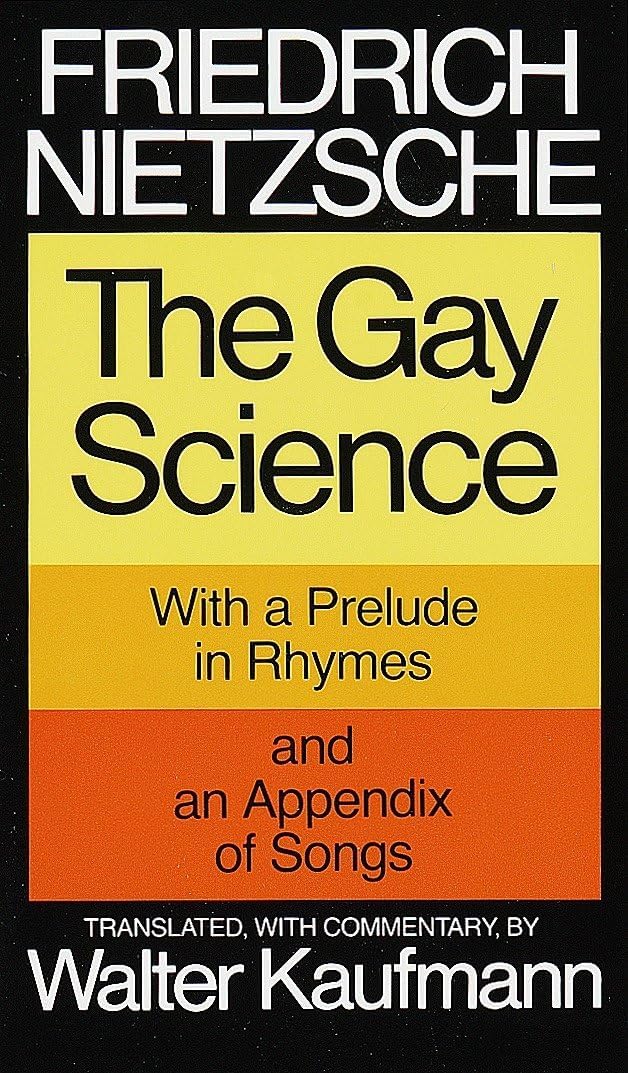

The Gay Science: With a Prelude in Rhymes and an Appendix of Songs (COLLECTIBLE) [Nietzsche, Friedrich, Kaufmann, Walter] on desertcart.com. *FREE* shipping on qualifying offers. The Gay Science: With a Prelude in Rhymes and an Appendix of Songs (COLLECTIBLE) Review: Alive, Electric—Crackling With Energy! - The structure of the book is this: • 63 poems (this is the “Prelude in Rhymes”) • 5 books with 383 sections in total (this is “The Gay Science” proper) • 14 songs (this is the “Appendix of Songs”) In this book, Nietzsche makes many perceptive observations about history, religion, morality, women, art, music, culture, Christianity, Jews, Germans, Europeans, suffering, joy, and much more. This is also where he first declares that “God is dead,” and where Zarathustra is first mentioned in his writings. In fact, he wrote Thus Spoke Zarathustra right after finishing book four. Book five was written a few years later, after he finished Beyond Good and Evil. Something vital to keep in mind: As Kaufmann notes, this book (these “books,” really) is not meant to be read willy-nilly; it is to be read in order and bearing the context in mind; this point cannot be stressed enough. Now to speak of the general spirit of the book: Nietzsche wrote elsewhere (Twilight of the Idols, Raids of an Untimely Man, 51), “The aphorism, the apothegm, in which I am the first among the Germans to be a master, are the forms of ‘eternity’; it is my ambition to say in ten sentences what everyone else says in a book—what everyone else does NOT say in a book” (“NOT” is italicized in the original, not capitalized; but since I can’t italicize here, I capitalized the letters for emphasis). If you want philosophical writing that’s dense, layered, and packed with meaning, all in a single breath, look no further! It’s not just about economy of language but a kind of compression that forces you to slow down and unpack every word. Agree or disagree with his ideas, you’re sure to be taken for a ride! I personally don’t “agree” or “disagree” but rather “relate” or “don’t relate”—and it’s usually the former! I’ve found this to be an excellent entry into Nietzsche’s writing. I’ll probably go with either Thus Spoke Zarathustra or Beyond Good and Evil next, depending on my mood. All in all, this isn’t just a book; it’s an experience, a diary of sorts. He himself calls it “the most personal of all my books.” I highly recommend it for the right person at the right time. Review: Kindle Edition of Nietzsche's Most Engaging Work - This review addresses the Kindle edition of Kaufmann's translation of what I have come to believe is Nietzsche's most engaging work, the one which gives some of his most interesting psychological insights, done in his period of greatest productivity, just before and during the writing of Also Sprach Zarathustra. (Beyond Good and Evil and A Geneology of Morals are also very important.) Unlike "Beyond Good and Evil", there are some excellently even-handed comments about women in this book. This may be the first book I am reading 'from cover to cover' on a Kindle, and the experience is rewarding. There are several things which are annoying about Kindle, but one of the very best aspects is the way it handles footnotes. Click on a footnote number, and it immediately takes you not only to the page where that note appears, but it puts the note at the top of the page. This is something no hard copy can do. The other side of the coin is that it suffers from Kindle's difficulty in handling bilingual texts. It takes a whole lot of jiggery pokery to have the German and English versions of the poems to come out side by side. I'm not even sure it's possible. Fortunately, the poems are numbered, for those who don't know German. Note that some of Kaufmann's Nietzsche books are protected from copying, which is hugely annoying when you are writing papers, and you want an accurate quote. This one has no such prohibition. I am fond of Kaufmann's translations, and the Cambridge University Press edition is not available on Kindle, so this is the one to get. Avoid the cheap or free versions. What is listed under the Cambridge Kindle is NOT the translation published by Cambridge. One general comment about Kindle on the PC. It would be really nice if one could open multiple Kindle windows. That way, you could have the English translation and the original German of Nietzsche's works open, side by side. Of course, you can always open the German in you Kindle device and prop it up alongsize your monitor.

| Best Sellers Rank | #23,738 in Books ( See Top 100 in Books ) #4 in Philosophy Aesthetics #12 in Free Will & Determinism Philosophy #27 in Modern Western Philosophy |
| Customer Reviews | 4.6 4.6 out of 5 stars (570) |
| Dimensions | 4.09 x 0.85 x 6.78 inches |
| Edition | 1st |
| ISBN-10 | 0394719859 |
| ISBN-13 | 978-0394719856 |
| Item Weight | 7.2 ounces |
| Language | English |
| Print length | 396 pages |
| Publication date | January 12, 1974 |
| Publisher | Vintage |
R**N
Alive, Electric—Crackling With Energy!
The structure of the book is this: • 63 poems (this is the “Prelude in Rhymes”) • 5 books with 383 sections in total (this is “The Gay Science” proper) • 14 songs (this is the “Appendix of Songs”) In this book, Nietzsche makes many perceptive observations about history, religion, morality, women, art, music, culture, Christianity, Jews, Germans, Europeans, suffering, joy, and much more. This is also where he first declares that “God is dead,” and where Zarathustra is first mentioned in his writings. In fact, he wrote Thus Spoke Zarathustra right after finishing book four. Book five was written a few years later, after he finished Beyond Good and Evil. Something vital to keep in mind: As Kaufmann notes, this book (these “books,” really) is not meant to be read willy-nilly; it is to be read in order and bearing the context in mind; this point cannot be stressed enough. Now to speak of the general spirit of the book: Nietzsche wrote elsewhere (Twilight of the Idols, Raids of an Untimely Man, 51), “The aphorism, the apothegm, in which I am the first among the Germans to be a master, are the forms of ‘eternity’; it is my ambition to say in ten sentences what everyone else says in a book—what everyone else does NOT say in a book” (“NOT” is italicized in the original, not capitalized; but since I can’t italicize here, I capitalized the letters for emphasis). If you want philosophical writing that’s dense, layered, and packed with meaning, all in a single breath, look no further! It’s not just about economy of language but a kind of compression that forces you to slow down and unpack every word. Agree or disagree with his ideas, you’re sure to be taken for a ride! I personally don’t “agree” or “disagree” but rather “relate” or “don’t relate”—and it’s usually the former! I’ve found this to be an excellent entry into Nietzsche’s writing. I’ll probably go with either Thus Spoke Zarathustra or Beyond Good and Evil next, depending on my mood. All in all, this isn’t just a book; it’s an experience, a diary of sorts. He himself calls it “the most personal of all my books.” I highly recommend it for the right person at the right time.
B**D
Kindle Edition of Nietzsche's Most Engaging Work
This review addresses the Kindle edition of Kaufmann's translation of what I have come to believe is Nietzsche's most engaging work, the one which gives some of his most interesting psychological insights, done in his period of greatest productivity, just before and during the writing of Also Sprach Zarathustra. (Beyond Good and Evil and A Geneology of Morals are also very important.) Unlike "Beyond Good and Evil", there are some excellently even-handed comments about women in this book. This may be the first book I am reading 'from cover to cover' on a Kindle, and the experience is rewarding. There are several things which are annoying about Kindle, but one of the very best aspects is the way it handles footnotes. Click on a footnote number, and it immediately takes you not only to the page where that note appears, but it puts the note at the top of the page. This is something no hard copy can do. The other side of the coin is that it suffers from Kindle's difficulty in handling bilingual texts. It takes a whole lot of jiggery pokery to have the German and English versions of the poems to come out side by side. I'm not even sure it's possible. Fortunately, the poems are numbered, for those who don't know German. Note that some of Kaufmann's Nietzsche books are protected from copying, which is hugely annoying when you are writing papers, and you want an accurate quote. This one has no such prohibition. I am fond of Kaufmann's translations, and the Cambridge University Press edition is not available on Kindle, so this is the one to get. Avoid the cheap or free versions. What is listed under the Cambridge Kindle is NOT the translation published by Cambridge. One general comment about Kindle on the PC. It would be really nice if one could open multiple Kindle windows. That way, you could have the English translation and the original German of Nietzsche's works open, side by side. Of course, you can always open the German in you Kindle device and prop it up alongsize your monitor.
R**L
An excellent starting point in modern thought.
This book is a masterpiece in my estimate, and I wanted it with its original English title. I got it, and it came on time and in perfect shape !!!
C**N
His Fun Book
If you want what Nietzsche essentially considered dessert, of all his work. This is it! Philosophy for the existentially whimsical. A good start if you want to understand part of why Nietzsche should be taken seriously is precisely because joy, to him, is a serious part of living and is a theme throughout all his work.
O**S
On the product
The book was shipped appropriately - it was a day or two after it was promised, but that is the only complaint on the shipping. The binding and its covers are of a relatively good quality; however I found an older version (still the same walter kaufmann translation) in Half Price Books which had a binding and covers of superior quality - and after reading the two, the older version looks almost impeccable with little to no creases (this was the first day). However the page quality, the material and overall the printing of the book (a few misprints, like three or four) are very neat and well done. 3.5/5 stars.
P**.
Nietzsche starts to up his game from the last great book Human All Too Human. I don't recommend this version of the book though because it's full of grammatical errors.
G**.
Everything top, great book quality.
S**Y
Im usually careful with how I hold a book when I read, but I like to part the book so theres sufficient light coming onto the page and theres no obstruction of vision. This is my second copy of the same edition. The first one I had started falling apart after page 50: the pages slowly rip at the bottom, then complete pages start coming out. This time, on my second copy, I made it to page 196 before half the books pages were hanging by a thread. Dont buy this edition. Period.
H**N
Purchase "Mass Market PaperBack version" i.e., Translated with commentary by Walter Kaufmann (Vintage) . Paperback version is not authentic and is translated by some unknown translator.
J**R
Probably the most beautiful and important of all Nietzsche's books. It is here that the famous fragment `God is dead' appears (The Madman, book III: 125) and a passage on Eternal Return (The Greatest Weight). The best way to get acquainted with Nietzsche is to read him direct: The Greatest Weight. -"What, if some day or night, a demon were to steal after you into your loneliest loneliness and say to you: "This life as you now live it and have lived it, you will have to live once more and innumerable times more; and there will be nothing new in it, but every pain and every joy and every thought and sigh and everything unutterably small or great in your life will have to return to you, all in the same succession and sequence - even this spider and this moonlight between the trees, and even this moment and myself. The eternal hourglass of existence is turned upside down again and again - and you with it, speck of dust! -Would you not throw yourself down and gnash your teeth and curse the demon who spoke thus? Or have you once experienced a tremendous moment when you would have answered him: "You are a god, and never had I heard anything more divine!" If this thought were to gain possession of you it would change you as you are, or perhaps crush you. The question in each and everything, "Do you desire this once more and innumerable times more?", would lie upon your actions as the greatest weight. Or how well disposed you would have to become to yourself and to life to crave nothing more fervently than this ultimate eternal conformation and seal? (book IV: 341)
Trustpilot
1 month ago
2 months ago