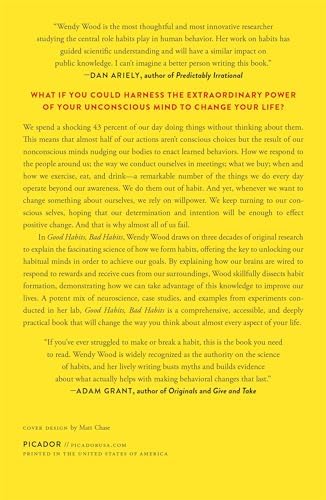

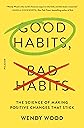

Good Habits, Bad Habits: The Science of Making Positive Changes That Stick
Product ID: 245941494
Buy Good Habits, Bad Habits: The Science of Making Positive Changes That Stick by Wood, Wendy (ISBN: 9781250159090) from desertcart's Book Store. Everyday low prices and free delivery on eligible orders. Review: Completely new perspective - Great read factual and fascinating Review: Good habits, bad habits, - Can highly recommend this book and author, lovely to read and understand, Prof Wendy Wood descriptions are very well written, difficult to put this book down, recommend same, there are other books on the market but not as well written as this one
| Best Sellers Rank | 2,646 in Psychology & Psychiatry 10,499 in Society, Politics & Philosophy 11,860 in Health, Family & Lifestyle Self Help |
| Customer reviews | 4.4 4.4 out of 5 stars (775) |
| Dimensions | 13.84 x 1.93 x 21.13 cm |
| ISBN-10 | 1250159091 |
| ISBN-13 | 978-1250159090 |
| Item weight | 1.05 kg |
| Language | English |
| Print length | 320 pages |
| Publication date | 29 Dec. 2020 |
| Publisher | Picador |
A**E
Completely new perspective
Great read factual and fascinating
P**N
Good habits, bad habits,
Can highly recommend this book and author, lovely to read and understand, Prof Wendy Wood descriptions are very well written, difficult to put this book down, recommend same, there are other books on the market but not as well written as this one
A**Y
Interesting
Like many other reviewers i thought this would be more of a self-help book with guides and strategies on how to develop the habits you want. It isn't! Instead it covers the scientific research into the psychology of habits in a readable way, without too much jargon and complicated theory. Although it's not aimed at being a self-help book, it describes how our habits can develop, how we maintain them (even if we don't want to) and what can cause them to change. In particular it emphasises how willpower alone is not sufficient. This can give you ideas of ways to help you change your habits so they work better for you. You'll also know if any self-help book on habits is talking sense or not.
T**N
Excellent!!!!
Excellent service, value for money and fast delivery!!!
P**S
Don’t expect the standard self-help book
The standard self-help book fills much of its space with folksy tales of the experiences of others. It’s supposed to make you relate to the facts. My reaction, if I don’t give in from boredom and irritation at the low information density, is always to skip straight to the science and what to do. So I like that this book goes straight to the science. It tells you to organise your world to cue good habits and To remove friction. Nit much about how, but that was OK. However, I got to the end of the chapter on rewards, which told me that rewards should be instant and preferably surprising, and thought very interesting, but what do I do as a result? It reminds me in a later chapter that rewards work best if they are surprising but again has no ideas about how to get that into your life. I do find the science interesting. It was my field. But I think the marketing should be clear that if you want advice on what to do to develop good habits this book largely leaves you to work it out yourself. As usual it assumes that all readers are working age parents with partners. Don’t people on their own, or at least with no children, ever write books?
D**E
Amazing
I would recommend to anyone to read it. It makes you look into your daily activities with fresh pair of eyes. Highly recommended.
N**T
This Or Atomic Habits?
Everyone's favourite question: this or Atomic Habits? The answer is this: she has a deeper knowledge of the subject, her work is more likely to move the needle in terms of improving your self control, and most importantly, it's more fun and compelling to read!
M**H
Excellent book - expect a lot of detail
Would recommend. Like many books written by academics, there is a lot of detail on the experiments / studies. A rewrite with half of the words would boost to five stars for me. Plenty of actionable points.
J**D
Wer schnelle und einfache Lösungen für seine Probleme sucht, wird hier nicht fündig, aber wenn man sich darauf einlässt und etwas Zeit investiert, kann man mit den hier gewonnenen Erkenntnissen echte und vor allem langfristige Veränderungen in Gang setzen.
T**E
From the opening pages of "Good Habits, Bad Habits," I appreciated Wendy Wood's exploration of what she calls our "second self" - the subconscious mind that controls much of our behavior without us even realizing it. As someone deeply interested in personal development, this book offered valuable insights into why real change is so hard despite our best intentions. Wood, a professor at USC, is one of the foremost researchers in habit formation. Her central premise is powerful yet simple: what we often mistake for extraordinary willpower in successful people is actually the result of well-established habits. The book's biggest strength lies in its scientific approach to understanding how approximately 43% of our daily behaviors (and up to 88% of our hygiene routines) operate on autopilot. Wood breaks down the three pillars of habit formation - context, repetition, and reward - providing a framework that explains why New Year's resolutions often fail and why environmental factors beat willpower almost every time. I found her exploration of "friction" especially useful. By explaining how small environmental changes can dramatically impact behavior (like how reducing the distance to a gym increases attendance), Wood offers practical strategies anyone can apply. Her discussions on habit stacking, replacement habits, and the concept of habit discontinuity (how major life changes create opportunities for new habits) provide actionable insights rarely found in typical self-help books. The chapter on stress and habits explains why we fall back on established patterns during difficult times - whether healthy or unhealthy. Understanding this alone is worth the price of the book, especially for those struggling with stress-triggered behaviors. What sets this one apart from other habit books is that Wood isn't just reporting on research - she's one of the pioneering scientists who conducted many of the foundational studies she references. This gives strong credibility to her conclusions and recommendations. You're hearing directly from a primary source in the field, not a secondary interpreter. While Wood writes for a general audience, if there's any critique to offer, it's that the book occasionally reads somewhat academically. However, you could also consider this one of the book's strengths. Unlike many pop psychology books that oversimplify complex topics, Wood respects our intelligence enough to share the nuanced reality of how habits truly function in our brains and she doesn't promise any magical 21-day transformations. Some people might feel like it’s a downer hearing how much of their bad behavior is on autopilot. But overall, Good Habits, Bad Habits gives a message of hope. When you understand how habit formation works, then we understand how we cam make it work in our favor. You learn that making changes isn't about iron willpower but about creating a environment that supports our goals and repeating behaviors until they become automatic. If you don’t mind books that are a little on the sciencey side, citing lots of research, then you will enjoy this book.
J**N
Live in the country and don't/can't get to any decent book stores in the city often. Heard about this book on the radio and searched it on AMAZON. Had it and it was delivered within 3 to 5 days. Great service. Good book.
S**M
Excellently researched book on habits formation and the psychology behind routine.
A**R
Original.
Trustpilot
2 weeks ago
5 days ago