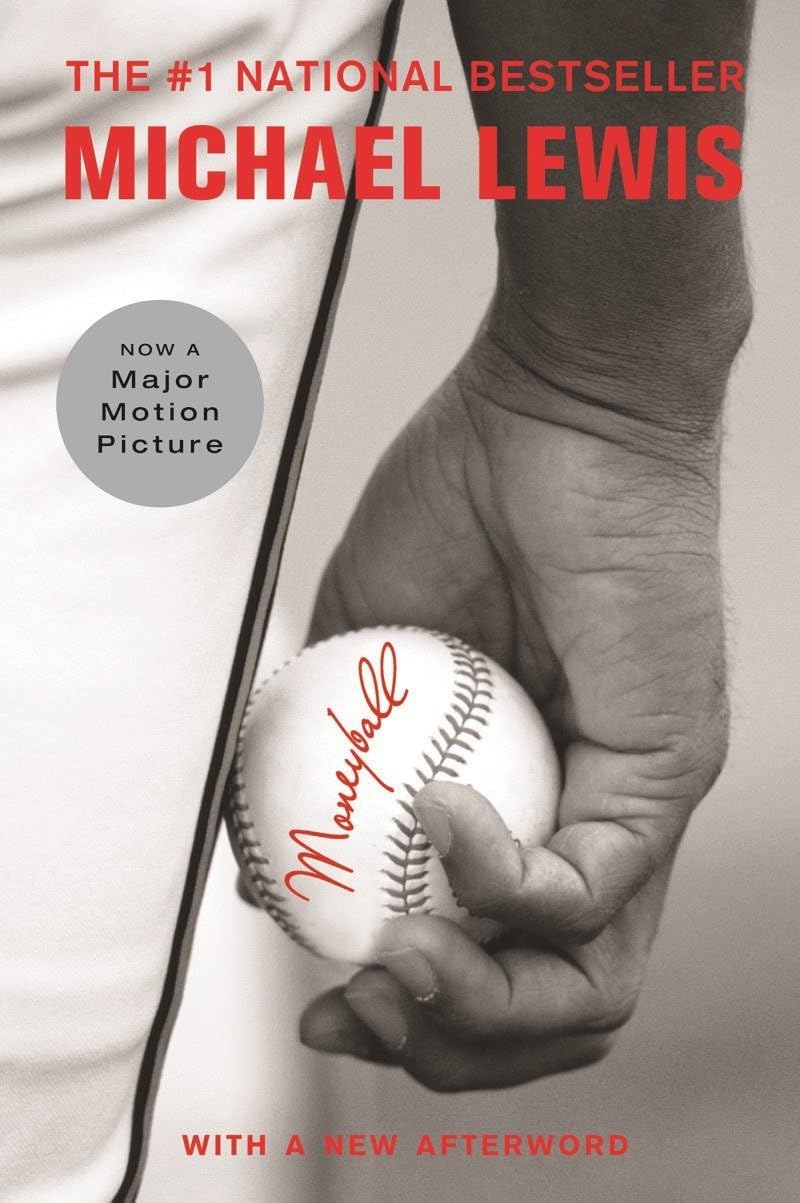

Moneyball: The Art of Winning an Unfair Game
Product ID: 255559982
🆕New mint condition
📦Same-day dispatch before noon
🔄No-quibble returns
Desertcart purchases this item on your behalf and handles shipping, customs, and support to Croatia.
⚾ Outsmart the giants with the ultimate playbook for winning against the odds!
Moneyball: The Art of Winning an Unfair Game reveals how Oakland Athletics’ GM Billy Beane used groundbreaking statistical analysis to build a winning baseball team on a shoestring budget. Praised as both a seminal baseball book and a business classic, Michael Lewis’s narrative uncovers the power of data-driven decision-making that challenges traditional wisdom and inspires professionals to rethink success.
| Best Sellers Rank | #45,487 in Books ( See Top 100 in Books ) #2 in Baseball #447 in Investing #472 in Industries |
| Customer Reviews | 4.7 out of 5 stars 2,246 Reviews |
B**A
AVery interesting read
Great read
O**G
Für Fachkundige und interessierte
Ein sehr gutes Buch über die Entwicklung und Bewertung von Spielern, gepackt in eine spannende Geschichte über den General Manager der Oakland Athletics. Es zeigt einen tiefen Einblick in die Art und Weise wie Spieler gescoutet wurden und teilweise echt über- oder unterschätzt wurde. Warum kann ein Spieler der nicht gut schlägt, nicht gut fielded, nicht gut rennt und nur 500k/Jahr verdient so gut und erfolgreich sein, wie jmd. der alles macht und 15mio. im Jahr verdient? Wie kann ein Team von 25 Spielern, die 40mio Kosten so gut sein wie ein Team das 150mio kostet? Das ist eine Frage der auch Michael Lewis nachgegangen ist und hat bei Billy Bean sagenhafte Entdeckungen gemacht. Es hat nur den Mut eines GM gebraucht, der Analysen aus den frühen 80ern verwertet hat, die von allen anderen nur belächelt wurde. Die Geschichte ist sehr spannend geschrieben aber etwas Vorwissen bezüglich Baseball ist unerlässlich, sonst verliert man sich im Dickicht des Baseballjargons ohne etwas zu verstehen.
L**A
Come atteso
Come atteso
J**R
The Beane Machine
Let's get one thing straight. This is not a book about baseball. America's pastime, they call it. But to our national psyche it's much, much more. It's a metaphor for heroism, hope, innocence, youth--the movies don't talk about fields of dreams for nothing. But dreams are about emotion, and emotions can deceive in cruel and powerful ways. And nowhere, according to Michael Lewis' intriguing premise in "Moneyball", does emotion distort with more pernicious force than in the sport of baseball. Billy Beane found this out the hard way. As an up and coming minor leaguer in the late 80s he fielded with Dykstra and Strawberry for the Mets. Mesmerizing baseball scouts nationwide, he found himself heralded as the sport's perfect man, a power hitter, a nimble fielder, a natural headed for greatness with effortless grace. But after spurning college at Stanford to take the seductive bait of the major league draft, Billy Beane found himself falling a lot faster and deeper than he'd climbed. Billy was an emotional guy. His minor league teams spent significant sums on the bats he broke when he struck out, the sinks he pulled out from their moorings when his genius failed. In hindsight, years later, he saw how his own nature had been his undoing. And he vowed to bend it to his own will, and define for himself a new and spectacular brand of success in the sport that so spurned him. No author in America was better suited to bring Billy Beane's story to print than Michael Lewis. There's not another writer at work today with the uncanny ability to bring literary style and journalistic discipline to the world of numbers with such concise and forceful effect. He showed this talent for fusion in his previous blockbuster, "Liar's Poker". But he here he eclipses himself in an investigative masterpiece as informative as it is compelling. Billy Beane's epiphany about his own failures in the early '90s came in tandem with a radical new school of thought in baseball, one founded in stark statistical analysis, devoid of the trappings of subjectivity and emotion. As Billy followed a new career path in baseball management these new ideas took firm and deep root in his thinking, and he set out on a course to prove them right. Let the old school scouts evaluate players based on gut instinct and showy play. Billy was sure he knew a different way. Baseball, the chastened Beane began to perceive, was living in the dark ages. Player were culled, and paid, based on subjective premises that had little to do with their ultimate ability to get on base and score runs. The old fashioned scouting system, rooted as it was in intuition, was rife with inefficiencies and distortions. With the advent of free agency, the imperfections of the scouting system were magnified without mercy. In olden times a sub-par player brought up through the scouting system might set a team back 150K. After free agency, it was more like 15M. All this did Billy Beane learn, through the prism of his own previous failures. And where there is inefficiency, as any Wall St. trader will tell you, there is huge opportunity. A general manager's challenge, Billy's challenge, was to construct a team of professionals stripped down to the barest, and most relevant, essence of their unique individual abilities, with no intrusion from internal doubt or external second guessing. This was the team that would win games, making little boys' dreams come true and a few shrewd men's wallets explode with cash. The body of "Moneyball" lays out the tale of Billy's tenure as the general manager of the Oakland A's, guiding the reader through the arcane processes of free agency and the psychology of trading. But baseball is only a vehicle for the development of much larger themes. It's man's fundamental struggle in every endeavor he undertakes to strip out emotions from decision making. The quest for the optimum exists in everything. But it's an uphill battle, against the way human beings are wired. Lewis' tale of one man's determination to win, using only the stark truth of mathematical analysis, is filled with countless insights and journalistic jewels. It's like watching one very exciting baseball game, where the win is about something much more than a game.
S**H
Sports Analyst's Textbook
Great Book. As a budding sports analyst, this book gave me some great insights on how an analyst should look at the game. Some of the metrics discussed in the book are also very eye opening and can be migrated to other sports.
J**R
Stain
Surely a great book (I haven't read it yet), but receiving it (supposedly new) with a big stain is quite a bummer...
Trustpilot
3 weeks ago
3 weeks ago