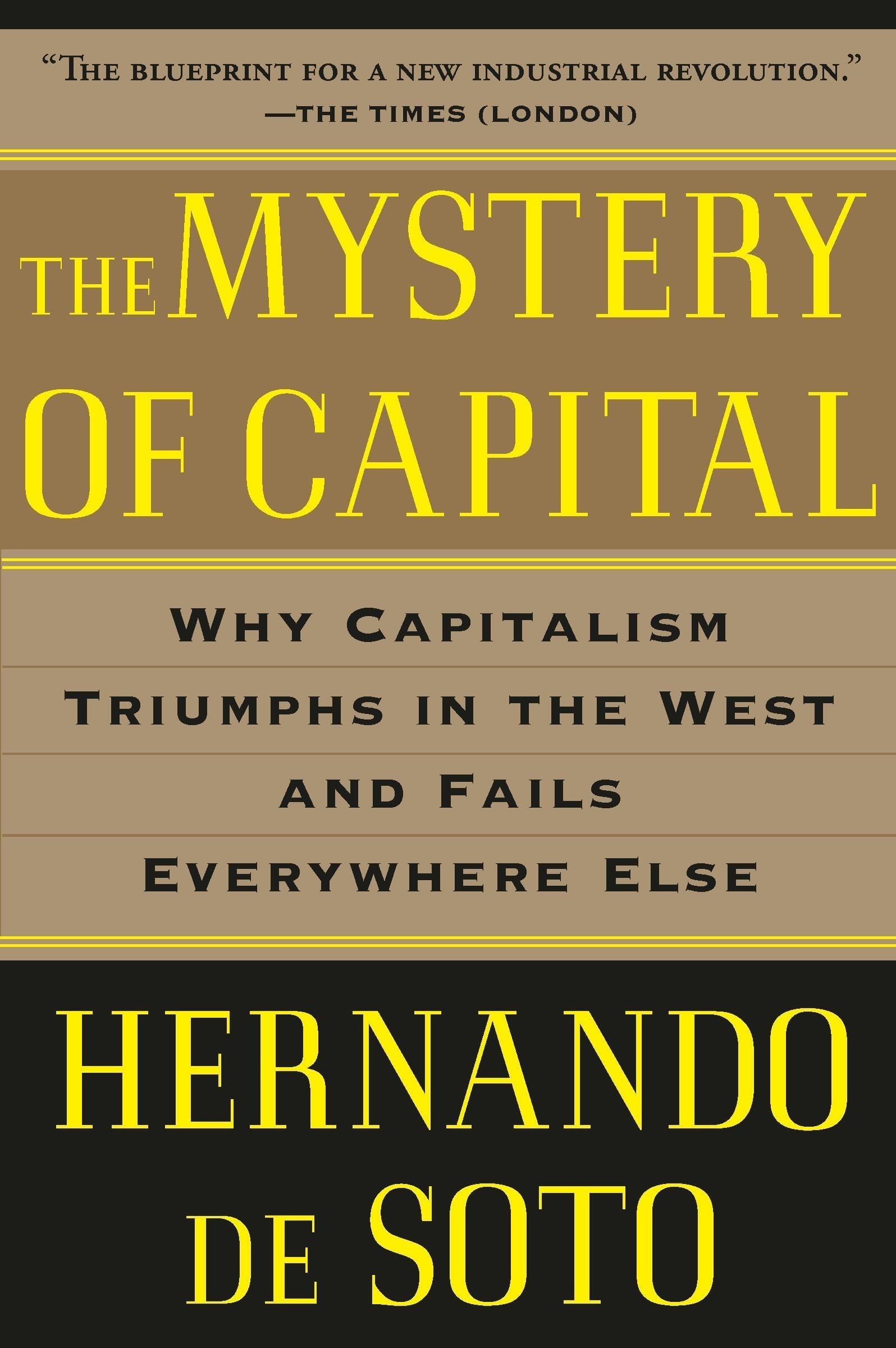
The Mystery of Capital: Why Capitalism Triumphs in the West and Fails Everywhere Else
Product ID: 280858468
Desertcart purchases this item on your behalf and handles shipping, customs, and support to Croatia.
Buy The Mystery of Capital: Why Capitalism Triumphs in the West and Fails Everywhere Else by de Soto, Hernando online on desertcart.ae at best prices. ✓ Fast and free shipping ✓ free returns ✓ cash on delivery available on eligible purchase. Review: Ce livre est un classique de la "non-gouvernementalité" avant la lettre. de Soto y montre comment le secteur informel où l'Etat ne livre pas beaucoup de biens publics est capable de produire de beaux succès économiques portés par des entrepreneurs informels. En termes simples, ces études de cas montrent que le développement économique est le résultat normal quand l'Etat n'interfère pas trop de façon contre productive. Un classique, qui mérite encore d'être lu. Review: Mr. De Soto's book has almost become a classic in the field of development economics. It is also a compelling and excellently written small book, with good argumentation, not overly using the immense amount of statistical data that underpins it. The argument is basically that economic development of a more equitable and prosperous for the poorest, could happen by simply creating good legal and administrative framework for property and investment. That is the so-called "mystery of capital": when this is in place, people will be able to extract capital from their property, just as they are largely doing informally in much of the developing world, but completely outside the formal economic system. The argument is excellent. Therefore, I believe the book is a must-read for anyone working with poverty and development (not only in the developing countries). Nevertheless, there are still some things that may be discussed. Mr. De Soto is a firm believer in the invisible hand of the market: when the framework is in place, people will be able to help themselves. In that sense, I can't help but thinking that Mr. De Soto is largely speaking of poor people as mostly urban dwellers, who although informally, are already to a degree incorporated into the economic system, and have a (minimum) knowledge and understanding of how the market works and how to extract capital from it. But what about the poorest of the poorest subsistence farmers in some African countries? I personally don't believe the arguments put forth in the book would change anything for them. On the contrary, without proper protection, they might be in for more exploitation from more capable people... While I still don't believe the links of market capitalism are directly related to reducing poverty (an argument implicit in Mr. De Soto's book), I do believe that the easing of market restrictions and clarification of property rights which Mr. De Soto argues for, are a pre-condition for economic development, which may help but will not alone alleviate the precarious situation for the poorest of the poor. Great book.


| Best Sellers Rank | #62,567 in Books ( See Top 100 in Books ) #63 in Economic Policy & Development #105 in Theory & Philosophy of Economics #158 in Economic History |
| Customer reviews | 4.6 4.6 out of 5 stars (348) |
| Dimensions | 13.65 x 1.91 x 20.32 cm |
| Edition | Reprint |
| ISBN-10 | 0465016154 |
| ISBN-13 | 978-0465016150 |
| Item weight | 318 g |
| Language | English |
| Print length | 288 pages |
| Publication date | 9 July 2003 |
| Publisher | Basic Books |
J**M
Ce livre est un classique de la "non-gouvernementalité" avant la lettre. de Soto y montre comment le secteur informel où l'Etat ne livre pas beaucoup de biens publics est capable de produire de beaux succès économiques portés par des entrepreneurs informels. En termes simples, ces études de cas montrent que le développement économique est le résultat normal quand l'Etat n'interfère pas trop de façon contre productive. Un classique, qui mérite encore d'être lu.
E**N
Mr. De Soto's book has almost become a classic in the field of development economics. It is also a compelling and excellently written small book, with good argumentation, not overly using the immense amount of statistical data that underpins it. The argument is basically that economic development of a more equitable and prosperous for the poorest, could happen by simply creating good legal and administrative framework for property and investment. That is the so-called "mystery of capital": when this is in place, people will be able to extract capital from their property, just as they are largely doing informally in much of the developing world, but completely outside the formal economic system. The argument is excellent. Therefore, I believe the book is a must-read for anyone working with poverty and development (not only in the developing countries). Nevertheless, there are still some things that may be discussed. Mr. De Soto is a firm believer in the invisible hand of the market: when the framework is in place, people will be able to help themselves. In that sense, I can't help but thinking that Mr. De Soto is largely speaking of poor people as mostly urban dwellers, who although informally, are already to a degree incorporated into the economic system, and have a (minimum) knowledge and understanding of how the market works and how to extract capital from it. But what about the poorest of the poorest subsistence farmers in some African countries? I personally don't believe the arguments put forth in the book would change anything for them. On the contrary, without proper protection, they might be in for more exploitation from more capable people... While I still don't believe the links of market capitalism are directly related to reducing poverty (an argument implicit in Mr. De Soto's book), I do believe that the easing of market restrictions and clarification of property rights which Mr. De Soto argues for, are a pre-condition for economic development, which may help but will not alone alleviate the precarious situation for the poorest of the poor. Great book.
M**E
when I was about to purchase this book, it was described as "Used - Very good" however, the book arrived absolutely smooth without any mark or scratch just like a new untouched book, better than described or I expected.
S**R
Read right away and loved it
O**O
It's an interesting read in economics and property law, but it didn't age well...
Trustpilot
2 weeks ago
2 months ago