🔐 Lock in your security with GIGABYTE's TPM Module!
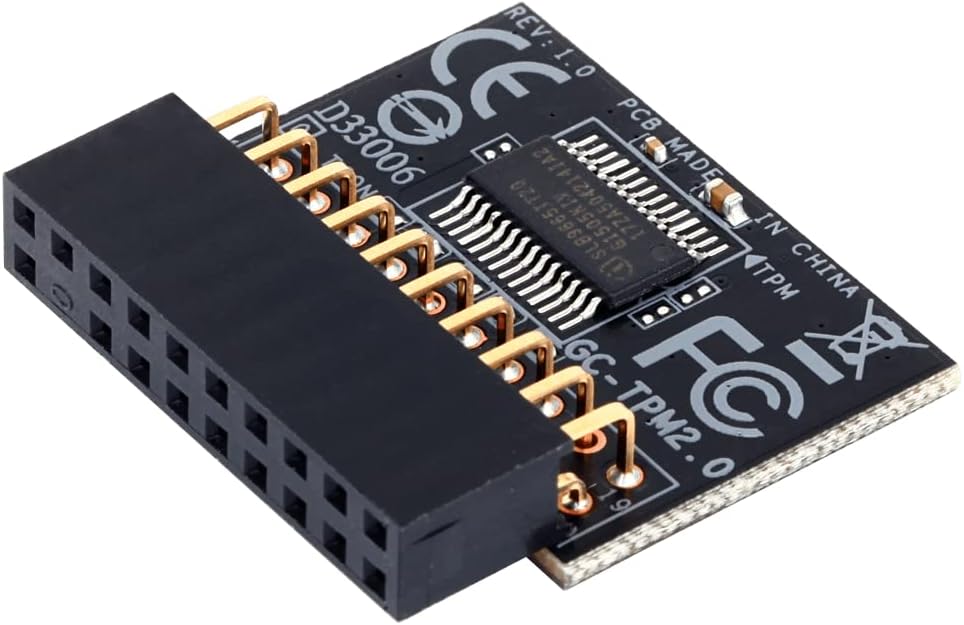
The GIGABYTE GC-TPM2.0 TPM Module is a compact and lightweight security solution designed to enhance data protection for your GIGABYTE motherboard. Weighing only 0.3 ounces and measuring 2 x 1.5 x 0.3 inches, this module is easy to install and integrates seamlessly into your system, ensuring your data remains secure.
| ASIN | B01G97X6T4 |
| Best Sellers Rank | #3,227 in Computer Memory |
| Brand | GIGABYTE |
| Chipset Type | AMD |
| Compatible Devices | Personal Computer |
| Compatible Processors | AMD Ryzen |
| Customer Reviews | 3.9 3.9 out of 5 stars (135) |
| Global Trade Identification Number | 00889523004470 |
| Graphics Card Interface | PCI Express |
| Item Weight | 0.3 Ounces |
| Main Power Connector Type | ATX |
| Manufacturer | Gigabyte |
| Memory Slots Available | 4 |
| Model Name | GC-TPM2.0 SPI |
| Model Number | GC-TPM2.0 |
| Processor Socket | Socket AM4 |
| RAM Memory Technology | DDR4 |
| Total Usb Ports | 6 |
| UPC | 889523004470 |
| Warranty Description | 1 yr limited |
A**N
Works like a champ!
Info - Windows 10 x64 Pro PC. Item ordered: Gigabyte GC-TPM2.0 module. Just received this item today. Installed, configured, and drive encrypted in about two hours. Installing and configuring is less than 10 minutes. Drive encryption varies. On my 512gig Samsung 950 Pro SSD drive, 28 percent filled, using BitLocker in Windows 10 x64 Pro, took just under two hours. And yes, Windows 10 will recognize this as a TPM 2.0 device. You can see this in Device Manager under Security devices. That said, you need to make sure it’s properly configured in the BIOS. It should be auto configured (mine was on my Gigabyte board), but double check anyway. Especially that it reads 2.0. With that, install really is a breeze - Just install, start the PC, enter the BIOS and configure if necessary. BIOS configuring is basically making sure the BIOS sees the module and that it is configured as a 2.0 device. Restart the PC, and Windows should see it. You may need an additional reboot as Windows finishes installing drivers, but that’s it. Now go to Control Panel, choose BitLocker, read and follow the instructions, to include saving your TPM key. Note, the key can’t be saved to a drive that’s being encrypted. Best to use a thumb drive. Or, you can have it saved to your MS account. Click next to encrypt the drive. As noted, encryption times vary, even between OS’s and thus this isn’t going to be a 10-minute job, especially if you’ve got a large drive with lots of data. Again, my drive took just under 2 hours, but that’s a 512gig SSD drive just 28 percent filled. Oh, and you can still use your PC while the drive is encrypting, but I wouldn’t do anything intensive. During my encryption window, I was able to browse the net and write a few Word docs no issue. I’ll rate this item 5, but really it either works or it doesn’t. And configuring is on the PC side. So again, it either works or it doesn’t.
A**R
Works great
Works as designed. Plug and play for my GA-H170-Gaming 3 (v 1.1), powering Win10. Note, most instructions online for BitLocker are outdated since MS 10's latest update. For example, things like password provisioning, taking ownership, setting a master password, and the like are handled by the OS and transparent to the user. If you can see see TPM under device manager, then go to town. I highly recommend three things: 1) Save the key to your MS account (assuming you have one) or to an equivalent online drive 2) Print out a copy of the recovery key and keep it handy for the first week or so to make sure no hiccup locks you out of your computer. You can obviously recover your key from your MS account, but its a pain. 3) Enable the OS feature requiring a pin to boot. If someone robs your house, they're not going to take the drives and leave your already mated computer+TPM...do the math. Yes, it's a full-blown 2.0 chip.
N**D
Gigabyte TPM 2.0 usage issues
Trust Module card does not work although the motherboard GIGABYTE GZ-Z77MX-D3H ver 1.0 states in the BIOS that it supports the trust module firmware from ver 1.3 and up. The manufacturer's website has some downloadable bios updates which claim to be able to allow support of GC-TPM2.0 on the latest version of BIOS, but I have tried this only to discover that the Q-flash utility is not able to update the version to the latest version. A progressive upgrade of the BIOS was attempted to upgrade the m/b from ver F5 to F11, but was unsuccessful. It could be due to a requirement to update from a dos environment long outdated. The attempt to upgrade the BIOS flash was through the m/b's built in flash utility screen. As a last resort, another attempt to update the BIOS to the latest (but beta) version of the BIOS flash software offered on the manufacturer's site (Gigabyte) was yet again unsuccessful. Maybe after some research, the module is redundant, due to Windows 10 Pro's inclusion of the bitlocker utility which the GC-TPM2.0 Module provides. But given the amount of malware and spyware that's going on in the internet, I thought an added layer of hardware protection might help. A pity it does not. Could be a faulty batch problem. Running the Win + Run cmd of tpm.msc also does not yield any detection of the firmware. There is a document article Gigabyte Smart TPM which allows a further layer of software security using the aforementioned run cmd but I reckon it will only work if the Bios is able to detect the firmware in the first place. In my opinion, the trust module is more suited for Windows 7 or below systems. Will post more if able to update the flash bios utility to get the module up and running. If anyone has any ideas especially on a version of the m/b bios that the trust module firmware is compatible with, please feel free to add to this review.
D**N
Works with some Gigabyte motherboards
I tried this module on two Gigabyte motherboards, an Intel based GA-Z170M-D3H rev1 and an AMD based GA-970A-D3P rev 2. I updated the BIOS on both prior to installation but the TPM was only recognized on the GA-Z170M-D3H. Note that the GA-970A-D3P was NOT listed as compatible with this TPM. I just tried it out because I could not find any TPM module listed as compatible with GA-970A-D3P. So, make sure your chipset is compatible with this TPM. You can find a list of compatible chipsets on Gigabyte's GC-TPM2.0 product page. Regarding TPM firmware, the module I received had version 5.62.3126.0. Windows didn't report any security warning to me after install, so I assume it is up to date enough. Unfortunately, Gigabyte doesn't have a tool to update the firmware, so you have to hope the one you receive has a good version of the software on it.
J**L
deffently not compatible with "any motherboard with a TPM header"
plugged it in into my motherboard and turned it on in the BIOS but every time I went into TMP.MSC to set it up it will give me a an error message; " Compatible TPM cannot be found on this computer. verify that this computer has a 1.2 TPM or later and it is turned on in BIOS (it has it in and its turned in on BIOS)". I later found on a couple forums stating that it has to be a 1.2 TPM not a 2.0. after 5-6 hours of research, updates and settings changes i am ready to send it back.
S**P
good price
what was needed
E**N
This TPM module as well as working properly connects to the motherboard snugly. I purchased another module for a another gigbyte board, the chip manufactured by msi which is technically a 14 pin but doesn't fit snugly although seems to function okay. Another I purchased by ASUS did not fit at all although still 14 pins. This is because the chip sits on side of connector and needs a special socket to fit. So I recommend consumers only by TPM modules made by the same manufacturer. But this one I bought from Amazon is perfect.
A**R
MSI H110M-SI01というマザーボードで動作しました。 (2016年のマウスコンピュータ製PC) GIGABYTEとMSIでメーカが異なりますが、同じような20-1pinの コネクタだったので、ダメもとで購入しました。 BIOSのバージョンは 06/16/2016です。 UEFIでWindows10を使用しており、Bitlockerで ディスクの暗号化を行うのが目的です。 最悪パソコンが壊れることを想定し、 データをバックアップしておきます。 マザーボード上のTPMと書かれているコネクタに本モジュールを差し込み、 電源を入れ、BIOS画面を表示させます(とりあえず大丈夫そう)。 やったこと: (1)BIOS画面→Advanced→Trusted Platform ModuleでTPM Support を Enabled にします。 パワーオフしてオンすることでBIOSに認識されるようになります。 Device Selectは AUTO (これだけですとWindows10のデバイスマネージャーにセキュリティデバイスが 表示(トラステッド プラットフォーム モジュール 2.0)されるだけで、 tpm.mscを起動しても認識されません) (2)BIOS画面→Chipset→ME Configurationで、 TPM Device Selection dTPM1.2 とします。 (これでtpm.mscでも認識されるようになります。 が、msinfo32.exeで確認すると「セキュアブートの状態」は無効のままです。) (3)BIOS画面→Securityを選択します。 →System Mode state が Setup、 Secure Boot stateが Not Active になっているかと思います。 ここで、Secure Boot Modeを Custom にします。 (4)Key Managementという項目が表示されますので、そのモードに入ります。 (5)Enroll all Factory Default keysを選択し、実行します。 (6)ESCでSecurityの画面に戻り、Secure Boot ModeをStandardに戻します。 →System Mode state が User Secure Boot stateが Active になったかと思います。 手順が抜けてたり間違ってたりするかもしれませんが、 とりあえずBitlockerで暗号化できました。
I**D
Used this to enable TPM2.0 in preparatrion for Windows 11 beta. Does not ned to be MB vendor specific, just needs to match the pin out of your board.
E**O
There is actually another model GC-TPM20_S (https://www.gigabyte.com/Motherboard/GC-TPM20_S) which fits the newer models of motherboards, I got the wrong one. Luckily, I realized the Intel CPUs may come with an embedded TPM 2.0 called Platform Trust Technology, just enable it in your BIOS and BOOM, you have TPM for FREE!
J**Z
Fu con a bien y cumple su cometido
Trustpilot
3 weeks ago
2 weeks ago