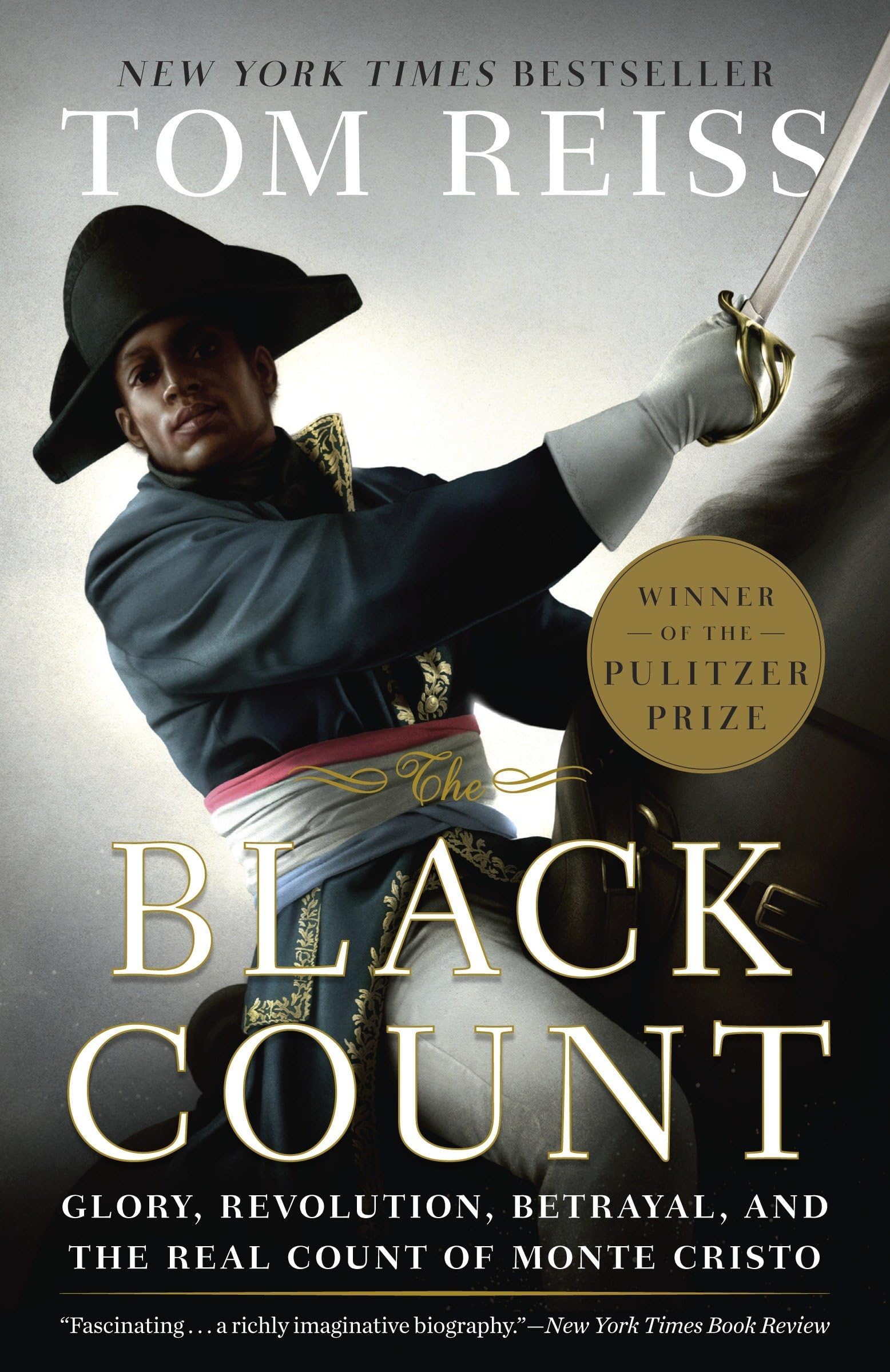
The Black Count: Glory, Revolution, Betrayal, and the Real Count of Monte Cristo
Product ID: 3451219
Desertcart purchases this item on your behalf and handles shipping, customs, and support to Croatia.
PULITZER PRIZE WINNER • NEW YORK TIMES BESTSELLER • A “richly imagined biography” ( The New York Times Book Review ) of General Alex Dumas, who rose from slavery to command vast armies in the French Revolutionary Wars—and whose exploits were immortalized in his son’s novels The Count of Monte Cristo and The Three Musketeers “Fascinating [and] entertaining.”— The Wall Street Journal “Remarkable.”— The Boston Globe “A truly amazing story.”—NPR A BEST BOOK OF THE YEAR: Time, The New Republic, NPR, Salon, Essence General Alex Dumas is a man almost unknown today, yet his story is strikingly familiar—because his son, the novelist Alexandre Dumas, used his larger-than-life feats as inspiration for such classics as The Count of Monte Cristo and The Three Musketeers . But hidden behind General Dumas’s swashbuckling adventures was an even more incredible secret: he was the son of a black slave—who rose higher in the white world than any man of his race would before our own time. Born in Saint-Domingue (now Haiti), Alex Dumas made his way to Paris, where he rose to command armies of more than 50,000 men at the height of the Revolution. No matter how high he soared, Dumas continued to live by his blade and his boldness in the face of overwhelming odds. Yet, because of his unwavering principles, he ultimately became a threat to Napoleon himself. Time magazine called The Black Count “one of those quintessentially human stories of strength and courage that sheds light on the historical moment that made it possible.” It is also a window into the modern world’s first multiracial society and a heartbreaking story of the enduring bonds of love between a father and son. FINALIST FOR THE NATIONAL BOOK CRITICS CIRCLE AWARD Review: Superb! - This historical biography is based on the life of the famous author, Alexandre Dumas’s father, Thomas-Alexandre, known as Alex Dumas. After time spent in the War of the Polish Succession that ended in 1738, Frenchman Alexandre (Antoine) Davy de la Pailleterie, a future marquis, left France to seek his fortune in Saint-Domingue, the island of Hispaniola. At that time, the Spaniards owned, Santo Domingo, the east side of the island, and the French owned the west, Saint-Domingue (Haiti). Because of sugar planting, Saint-Domingue was one of the wealthiest islands in the world. Antoine moved in with his younger brother, Charles, who had married well and became a well-known sugar planter. Antoine scrounged off his brother for a decade, kept several slave mistresses, and refused to work. Charles and Antoine’s relationship ended violently. Antoine fled with three of his brothers’ slaves, one of which was his latest mistress. To probably resist arrest, Antoine moved up into the highlands, a densely wooded mountains, eventually settling in Jérémie, an isolated area of Haiti. There, he changed his name to Antoine de l’Isle—Antoine of the island. Antoine purchased a mistress for a very high price, Marie Cessette Dumas. Marie Cessette bore him four children. The eldest child was Antoine’s favorite, Thomas-Alexandre, born in 1762. When Antoine returned to France, he would eventually send for fifteen year old Thomas-Alexandre. Antoine sold Marie Cessette and their other three children. In France, Antoine made sure his son was well educated. Thomas-Alexandre became an excellent swordsman. As a young man, Thomas-Alexandre, enlisted in the dragoons, and rejected his father’s surname, Davy de la Pailleterie, and took his mother’s surname, Dumas. He would never again be known as Thomas. Instead, he used Alexandre (Alex) Dumas. He even listed his father as Antoine Dumas. As a Lieutenant Colonel, Alex, who was later commissioned as a General, married Marie-Louise Labouret of Villers-Cotterets, France. They would have three children: two daughters and Alexandre Dumas, Jr. their last child, the future author, was born 10 years later. The book is filled with an enormous amount of French history, some of which includes the shrewd General Bonaparte. At one point, General Dumas and Bonaparte fought together. General Dumas sailed to Egypt with Bonaparte. General Dumas appeared to be a loving husband and good father. On the front, he was a courageous, strong-minded, intuitive leader, unbiased toward his troops. From his men he received much devotion and admiration. His flaw was sometimes not using tact and being too critical. He had high expectations of a soldier’s performance. Yet his bold criticism toward inept superiors or those favored by superiors cost him promotions or unkindness later in life. General Napoleon showed farsightedness concerning his own future ambitions. However, he appeared to be intolerant of criticism expressed by General Dumas, and inflated his own self-importance when he and Dumas were generals. Napoleon was willing to cruelly exploit others for his own gain, especially concerning the Rights of Man decree. When Napoleon became emperor, the law, previously decreed by former King Louis XVI of France, April 4, 1792, which provided citizenship for all property owning free men of color on the islands, became invalid in 1800. In France, interracial marriages as well as interracial education were outlawed. People of color who had lived free in France were to be rounded up and sent back to the colonies. They could no longer live in Paris or the surrounding suburbs. This appears like history repeating itself. German citizens had experienced this during the Second World War, and currently Dominicans of Haitian descent are being denied citizenship because of their place of birth. Without giving too much away, this is a superb historical biography, well written, full of information, and a pleasure to read. The history in France and on the island, Saint-Domingue, will amaze you. I took my time reading this book. Surprisingly, Alexandre Dumas, author of The Three Musketeers, incorporated some of his father’s famous expeditions when writing his book. The author, Alexandre Dumas, expresses a genuine, tender love and admiration for his father, General Dumas. This book deserves five stars. Review: The former slave who became one of Napoleon's generals - Alexandre Dumas, author of the Count of Monte Cristo and assorted other 19th century best-sellers, was the son of a half-white / half-black former Haitian slave, named Alex Dumas. Alexandre's father's father was a French count, a ne'er-do-well who went to Haiti to sponge off of his sugar plantation-owning brother. Eventually the French count returned to France, some years before the French Revolution, paying for his passage by selling the black mother of his children and his children themselves into slavery. Eventually, he bought back his eldest son Alex, and brought him to France. There, the teenage boy was sent off to a famous French school outside of Paris where he received an upper-class education and became an accomplished swordsman. Astoundingly, mixed-race Frenchmen seemed to have been reasonably well-accepted in France of that period, in a way that would have been inconceivable in the United States of the same era. This is perhaps because there was no slavery in France itself and because so many of these mixed-race people were the offspring of well-off and even aristocratic Frenchmen. Alex Dumas thrived in his education and became an accomplished rider and swordsman. Falling out with his father the count, he joined a regiment of French dragoons and became a cavalryman, with the rank of private. Soon, the French Revolution broke out, creating immense opportunities for men of ambition and modest birth. His military exploits against the invading armies of other European countries in the early months after the Revolution earned him quick promotion, and when he transferred to a regiment led by another Haitian mulatto, he was catapulted to the rank of lieutenant colonel and not long after that became a general -- all in the space of a single year. The rest of the book consists of more extraordinary exploits of this man, who became a military hero because of his exploits but had the misfortune of running afoul of the "Corsican upstart", Napoleon, and then of being captured by the enemy and languishing in prison for years. All this makes for a great page-turner of narrative history, but equally interesting is what the reader will learn of the French Revolution itself, and how Dumas negotiated its treacherous and lethal politics. It did not take long before the Revolution was taken over by radical Jacobins, who soon took the helm of the government and began to devour not just the old aristocracy but the Revolution's own children. The guillotines set up in towns all across France were kept very busy. In the western part of France, in the region known as La Vendee, a widespread revolt against the mass conscription, taxation and anti-clericalism of the government resulted in brutal repression reminiscent of Stalin in the 1930's. Much of the region became a smoking ruin and 250,000 people were left dead. During his brief two-month service in the Vendee, Dumas was appalled. Being a general was no guarantee of safety, and in fact hundreds of French generals went to the guillotine, accused of being insufficiently revolutionary or insufficiently zealous in combating France's enemies. Somehow, Dumas survived, partly through luck and partly because he was a very competent officer who won his battles. All in all, the book is a good read, and you will learn much about the colonial era in Haiti, French society just before and during the Revolution, the savage politics of the Revolution itself, and the Napoleonic wars.


| Best Sellers Rank | #14,502 in Books ( See Top 100 in Books ) #4 in Historical France Biographies #4 in French Literary Criticism (Books) #53 in Black & African American Biographies |
| Customer Reviews | 4.5 out of 5 stars 2,620 Reviews |
U**A
Superb!
This historical biography is based on the life of the famous author, Alexandre Dumas’s father, Thomas-Alexandre, known as Alex Dumas. After time spent in the War of the Polish Succession that ended in 1738, Frenchman Alexandre (Antoine) Davy de la Pailleterie, a future marquis, left France to seek his fortune in Saint-Domingue, the island of Hispaniola. At that time, the Spaniards owned, Santo Domingo, the east side of the island, and the French owned the west, Saint-Domingue (Haiti). Because of sugar planting, Saint-Domingue was one of the wealthiest islands in the world. Antoine moved in with his younger brother, Charles, who had married well and became a well-known sugar planter. Antoine scrounged off his brother for a decade, kept several slave mistresses, and refused to work. Charles and Antoine’s relationship ended violently. Antoine fled with three of his brothers’ slaves, one of which was his latest mistress. To probably resist arrest, Antoine moved up into the highlands, a densely wooded mountains, eventually settling in Jérémie, an isolated area of Haiti. There, he changed his name to Antoine de l’Isle—Antoine of the island. Antoine purchased a mistress for a very high price, Marie Cessette Dumas. Marie Cessette bore him four children. The eldest child was Antoine’s favorite, Thomas-Alexandre, born in 1762. When Antoine returned to France, he would eventually send for fifteen year old Thomas-Alexandre. Antoine sold Marie Cessette and their other three children. In France, Antoine made sure his son was well educated. Thomas-Alexandre became an excellent swordsman. As a young man, Thomas-Alexandre, enlisted in the dragoons, and rejected his father’s surname, Davy de la Pailleterie, and took his mother’s surname, Dumas. He would never again be known as Thomas. Instead, he used Alexandre (Alex) Dumas. He even listed his father as Antoine Dumas. As a Lieutenant Colonel, Alex, who was later commissioned as a General, married Marie-Louise Labouret of Villers-Cotterets, France. They would have three children: two daughters and Alexandre Dumas, Jr. their last child, the future author, was born 10 years later. The book is filled with an enormous amount of French history, some of which includes the shrewd General Bonaparte. At one point, General Dumas and Bonaparte fought together. General Dumas sailed to Egypt with Bonaparte. General Dumas appeared to be a loving husband and good father. On the front, he was a courageous, strong-minded, intuitive leader, unbiased toward his troops. From his men he received much devotion and admiration. His flaw was sometimes not using tact and being too critical. He had high expectations of a soldier’s performance. Yet his bold criticism toward inept superiors or those favored by superiors cost him promotions or unkindness later in life. General Napoleon showed farsightedness concerning his own future ambitions. However, he appeared to be intolerant of criticism expressed by General Dumas, and inflated his own self-importance when he and Dumas were generals. Napoleon was willing to cruelly exploit others for his own gain, especially concerning the Rights of Man decree. When Napoleon became emperor, the law, previously decreed by former King Louis XVI of France, April 4, 1792, which provided citizenship for all property owning free men of color on the islands, became invalid in 1800. In France, interracial marriages as well as interracial education were outlawed. People of color who had lived free in France were to be rounded up and sent back to the colonies. They could no longer live in Paris or the surrounding suburbs. This appears like history repeating itself. German citizens had experienced this during the Second World War, and currently Dominicans of Haitian descent are being denied citizenship because of their place of birth. Without giving too much away, this is a superb historical biography, well written, full of information, and a pleasure to read. The history in France and on the island, Saint-Domingue, will amaze you. I took my time reading this book. Surprisingly, Alexandre Dumas, author of The Three Musketeers, incorporated some of his father’s famous expeditions when writing his book. The author, Alexandre Dumas, expresses a genuine, tender love and admiration for his father, General Dumas. This book deserves five stars.
G**H
The former slave who became one of Napoleon's generals
Alexandre Dumas, author of the Count of Monte Cristo and assorted other 19th century best-sellers, was the son of a half-white / half-black former Haitian slave, named Alex Dumas. Alexandre's father's father was a French count, a ne'er-do-well who went to Haiti to sponge off of his sugar plantation-owning brother. Eventually the French count returned to France, some years before the French Revolution, paying for his passage by selling the black mother of his children and his children themselves into slavery. Eventually, he bought back his eldest son Alex, and brought him to France. There, the teenage boy was sent off to a famous French school outside of Paris where he received an upper-class education and became an accomplished swordsman. Astoundingly, mixed-race Frenchmen seemed to have been reasonably well-accepted in France of that period, in a way that would have been inconceivable in the United States of the same era. This is perhaps because there was no slavery in France itself and because so many of these mixed-race people were the offspring of well-off and even aristocratic Frenchmen. Alex Dumas thrived in his education and became an accomplished rider and swordsman. Falling out with his father the count, he joined a regiment of French dragoons and became a cavalryman, with the rank of private. Soon, the French Revolution broke out, creating immense opportunities for men of ambition and modest birth. His military exploits against the invading armies of other European countries in the early months after the Revolution earned him quick promotion, and when he transferred to a regiment led by another Haitian mulatto, he was catapulted to the rank of lieutenant colonel and not long after that became a general -- all in the space of a single year. The rest of the book consists of more extraordinary exploits of this man, who became a military hero because of his exploits but had the misfortune of running afoul of the "Corsican upstart", Napoleon, and then of being captured by the enemy and languishing in prison for years. All this makes for a great page-turner of narrative history, but equally interesting is what the reader will learn of the French Revolution itself, and how Dumas negotiated its treacherous and lethal politics. It did not take long before the Revolution was taken over by radical Jacobins, who soon took the helm of the government and began to devour not just the old aristocracy but the Revolution's own children. The guillotines set up in towns all across France were kept very busy. In the western part of France, in the region known as La Vendee, a widespread revolt against the mass conscription, taxation and anti-clericalism of the government resulted in brutal repression reminiscent of Stalin in the 1930's. Much of the region became a smoking ruin and 250,000 people were left dead. During his brief two-month service in the Vendee, Dumas was appalled. Being a general was no guarantee of safety, and in fact hundreds of French generals went to the guillotine, accused of being insufficiently revolutionary or insufficiently zealous in combating France's enemies. Somehow, Dumas survived, partly through luck and partly because he was a very competent officer who won his battles. All in all, the book is a good read, and you will learn much about the colonial era in Haiti, French society just before and during the Revolution, the savage politics of the Revolution itself, and the Napoleonic wars.
B**.
A Worthy Tribute to a Forgotten Soldier
As I read through these pages, recounting the magnificent battles won for France by General Alexander Dumas, I wondered how much of this was known by the people of France and how he is treated in history books. His military heroics would seem to highlight his prominence. Historians wrote that "The Revolution was a great event that went terribly wrong"; perhaps negating some of the historic significance occurring in time. I was fascinated by Tom Reiss' book and applaud his persistence in bringing it into the public realm. A black man, who rose to the rank of General of the Army, during the eighteenth century, in France, was an extraordinary achievement even as France maintained a policy of slavery in their caribbean colonies. His efforts were attained when slavery was an entrenched institution throughout the Americas and other people of color were relegated to subhuman conditions. The "Ancien Regime" was overthrown by an uprising of the people which initiated the infamous "Revolution". General Dumas diligently assisted in implementing the military plan outlined by its leaders. This is a compelling story of a dedicated, loyal and talented soldier who overcame tremendous odds in achieving his goals. His love of country and display of honesty and forthrightness best characterized him. I did not know what to expect when I purchased this book. I have read Alexander Dumas, the novelist, but did not know of the vast achievements of his father, "The General". This was a serendipitous moment. General Dumas's leadership was well-documented and exciting to read. The book was well-written and researched. These were tremendous achievements, for a man who had to endure racial taunts and setbacks, and yet, he persevered to become one of France's great military leaders. I hope that his great accomplishments were recognized, even though he was later overshadowed and his role diminished by one who, through his self-serving attitude and outlandish ego, became a dictator and subsequent ruler of France. A colossal history of the highest order; one of valor, triumph and courage! Bruce E. McLeod, Jr. Las Vegas, Nevada 15 August 2013
K**E
Amazing
Stars: 5 Stars Format: Print Series: Stand Alone Steam Level: Not Steamy CW: racism, violence, death, Napoleon, war, slavery, betrayal, murder I read this for my April 2026 book club. This has been on my TBR for years. Two months ago I recommended it to one of my book club friends for her collage age daughter. Turns out she adored it and we decided to read it for April. And she was right, the book was great. Quick Thoughts: - The only things I knew about the French Revolution was that it was short and freely used guillotines. I was so glad, and relieved to see that Tom Reiss included a lot of information about this time period. While at first I was annoyed and a little bored, it actually really helped me understand the world and actions of General Dumas, consequently, I actually ended up enjoying those parts - I really loved how the Writer Dumas’ biography he wrote about his dad was woven in with accounts Tom Reiss researched and showed how they overlapped and differed - There are so many details in the book that it just floors me how much work and research had to go into this THEN turning around and making it into a engaging narrative - It was fun spotting the real life things that Writer Dumas used in The Count of Monte Cristo - I was willing to keep an open mind about Napoleon thinking that I just might be biased against him because of all English literature written during, and set during, that time. Nope. He was a first class AH who deserved worse than what he got - Even knowing that slavery would return to France, I was still utterly heartbroken to read it - An unsung hero in this book is General Dumas’ wife, Marie-Louise. The way she held the house together when her husband was away on campaigns, knocked on every door when he was captive, and continued on raising their family after his death was amazing Overall I can see why this book won the Pulitzer, it’s just an amazing book. If you aren’t a fan of history, you should skip this. But if you are a fan of The Count of Monte Cristo or enjoy learning about history, this should be at the top of your TBR.
B**P
General, Slave, Father
This is the amazing true story of Alexander Dumas - but not the Alexander Dumas so famous for writing 'The Man in the Iron Mask' and 'The Count of Monte Cristo. It's about the author's father (of the same name), who's life was the basis for many of his son's most famous novels. [for clarity I will use 'Alex' to refer to the father and 'Alexander' for the son from here on] Alex Dumas was born a black slave in the Dominican Republic, the son of a slave who was used and tossed aside, one of many, by a shiftless French aristocrat who was broke and on the run. This book is the story of how he made his way to France, becoming a towering giant of a man, reputedly so strong that he could mount a horse, grab an overhead beam in the stable, and lift himself and the horse off the ground. While this is doubtless a myth, it was one that was widely told in his day, and indicates the kind of power and presence that Alex projected as he rose to become one of the most famous French generals of his time, ultimately accompanying Napoleon on his ill fated invasion of Egypt as the General of the Cavalry. Although the book is meticulously researched and references historical documents frequently, it still manages to read like a fiction thriller. Author Tom Reiss also uses notes and comments from Alex's son about his father to add a fascinating inter generational reflection on the times and life of Alex Dumas. This book is an easy, fun read, and I highly recommend it to anyone with an interest in Napoleon, the French Revolution, slavery and abolitionism, or the roots of today's Dominican Republic.
B**O
Good mix of history and biography
I thought this was a good story about an unheralded man who was sold as a slave yet rose to become a Division General in the French Army. His extraordinary life inspired characters in his sons books, Count of Monte Cristo and the 3 Musketeers. That being said, what keeps this book from being a truly great biography are the historical background that occasionally takes you away from the life of Thomas-Alexandre. While I feel the background is necessary to understand racism in pre-revolutionary France, you just feel as if your being taken away from the excitement when the author goes on and on about the environment in which he lived. The book is good mainly because the life of Thomas-Alexandre Dumas is so interesting. Anyone who enjoys a good historical read in addition to a good biography will really love this book. Those who are looking strictly for a good biography may not enjoy it as much. This history aspect is heavy in this book and it can sometimes read like a textbook for brief periods. It sounds like I am writing a bad review but I am really not. I really liked this book, but to truly enjoy it you have to be interested in history, and I can see how some may not like it as much as I did.
F**T
Biography Recounts Larger History of France
I never knew much about Alexander Dumas, much less anything about his father, and I did not know much about the French Revolution. These events make for a fascinating read, and the biographical vehicle gives the history much poignancy. The French Revolution led to many enlightened milestones, including the granting of equal rights to blacks, a breakthrough that belatedly inspired rebellion against France's extremely cruel system of slavery in its West Indies colonies. It also led to the liberation of the Jews from the ghettos, as well as greater rights for minorities, women and commoners wherever the.revolution spread. At the same time, the revolution featured terrible arbitrary cruelty and injustice, especially against the Christian clergy and the wealthy, as guillotines were erected in towns ruled by the revolutionaries. Many innocent people were unjustly murdered. When Napoleon took the reins of power, liberty, equality and fraternity tended to be eclipsed by egomania, rank and empire. Of course, after Waterloo, Europe reverted to its old ways as the republican innovations were rescinded. Through it all, Alex Dumas, son of a slave woman and a white planter, Alexander Dumas's father, shone as a beacon of bravery, military brilliance, and fairness, embodying the ideals of the revolution as they were originally meant to be. His career tended to follow the arc of the revolution, ascending rapidly as revolutionary forces advanced, declining as Napoleon arose and corrupted republican practices, and then coming to a bad end as he was imprisoned for years in Italy on his way back from Napoleon's disastrous Egyptian venture, a stint that broke his health. Alexander Dumas based his famous novels on his father's life. The author demonstrates interesting biographical parallels with these works and is to be commended for his tireless and painstaking research efforts in uncovering the documents that enabled him to write this amazing book.
A**H
Fascinating!
A truly fascinating biography! For those who enjoy the novel "The Count of Monte Cristo", have a look at the brilliant new sequels written by the mysterious "Holy Ghost Writer". They are written in the same style as Alexandre Dumas' original, and are equally as gripping. Titled "The Sultan of Monte Cristo" (Book II) The Sultan of Monte Cristo: First Sequel to the Count of Monte Cristo and "That Girl Started Her Own Country" (Book III) THAT GIRL STARTED HER OWN COUNTRY (The Count of Monte Cristo) Price is $1.99 and $7.77 respectively, for the Kindle Editions. Both are riveting books from beginning to end, and worthy successors to the original. If, at the end of "The Count of Monte Cristo" or "The Black Count", you are left thirsting for more, I urge you to have a look at these fabulous sequels. Both books are available on Amazon, Goodreads and Barnes and Noble. Check out all the glowing 5 star reviews on the books, if you still need convincing! :)
H**9
ben raccontato!
Ho conosciuto l'autore ai tempi che ha lavorato ancora su questo libro. Nel maggio 2007, durante il suo percorso italico da Taranto a Bolzano per ripercorrere i luoghi dove il nostro eroe aveva combattuto e dove è rimasto prigioniero, ho avuto modo di intrattenermi con il Reiss, purtroppo senza essere in grado di potergli fornire materiale utile alle sue ricerche. Leggendo il libro mi sono reso conto che di ricerche approfondite si tratta, perché tutto ciò di cui scrive è ben documentato - il libro non si basa su congetture o dicerie, ma su riscontri documetali verificabili. Un bel libro su un personaggio (Dumas nonnno) che ha ispirato sia i romanzi sui 3 moschettieri che il conte di Montecristo. A quanto vedo non esiste per il momento un'edizione italiana.
B**B
A little Ehh
Not as thrilling as described and a little monotone
L**A
Obra muito interessante edição fraca
A obra é muito interessante e bem escrita, lê-se como um romance. Mas a edição não corresponde - letra minúscula, papel fraco e amarelado, formato incomodo. O esforço de leitura pode deteriorar a apreciação da obra.
S**Z
The Black Count
This is a biography of General Alexandre Dumas, father of the novelist and a man who experienced and achieved a great deal in his amazing life. His son was not yet four when he died in 1806, but obviously hero worshipped him and incorporated many of the tales of his life, told by his mother, into his novels. In fact, his fathers life reads very much like a novel and is an astounding account of a man who was born the son of a slave and lived through a revolution and the rise of Napoleon. The first part of this book looks at the early life of Alexandre Dumas, who was himself the son of a Marquis, a French nobleman in hiding on the French sugar colony of Saint-Domingue, and Marie Cessette Dumas, who was a slave. Saint-Domingue was a place where the sons of impoverished noble familes could strike it rich, as sugar was a scarce and luxurious commodity. The Marquis, known then as Antoine Alexandre de I'Isle, had effectively come 'to sponge' off his younger brother, who had married the daughter of a plantation owner. Eventually he had four children with Marie Cessette Dumas, although when he eventually returned to France he took only his youngest child, Alexandre, with him. Alexandre must have had a difficult time in Paris. Although 'men of colour' lived a free life in France, he still came up against racism at every turn. Eventually, he set up on his own, taking his mothers name, and joining the army as a dragoon. The author recreates the history of that period so well you almost feel you are living through it. We read of Alexandre's great skills as a swordsman, his incredible strength and agility, his renowned good looks and intelligence. These were abilities he used to climb through the ranks of the army as the French Revolution erupted and the army was reformed. When he was billeted with the Labouret family and fell in love with their young daughter Marie-Louise, his father accepted her lovers proposal, but asked that the wedding be postponed until Alexandre became a sergeant. Within a year he was a general, with ten thousand men under his command... We read of the Revolution, the Committee of Public Safety and the unleasing of the Terror, when everyone was under suspicion and heads rolled. Also, there is much of his fathers life that Dumas the novelist incorporated into his writing. An example of this was when Alexandre Dumas was imprisoned in the fortress of Taranto, which is obviously the basis of the Count of Monte Cristo. This is only one example, but the author deftly ties together stories, both real and exaggerated, which the author weaved into his novels. Overall, this is a fascinating account of a man and a time, incredibly well written and researched. The author obviously had a great deal of respect for the man he was writing about and this is both history and biography at their best.
E**N
Excellent Reading
Studying history or reading historical biographies is like putting together the pieces of a humongous jigsaw puzzle. Every book you read adds more pieces and makes the whole picture a lot clearer. In certain cases it also takes you on an emotional journey when you catch a glimpse of the remarkable lives people lived - how they suffered and how they triumphed in the face of innumerable and unimaginable obstacles as well as the conniving of countless scoundrels along the way. I must say I couldn't help but be highly impressed by the heroics and the humanity of this 'Black Count' (Alex Dumas) - someone most worthy of our admiration, but overshadowed in history by his arch nemesis Napoleon. Known as 'der schwartze Teufel' (the black devil) to the Austrians for his ferocity in battle, Dumas' exploits and his leadership are awe inspiring. One of the particularly illuminating aspects of this book is its profile of the evolution and devolution of attitudes towards race and slavery throughout pre- and post-revolutionary France and its colonies - the conflict between the revolutionary ideals of "Liberty, Equality and Fraternity" versus the economic interests of the colonial plantation owners and the resulting re-emergence of racist bigotry that allowed for the re-enslavement of its black population as well as the erasure of the memory of the valiant contributions they made to France - including those of the Black Count. Had it not been for Dumas's son - the literary genius who gave us such classics as 'The Three Musketeers' and 'The Count of Monte Cristo', as well as the dedicated work of author Tim Reiss in uncovering the left over fragments of his biography, his memory would most likely never have been more than a brief footnote in history, and the bulk of his achievements relegated to the dustbin of time. (Yes, I for one had never heard of this remarkable person until I came across this book.) And I learned so much along the way - I am truly grateful to those who helped preserve the memory of this great man.
Trustpilot
2 weeks ago
2 weeks ago