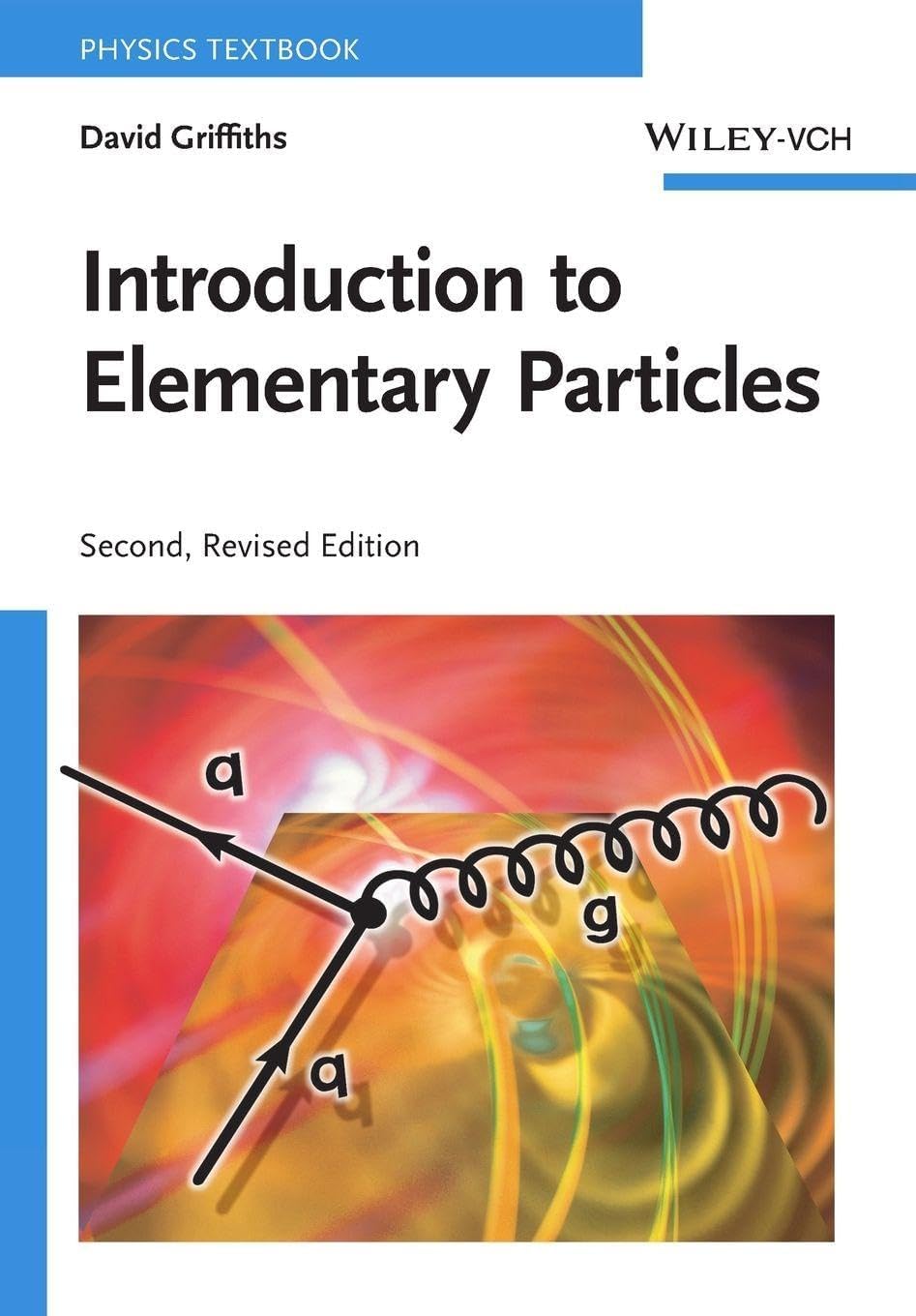
Introduction to Elementary Particles
Product ID: 3662417
Buy anything from 5,000+ international stores. One checkout price. No surprise fees. Join 2M+ shoppers on Desertcart.
Desertcart purchases this item on your behalf and handles shipping, customs, and support to Croatia.
In the second, revised edition of a well-established textbook, the author strikes a balance between quantitative rigor and intuitive understanding, using a lively, informal style. The first chapter provides a detailed historical introduction to the subject, while subsequent chapters offer a quantitative presentation of the Standard Model. A simplified introduction to the Feynman rules, based on a "toy" model, helps readers learn the calculational techniques without the complications of spin. It is followed by accessible treatments of quantum electrodynamics, the strong and weak interactions, and gauge theories. New chapters address neutrino oscillations and prospects for physics beyond the Standard Model. The book contains a number of worked examples and many end-of-chapter problems. A complete solution manual is available for instructors. Review: Physics at its finest - This is possibly the best textbook on any subject that I have ever read. And when I say read I mean cover to cover, several times! (The book is now so shabby and food stained that I'm thinking of buying another copy.) The previous reviews have said it all but I want to summarize some quick points. 1. The footnotes and references are in a class of their own. You MUST read them to get full value. They contain a wealth of critical information. 2. The narrative style and method of explanation in this book makes me feel as though David Griffith is talking one-on-one to me alone. In my opinion he is peerless as a teacher! 3. The ability of this text to present some of the most complex mathematical material in an a simple, accessible and meaningful way using ordinary, jargon free language is just amazing. Of course particle physics is never going to be simple in laymen's terms but the ability to simplify the difficult ideas it contains as much as possible is critical for a student. 4. The ability of David Griffiths to make the subject - even at its most formal and driest points - exciting and alive is a rare and special skill. 5. The problems posed at the end of each section are the gateway to true understanding. They are clear, practical, have a definite educational purpose and are often fun to solve as well. 5. If you are affiliated with a university or other teaching institution and can get hold of the Solutions Manual, you MUST do so. It is a gem in itself and an essential part of the total "David Griffiths" experience. Although this book is an absolute must if you are studying the subject and even if you are merely interested in it, there are a couple of minor quibbles that I need to bring to your attention. Firstly, I would have loved to see a bit more on the fascinating subject of Renormalization and especially some of the deeper implications of Renormalization Theory. As it is the subject is treated in a very practical way and the book contains just enough material to enable one to solve the problems and to get on with other things. A little more would have been nice. Secondly, and much more seriously, my copy of the book arrived with a double sided printout of 53 errata. These range from minor typos to complete show stoppers (if left uncorrected)! In fact there are so many of them, and they often have such serious effect on the text that I have broken a habit of a life-time and penciled in the corrections on the pages themselves. I would normally regard this as inexcusable vandalism but the constant referral to the errata sheet had become tiresome. I regard Wiley the publishers of this book to be one of the best technical publishers in the world and I can only guess at the glitch which let so many errors get through to the print stage. Having said this, once the errors are noted and corrected one can get back to the study and enjoyment of this fine work. Review: Great first introduction into Particle Physics, Feynman Rules and QFT, Terrific Book! Buy it. - This is a great book as an introduction for physics undergraduates students in their final years for the beautiful subject of Particle Physics. I used the first edition back at PUC on my final year of the BSc in Physics and it was of great help. It brings a whole chapter about The Feynman Calculus or Feynman logic, that is, set up the Feynman Rules and use them to calculate diagrams. One thing that I really liked about this book are the diagrams themselves, I mean where else would you find the beta decay of a neutron as a Feynman Diagram showing three lines in parallel for the two down and one up quarks travelling together and then interacting with the weak boson W to produce some lines of the electron and (anti) neutrino, plus some other quarks that are now two ups and one down i.e. a proton. There are also many other fancy diagrams like Yukawa's exchange of a Pion between two protons etc. This new edition has been rewritten in some parts, making it clearer and adding new material to previous chapters of the first edition. It also brings a whole new chapter about the oscillations of neutrinos and instead of one chapter, two chapters of introductory material for all this subject, one about a historical introduction and one on the main constituents of the Standard Model (the four forces, quarks, leptons, bosons or force carrier etc.) It bring very useful problems at the end of each chapter (you can get a lot doing them!) It also brings some very beautiful diagrams of Gellman's eightfold way, some in two dimensions and other arrangements in three dimensional form. Griffiths is a very good author, that is very clear from his best seller book on Electrodynamics (has 5 editions up to now, and that's where I learnt the stuff of Classical Electrodynamics) and another great book on Quantum Mechanics. Terrific book!
| Best Sellers Rank | #202,502 in Books ( See Top 100 in Books ) #27 in Nuclear Physics (Books) #51 in Physics (Books) |
| Customer Reviews | 4.6 out of 5 stars 250 Reviews |
J**N
Physics at its finest
This is possibly the best textbook on any subject that I have ever read. And when I say read I mean cover to cover, several times! (The book is now so shabby and food stained that I'm thinking of buying another copy.) The previous reviews have said it all but I want to summarize some quick points. 1. The footnotes and references are in a class of their own. You MUST read them to get full value. They contain a wealth of critical information. 2. The narrative style and method of explanation in this book makes me feel as though David Griffith is talking one-on-one to me alone. In my opinion he is peerless as a teacher! 3. The ability of this text to present some of the most complex mathematical material in an a simple, accessible and meaningful way using ordinary, jargon free language is just amazing. Of course particle physics is never going to be simple in laymen's terms but the ability to simplify the difficult ideas it contains as much as possible is critical for a student. 4. The ability of David Griffiths to make the subject - even at its most formal and driest points - exciting and alive is a rare and special skill. 5. The problems posed at the end of each section are the gateway to true understanding. They are clear, practical, have a definite educational purpose and are often fun to solve as well. 5. If you are affiliated with a university or other teaching institution and can get hold of the Solutions Manual, you MUST do so. It is a gem in itself and an essential part of the total "David Griffiths" experience. Although this book is an absolute must if you are studying the subject and even if you are merely interested in it, there are a couple of minor quibbles that I need to bring to your attention. Firstly, I would have loved to see a bit more on the fascinating subject of Renormalization and especially some of the deeper implications of Renormalization Theory. As it is the subject is treated in a very practical way and the book contains just enough material to enable one to solve the problems and to get on with other things. A little more would have been nice. Secondly, and much more seriously, my copy of the book arrived with a double sided printout of 53 errata. These range from minor typos to complete show stoppers (if left uncorrected)! In fact there are so many of them, and they often have such serious effect on the text that I have broken a habit of a life-time and penciled in the corrections on the pages themselves. I would normally regard this as inexcusable vandalism but the constant referral to the errata sheet had become tiresome. I regard Wiley the publishers of this book to be one of the best technical publishers in the world and I can only guess at the glitch which let so many errors get through to the print stage. Having said this, once the errors are noted and corrected one can get back to the study and enjoyment of this fine work.
R**A
Great first introduction into Particle Physics, Feynman Rules and QFT, Terrific Book! Buy it.
This is a great book as an introduction for physics undergraduates students in their final years for the beautiful subject of Particle Physics. I used the first edition back at PUC on my final year of the BSc in Physics and it was of great help. It brings a whole chapter about The Feynman Calculus or Feynman logic, that is, set up the Feynman Rules and use them to calculate diagrams. One thing that I really liked about this book are the diagrams themselves, I mean where else would you find the beta decay of a neutron as a Feynman Diagram showing three lines in parallel for the two down and one up quarks travelling together and then interacting with the weak boson W to produce some lines of the electron and (anti) neutrino, plus some other quarks that are now two ups and one down i.e. a proton. There are also many other fancy diagrams like Yukawa's exchange of a Pion between two protons etc. This new edition has been rewritten in some parts, making it clearer and adding new material to previous chapters of the first edition. It also brings a whole new chapter about the oscillations of neutrinos and instead of one chapter, two chapters of introductory material for all this subject, one about a historical introduction and one on the main constituents of the Standard Model (the four forces, quarks, leptons, bosons or force carrier etc.) It bring very useful problems at the end of each chapter (you can get a lot doing them!) It also brings some very beautiful diagrams of Gellman's eightfold way, some in two dimensions and other arrangements in three dimensional form. Griffiths is a very good author, that is very clear from his best seller book on Electrodynamics (has 5 editions up to now, and that's where I learnt the stuff of Classical Electrodynamics) and another great book on Quantum Mechanics. Terrific book!
J**N
Fantastic overview of a complex subject
Griffith's introductory book on the Standard Model of particle physics is a magnificently accessible overview of a very complex subject. The book covers all of the major topics, including the quark model, quantum electodynamics (subatomic level electromagnetic interactions), quantum chromodynamics (strong nuclear force interactions), Feynman diagrams (used to calculate information about particle interactions), electroweak theory (involved in nuclear decay processes). He also presents one of the most easily comprehensible discussions of quantum field theory I've seen. Griffith's writing style is engaging and entertaining, which is very unusual for an advanced physics text. The book is a pleasure to read even if you don't really understand the topics. It was good enough that I sat and read the whole book, end to end. What this book does not have is detailed mathematical derivations of the theories presented. Griffiths provides references to books that contain the proofs and derivations, but he focuses solely on the whats and hows. Another unfortunate drawback is that the book doesn't contain solutions to the problems at the end of each chapter, which would have been nice to have. To really appreciate the book, one should have a college level science background, but one doesn't need to be a full blown physicist or mathematician to appreciate the book (I am a professional chemist, and my mathematical background is not all that advanced). All in all, this is, in my opinion, the best introduction to the Standard Model that's out there.
S**R
Begin here
High Energy Physics would be fascinating even if it were not constantly in the news but even people with a smattering of Quantum Mechanics and strong quantitative backgrounds in general, such as engineers and applied mathematicians, find the subject impenetrable. The troubles begin upon opening any of the many painstakingly written texts on Quantum Field Theory. It all seems dreadfully contrived, especially the covariance of the formalism, and one can do all the exercises yet still be treading water when attempting to read the latest exciting news from Fermilab or CERN or... Give this a try instead: read Griffiths once from cover to cover. Ignore all the excellent footnotes, references and exercises on your first reading. Work through, line for line, Bjorken and Drell's 1964 "Relativistic Quantum Mechanics". It's readily accessible to the reader described in the first line of this review. You will then have covered a staggering amount of fantastic physics, and not a moment will have been wasted in your pursuit of a grasp of the latest screaming headlines about the Higgs and exotic hadrons. You will also have done a lot of the exquisite mathematical needlepoint that the real hep guys do 24/7. Continue to graze in Griffiths. Over and over. Read every footnote, try some exercises, snoop around a few of the references. You may surprise yourself: you may even develop a critical streak. The SM ? Bring it on. Hint: a strange and noisy coffee shop is for me an easier place to concentrate than my quiet study at home. Oh. Did I forget to say? This is such a good book.
B**X
An absolut masterpiece in physics teaching
In my 35 years in physics, this is one of the very best textbooks that I have come across. If you’re interested in elementary particle theory, you’ll do yourself a huge favor to read this book. It provides a wonderfully approachable introduction to a rather esoteric and demanding field of physics, and I guarantee you’ll keep it, and continue to consult it, as you progress. Anyone who ever wrote even a tutorial review article, let alone a textbook for students, appreciates the difficulties this involves. Professionals who wrote a lot of papers but never taught any class themselves tend to scoff at this notion, but personally mastering a subject is one thing; being able to teach it effectively to students requires considerable additional skills above and beyond being a subject matter expert. And when it comes to teaching, Griffiths’ book is just about as good as it gets. Of course, the book is for (upper!) undergraduates. But its level has little to do with the fact that this is an exquisitely well written student text! Profs who think about writing particularly graduate texts would do very well to study the deeper didactic devices Griffiths uses and learn from his style. Students the world over will thank you for it – and are much more likely to buy your book!
H**Z
Me gusta la ciencia
excelente
C**.
Great book, small font
Griffiths, he's great. If you've read and understood undergrad mechanics, e&m (Griffiths), and quantum mechanics (Griffiths), then you're ready for this book and you'll know what to expect from Griffiths. I like his wordy introduction to the subject---he tells the history of particle mechanics like a story, thus making it easier to memorize the particle's names and properties. I'm using this book as a backup to Perkins. Perkins flies through this stuff, Griffiths actually explains it. The font size in this paper back print is kinda small, maybe 10 (pt). Some of the information in this book is dated given the youth of the subject. Nonetheless, I'm finding it to be a good introductory text.
T**T
Book in excellent shape. Griffiths is perhaps the best technical writer I have ever encountered.
I bought because the preview of the first chapters had clear description of basics and definitions that one is always looking for. As I start reading (far from done), it continues with an engaging and approachable style that works more on the "what are you trying to do level than just the math." Which I had this back in college days!! Tremendous book!
G**O
Muy buen libro
Todos los libros de Griffiths son buenos y este no es una excepción. Son libros difíciles de encontrar en las librerías habituales. Aquí lo consigues fácilmente y por un buen precio. Cualquier estudiante de física disfrutará y aprenderá con gusto de este libro.
A**I
Excellent book! (and a printing problem)
⚠️ A warning follows. This book is wonderful, and does exactly what it intends to do: a broad and detailed (and also historical!) introduction to, and review of, particle physics, WITHOUT going to into field theory. This could be a great read BEFORE studying field theory. Griffiths is a great teacher, and the book is written with the reader in mind. Love it. ⚠️ The warning: my copy, bought on Amazon UK and also printed in the UK, had a printing problem: printed too small, leaving much of the page white, making it a bit strenuous to read. Shame. The paper is of good quality, but printing is tiny.
P**R
Schöne und umfangreiche Einführung
Ich habe mir dieses Buch zur Vorbereitung auf meinen Schwerpunkt im Master-Studium angeschafft. Die von mir gesteckten Erwartungen wurden voll erfüllt. Die Lektüre ist nicht zu trivial und holt den Physikstudenten, der keine Ahnung von Particle Physics hat, an der richtigen Stelle ab. Ich habe jetzt einen schönen Einblick in das erhalten, was mich (hoffentlich) im Studium erwartet.
P**R
Libro
Llegó en tiempo y en buen estado
L**S
Quase perfeito
O livro possui um conteúdo inestimável, o autor consegue passar um conteúdo técnico mas em linguagem pouco formal, o que facilita muito o gosto pelo estudo. Mas o preço que disso é que o livro não "pega na mão do aluno", se quiser mais detalhes sobre as contas, terá que faze-las ou buscar outra referência. Sobre o material, as folhas parecem um papel cartão, não sei que tipo de papel é, primeiro livro que compro com esse tipo, são de muita qualidade e tornam a gráfica ainda mais bonita. Apesar dos pontos fortes, a encadernação é uma decepção, não fazendo jus ao preço altíssimo. A capa não da robustez alguma ao livro, ele é extremamente "molenga", o que o deixa muito instável na estante, podendo cair facilmente e danificar o material com rasgos e amasso, não fazendo jus ao preço altíssimo dele em real.
Trustpilot
1 month ago
3 weeks ago