Desertcart purchases this item on your behalf and handles shipping, customs, and support to Croatia.
๐ฑ Measure Deep, Water Smart โ Never Over or Under Again!
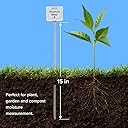
The REOTEMP 15 Inch Garden and Compost Moisture Meter is a professional-grade tool designed for gardeners, farmers, and composters seeking precise soil moisture readings. Featuring a rugged stainless steel 15-inch probe and a user-calibratable 0-10 wetness scale, it delivers instant, reliable moisture data to optimize watering schedules and plant health. Powered by a single AAA battery, this durable meter is built to withstand tough soil conditions and provide accurate readings deep in the root zone.
| ASIN | B07DM4LS1D |
| Battery Description | AAA battery |
| Best Sellers Rank | #36,617 in Tools & Home Improvement ( See Top 100 in Tools & Home Improvement ) #18 in Moisture Meters |
| Brand | REOTEMP |
| Brand Name | REOTEMP |
| Customer Reviews | 4.1 out of 5 stars 1,365 Reviews |
| Item Weight | 0.62 Pounds |
| Manufacturer | REOTEMP |
| Model | 43398-50865 |
| Mounting Type | Tabletop |
| Part Number | 43398-50865 |
| Smart Home Compatibility | Not Smart Home Compatible |
| Temperature Reading Accuracy | plus_minus_1_degree_celsius |
| UPC | 853850002287 |
| Unit Count | 1.0 Count |
| Upper Temperature Range | 40 Degrees Celsius |
| Upper Temperature Rating | 40 Degrees Celsius |
B**G
Well built and serves my application.
This measures current through soil and the least resistance is saturated dirt, not fresh water. This is important if you are trying to calibrate the 10. I like that the probe is strong enough to be able check several spots around my fruit trees. No fear of breaking it. I already decided not to water one zone the first day, Thatโs why I bought it, so Iโm happy.
J**.
Quality, solid, construction
I have been using my Reotemp moisture meter for 1 month now. I am mostly impressed with its construction, solid metal case, and robust, thick, non-bending probe. I bought this meter for those reasons as the other available moisture meters have very flimsy probes that end up bending and breaking when placed in the soil to take readings. We have a new home and have done a lot of costly landscaping, plus put in a tomato/ vegetable garden and monitor our water needs daily. Our soil has a high clay content, so in some areas drains poorly, so in some instances one can easily overwater-- so a decent moisture meter is an essential tool. The Reotemp's probe extends 15", so you can measure down in the root area of most plants, for accurate readings. The meter has a quality, easy to read basic scale that gives you relative moisture meters (not % of moisture). First you set it up, and set it to a previously watered area to give you a relative reading of satisfactory moisture. This is all relative so you have to set it up to what you consider a healthy/plant soil moisture condition. The meter readings our easily adjusted with a screw driver. I set mine to six on the scale, so there is room to read over or under moisture conditions. Everyone probably will use their own criteria. The first few days I tested it against other meters I had and it was always accurate and dependable for a good reading. The probe is probably 1/4" + thick, and has no problem getting down into fairly compacted plant medium. It certainly is making gardening a lot easier for me taking daily readings-- as I don't like to water to a schedule, but rather, water when a plant actually needs it. I recommend the Reotemp meter! Joseph
J**P
Works Well.. for multiple Uses
I got tired of the always break Home Depot/Lowes models made in China. This is made by Reotemp a high end industrial supplier based out of California. They sell more robust version of this product which I think are made in the USA. This one was made in communist china. I took it apart and while the quality of the components was pretty good, the mfg was not and the calibration screw was not mounted properly but I could still access it and use it. These device use galvanic current action which trips a electromagnet and requires a coarse calibration to use. The Calibration directions are not correct. You should use a two point calibration. First stick the device in water and make sure it reads above full scale and the meter is pegged. Next take a known soil source that you have water thoroughly, such as a pot you have dripped through thoroughly and is truly wet. Then stick the probe in and make sure it reads full scale by adjusting the calibration screw if required. Then take some dry potting soil or other very dry soil and make sure it reads near zero. The mfg sells direct to the public and has wireless versions. These are primarily used, I think for testing commercial compost piles although those use a longer probe. You cant keep this out 24/7 but you can check your compost soil and most soil. The case and probe are pretty rugged but your not going to be able to use it to check hard clay soil due to the fragile electromagnetic. I use it for checking my compost pile but mainly for checking the 200 or so potted plants and numerous garden beds that use compost based soil. You should be aware if you have salty soil this probe will read a higher water content than you have. Real moisture sensors are called tensiometers and cost hundreds of dollars. This is a deal for 35 dollars and the quality should give you a decade or more of use if you don't pound it into the soil. Infinitely better than the made in china garbage you can get at Home Depot or most gardening stores which simply does not work well and dies in short order.
D**E
So Far, So Good
MM17 Moisture Meter I use this meter primarily to keep tabs on my lawn irrigation system performance. This evaluation is based on 3 weeks of use. Durable construction: The meter/electronics/battery box is made from 0.1โ (10 gauge) thick aluminum - very substantial construction. It has a stainless steel probe, 5/16โ diameter x 17โ long making it useful for lawn, plant or compost use. I expect little problem with rust or corrosion. And I donโt have to bend over too far to make lawn soil readings. Sensible design: The meter indicator is a dial and pointer style which means it can be read in bright sunlight, unlike the digital LCD indicator types that either wash out in sunlight or cannot be read at an angle other than head-on. The meter face is visible from above the instrument which means you donโt have to lie with your face on the ground to make lawn soil readings. Special feature: User calibration - Ideal moisture content will vary among soil types and the kinds of plant life growing there. So no one moisture meter can tell you what is too โdryโ or โwetโ for your conditions. The calibration feature lets you determine what the meter should read for conditions you deem to be โgoodโ. To calibrate, I dig a test hole to the depth I want to test and see how well soil sticks to my skin. When I find a spot that looks about right, I probe close to the spot and calibrate the meter to mid scale, leaving enough dial space to indicate plus or minus deviation on future readings. The 1 Yr warranty is better than some cheaper meters. Negative: Made in China. No problems yet, but, just sayin . . . things I canโt see may limit durability. From here, it is my hope that the sensitivity of the MM17 will remain consistent.
T**Y
Inconsistent Readings.
Model: 24" probe. I had a moisture meter several years ago that was very much like this one. I sent it back because the readings were very inconsistent. When I received this unit, I decided to conduct an experiment. I have three tomato plants that are all planted in an above ground bed. All of the plants are spaced approximately 24" apart. All three plants were watered with the same amount of water. Drainage in the bed is excellent. After allowing the excess water to drain away for two hours I began my experiment. Per the manufacturer this unit must be calibrated before use. This device does not display a specific volume of moisture in the soil. Instead, it provides a comparison of the current reading to a previous "ideal" reading that was determined and set by the user. The calibration starts by inserting the probe into soil that already has the "ideal" amount of moisture as determined by the user. The meter is then adjusted (using a small screwdriver), until it reads "5" on the scale ("0" indicates Dry, and "10" indicates Wet). When later readings are taken, the user can see if the current reading is "low" or "high" in comparison to the previously determined "ideal" reading. This all sounds great in theory. But how well does it actually work? Not very well in my opinion. After probing the soil multiple times about four to eight inches deep around all three plants (and at multiple angles), the readings were all over the place between 2 and 8. I then probed some soil several feet away that had not been recently watered and it was quite dry. Again, the readings were all over the place. Which reading is correct? Is "2" displayed on the scale correct, or is "8" on the scale correct? I have no idea. The end result is that I ended up poking my finger in the soil to make my own determination. And if I'm going to do that, what do I need a moisture meter for that provides inconsistent readings that I can't trust? Indeed. I sent it back.
J**Y
This Thing Flat Out Works!
I bought seven several year old cherry trees in 5 gal containers and immediately transplanted them into 35 gal containers. With summer coming on I was concerned I might not water them enough and that in reaction I might overwater them. I set up an automatic watering system where the main variables were when, for how long and how many times per day to water them. The moisture meter worked right out of the box and I quickly discovered the soil was extremely saturated near the container sides and bottom, (9 on the scale) but much drier near the root ball (2 - 3 on the scale). I changed the flow pattern to correct this, getting a uniform 4 to 5 reading every where. It didn't take long with the moisture meter to determine the trees liked a reading of 4 on the scale and I set the watering to start their day between 4 and 5, with two early morning waterings, going down to around 3 late in the afternoon before a single watering in the evening to bring it back up to 4 for overnight to keep them comfortable even though not growing then. When I found the surface area was much dryer (2 to 3) than halfway down, (the potting soil in the containers is nearly 14 inches deep) I obtained some large chip size cedar shaving mulch, and the surface moisture came up to the 4 moisture value they really seem to thrive on. The trees have added 14 inches of new growth, nearly tripling in leaf abundance in the five weeks since I got them and I am certain that this is in no small measure due to using this Moisture Meter with its 15 inch probe to find the moisture level the trees like, and be able to easily monitor and maintain it. Kudos ReoTemp! My cherry trees are sailing towards Cherry Blossom Time big-time thanks in large part to your really excellent Moisture Meter that has worked perfectly in my deep potted soils application!! In rating features, absolute Accuracy is not something I could measure, but repeatability of measurement reading, relative Accuracy, for given soil moisture levels is excellent in my uniform soil type application for sure. I am thankful I got it, and most importantly, my cherry trees are thankful too!
A**R
Good For Compost, Inaccurate For Soil
These meters are sturdy, made of stainless steel and folded steel plates. The inner construction is simple; an alkaline 1.5V AAA battery, a potentiometer (for calibration), and a needle meter. The 17" long probe is very helpful for testing deeper soil and compost. The manufacturer makes even longer models, but they couldn't be found on Amazon.com. I spoke with the manufacturer, for help, when the meter was giving a high reading in dry soil. They were very pleasant to speak with, USA local -English native speaking, and willing to spend as much time as needed. The meter gives high readings in compacted dry soil with any significant mineral content; unless the soil is fluffed/cultivated, the moisture meter does not work accurately. I tested this against other models of moisture meter, with the same results. The conclusion being that these types of moisture meters cannot be trusted as accurate in soil, but should work fine in compost or other non-mineral rich/salty materials.
P**S
Wonderful product, but I didn't understand the most important part about using it!
This is a wonderful product! It's quickly become my favorite garden tool. But there is something in particular that I did not understand about how to use it when I bought it. I see now that the manufacturer's product description includes this information, but I didn't really understand it. Now I do. The manufacturer's description includes the following words: "The 0 to 10 scale of the MM24 indicates a relative "wetter" or "dryer". I missed the meaning of that at first. Once I got the meter I figured it out. The 0 to 10 moisture scale is not in some type of universal moisture units. It is a relative scale - relative to some sample soil that you have chosen to calibrate the meter to. The calibration process is easy, it doesn't take more than 2-3 minutes to do. But it is very important. There is a little screw, under a little rubber cap, on the back of the meter. This is the calibration screw. You find (or mix together) some reference sample soil that you feel has a reasonable amount of moisture contained in it for the type of plants you will be using the meter on - not sloppy wet, but not obviously too dry (I used some soil in an outside planter box to calibrate my meter to that I had just watered well and allowed to drain well). With the meter placed at least a few inches into the sample soil, you turn the screw until the meter needle reads "5" on the "0" to "10" scale. Replace the rubber cap over the screw. Your meter is now calibrated to your sample soil. These calibration instructions are actually printed in very small text on the back of the meter. When you test other soils in the future any reading under "5" is dryer than your sample was, and any reading over "5" is wetter than the sample soil was. I have concluded that any reading of between about 3 and 7 are acceptable for the plant I am checking. I think this is a brilliant system. You determine the range of wetness you want for your trees/shrubs/plants. After calibrating the meter to that reference point you are then comparing all other soils to it. If you have dramatically different types of plants (e.g. cactus vs bamboo) you might have to re-calibrate for each of those. My meter is the 24" version. When checking trees, especially two young small ones I have planted during the past few months, I have found it is important to slowly push the meter stem all the way down the 24" inches, while watching the meter during the process to get an idea of how wet the soil is at different depths. Sometimes it is pretty dry the first few inches, but by the time I get about 12" to 15" deep it is registering 8 to 10 on the meter. So I know not to water yet because the tree's root ball was planted 24" deep. Other times it is pretty wet the first few inches from lawn watering, but only registering 2 or 3 on the scale at deeper levels, so I know it is time to water it.
V**I
Que funcione
NO SIRVE !!!!! En primer lugar las instrucciones dicen: remover cinta roja Y NIO HABรA TAL CINTA. Despuรฉs dicen calibrar usando la muestra de suelo hรบmedo. Lo hice y NO RESPONDE, intentรฉ varรญas veces a diferentes humedades y la aguja en el indicador siempre estรก entre 2y4, NI SE MUEVE, ni se puede calibrar. ME LI DEBEN CAMBIAR!!!!
M**R
Nice long stem to reach the roots of plants
Works ok. Not as accurate in reading soil moisture as I had hoped. Nice long stem to reach the roots of plants.
B**Y
Sturdy, well built, and consistent
Out of the box the meter is already usable (about right for my indoor plants) without calibration. Compare to other cheap soil meters that I've used before, this one is definitely well/over built. The only thing that I don't like it is the battery compartment, after removing the 4 screws, you'll find the battery holder at the back, not easily accessible. It should be rearranged and place in the front.
R**S
Works well for lawn moisture recording
Despite other reviews saying that they're a waste of time. I found it Very useful in recording my lawn moisture content over a wide area. The instructions say calibration is required when first using (using The screw), but experimenting I found that it was fine straight from the box.
T**D
Worth the price
We have so many large trees in the yard, that even with a couple days of rain, we were never really sure how much water was actually getting to different areas in the perennial beds. This meter has helped take the guess work away and we are very pleased with its simplicity and construction.
Trustpilot
3 days ago
1 week ago