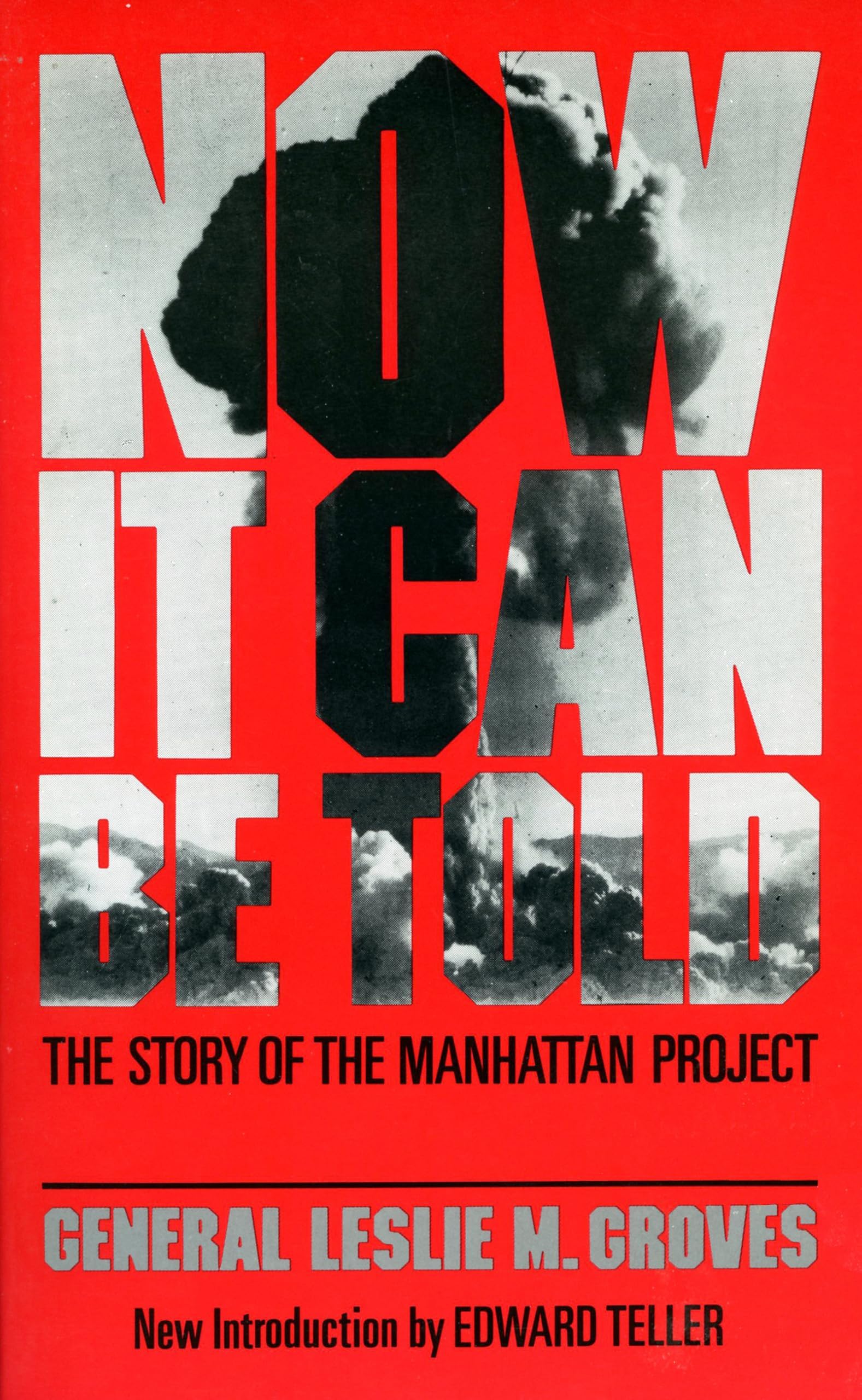
Now It Can Be Told: The Story Of The Manhattan Project
Product ID: 3907289
Desertcart purchases this item on your behalf and handles shipping, customs, and support to Croatia.
General Leslie Groves and J. Robert Oppenheimer were the two men chiefly responsible for the building of the first atomic bomb at Los Alamos, code name "The Manhattan Project." As the ranking military officer in charge of marshalling men and material for what was to be the most ambitious, expensive engineering feat in history, it was General Groves who hired Oppenheimer (with knowledge of his left-wing past), planned facilities that would extract the necessary enriched uranium, and saw to it that nothing interfered with the accelerated research and swift assembly of the weapon.This is his story of the political, logistical, and personal problems of this enormous undertaking which involved foreign governments, sensitive issues of press censorship, the construction of huge plants at Hanford and Oak Ridge, and a race to build the bomb before the Nazis got wind of it. The role of groves in the Manhattan Project has always been controversial. In his new introduction the noted physicist Edward Teller, who was there at Los Alamos, candidly assesses the general's contributions-and Oppenheimer's-while reflecting on the awesome legacy of their work. Review: As Told to a New Generation - `NOW IT CAN BE TOLD The story of the Manhattan Project' by Leslie R. Groves Academics record memoirs. So the story of the atomic bomb by and about physicists, mathematicians, and other academics are many. Military people, in comparison, write less frequently. So General Leslie Groves `Now it Can be Told' fills a unique need, particularly for the post-WW2 anti-Vietnam generation. The philosophical clash is obvious: military discipline v's academic freedom; force of arms v's pursuit of knowledge; free enquiry v's security with "compartmentalization of knowledge"; freedom v's discipline; management v's theoreticians; power v's idealism; or such comparisons. Groves presents a factual account of the project management being "an even greater adventure into the unknown than the first voyage of Columbus" in which "never in history has anyone embarking ... had so little certainty" as "there has never been an improvement in weapons comparable in degree and sudden impact to the atomic bomb". From grand construction, security, relations with the British, intelligence from Germany and Japan, often minor detail, plus insights of honesty such as General Eisenhower "I have so many things to deal with that it puts an undue burden on me to be given any secret information, as I am forced to think what is secret and what is not." Groves shoves the physics into place: "The need for a sound knowledge of atomic physics was much less vital..." for "...it is not extraordinarily difficult for anyone who will apply himself ... to understand the basic principles of atomic physics". He describes the priority of the nation to achieve success partly because of the amazing response of USA firms such as du Pont and Allis Chalmers. He dismisses academic anti-management advice. And when it is all over the withdrawal symptoms are clear. Yet our generation can but wish for more personal detail. Here is a man who dealt with Einstein, Oppenheimer, Teller, etc plus USA presidents and politicians. Here is a disciplined management/military general who intersperses, perhaps surprisingly, at least six welcome humorous paragraphs. It matters not that the neutron waits 55 pages for a fleeting mention. But it is regretful that General Groves neglects his own background, his CV and prior knowledge of physics for example. We wait for the third last paragraph of the book to find: "When I was a boy, I lived with my father in a number of the Army posts that had sprung up during the Indian wars ... There I came to know many of the old soldiers and scouts who devoted their active lives to winning the West. And as I listened to the story of their deeds, I grew somewhat dismayed, wondering what was left for me to do now that the West was won." Yet he does not mention that his father was a military pastor. There is sadly no feeling for the inter-relationships between Groves and Oppenheimer who he appointed while "thoroughly familiar with everything that had been reported about [him]" but gives no detail. How theoretical physics cascaded down to management requirements. Or even why 1250 tons of uranium ore had been previously mined in the Belgium Congo. What for? And finally why two bombs, U235 and plutonium, were necessary to end the war and save lives rather than one. In comparison, Groves gives satisfying detail in describing the reaction of captured German physicists - including Otto Hahn and Werner Heisenberg - to the news "If they have really got it, they must have been very clever in keeping it a secret" ... "That shows the Americans are capable of real co-operation on a tremendous scale". Review: This Edition has an Odd Typesetting That Varies in Quality--Kind of an Offset Print of the Original - The book, while somewhat dated, offers a sound foundation for someone wishing to learn more about the Manhattan Project. The technical data is detailed enough to provide the full picture, but still easy for the layperson to understand. it would be nice to have an updated Introduction as the Edward Teller Introduction was written in 1983. The main complaint I have about the book is the quality of the printing. I don't know the terminology to use, but it looks like a copy of the original text--not quite clear, and in some places the edge of the text is missing. If you can find another version, you might be happier. Otherwise, this edition does the job, but could be better in its quality.
| Best Sellers Rank | #73,420 in Books ( See Top 100 in Books ) #23 in Nuclear Physics (Books) #27 in Nuclear Weapons & Warfare History (Books) #28 in Conventional Weapons & Warfare History (Books) |
| Customer Reviews | 4.4 out of 5 stars 568 Reviews |
M**N
As Told to a New Generation
`NOW IT CAN BE TOLD The story of the Manhattan Project' by Leslie R. Groves Academics record memoirs. So the story of the atomic bomb by and about physicists, mathematicians, and other academics are many. Military people, in comparison, write less frequently. So General Leslie Groves `Now it Can be Told' fills a unique need, particularly for the post-WW2 anti-Vietnam generation. The philosophical clash is obvious: military discipline v's academic freedom; force of arms v's pursuit of knowledge; free enquiry v's security with "compartmentalization of knowledge"; freedom v's discipline; management v's theoreticians; power v's idealism; or such comparisons. Groves presents a factual account of the project management being "an even greater adventure into the unknown than the first voyage of Columbus" in which "never in history has anyone embarking ... had so little certainty" as "there has never been an improvement in weapons comparable in degree and sudden impact to the atomic bomb". From grand construction, security, relations with the British, intelligence from Germany and Japan, often minor detail, plus insights of honesty such as General Eisenhower "I have so many things to deal with that it puts an undue burden on me to be given any secret information, as I am forced to think what is secret and what is not." Groves shoves the physics into place: "The need for a sound knowledge of atomic physics was much less vital..." for "...it is not extraordinarily difficult for anyone who will apply himself ... to understand the basic principles of atomic physics". He describes the priority of the nation to achieve success partly because of the amazing response of USA firms such as du Pont and Allis Chalmers. He dismisses academic anti-management advice. And when it is all over the withdrawal symptoms are clear. Yet our generation can but wish for more personal detail. Here is a man who dealt with Einstein, Oppenheimer, Teller, etc plus USA presidents and politicians. Here is a disciplined management/military general who intersperses, perhaps surprisingly, at least six welcome humorous paragraphs. It matters not that the neutron waits 55 pages for a fleeting mention. But it is regretful that General Groves neglects his own background, his CV and prior knowledge of physics for example. We wait for the third last paragraph of the book to find: "When I was a boy, I lived with my father in a number of the Army posts that had sprung up during the Indian wars ... There I came to know many of the old soldiers and scouts who devoted their active lives to winning the West. And as I listened to the story of their deeds, I grew somewhat dismayed, wondering what was left for me to do now that the West was won." Yet he does not mention that his father was a military pastor. There is sadly no feeling for the inter-relationships between Groves and Oppenheimer who he appointed while "thoroughly familiar with everything that had been reported about [him]" but gives no detail. How theoretical physics cascaded down to management requirements. Or even why 1250 tons of uranium ore had been previously mined in the Belgium Congo. What for? And finally why two bombs, U235 and plutonium, were necessary to end the war and save lives rather than one. In comparison, Groves gives satisfying detail in describing the reaction of captured German physicists - including Otto Hahn and Werner Heisenberg - to the news "If they have really got it, they must have been very clever in keeping it a secret" ... "That shows the Americans are capable of real co-operation on a tremendous scale".
B**N
This Edition has an Odd Typesetting That Varies in Quality--Kind of an Offset Print of the Original
The book, while somewhat dated, offers a sound foundation for someone wishing to learn more about the Manhattan Project. The technical data is detailed enough to provide the full picture, but still easy for the layperson to understand. it would be nice to have an updated Introduction as the Edward Teller Introduction was written in 1983. The main complaint I have about the book is the quality of the printing. I don't know the terminology to use, but it looks like a copy of the original text--not quite clear, and in some places the edge of the text is missing. If you can find another version, you might be happier. Otherwise, this edition does the job, but could be better in its quality.
A**E
Interesting & highly educating.
The duo of the late General Leslie Groves (1922 - 1970) and Robert J. Oppenheimer (1904 - 1967) were the midwives of the first atomic bomb and the birth of the nuclear age. General Leslie Groves as one of the main actors of those times penned a book that is unbeatably interesting and highly educating. My interest in the book delves from the point of view of project management. To this end, I was not disappointed at all. From the begining to the end, there is no let-off. You will keep on reading to the last page. The displayed leadership and management efforts needed to guide this monumental project from mere theoretical concepts to practical reality in a relatively short timeframe was quite unparalleled in history. Students of management and project managers will find invaluable insights here. While I am not celebrating the waste and loss of invaluable lives resulting from World War II (or any war for that matter), it is a testament to American ingenuity that a bomb that was decisively important towards winning the war was not yet completely assembled or tested just about three weeks before it was first deployed in the warfront. And yet it worked on first try! As stated by the author, the first gun-type atomic bomb was dropped in combat without a prior test to ascertain if it will work, "Nevertheless, the indications for success were strong enough so that no one urged us to change our plans of dropping the first gun-type bomb in combat without prior test." From the book, it is clearly evident that, it was World War II that made the development of atomic bomb and atomic energy possible. It would have been very difficult for any nation (America included) to contemplate and commit to such a costly project (running into several hundreds of billions of dollars in today's money) in the time of peace. I whole heartedly concur with the author that the world is a better place today and is still what it is because America was the first nation to create the atomic bomb and also developed and master nuclear energy. One can only imagine what would have happened if such power has fallen into the hands of Adolf Hitler and Nazi Germany, or to Josef Stalin in the hey days of the Soviets. The bombing of the World Trade Centre in New York on September 11, 2001, the Paris massacres of November 2015, and many others are unimaginably evil. Heinous as they were, these atrocities would have paled to mere children-plays in comparison to what these terrorists and their sponsoring power hungry individuals and nations would have done if they ever get access to these weapons of calimitous destruction first. NOTABLE EXCERPTS FROM THE BOOK "Only strength can counter an adversary determined to enforce his goals by physical force." "… nothing would be more fatal to success than to try to arrive at a perfect plan before taking any important step." "I wanted a man who was experienced in the oil industry, feeling that he would be used to making quick, conclusive decisions, based, if necessary, on very limited information. I did not want anyone who would always insist on 100 per cent proof before making a move.." "He reminded me that no weapon developed during a war had ever been decisive in that war." "I suggested that the time was fast approaching when we should begin to make plans for the bombing operation itself, even though we still had no assurance that the bomb would be effective." "… a nuclear war could never be fought on this earth without bringing disaster to all mankind." "… if we played it safe, we could never hope to win; chances had to be taken." "While it is tragic that the forces for destruction that we unleashed are stronger than man’s present ability to control them, it is fortunate indeed for humanity that the initiative in this field was gained and kept by the United States." "We know now that when man is willing to make the effort, he is capable of accomplishing virtually anything." All quotations and excerpts are from the book: Now It Can Be Told - The Story of The Manhattan Project By General Leslie Groves ©Da Capo Press, Inc. 1962
D**Y
Invaluable lessons on project leadership
This book was probably not intended to be a course in project leadership. However, I probably learned more about project leadership from it than any other source. I spent most of my 50-year career planning, organizing, leading and managing projects in a variety of fields. I started out as a mechanical engineer, got into computing, went into in management consulting, worked in finance and finished out my career in computing security. A common denominator of these projects was a lack of common denominators. They often dealt with things that neither I nor others had prior experience with when viewed from an overall perspective, and sometimes not even from a detailed perspective. The true scope, difficulties encountered and solutions required were often poorly understood before the project began and often not understood much before they became apparent during the project. Groves' Manhattan Project was like that, only in spades, on steroids, and at an intergalactic scale. If you find yourself in charge of projects of his nature, I highly recommend you read this book.
E**C
Not a good read.
Too many details presented in a mind numbing fashion. An interesting story but not an interesting read. Be ready to skim.
A**R
A Rich, Clear, Thorough Account of an Outstanding Achievement
As I read this account of the Manhattan Project, I felt awe at what can be accomplished by determination and focus, multiplied by cooperation. I have been familiar with fragments of history of the development of the atomic bomb; this book brought it all together and added immense depth. A day-long visit to Hanford last summer prompted me to read Now It Can Be Told, and it has resulted in a greater appreciation for what was accomplished in less than four years. I mourn the loss of such spirit in this country, as well as the revisionist history that disparages this achievement which truly ranks among the most significant in human history. Criticisms that Groves was arrogant or hogged credit are so baseless I have to conclude that people who wrote such things didn't read the book and are just spewing talking points. The book also makes it clear that there was not some kind of bloodlust or racism behind the project or the dropping of the bombs. Groves was generous in his praise of the skill and dedication of so many people, and he was also humble without being falsely so. He recounting was even, and there is no sense of political agenda. For as objective as it is, it reads like an outstanding spy/action/thriller novel. Perhaps that is because it recounts a true achievement; such accomplishments don't need false drama. If you want to be inspired by true human triumph, if you want to see what real leadership is, if you are tired of paeans to rock stars and actors and sports figures and people whose create diversions and entertainment, and, instead, you want to see how people can develop fundamental knowledge of the universe, apply that knowledge to tangible results in the real world, all under immense difficulty, and to the most honorable purpose (ending a savage war by nations that wanted to subjugate the peoples of the world), then you will find this refreshing.
M**Y
First person story about an important series of historical events
General Groves was a very important figure in the Second World War, and this is mostly a first person account of the Manhattan District project. It reads very well but at the end there are things about which I would have liked to know more. Groves does not describe in enough detail his relationship with Oppenheimer, and he does not describe at all the Soviet spies in the program. Fuchs, Greenglass, the Rosenbergs and so forth. One suspects that he could not say much about them because, when he wrote the book, many of the details were still classified. That said, this book does outline what went on in the development of the atomic bomb used to subdue Japan.
D**R
The Unbelievable, Expensive and Fantastic Making of the Atomic Bomb
This book is a fantastic description of the various technical processes for enriching Uranium and making Plutonium, the major scientists engaged in the project and the limited political involvement to accomplish the Manhattan Project. General Groves describes the major obstacles from the first successful chain reaction in Chicago, to building the massive plants and facilities at Hanford, Los Alamos and Oak Ridge, each employing thousands of people – all while keeping the two billion dollar project an absolute secret from the military, congress and the general population. Even the thousands workers at the enrichment plants did not know or understand what they were doing. On top of it all was the fear that this $2 Billion project might not produce a destructive atomic bomb before the Nazis. Scientists believed in the results but there was no guarantee that the enriched U235 or Plutonium would actually create the theorized explosions. Now It can be Told: The story of the Manhattan Project is a great book. Well written, easy to understand, providing great insights to the required resources, technical processes, chief scientists, enrichment plant production chiefs and training of B29 Army Air Force crews to deliver the “gadget.” A great read, highly recommended.
A**O
Muy bueno
Muy buen resumen del Proyecto Manhattan. Muy buen complemento al libro de Rhodes, invluye un resumen del proyecto Alsos en sus tres etapas.
雨**郎
原爆開発の実話
キンドル版の購入・ダウンロードにあたり二度クリックデモしたのか、料金が二重請求されている。Kindle端末には1コピーのみダウンロードされている(2以上は当然不要)。 返金するようここに改めて請求します。
D**O
Really impressive
It is an exciting book giving a different perspective --that of an insider- to an enormous project.
C**W
Hard work
I was hoping for something more readable on this interesting subject, but this book is very dry, the author is hard to like and it takes a lot of effort not go give up.
M**D
As advertised
Prompt delivery. In the condition stated
Trustpilot
4 days ago
2 months ago