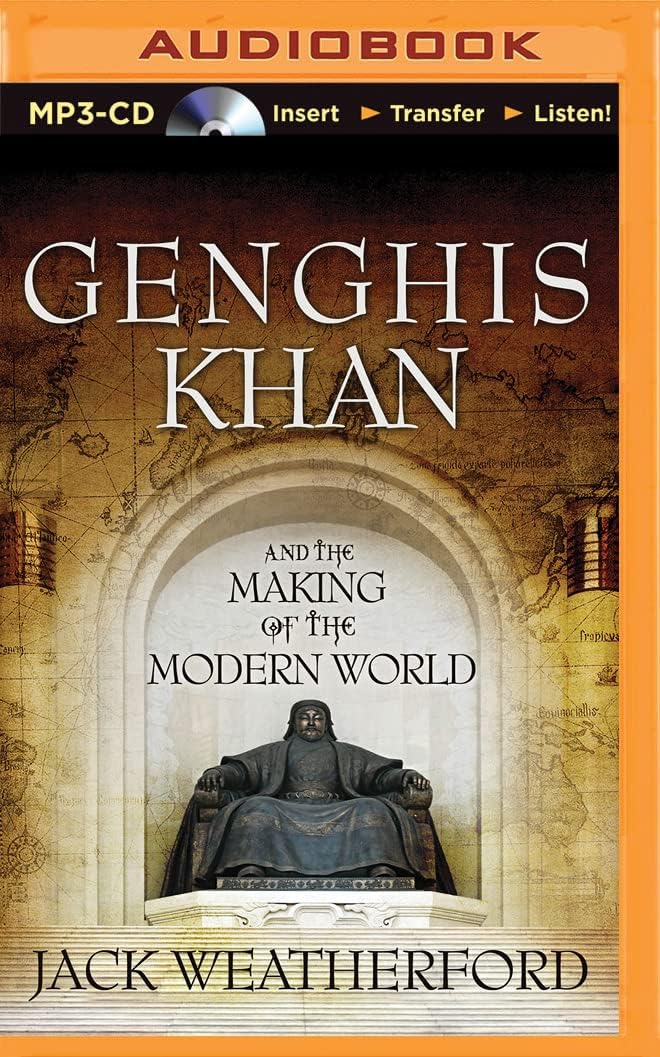
Genghis Khan and the Making of the Modern World
Product ID: 39373322
The Mongol army led by Genghis Khan subjugated more lands and people in twenty-five years than the Romans did in four hundred. In nearly every country the Mongols conquered, they brought an unprecedented rise in cultural communication, expanded trade, and a blossoming of civilization. Vastly more progressive than his European or Asian counterparts, Genghis Khan abolished torture, granted universal religious freedom, and smashed feudal systems of aristocratic privilege. From the story of his rise through the tribal culture to the explosion of civilization that the Mongol Empire unleashed, this brilliant work of revisionist history is nothing less than the epic story of how the modern world was made. “Reads like the Iliad…Part travelogue, part epic narrative.” — Washington Post “It’s hard to think of anyone else who rose from such inauspicious beginnings to something so awesome, except maybe Jesus.” Review: "A Powerful and enlightened reversal of the 'Mongol' image. - Weatherford's remarkable book about Genghis Khan and the Mongols, and their contributions to our world today seems so well researched, well written, full of surprises and reversals, introducing information that to me is new and radically different from what I had learned in school--and thus had believed most of my life--reading this book was not only enjoyable but was also an image reversal for me. I now consider it one of the few books that has changed my view and appraisal of a significant part of history and of a man and a people who dominated that period. The man: Genghis Khan. The people: the Mongolian hoards. I had previously thought of Genghis Khan and the Mongolian hoards as the embodiment of "evil, cruel, barbarian." But while reading this book my image of that man changed to one of a man who should stand among the greatest men of history, and of a people who created and promoted the foundations of many of the things our modern world now considers "good, progressive, and civilized." Until now, the contributions of Genghis Khan and the Mongolians have gotten little or none of the credit due them for their monumental contributions to our current "civilized" way of life. It's possible that Weatherford goes too far and promotes Genghis Khan and the Mongols beyond their merits. I have read criticisms of the author for making mistakes in some of the factual details. Perhaps he did. I am not qualified to judge. But I doubt anyone researching and writing a work of the same scope as "Genghis Khan" has ever gotten all the details right. Perhaps it is impossible to do so. If such mistakes indeed do exist in the book, (which they must), we cannot forget the writer's pupose: restore the man and the people to their rightful positions. The writer paints with a broad brush, which is what is needed to reshape the "big picture" of the Mongols and their contributions to our modern world--which to me he did brilliantly and convincingly. Achieving that goal, in my opinion, goes far beyond atoning for any "mistakes in details." In this case, God is NOT in the details. To me, such "mistakes in details" rank no more than tiny specks of dust on the book's pages. The act of reading the book is a fascinating and compelling journey of discovery through which the author leads the reader in his attempt to restore credit and recognitions to a brilliant and resourceful leader and to the great people who followed him. Both were far ahead of their time. In his attempt to restore respect, credit, and recognition to them for their contributions, Jack Weatherford has earned my respect, and I credit him with achieving his goal of changing, even reversing the Mongol image--at least with me. Recognizing that I am unqualified to be a final judge of a work so grand in size, time, people, and contributions, from my personal vantage point, I see few if any ways the book "Genghis Khan" could be improved if judged by how well it achieves its goal of restoring a man and a people to their rightful and deserved positions in history for their contributions to the world today. What I liked best about this book was the many surprises and unlikely events and endings the author skillfully leads the reader through. I loved seeing how the reputation of Genghis Khan and the Mongols has ebbed and flowed, up and down, good and bad through the centuries following their initial conquests, resourcefulness and contributions. The details of the individual Mongols of the1200's and the respect and honor they are still shown by their descendants 800 years later gives credible support to the author's successful attempt--successful to me, at least--of re-establishing Genghis Khan and the Mongols to their deserved and well-earned status as important shapers of our modern world. Maybe it is an overkill, as some suggest, but after centuries of being demonized, perhaps an overkill is what is needed. In some areas, we may not yet have caught up with, let alone surpassed some of the Mongol's achievements. The descriptions of the religious tolerance and the peaceful mixing and co-existence of such various religions was moving to me. It is an example of something we have not yet succeeded in matching let alone exceeding today. Most of the Western world, and certainly much more, such as the Muslim world, have been taught gross distortions about Genghis Khan and the Mongols in both their schools and churches. Learning about the Mongol invasions into Europe while I was in high school, I felt a genuine revultion towards them. I felt, if not voiced, a "Thank God!" when the Mongol hoards were stopped at Vienna. Jack Weatherford, through his book, Genghis Khan, has caused me to rethink those old feelings and judgments and wonder how different our world would be--and possibly how much better it might be--if the Mongols had not been stopped at the edges of Western Europe. Review: Terrific but polemic - I loved this book. It is a delightful read and very comprehensive. In fact, Genghis's life is covered in a little over half the book. The rest deals with the consequences. Other reviews have mentioned the inaccuracies, and sometimes the author is unclear as to whether he is recounting legend or fact. Much of the book about Genghis himself is based on The Secret History, a rare book, difficult to translate, and obviously written for political reasons. A problem I have is the tone of the book. While the author wants to correct the erroneous and confused image of Genghis, he tries too hard to "rehabilitate" the image. This is to some extent quite justified. But, I think the tone is almost like that of Genghis's PR agent. Of course it is a political year, so maybe I'm oversensitized. The author makes the very good point that the administration of Ghenghis, and to some extent his grandson Khubulai,employed many creative aspects from which we might learn. I'm puzzled, however, by the fact that Genghis was untutored and illiterate, typical of the Mongols, yet his administration required a lot of record keeping and arithmetical skills, the source of which is unclear. Moreover, the plethora of creative innovations would seem to have come from more than Genghis's experience and observation. Perhaps the author might have delved more deeply into where these factors came from. The author makes a very persuasive argument that much of the foundations of the Renaissance came not from Crusaders grabbing texts from the Holy Land but from their observations of, and interest in, the Mongols. There is a great section on the bubonic plague, supposedly originating in Southern China, infecting the world due to the trade routes and mail system developed by the Mongols. This development prostrated Europe and the Mongols as well, although several centuries before the Renaissance. One interesting note, not made by the author, is the impact of these reforms on modern China. For instance, we read elsewhere of the neighborhood and workplace "councils" prevalent to this day in China. An argument can be made that these reflect mongol traditions. Further, some of the current politburo struggles are reminiscent of those of the Mongols in a rather striking way. Those in the military might also benefit from reading the analysis of Genghis's military victories. He used the latest technologies, was highly unpredictable, focused on winning and winning only. Those enemies who gave up were treated well, those who didn't were disposed of. The Mongols succeeded in abolishing the assassins, appeared to pacify Afghanistan, and subdued a major portion of the Muslim world. Would that we were that successful. Although the purpose of war was often the booty, the book also shows the problems associated with an economy based on warfare, booty or none. Despite the author's academic background, the style is lucid and enjoyable. All in all, this is a very stimulating and enlightening book. I took one star away only because of the tone and what the author did not face, as described above.
| Best Sellers Rank | #4,451,468 in Books ( See Top 100 in Books ) #3 in Asian History (Books) #24,032 in Books on CD |
| Customer Reviews | 4.5 out of 5 stars 9,288 Reviews |
D**G
"A Powerful and enlightened reversal of the 'Mongol' image.
Weatherford's remarkable book about Genghis Khan and the Mongols, and their contributions to our world today seems so well researched, well written, full of surprises and reversals, introducing information that to me is new and radically different from what I had learned in school--and thus had believed most of my life--reading this book was not only enjoyable but was also an image reversal for me. I now consider it one of the few books that has changed my view and appraisal of a significant part of history and of a man and a people who dominated that period. The man: Genghis Khan. The people: the Mongolian hoards. I had previously thought of Genghis Khan and the Mongolian hoards as the embodiment of "evil, cruel, barbarian." But while reading this book my image of that man changed to one of a man who should stand among the greatest men of history, and of a people who created and promoted the foundations of many of the things our modern world now considers "good, progressive, and civilized." Until now, the contributions of Genghis Khan and the Mongolians have gotten little or none of the credit due them for their monumental contributions to our current "civilized" way of life. It's possible that Weatherford goes too far and promotes Genghis Khan and the Mongols beyond their merits. I have read criticisms of the author for making mistakes in some of the factual details. Perhaps he did. I am not qualified to judge. But I doubt anyone researching and writing a work of the same scope as "Genghis Khan" has ever gotten all the details right. Perhaps it is impossible to do so. If such mistakes indeed do exist in the book, (which they must), we cannot forget the writer's pupose: restore the man and the people to their rightful positions. The writer paints with a broad brush, which is what is needed to reshape the "big picture" of the Mongols and their contributions to our modern world--which to me he did brilliantly and convincingly. Achieving that goal, in my opinion, goes far beyond atoning for any "mistakes in details." In this case, God is NOT in the details. To me, such "mistakes in details" rank no more than tiny specks of dust on the book's pages. The act of reading the book is a fascinating and compelling journey of discovery through which the author leads the reader in his attempt to restore credit and recognitions to a brilliant and resourceful leader and to the great people who followed him. Both were far ahead of their time. In his attempt to restore respect, credit, and recognition to them for their contributions, Jack Weatherford has earned my respect, and I credit him with achieving his goal of changing, even reversing the Mongol image--at least with me. Recognizing that I am unqualified to be a final judge of a work so grand in size, time, people, and contributions, from my personal vantage point, I see few if any ways the book "Genghis Khan" could be improved if judged by how well it achieves its goal of restoring a man and a people to their rightful and deserved positions in history for their contributions to the world today. What I liked best about this book was the many surprises and unlikely events and endings the author skillfully leads the reader through. I loved seeing how the reputation of Genghis Khan and the Mongols has ebbed and flowed, up and down, good and bad through the centuries following their initial conquests, resourcefulness and contributions. The details of the individual Mongols of the1200's and the respect and honor they are still shown by their descendants 800 years later gives credible support to the author's successful attempt--successful to me, at least--of re-establishing Genghis Khan and the Mongols to their deserved and well-earned status as important shapers of our modern world. Maybe it is an overkill, as some suggest, but after centuries of being demonized, perhaps an overkill is what is needed. In some areas, we may not yet have caught up with, let alone surpassed some of the Mongol's achievements. The descriptions of the religious tolerance and the peaceful mixing and co-existence of such various religions was moving to me. It is an example of something we have not yet succeeded in matching let alone exceeding today. Most of the Western world, and certainly much more, such as the Muslim world, have been taught gross distortions about Genghis Khan and the Mongols in both their schools and churches. Learning about the Mongol invasions into Europe while I was in high school, I felt a genuine revultion towards them. I felt, if not voiced, a "Thank God!" when the Mongol hoards were stopped at Vienna. Jack Weatherford, through his book, Genghis Khan, has caused me to rethink those old feelings and judgments and wonder how different our world would be--and possibly how much better it might be--if the Mongols had not been stopped at the edges of Western Europe.
J**K
Terrific but polemic
I loved this book. It is a delightful read and very comprehensive. In fact, Genghis's life is covered in a little over half the book. The rest deals with the consequences. Other reviews have mentioned the inaccuracies, and sometimes the author is unclear as to whether he is recounting legend or fact. Much of the book about Genghis himself is based on The Secret History, a rare book, difficult to translate, and obviously written for political reasons. A problem I have is the tone of the book. While the author wants to correct the erroneous and confused image of Genghis, he tries too hard to "rehabilitate" the image. This is to some extent quite justified. But, I think the tone is almost like that of Genghis's PR agent. Of course it is a political year, so maybe I'm oversensitized. The author makes the very good point that the administration of Ghenghis, and to some extent his grandson Khubulai,employed many creative aspects from which we might learn. I'm puzzled, however, by the fact that Genghis was untutored and illiterate, typical of the Mongols, yet his administration required a lot of record keeping and arithmetical skills, the source of which is unclear. Moreover, the plethora of creative innovations would seem to have come from more than Genghis's experience and observation. Perhaps the author might have delved more deeply into where these factors came from. The author makes a very persuasive argument that much of the foundations of the Renaissance came not from Crusaders grabbing texts from the Holy Land but from their observations of, and interest in, the Mongols. There is a great section on the bubonic plague, supposedly originating in Southern China, infecting the world due to the trade routes and mail system developed by the Mongols. This development prostrated Europe and the Mongols as well, although several centuries before the Renaissance. One interesting note, not made by the author, is the impact of these reforms on modern China. For instance, we read elsewhere of the neighborhood and workplace "councils" prevalent to this day in China. An argument can be made that these reflect mongol traditions. Further, some of the current politburo struggles are reminiscent of those of the Mongols in a rather striking way. Those in the military might also benefit from reading the analysis of Genghis's military victories. He used the latest technologies, was highly unpredictable, focused on winning and winning only. Those enemies who gave up were treated well, those who didn't were disposed of. The Mongols succeeded in abolishing the assassins, appeared to pacify Afghanistan, and subdued a major portion of the Muslim world. Would that we were that successful. Although the purpose of war was often the booty, the book also shows the problems associated with an economy based on warfare, booty or none. Despite the author's academic background, the style is lucid and enjoyable. All in all, this is a very stimulating and enlightening book. I took one star away only because of the tone and what the author did not face, as described above.
M**N
Revisionist History At Its Best
This is an enlightening book. Even though I like to consider myself knowledgeable about history, good historical literature routinely reminds me that I'm not really. Like most of us, I've allowed certain of my views to be shaped by stereotypes laid down in school and reinforced over the years by movies and other forms of popular entertainment. Judging from the story told in Professor Weatherford's book, perhaps no historical phenomenon has suffered from such degradation more than the Mongol Empire and the life of its founder Genghis Khan. I picked the book up because I had been searching for a biography of the famous conqueror. However, with only one primary source in existence giving any inside information about his origins, it quickly dawned on me that a comprehensive life story was neither available nor feasible. So I settled on this relatively short book, hoping to glean what I could. Weatherford recounts the standard fragmentary bio about as well as anyone might, but he alludes to the real purpose of his book in its subtitle. Genghis Kahn lived towards the end of what Westerners refer to as the Middle Ages. Weatherford suggests to us that this is no mere historical coincidence, and that Genghis Kahn and his descendents were key transitional figures who helped eradicate the parochial traditions of pre-modern society and lay the groundwork for our contemporary era. Despite the limitations in our knowledge of Genghis Kahn's early life, we know much more about what came later, for the simple reason that he overran so much of the world that he eventually forced his way into the attention of numerous chroniclers. Few of them had much good to say about him, but they did round out the history of his accomplishments. Stereotypes are rarely completely off-base, and the book does not minimize Genghis Kahn's penchant for unspeakable violence. Nazi militarists would later credit his cavalry tactics as the inspiration for their Blitzkrieg tank warfare that was to crush much of Europe seven centuries later. In the few short decades of his life, Genghis Kahn hammered together the largest contiguous empire in the history of the world, and he did it through the cold-blooded application of military power. However, what the popular picture leaves out is much about his motives and his methods, or the constructive side of his legacy. For it seems that Genghis Kahn was first and foremost a man of business. Far from being an end in itself for him, conquest was the means initially of acquiring the tribute necessary to finance the early expansion of his empire. Later, it gave him the range and leverage he needed to open up the world's trade routes, both among various regions of the Eastern world and, ultimately, between East and West. It was with this achievement that we see the real focus of his life and his contribution to our modern world. Genghis Kahn can be viewed as an early proponent of what we today have come to call "globalization". He understood both the military and economic power of technology, and he was adept at integrating the unique skills and resources of his subject peoples into his expanding realm. In this respect his empire was a progenitor of our modern multinational organizations. For all his military ferocity, Genghis Kahn was a surprisingly enlightened politician. He crushed opposing armies without mercy, but he protected and even nurtured civilian populations so long as they pledged loyalty and had useful knowledge and skills to contribute. He respected religion and, at a time when Christians were imposing a kind of religious totalitarianism over much of Europe, he was enforcing the freedom of worship within the regions he controlled. He established a pragmatic legal code and outlawed the more egregious forms of torture that were common in his day. He was meritocrat who accepted into his inner circle not only Mongol animists like himself, but Buddhists, Christians, Muslims, Jews, and anyone else deemed to have talents helpful in administering an empire of such unprecedented size and complexity. He viewed entrenched aristocracies as impediments to his work, and he routinely dismantled them in favor of new power structures more amenable to economic development. If the tales of his youth are to be believed, he enjoyed an intense albeit turbulent romance with his wife, and they remained loyal to one another throughout their lives. Author Jack Weatherford seems like an interesting fellow in his own right. He's an anthropology professor at a Midwestern college, but is no armchair academic. Apparently having a streak of Indiana Jones in him, Weatherford spent a great deal of time roaming the modern-day Mongolian steppes in an effort to overcome the dearth of primary sources for this study and to get closer to the spirit of his protagonist. His obvious affinity for Mongol culture imbues his writing with authenticity and a poetic quality that makes it a joy to read. This is an excellent book and I highly recommend it.
R**S
whopping good historical novel
When reading biographies it is always important to keep in mind, that what Peter says about Paul often tells you more about Peter than about Paul. It is certainly true in this case(perhaps more so than is usual), for i am sure i learned as much or more about J.Weatherford when reading this book then i did about G.Khan, although the problem is that most of it is projected onto Khan rather than honestly attributed to the author. But no matter, consider the book a whopping good historical novel, for it reads smoothly like a good addictive detective novel until almost the end. That is the book's greatest strength, and the author's, it is fine and engrossing reading, even if it presents a distorted and revisionist viewpoint of the great Mongolian world conqueror, it does so in such a way that people will actually read and enjoy the book. J.Weatherford has my welcome permission to rewrite any engineering and math text i've ever been subjected to, he can alter the formulas and make the equations as unbalanced as he wants, the sacrifice of truth and correctness to readability is worth the exchange. (not really but you get the idea) As has been remarked in several other amazon reviews, the book is uneven: Part I The Reign of Terror on the Steppe: 1162-1206 1: The Blood Clot 2:Tale of Three Rivers 3: War of the Khans Part II The Mongol World War: 1211-1261 4: Spitting on the Golden Khan 5: Sultan Versus Khan 6: Discovery and Conquest of Europe 7: Warring Queens Part III The Global Awakening: 1262-1962 8:Khubilai Khan and the New Mongol Empire 9: Their Golden Light 10: The Empire of Illusion Epilogue: The Eternal Spirit of Genghis Khan Parts I and II are excellent. Better history, sticking more to G.Khan than to J.Weatherford and his moralizing of the Mongols. Part III is worth reading but only if you like the big ideas that Weatherford is trying to sell: the Mongols as internationalizers. As the book puts it, G.Khan tears down the walls between the cities, allowing their merchants to exchange goods without political interference. The author may very well be right in his analysis, but i would prefer that it be introduced as analysis and not as biography. So, generally the author's top down analysis condemns the book on the factual level to historical novel status. Akin to rewriting a math book and getting the formulas wrong because they read better in the revisionist form. As a result, because the book interests me, not just at the low level of biographical details, but because i am interested in these high order analysis principles i collected a few recommendations as i read the amazon reviews, find them attached. Furthermore, I thought at first, that the introduction was a joke, the secret history of the mongols, the forbidden zone around a sacred mountain set off internal alarms that this guy is wacko, so don't start reading there, too many red flags. Read either of the first 3 chapters to get a flavor and frankly to get addicted to read the rest. My big question is if the death and destruction was worth the universal, widespread, free flow of goods, ideas and people that followed under a unified(kindof4in1) Mongol empire? It is a moral question, complicated by the fact that the Black Death may not have followed the Mongol lines of communication as they did, killing even more people, if the Mongols had never conquered the known world. I know it is playing the "what if" game, which may not be the greatest way of handling nor understanding history. But it is one of the big issues of the book, the making of our modern world begins with the Mongol conquests (at least the gospel according to J.Weatherford) First, is it true or even a useful idea? and Second was it a good thing? I don't know, hence the list of further reading to do. But that is the legacy of this book, more questions, and that is why, despite it's shortcomings i rated it a 5 star. Books that ask these sorts of questions (big questions, moral questions, big picture principles) and encourage people to read them because of their style and ability to suck the reader in, are worth reading. Does Genghis Khan need a good press agent(in addition to J.Weatherford)? Was his memory distorted and unjustly tied to Tamerlane? I don't know, but i know i don't trust this author to tell me it was. Did the Mongols act as a conduit for lots of good ideas from China to Europe? Of course, printing, gunpowder, compass for example. Was their's a benevolent, all faith's compete equally for the Khan's attention, state over religion, pragmatic rule that brought enlightenment to those it conquered, while carrying away the skilled and intelligentsia and killing off the hated aristocracy? Perhaps. Was it the last great battle in the Cain versus Abel, horsemen versus planter, ger versus city, tabernacle versus temple, great metaphoric battle? It's not a bad organizing principle even when it sacrifices historical detail to persuasiveness. After all, much of the value of reading lies in what you remember in a year, versus the lost details which escape our diminishing memories, those big images will remain in my mind long after the textbook details they substituted for vaporize as did the Mongol empire. but don't let this review miss the first big point, Genghis Khan was a genius, of first order rank, a worth subject of biographies and of directed reading. What makes men like this, what they did to our world and what that means to us are important issues. nor the second big point, history is moralizing, by it's very nature, but usually it isn't so blatant or obvious. Which is a good-bad thing, at least with this book it is so obvious that you recognize it, others sneek it in below the level of consciousness and you imagine that they're objective and unmoralizing when they just hide their message better. History is written, not for the past but to influence the future by changing the people's minds about how their present really, truely got here. In that way, because the book is so heavy handed in it's analysis, his revisionist message will be rejected more often than it is taken seriously and examined. Maybe that is sad, perhaps the Mongols are the first empire builders that ushered in the modern age. so, i do recommend the book, but not for the details but for the big picture, and understanding that it is rather distorted by the author's strong revisionist ideas. If you understand that you are learning about two men in reading the book, G.Khan and J.Weatherford, then you'll get the priorities close enough to get the book into the right slots in your mind, for what JW says about GK really does say as much about JW as it does about GK. If you want to learn more about GK and not about JW, see the books listed, and please email me with your recommendations at rwilliam2 at yahoo dot com. thanks. reviewer recommendation: Rene Grousset's "The Empire of the Steppes" or Harold Lamb's "The March of the Barbarians" Genghis Khan or the Emperor of All Men by Harold Lamb Genghis Khan and the Mongol Conquests 1190-1400 by Stephen R. Turnbull Subotai the Valiant : Genghis Khan's Greatest General by Richard A. Gabriel The Perilous Frontier by Barfield
C**S
A compelling historical narrative!
If you are like me, the historical figure Genghis Khan is known mostly in name only. Of course somewhere in the dark recesses of my education past I was exposed to the history of the Mongol Empire. But other than a few historical tidbits, my store of knowledge involving 13th Century history is fairly shallow. I do not know if that is attributable to an insufficient education or a sufficient education with an insufficiently motivated student. The truth is probably a combination of most factors. But a consistent reading program is curing my ignorance (some would say only slightly) one book at a time. Author Jack Weatherford has written a helpful, readable and compelling history of the Mongol Empire entitled, “Genghis Khan and the Making of the Mongol World.” Mr. Weatherford is an expert on the Mongol Empire. But he is no library-bound historian; rather, Mr. Weatherford has lived with the people who are descendants of this once-great Empire. That experience gives a richness and a depth that is lacking in other histories. Weatherford clearly identifies with this nomadic people, but that does not mean he is unquestioning in his historical examination of the great (and the inauspicious) Khans of the Mongol Empire. One of the most helpful aspects of this work is the clear delineation of the historical debt that the world owes to the Mongol Empire in Europe, Asia, the Middle East—indeed, all across the globe. The contribution of the Mongol Empire was not just in terms of conquest but in areas of civil administration, law, government, commerce, trade, language, art, alphabet, printing, art, the list is long. Amazingly, in less than 300 pages Weatherford provides a substantial picture of this once great Empire and its contribution to the world. Of course, as many of us did learn—and perhaps the only thing we did learn about the Mongols in school—was negative. But Weatherford provides us with a more complete picture of the 13th Century and the Mongol’s substantial participation in it. This book is compelling by the up-from-nothing and against-all-odds story that is Genghis Khan. But there is so much more. And Weatherford leaves the reader wanting more—clearly a mark of a well written book. Read this book. You will be glad that you did!
L**.
An OK book on Genghis and his family
I think the title is somewhat misleading, it wasn't just good old Genghis who changed the world, but his sons and grandsons. And change it they did, without a doubt. Did they change it as much as stated in this book? I don't know. I also don't know enough to put forth an intelligent argument for or against. What I do think is this should have been written as two books, Volume I on Genghis (who dies fairly early in this book) and Volume II on the rest of the crowd. I have read a few books on Genghis, and while this book does bring to light some heretofore-unknown tidbits, it doesn't tell nearly as much as I'd hoped, especially from Weatherford. I've also read a couple of books about Kublai, and again, this book seemed to gloss over some fascinating areas. Two books, each in the 400-500 page range would have been a treat most rare. I won't get into the "who invented noodles first" – Mongols or Europeans argument? From what I've read just about all agricultural communities that grew wheat or a similar grain, came up with a form of noodles. And also, from what I've read, the Mongols had a real antipathy toward blood and raw meat, and I can't help but wonder about them placing meat between them and their horses to tenderize it. Between the horse and the saddle would seem to be a. unbalancing, and b. too iffy to rub sores on the horse. I believe they did put milk in bags tied to their saddles to beat it into butter or yogurt, or at least fermenting it. I can picture them doing the same with the meat to tenderize it, but cooking it later. I absolutely loved the parts where Weatherford talked about having been there, seeing the places, being with the locals who explained various things to him, such as why horses would go in this direction, how to tell if the ice is thick enough to ride across, etc. I also appreciated the maps. Really appreciated the maps! All in all, if you're interested in Genghis Khan, read this book. But don't stop when you put the book down. Try some of John Man's books; he, too, has been there. This book is easily read, it is not a textbook, it is very accessible to the average person, and the history buff will, I'm sure, enjoy it. I did. There are several excellent books out there about Genghis, and this is a good one.
T**N
Important book and dispels many stereotypes and myths
A confession: I already own this book, but I have been ordering some history books for an assisted-living history buff. He has found all of the books somewhat disappointing but one (Thomas Jefferson's Creme Brulee). Having already read this book a few years back, I came upon it again and realized this book is what he was looking for. He is, however, an American Revolutionary War afficionado, but I know he will love this book as much as I do. Firstly, this is an extremely well-written and researched book. The author is judicious in his use of words, especially descriptors, of a leader from centuries ago that Americans think of as just a barbarian. Not true for Ghengis Khan. Secondly, how difficult it must have been to research this mysterious leader from such humble beginnings and who was feared and disdained everywhere and in almost every time period. Source material is disparate, often in conflict with one another, or commonly missing altogether. Interpreting the ancient Mongolian, different for each clan, must have really taxed the author, too, as he searched for original source material. The book covers his clan beginnings as a boy known as Temujin, the loss of his mother, his important friendships (some important to the unification of all the clans to form Mongolia), the Khan's conquests, his important relatives and descendants, as well his intelligent and clever means for extracting tributes. Readers are left with a portrait of this leader as brilliant, innovative, determined, respected, and survivalist. Rarely does the reader come away with the stereotypical Western stereotype of Genghis Khan as solely barbaric and ruthless. This is such a favorite book of mine that I was reluctant to loan it to my friend. Therefore, I happily bought my friend his own copy. I think he is going to love it and keep it for his library just as I did. If you have a singular view of this Khan and love history, this would be a terrific book for you.
S**N
So much of what we "knew" wasn't true
I came to this book with some preexisting ideas about the Mongols: they were formidable warriors, the most skilled and organized horse archers in history; great conquerors, but not skilled rulers; ferocious, bloodthirsty fighters fond of torture and of creating wastelands where there once had been cities; essentially smash-and-grab barbarian looters like the Vandals, the Huns, and other blights on ancient history. As Weatherfield shows in this beautifully-written, well thought-out book. Almost all of what I just wrote (except for the first description) is wrong. I suspect that this book started out as a book on historiography, the study of how history is understood and recorded, and then gradually changed into its present form as the author started to realize the implications of what he was learning. As I will discuss below, the historiography is eye-opening, but so is the history. Many of us know that the Mongols and other steppe-based tribes in East-Central Asia somehow became united into a single military entity and swept in all directions, conquering virtually every civilization then encountered, much as the Arabs united and conquered in the Middle East and beyond in the 7th Century. It turns out that the "somehow" was one man, an outcast from his tribe, who gradually and patiently built up alliances and started to focus the endless, chaotic warfare that had been the life of his people from time immemorial. Genghis Khan has a reputation as a military genius, but he was something even more rare: a man who recognized his mistakes and learned from them. His great goal was to unite the people of his region into a single nation that he would lead and, day after day, year after year, he worked to make this happen. He wound up with a single nation with an extraordinarily powerful army. He wound up launching that army at Khwarezmia, a powerful neighboring Muslim state that occupied what are now Iraq, Iran, much of Afghanistan, etc. after trade delegations he had sent there seeking an alliance had been killed or mutilated, and conquered it in short order. This produced an enormous flow of wealth for the Mongols and was the beginning of an empire that stretched from the Pacific Ocean to Hungary and up through what are now Ukraine and Russia. Part 1 of the book is how this came about. Part 2 of the book is the consequence of those conquests. The Mongols, ferocious and terrifyingly efficient in battle, were just as businesslike as rulers. In battle, their goal was to destroy resistance as quickly as possible with the least risk to themselves. In running their empire, their goal was to create a peaceful and safe place where commerce could flourish and enrich the rulers and, incidentally, the populace. They enforced religious toleration, with the religious authorities subject to the state. They created a system of laws that were uniform and, by the standards of the time, enlightened. They had no use for torture (with very few exceptions). They worked hard to ensure the free and safe flow of goods from end to end of their state. The Mongol Empire at its peak was probably one of the best places to live in the world. It had some very wise rulers, chief among whom was probably Khublai Khan of Marco Polo fame. It created a new silk road by sea parallel and much faster and more efficient than the old land routes. Unfortunately for those who lived there (and in many other places) the Black Death appeared in the 1300s and all the safe travel routes that had sustained the empire's trade were now channels to bring plague and death to tens of millions of people. The commercial structure collapsed and took the Mongol political structure with it. Some vestiges or successors to the Mongol governments remained in place, but the giant entity was gone. Weatherfield argues that the commerce fostered by the Mongols brought goods and ideas to Europe that helped lead to the Renaissance. Part 3 is an examination of how the Western perception of the Mongols and their ruler went from admiration at the time of the Empire's existence to scornful during the Enlightenment and even worse with the growth of eugenics in the 19th century and after. Humans were arbitrarily divided into races, which were arbitrarily assigned places on some scale of human development. The East Asians were called Mongol or Mongoloid and were associated with children with developmental handicaps, with primitive and barbarous culture and terrible laws designed to keep East Asians out of the U.S. and widespread discrimination. The Soviet Union and the Chinese Communist government worked hard and cruelly to suppress all signs and memory of past Mongol greatness (including descendants of past rulers)when they occupied what is now Mongolia. Weatherfield shows admirable restraint in not pounding his readers with how advanced in how many ways East and Central Asia was for so long in comparison with Europe. Weatherfield is trained as an anthropologist and his writing does much to bring the Mongol culture - as it existed in the past and continues today - to life. This is a compelling story compellingly told. It is well worth the time it will take to read it.
R**R
A history book which unfolds itself like an adventure story
I'm a history buff and spend most of my spare time reading history books/magazines either from print or digital media. So having read a lot of history books I can say this one of the most interesting history book I've ever read. It's not just about the story and unknown facts of Genghis Khan but the way the book is written - the pace, the language - just awesome. I've now bought multiple copies of the book to give as gift to my friends.
B**5
Ottimo libro di storia
Per approfondire un tempo, un mondo davvero poco studiati
グ**ン
Awesome
Must read if you want to learn about the nomadic life
L**J
Defective book
Seller’s book is defective
9**T
An excellent introduction for the serious student and casual reader alike.
If you are just beginning to research the Mongol Empire, this is an excellent book to begin with. Also if you are just looking for a brief overview, this book would also be fit for purpose. This is and easy read without weighty voluminous detail and does not pretend to be a textbook, but a short informative introduction. The serious study of Mongol history has been hampered by centuries of secrecy by both the custodian, the Qing Dynasty and the repressive Soviet Union. The translation of the Secret History of the Mongols was first begun in the early 1980's by an Australian/Italian historian of noble Tatar (Mongol) descent, Igor de Rachewiltz. The torch was taken up by others following the collapse of the Soviet Union and the freedom of Soviet controlled Mongolia. However, the over a million Mongols remain under the repressive hand of China in an area of about half of the Mongolian Republic, called Inner Mongolia on the the republic's southern border. In full disclosure, in 1984, as an undergraduate, I wrote and extensive research paper titled, "The Sino-Mongolian Impact on Europe." The impact of the Mongols on world history cannot be underestimated. In the late Medieval Era, the Mongols created a superhighway into Europe that led to an explosion of knowledge and technological advancement. All the brilliance of science and technology in the Orient, particularly China, streamed into Europe leading to the Medieval evolving into the Renaissance and eventually the Agrarian and Industrial Revolutions. At the point of first contact in the mid-Thirteenth Century Europe was a millennium behind Asia in technology, art and science. Within less than two hundred years that gap had been closed and the sky was not even the limit. Rather than the blood thirsty and cruel invaders that later ignorant people portrayed them to be, they were brilliant administrators and free thinkers ended religious wars and banditry. In so doing, they intentionally and deliberately facilitated the free flow of trade and ideas from Asia to Europe. It was the restriction of this trade by the rising Ottoman Empire that led to the Age of Discovery. Europeans seeking direct access to China and India drove the creation of the modern world. For further reading, have a look at the work begun by Professor Joseph Needham of Cambridge, Science and Civilisation in China that is an ongoing work of 7 volumes in a current set 27 books. While the prosperity of the modern world has allowed space for new nihilistic and destructive voices decrying this advance, they, themselves, would not exist, nor be able to communicate with the books, technology and free trade were it not for the Mongol Empire.
Trustpilot
2 weeks ago
3 weeks ago