

Desertcart purchases this item on your behalf and handles shipping, customs, and support to Croatia.
🌟 Unlock the secrets of civilization’s rise — don’t get left behind in history’s biggest story!
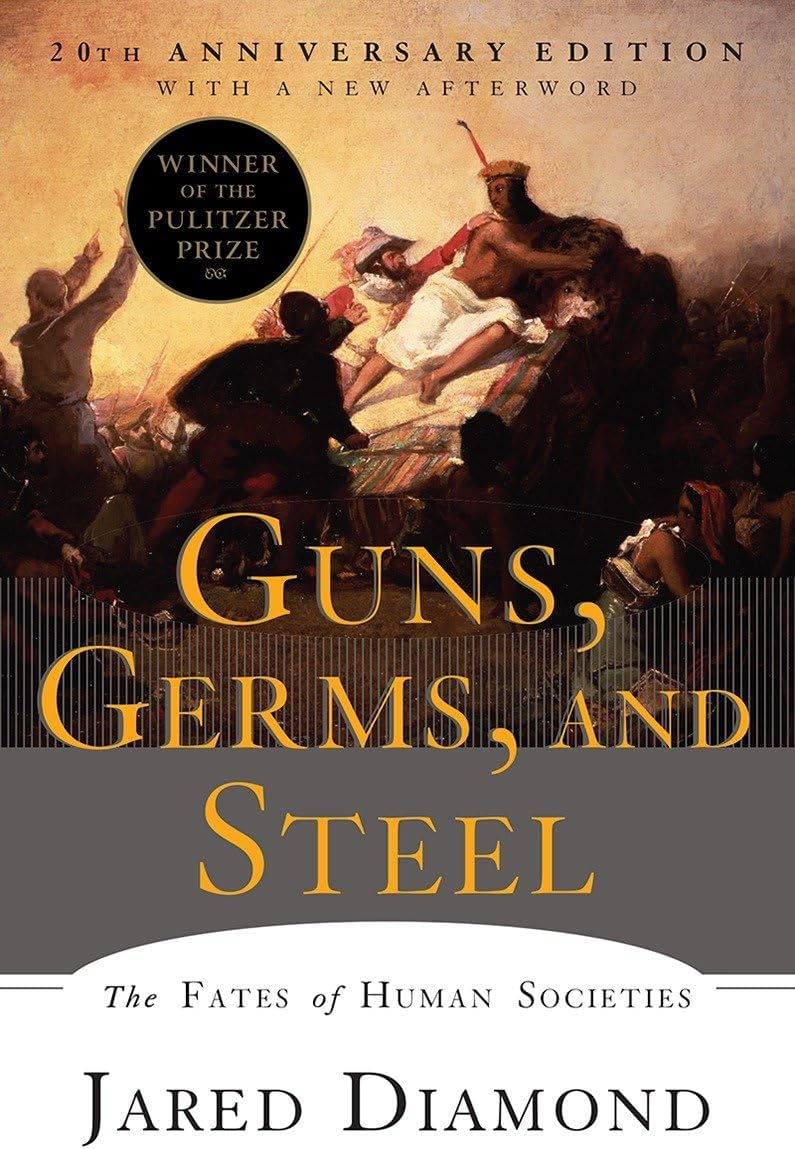
Guns, Germs, and Steel by Jared Diamond is a Pulitzer Prize-winning bestseller that offers a revolutionary explanation for why some societies dominated others. Drawing on decades of research, it reveals how environmental factors like geography, domestication of plants and animals, and the spread of germs shaped the fate of human civilizations. This interdisciplinary classic is essential reading for anyone eager to understand the deep forces behind global history and inequality.
| Best Sellers Rank | #2,918 in Books ( See Top 100 in Books ) #1 in Anthropology (Books) #1 in Crop Science (Books) #1 in Geography (Books) |
| Customer Reviews | 4.5 out of 5 stars 14,606 Reviews |
G**6
One of my favorite books and the inspiration for my World Regional Geography courses that I teach.
Two decades ago when I served in the Missouri National Guard we had an extended drill weekend at Ft. Leonard Wood for a live fire artillery exercise. This was a three day drill and I remember it clearly because it was the same weekend as Princess Diana’s funeral on September 6, 1997. I had been at the local library the day before we rolled out and saw an interesting book that promised to explain why western civilization had been the one to colonize the New World and rise to ascendency over much of the world for a long period of time. That had always been an interesting question for me and one which many people do not know the answer to. I checked out the book and during some downtime I began to read. To say that the book grabbed my attention is an understatement. I started it on Friday and finished it on Saturday. My whole conception of how history had seen the rise of Western Civilization was fundamentally altered and would never be the same. At the time I thought that using Guns, Germs, and Steel as an educational tool would be a great idea. My dream of teaching history had never been realized and in 1997 seemed like it would never happen. However, history is full of strange things and in 2009 I got the chance to return to college and pick up my degrees. I began teaching American History in 2013 and was then asked to teach World Regional Geography for the Spring 2014 semester. They handed me a textbook and said, “Good luck.” As I drove back home I considered how I would teach this course and my mind recalled Jared Diamond and his Pulitzer Prize winning book. To make the story short, I built a course that used the textbook, Diamond’s book, and the National Geographic series based on the book. Obviously I take what Diamond said in Guns, Germs, and Steel seriously. I think Diamond did some outstanding work in doing three decades of research and then writing a book which to me is resonates with readers. For many years the idea that Western Civilization was superior to any other form has been the dominant world view. Diamond rejects that completely by saying Western Civilization had advantages that others did not have due to geography, or literally where it was. When you stop and think about it, why were the Europeans so superior to others for so long? Was it their race, their ideals, or what? Diamond said it was because of where they started that they developed into the world spanning civilization we know. What advantages did the Europeans have over others? They arrived with technology superior to all others, were better organized, and had the lethal gift of germs which in the Americas killed over half the population and was the biggest reason as to why the Europeans took those lands over. When Diamond explored the germ theory he realized that these germs came from contact with domesticated mammals such as horses, cows, pigs, chickens, sheep, and goats. These same mammals were what enabled Europeans to transport materials as well as have a convenient food supply and a power source such as horses pulling plows. This idea works when you look at the Americas and Australia, but not when you look at Africa and Asia. The lethality of germs did not affect the people in those regions like it did the Americas. In fact, some of the diseases in Africa killed the Europeans and prevented them for exploiting Sub-Saharan Africa for centuries. Some of these germs are now known to have come from Asia as well along with domestic animals that came from there. Many of the larger mammals Europe had were also found in Asia. In fact, some of the technology such as gunpowder came from Asia as well. Diamond acknowledged this in his book and sought to explain why Europe was able to expand while Asia did not. This is something I really stress in my class and it is something which the book and National Geographic series does not explore as deeply as it should. Diamond saw a decision made in the 15th century by a Chinese emperor as being the decisive event that altered human history. At that point China was the leading power in the world. It had a great navy, the largest country, gunpowder, advanced technology and far more people thanks to its agricultural practices than any other nation at that time. The decision by emperors in China’s Ming dynasty led to China losing its technological advantage over Europe although no one had any idea that this was happening. These decisions or orders are called Haijin. Diamond did not explore this in any depth other than to point to it and say that China’s inward looking policies which had existed for centuries were the result of its location, its geography. Its singular form of government used Haijin to build up its power at the expense of expanding China’s culture and boundaries. There is a lot here to work with, but Diamond seems to casually bring it up in the book’s epilogue. Instead he focuses heavily on the Americas where his theory of environmental determinism is the strongest. I think he gets the theory right, but in the case of Asia he needed to go deeper. Since Diamond is an ornithologist by education, and his world journey’s focused on New Guinea, I think his point of view was heavily influenced through his contact with hunter-gatherers. His theory is at its weakest in Asia and specifically China. That again reflects his preference for focusing on one type of people versus another. This does not mean his theory is wrong. It just needs expansion and I do not think Diamond will be doing that any time soon. His recent works have dealt with different ideas. Even with this glaring problem, I think this book is outstanding. It does answer the question of why Western Civilization dominated the world for the most part. For my geography class it is a wonderful tool. I focus heavily on how man domesticated two grains from the Middle East, wheat and barley, and built Western Civilization upon them. Coupled with the domestication of large mammals, the forerunners of Western Civilization spread through Europe. Geography played a huge role in why it went west and why there are so many differences between East and West on a cultural level. It also explains why there are such huge differences between North Africa and the lands to the south of the Sahara. The role of geography in shaping mankind is without a doubt the single underlying reason as to why history occurred like it did. This is really hard for students to understand because they seem to have been taught a much different concept prior to taking a geography course. Only by explaining the human-environment interaction do students begin to realize that geography caused man to make decisions which would reverberate for millennia. The people of the Middle East followed the Tigris and Euphrates rivers northwest into Anatolia and out of the desert. Man’s movement west, north, and south with the crops and animals of the Middle East were shaped by geographical barriers. Diamond points out how man overcame these barriers over time. The civilization that was able to do so developed greater technologies than others. He points to both European and Chinese naval developments in this regard. China’s need to continue to build its naval forces was negligible due to a lack of naval enemies while in Europe those enemies were often themselves as nations competed for resources and trade. Since China controlled all of its trade which was mostly internal or land based, its need for a navy was reduced. Europe surged ahead while China languished. In my classes I point to the barriers as we explore the world’s regions. I show how these barriers played such big roles. We play a board game by Avalon Hill that helps to illustrate this as well. Diamond’s book plays a big role in my class and so do his theories. I find it really helps students take the principles and ideas from the first part of the class and begin to apply them to the world regions we study. They are able to make the mental leap to the realization that the people of the world are different for many reasons, the foremost being the place in which they live more than anything else. It helps them to break down and discard the erroneous belief which many of them have regarding their place in the world. Using Diamond’s Guns, Germs, and Steel I am able to use Transformative Learning Theory to overcome the disorientating dilemma they find themselves in at the beginning of class. I could build a new class out of Diamond’s book that encompasses geography, history, and sociology if my school would let me. In fact, I could build two classes out of it. One would focus on why Western Civilization developed like it did and expanded to the Americas while the second one would focus on the development of Eastern Civilization and its failure to expand beyond Asia itself. While courses exist that dive into those ideas, they are built around history more than anything else. Few instructors use environmental determinism in explaining how early mankind developed in the places it did. The ultimate objectives of these courses would be why they developed like they did, not just their history. Diamond has written several other books such as Collapse, The Third Chimpanzee, and The World Until Yesterday. He is Professor of Geography at the University of California, Los Angeles. He has been awarded all kinds of prizes and awards for his research and work in multiple fields. I find it interesting that he began to study environmental history in his fifties which led to this book and many others. This to me is proof that you are not bound by formal rules regarding your education, but rather by using your interests coupled with the research capabilities your education has provided you new careers beckon. This book is a testament to following one’s interests and using one’s intellect. I highly recommend it to all readers. It is one of my favorite books and I have read through it multiple times.
T**N
Outstanding work of history, one of the best ever
_Guns, Germs, and Steel_ by Jared Diamond is one of the most informative, epic, well-written, and fascinating "macrohistory" books I have ever read. In this book, Diamond discussed the rise of complex human societies in the last 13,000 years, seeking to answer one fundamental question; why did some civilizations come to dominate others? Why did the Fertile Crescent and China for instance develop advanced societies with, as the title suggests, guns, germs, and steel, while other areas of the world, such as Polynesia, Australia, and the Americas, did not? Or in those cases where some civilizations were beginning to acquire such things, why did they get off to such a late start? Why did the Spanish conquer the Incans instead of vice versa? In a nutshell, he concluded that societies developed differently on different continents not because of racial differences in attitudes or intelligence, but because of differences in continental environments. Advanced technology, centralized political organizations, writing, and professional armies (or simply put the military advantage of simply having large numbers of people), etc. could only emerge in dense, sedentary populations capable of accumulating food surpluses. Unfortunately, domesticable wild plant and animal species needed for agriculture to arise were very unevenly distributed around the world, with the most valuable species concentrated in only nine small areas of the globe (Southwest Asia, China, Mesoamerica, the Andes and the adjacent Amazon basin, the eastern U.S., Africa's Sahel, West Africa, Ethiopia, and New Guinea), all of which became the earliest homelands of agriculture and thus regions that got a head start on developing guns, germs, and steel. Animals were vital to a society as a source of meat, milk products, fertilizer, transportation, leather, for military use, plow traction, and wool and those areas that lacked suitable animals to domesticate suffered accordingly in terms of societal development. The Late Pleistocene extinctions of large mammals in the Americas and Australia deprived humanity in those areas of potentially very valuable domesticable species. Of the big (over 100 pound) herbivores and omnivores, 148 potential candidates for domestication, they are mostly located in Eurasia (72 candidate species, versus 51 in Sub-Saharan Africa, 24 in the Americas, and 1 in Australia). Further, out of those candidates, only 14 were actually domesticated, 13 of them in Eurasia; what he called the "Major Five" - sheep, the goat, cow, pig, and horse, and the "Minor Nine" - the Arabian camel, Bactrian camel, donkey, reindeer, water buffalo, yak, Bali cattle, mithan (wild ancestor the gaur, found primarily in India and Burma), and the one American one, the llama and alpaca (two well-differentiated breeds of the same species). The other 134 potential candidates were eliminated due to problems with diet, growth rate, problems of captive breeding, nasty disposition, tendency to panic, and/or social structure, any one problem enough to preclude domestication even in modern times. Of further interest, Southwest Asia had seven of the wild ancestors naturally occurring, a huge advantage. In the world of plants there were similar disparities in distribution; of the 56 species of grass with the heaviest seeds, at least 10 times heavier than median species, Eurasia's Mediterranean zone had 32 of them, with barley and emmer wheat 3rd and 13th respectively in seed size. In contrast, of the 56 species, only 6 were found in East Asia, 4 in Sub-Saharan Africa, 11 in the Americas, and 2 in Australia. Another set of differences lead to a variation in societal evolution in the case of plant and animal domestications as well as in technological innovations and political institutions, as most societies acquire much more from other societies than they invent themselves (his discussion on the evolution of writing and in particular the alphabet in this regard was fascinating). Diffusion and migration within and between continents played a very important role in the development of a society, and in some continents diffusion and migration was considerably easier, most rapid in Eurasia because of its east-west major axis and its relatively modest ecological and geographical barriers. As crops and animals depended strongly on climate and hence on latitude, huge areas ranging almost from the Atlantic to the Pacific were open to the movement of domesticated plants and animals. Diffusion was slower in Africa and especially in the Americas due to those continents north-south major axes (traveling just a few hundred or a thousand miles north or south can render a society's crops and animals completely unsuitable for use) and much more pronounced geographic and ecological barriers (such as the Sahara Desert in Africa). Similarly, diffusion in the last 6,000 years has been easiest from Eurasia to sub-Saharan Africa, while long completely absent between Eurasia and the Americas (isolated at low latitudes by broad oceans and at high latitudes by geography and by a climate suitable just for hunter-gatherers). The last set of major factors he analyzed related to continental differences in area or total population size. A larger area or population meant more inventors, more competing societies, more innovations that exist to be adopted, and more pressure to adopt and retain those innovations, as those societies that fail to do so tend to be eliminated or absorbed by competing societies. Among the world's landmasses, area and the number of competing societies were greatest for Eurasia, while considerably smaller for Australia for instance. The Americas, despite their rather large total land area, were in effect fragmented by ecology and geography into a series of poorly connected smaller continents. Relating to both population size and the "Eurasians' long intimacy with domestic animals" was the development of germs. Crowd diseases could not sustain themselves in small bands of hunter-gatherers or slash-and-burn farmers, nor perhaps would they develop at all, as only human association with cattle gave us for instance measles (evolved from rinderpest) and smallpox (evolved from cowpox). Obviously I have just scratched the surface in my review. This is an excellent book that ties together findings in history, archaeology, paleontology, epidemiology, and linguistics in an extremely readable and informative format.
M**E
Monumental Thesis, Richly Researched & Carefully Argued
Motivating this book are two questions 1) When Spanish conquistador Pizzaro encountered Inca emperor Atahualpa, how did the former, with fewer than two hundred men overwhelm the latter with over 80,000? and 2) When the Europeans set up colonies on the island of new Guinea, why was it that they had so much stuff to trade, but the natives of the island had so little? The answer to the first question is, of course, that the Spanish had Guns, Germs, and Steel. Diamond does an outstanding job arguing for the pivotal importance of Germs in the equation. He clearly explains - using the idea of germs - why Europeans overran the Americas and Australia but not Africa. His agument regarding steel is notably weaker; but I think it does support his thesis adequately. I failed to detect a compelling argument for why Europeans had guns but others did not. The book's primary focus is on how civilization got started. He looks first at the cultivation of plants and then at the domestication of animals. Examining areas in Africa, Eurasia, the Americas, and Australia, he totes up the lists of suitable flora and fauna and evaluates their merits. He notes that it was the fertile crescent that harbored the most suitable grains, legumes (or pulses), and domesticable animals. No other location comes close to having this rich combination of natural resources. He shows that this explains the very early appearance of agricutlure and therefore of writing, religion, and law in this area (and in China). He also shows how any human advancement would spread more quickly in Eurasia than it would within the Americas and Africa. This gives Eurasia a double advantage; it can harbor more people by virtue of its agricultural practices and each person has greater access to new ideas because of strong east-west trade currents. Thus cultures in Eurasia could easily adapt ideas based on those of other societies instead of creating them from scratch. He concludes that any person who accepts his thesis of the forces shaping civilization - at least the necessary precondition to get started - would necessarily conclude that civilization's advances must inevitably run quickest on the Eurasian continent. A large portion of the book is focussed on the factors influencing the establishement of an agricultural system that is capable of supporting a whole large class of non-agricultural workers. The assumption, I believe, is that we already know that this is the primary requirement for the birth of a civilization. Still I was looking forward to Diamond's take on what happens after we all learn to read and write. I was hoping he might explain the ascent of the west since 1000 BC or 1500 AD. But he does not. He does not, for instance, argue why it was the British and Spanish, not the Turks and Indians who settled Australia and the Americas. This, perhaps is a different question. Yet it seems to be linked to the idea of frontiers and access to resources. For it is always when the full set of advanced cultural practices reach populations in the richest, most uncultivated frontiers and these ideas cast anew in the light of a new environment that civilization seems to gain its greatest momentum. He uses Polynesia as a microcosm for the world. In this laboratory, a group of people with the same genetic cross-section and same cultural practices embarked on a grand venture to settle all the islands of the Pacific some two millenia ago or so. The systems of government they set up and the level of civilization they reached were highly dependent upon the agricultual productivity of their citizens. Colonists on small islands unsuitable for agriculture became hunter-gatherers and lived in egalitarian societies. Those in productive lands organized into small states with strong chiefs or kings, each with their own little standing armies. The book is richly researched and solidly argued as far as it goes. But there are a handful of quibbles one might raise. 1) The author tends to repeat himself. As the book progresses, the portion of prose that is a restatement of something said before becomes so high that this reader found himself skipping whole chapters. 2) The author fails to provide a compelling argument about why China lagged Europe at some point after 1500. One wonders why the author did not simply use the argument at hand. Colonialism provided to Europe the raw materials necessary for industrial production. China was closed until two or three decades ago and so did not have adequate access to the raw materials that vaulted Europe and North America to their current place. The opening of China to the world has quickly closed this gap. In other words, the cultural practice that gave frontier states the advantage was the high value they realized in trade: of getting required natural resources and finished goods from other places instead of being closed off. The book's central thesis is that the first and most necessary condition for the success of a society lies in its access to the required resources, and that transport of goods and ideas is crucial to the success of this enterprise. For this book to fail to make this connection I find to be an astonishing lapse. 3) Unless it is hidden in one of the skipped chapters, Diamond never starts to answer the second motivating question about 'stuff', even though it is a simple and direct extension of his fairly robust argument. This book is of crucial importance in counter-balancing our Darwinian view of the world. It was not that Europeans were better people by some genetic measure. (Darwin seemed to assume a single measure of fitness. But each environmental variable provides a different metric of fitness so the whole notion of one group being generally 'more fit' is utter nonsense.) It was that they had a body of technologies, cultural practices and diseases that naturally tended to overwhelm other groups. And that these ideas and practices (and sometimes diseases) are an inevitable advantage any agrarian or post agrarian society has over a less highly organized one. Europeans simply got a head start thanks to geography. There is much to learn, and much to contemplate in this book. Read It.
A**E
You may never see the world the same way again
Ok I got a lot out of this book. Like Yali, the charismatic New Guinean local politician who quizzed the author 25 years before the book was written wanting to know why Europeans developed so much cargo and brought it to New Guinea which had little cargo of theirs, I bought this book in a bid to understand why Africa and its inhabitants developed at a much slower pace than other continents. Was it a matter of fate? Or was the politically incorrect charge that Africans are innately inferior to their fairer skinned counterparts somewhat justified ? Jared Diamond makes a strong case for Geography's deterministic role in the evolution of societies. In other words, the rich societies of today simply won the geographical draft lottery (in terms of who got the largest continental pie/size, who got the most ideal conditions for farming, who got the most number of wild mammals suitable for domestication, and who got the widest variety of wild plant species ideal for agriculture) played over 13,000 years ago when modern man began to settle into village life in a few parts of the world. That decisive edge, reinforced over the last 13,000 years is what led to the emergence of an indomitable Europe that eventually came to lead the world due to its development of guns, germs, and steel. According to the Author, Eurasia got decisively lucky in more ways than one: The Late Pleistocene extinction decimated Eurasia's competitors by felling wild mammal species of most of North and South America and those of Africa that may have facilitated intensive farming instead of the hunter-gathering lifestyle which eventually became a big impediment to the development of rapidly evolving complex societies on those continents. Those extinctions left Eurasia with many more wild candidates for domestication than the Americas and Africas offered. Agriculture and Continental Size were huge enablers. Eurasia is twice as large as the next largest continent, Africa, and had a wide extensive landmass of fertile soil amidst a variety of wild life that were easily domesticated for animal herding and valuable crops that facilitated the development of intensive farming techniques that helped serve denser populations and formed the basis for the formation of complex organized societies. Denser populations tend to rise only under conditions of food production, populations served by food surpluses from intensive farming techniques were more likely to have non-farming specialists, technocrats, warriors and bureaucrats. In contrast, poorer societies such as hunter-gatherers without such advantages remained as hunter-gatherers living in bands which were far from ideal to produce crop surpluses available for redistribution or storage, and hence could not support and feed non-hunting craft specialists, armies, bureaucrats, and chiefs to enable them evolve complex societies. In turn, agriculture spawned lethal germs emanating from Eurasian's long advantageous exposure to domestic Animals which was as decisive in eliminating local populations in conquest as guns and steamboats were. As illustrated by the New world's conquest of almost 95 percent of the 20million American Indians; exposing the Indians to strains of germs the Indians had never been exposed to, and against which they therefore had neither immunity nor genetic resistance to. The development of writing was another essential agent in assisting the conquests of Eurasian Societies: by fostering the development of maps that were beneficial to sailors exploring new lands to conquer, by providing a new way of communicating and (through preserved records) inspiring later generations to conquest, writing played a crucial role in the course of civilization but could not have been possible without food production. Writing emerged independently only in the Fertile Crescent, Mexico, and China because those were precisely the first areas were food production arose in their respective hemispheres. I already told you that what brought me to this book was to understand why as an African, we've evolved rather slowly compared to everyone else? I got my money's worth somewhere in pg 399 where the author states that "the factor behind Africa's slower rate of Post Pleistocene development compared with Eurasia's is the different orientation of the main axes of thee continents. Like that of the Americas, Africa's major axis is north-south, whereas Eurasia's is east-west. As one moves along a north south axis, one traverses zones differing greatly in climate, habitat, rainfall, day length, and diseases of crops and livestock. Hence, crops and animals domesticated in one part of Africa had great difficulty in moving to other parts. In contrast crops and animals moved easily between Eurasian societies thousands of mile apart but at the same latitude and sharing similar climate and day lengths". In a nutshell, geography, and not biology, ultimately did us in. I found this book a bit of a slog to get through due to the author's interdisciplinary approach ( history, archaeology, evolutionary biology, sociology, cultural anthropology etc) which mirrors his career trajectory so far. One of the few bones I have to pick with the book, as so many other reviewers have already mentioned, is its lack of sources. I also thought the author strove, quite frequently, a bit too hard for political correctness in for example, sounding a bit patronizing to the plight of poor societies like mine. I admit it may amount to career suicide for a tenured professor to have done otherwise; but to my mind any reader who can't handle a little intellectual honesty no matter how inconvenient isn't ready to address the fundamental questions about the human condition. For some reason, the kindle version I purchased didn't have images due to copyright issues. A bit of a setback because I didn't have any maps handy to make sense of the strange locations that pop up at various points in this read and no thanks, I like to read with an internet connection as far from me as possible. Then lastly, there was the glossy treatment of why different parts within Eurasia developed differently which he addresses scantly in a later edition of the book. But GGS ultimately proved to be a great read for me, and highly recommended for anyone who wants a keener appreciation of the world we live in today. But be forewarned, you may never see the world the same way again which surely is a good thing.
Z**H
Guns, Germs, and Steel: The Fates of Human Societies
Recently, I finished this great, broad, historical, and significant endeavor. Let me begin by expressing my appreciation of Jared Diamond’s wonderful ability to simplify a very complex topic and related ideas. This alone, makes this read a great one. Too, there a few gems of humor and wit within the pages which caught my eye and mind. Don’t get me wrong though. The pages are filled with complex data, examples, and comparisons. Upon more than one occasion, my understanding necessitated the rereading of paragraphs and pages. Before I proceed into deeper thoughts, I must admit the duration of this read as being conducted well over an extended timeframe. I began reading it years ago, stopped, and then started again. Over the course of the last several months, I recommitted and achieved. In thoughtful detail, Diamond seeks to explain why certain groups of people have been successful over the course of human events and history, while others, in comparison, are not. It should be noted, the idea of “success” is very subjective. So, success in this case, is related to Western ideas of technological development, exploration, and conquest - generally described as one group of people gaining control or influence over another. An effective description of this is the Spanish conquest and colonization of the “New World,” especially the Aztecs and Incas. This example, though quite large in scope, and as pointed out by Diamond, has occurred throughout human history in large and small ways involving a multitude of others groups of people, both known and unknown. In short, I believe Diamond does well in addressing the impact and luck of geography and resources, as well as, the influences of more innate human characteristics and variety. The debate of nature versus nurture is here too contained. In the past, and not only in recent history, humans have expressed understandings of success in terms of innate differences which must exist between people - obviously though, those in power and dominate are able to define and express such ideas. However, Diamond looks beyond this and recognizes the complexity, and ultimately more profound influence of reality, nurture. In this sense though, it is not simply human nurturing and choice, it is the opportunities presented to humans, in difference places, at different times, to take advantage of their earthly surroundings and the ability to nurture developments, or not. This read is filled with a plethora of well detailed examples which come to show how access, or not, to certain elements leads to the success and superiority which has been described and known by those in power, throughout history. So, today, when certain people look down upon others and their lack of some qualities or characteristics, Diamond’s historical analysis provides engaging insight beyond and through the bias. Who we are presently is the result of all the past experiences of the human ancestors who preceded us, and furthermore, our development and success, in comparison to other humans, is simply more so the result of the access we have had to a confluence of resources and circumstances which allowed us to dominate other groups of humans with less access to the same. As groups of humans defined through sociological processes, we are no more intelligent, healthy, or physiologically better than the whole of humanity understood to exist through anthropology, biology, and any other area of study. “We all know that history has proceeded very differently for peoples from different parts of the globe...Those historical inequalities have cast long shadows on the modern world, because the literate societies with metal tools have conquered or exterminated the other societies. While those differences constitute the most basic fact of world history, the reasons for them remain uncertain and controversial.” In this work, Diamond splendidly explains how, “History followed different courses for different peoples because of differences among peoples’ environments, not because of biological differences among peoples themselves.” Please give the ideas of these pages the opportunity to share with you a detailed perspective of human experience which reaches far into the depths of history, beyond even the earliest written language. Diamond’s words will likely cause you to become lost in thoughts of the past. However, at the same time, he’ll take you to definitive places of demonstrable purpose leading to a better future understood through the context(s) of human experience.
D**H
Brilliant, eclectic panorama of the past 13,000 years
This intriguing and expansive book gathers knowledge from a number of fields (archaeology, anthropology, ecology, evolutionary biology, horticulture, and more). Its novelty is not in the details, any of which can be found in other books, but in the synthesis of 13,000 years' worth of human history. Diamond argues that many (but not all) of "the striking differences between the long-term histories of peoples of the different continents have been due not to innate differences in the people themselves but to differences in their environments." Diamond covers so much material that any attempt at summary would be imprecise. The sections I found most compelling dealt with agriculture and animal husbandry--two topics that would have probably induced sleep if covered by another author. For example, he presents the fascinating background that the dominant five "large" domesticated mammals--sheep, goats, cattle, pigs, and horses--originated in central Eurasia (and that no easily domesticated, large mammals were available, for example, to North Americans or Australians); that these animals include the world's only widespread "beasts of burden," giving their human handlers additional advantages in mobility and farming; and that most of the world's lethal diseases resulted from proximity to the barnyard, gradually providing Eurasians with immunity to illnesses that later wiped out entire societies upon first exposure. The minor mammals (camels, llamas, reindeer) were too limited by geography and climate to affect the course of history outside their confines. As for zebras, bears, giraffes, tigers, hippos--to this day, nobody has been able to domesticate them. While this seems intuitively obvious, no writer has so clearly and irrefutably connected the dots, showing how access to these animals gave early chiefdoms an insurmountable advantage over those human societies without them and allowed them to develop surpluses and commerce that supported the world's most enduring civilizations. Comments made by the author's critics, while few in number, nearly prevented me from reading this book and need to be addressed so other readers won't be similarly discouraged. A few readers seem offended by Diamond's self-mocking and somewhat tongue-in-cheek assertion (in the Introduction) that the natives of New Guinea have certain advantages that make them arguably more "intelligent." Yet these commentators are willfully ignoring the context: Diamond admits that "New Guineans tend to perform poorly at tasks that Westerners have been trained to perform since childhood," yet he is quite aware of how "stupid I look to New Guineans when I'm with them in the jungle." That is, if one defines "intelligence" not as the knowledge needed to use a computer or write a book review but, rather, as the ability to survive in the wild ("following a jungle trail" or identifying poisonous mushrooms, to cite two of the author's examples), then the New Guineans win hands down. To make a similarly lighthearted argument: when the house of cards we call "civilization" is threatened by the least misfortune (economic recession, power blackout, bad weather, the death of a British princess), a frightening number of otherwise "intelligent" people, instead of relying on their wits and survival skills, rush straight for their therapists. Likewise, anyone who accuses Diamond of "geographic determinism" cannot have read the epilogue, in which he clearly rejects such an extreme position. He admits that individuals and cultures--and, for that matter, pure chance--can also influence history, but "that some environments provide more starting materials, and more favorable conditions for utilizing inventions, then do other environments." The author's argument is unambiguous: while culture, as well as individual inventors and rulers, certainly influence history on a microcosmic level (during spans of centuries or millennia), there are larger factors, such as geography and ecology, at play when human history is considered as a whole over the last 13,000 years. Diamond is looking at the forest rather than the trees; thus, to fault the author for ignoring such factors as religion and politics is off the mark, since such belief systems didn't exist in anything remotely resembling their present form for most of the period under discussion. Furthermore, to identify human advances in terms of culture still fails to explain how differing cultures arose in the first place. Finally, and more easily dismissed, are those hecklers who howl "political correctness." Such critics seldom identify flaws in the author's arguments or even tell us what they insinuate by this increasingly meaningless term. Since the book's span is so sweeping and since many of Diamond's hypotheses are offered tentatively (as suggestions for a new "science" of history), there are bound to be statements or implications that may eventually prove inaccurate or too simplistic. I strongly suspect, however, that his overarching thesis will withstand the test of time; at the very least, "Guns, Germs, and Steel" will inspire open-minded thinkers to consider human history--in its broadest sense--in a whole new light.
H**S
Great scope and central thesis, but tries too hard
[Strong 3.5 stars for its scope and development of the central thesis, but loses points for trying too hard to explain away non-European cultural failures.] The first line of Jared Diamond's Pulitzer Prize-winning opus is: "This book attempts to provide a short history of everybody for the last 13,000 years." His central thesis is that luck of genetic distribution of domesticable plants and animals, particularly cereals and large mammals, gave a tremendous leg up to western Eurasia in the development of civilization. In other words, it wasn't poor choices or innate inferiority that caused most of the world to be dominated by European culture -- just luck. In a book with greatly wider scope than most nonfiction Pulitzer winners, Diamond pulls together long-term threads of farming, herding, languages, disease, technology, government, and religion. He attempts to explain how trends in all these disparate areas rather inexorably led to the cultural and economic state of the world today. While many of the author's arguments are subject to debate, the writing is lucid; it's easy to see why the Pulitzer committee gave Diamon the prize. To take to task all the debatable points in "Guns, Germs, and Steel" would be a huge undertaking. I'll try to highlight a few. Diamond argues that the temperate Mediterranean climate (featuring wet winters and dry summers) of southwest Asia aided greatly in early development, then has to explain why similar climates in California, Chile, and southwest Australia didn't spur development in those places. Human actions (particularly deforestation and overgrazing) have turned what used to be called the "Fertile Crescent" into a wasteland, whereas this didn't happen in the similar southern European area. Thus southwestern Asia possessed the seeds of human development, but the locals squandered their head start. At that point Europe and eastern Asia had an equal chance of pulling ahead, and Diamond proposes that the geographical fragmentation of Europe gave it a competitive advantage over China's cohesiveness. But because he earlier claims that easy movement (for the spread of domesticable species) gave Europe a competitive advantage over America and Africa, this argument is not compelling. Diamond thinks that the different parts of the world were on a developmental par about 13,000 years ago. At that time there were many more potentially domesticable large mammals in the Americas than there are now. The evidence as to what the human presence at that time is mixed, but Diamond pushes hard to dispute evidence of any prior human occupation. He favors the "Clovis first" theory, which has humans first entering from Siberia across the ice age Bering land bridge not more than 13,000 years ago, carrying stone "Clovis point" weapons. Clovis points have been found in large numbers in mammoth carcasses in North America, and Diamond thinks they were developed in Asia and transported across Beringia. Mammoths are one of the many now-extinct large mammals. From the mammoth kill evidence, Diamond assumes hunting by immigrants from Siberia caused the extinction of not just mammoths but horses, elephants, lions, and all the other megafauna. But there are several problems with this argument. Firstly, there are more recent findings than those Diamond disputes to back up the earlier human occupation theory. Secondly, there are no Clovis points north of British Columbia, which would mean these genocidal immigrants fasted all through Alaska. And thirdly, while there are thousands of Clovis points in mammoth skeletons, to date we've found just ONE clovis point in an American horse carcass, and NONE in elephants, lions, or giraffes -- all at one time widely found in North America. All of this debate for later occupation of the Americas appears designed to buttress a secondary argument that American development got started too late to catch up with the Eurasians. But ironically, the Pleistocene overkill hypothesis, linked to a single overwhelming swarm of human invaders, argues against Jared Diamond's central thesis. If he's right, it WAS the Native Americans' own fault that they were later overrun by Europeans on horses, becaused they killed and ate all the existing horses on arrival. Diamond also has to resort to some hand-waving to explain why independent Mesoamerican invention of writing and wheels (used only in toys, rather than tools like wheelbarrows) never went anywhere. Similar weak arguments are used to explain why China went into cultural stagnation centuries ago. Ultimately, the author tries too hard to make all of history fit his model. In trying to explain why superior technology isn't necessarily accepted, Diamond trots out the old myth about the Dvorak keyboard being superior to the standard QWERTY layout, yet never finding much demand. However, Diamond's book came out in 1997, and the Dvorak myth had been debunked 7 years previously (Journal of Law & Economics vol. XXXIII (April 1990)). Diamond is left with no argument other than cultural superiority to explain why societies that adopt better technology succeed, and he rejects that position a priori. In his professional career the author has spent much time working in New Guinea. He thinks constant local warfare has made the average surviving New Guinea tribesman superior to the average descendant of European culture, and wants to explain why the people of New Guinea have so little "cargo" (wealth). But Diamond's focus on New Guinea as a model for global development is more elucidating to the author than to his readers. There are some problems with the book layout itself, including a surprisingly poor index. For instance, trying to look up horse extinctions in the Americas, I found references to horses under "Americas, animal extinctions in" that didn't appear under "horses, in Americas". Also, there are a variety of different maps with different levels of detail to show the migrations of peoples, languages, and domestic species. It's necessary to flip back and forth between the maps to follow the narrative thread. This is a good book to read, but a skeptical perspective is necessary while doing so.
T**E
Guns Germs & Steel Book Review
Guns, Germs, And Steel is an influential treatise of competitive plausibility regarding the challenging question why population groups on different continents experienced widely divergent paths of development. Contrary to the voluminous objections cited in the many of the revisionist historians and anthropologists, the famous biologist Jared Diamond tackles the most important question of global history in one compelling volume: "Why did Europeans come to dominate the New World?" This question has been answered by others before and Diamond's idea that Europe's geography is the cause geographical determinism has also been proposed before. Any student of history or anthropology can drag up a case or two of this thesis. Baron Montaigne, for example, suggested that Europe's predominance curtailed from its superior government, which could be derived directly from the coolness of its climate. However as an enthusiastic proponent of environmental determinism, Jared Diamond presents a set of premises consistent with evidence provided from a wide range of disciplines, but he does not attempt to answer the question of genetic diversity, including segregated intelligence among racial groups as many reviewers have inferred. If anything, implicitly, the author appears to support promulgations of differentiated intelligences; he sets out to demonstrate intelligence was not the root cause to Eurasian dominance. The deep significance of this book is that Diamond's thesis is not simply idle conjecture. He proves that the Eurasian land mass had by far the best biological resources with which to develop agricultural societies, and was thus more able to form large, coherent, and powerful social entities. In order to back this idea, Diamond introduces a set of well-researched data on what kinds of plants and animals are necessary to support a farming society. He investigates the biological resources available to potential farmers in all parts of the world. The people of Eurasia had access to a suite of plants and animals that provided for their needs. Potential farmers in other parts of the world did not have such access and so, their fertile soil went uncultivated. Beginning 13,000 years ago, the author illuminated the circumstances that may have smoothed growth for some groups and repressed the same for others. Diamond accepts the out of Africa theory for the dispersion of Homo sapiens to the other continents as well as the importance of location that they went. For Diamond, food production is the definitive cause of capricious rates of development for different peoples. He demonstrates how the abundance of wild plants subject to domestication and availability of large mammals served as immediate factors to transition from hunter/gatherer bands and tribes to sedentary agriculturally based chiefdoms and states. In this context, Eurasia was home to important number of crops and animals that readily and successfully domesticated. This domestication resulted in mass food production, which the author claims is the "ultimate" cause of Western dominance. Food production in turn, led to a number of adjoining causes related to the rise of the West:- farms and animal herds led to stationary populations and excess food to support a specialized class of bureaucrats and soldiers and it also increased population density. After establishing this strong foundation, Diamond falls into reiterating ideas about the creation of large-scale societies. These ideas, while clichéd, are still enthralling and Diamond presents them in a very clear and well-written way. His other major original contribution comes when he discusses the diseases that helped the Old World conquer the New World. Building on his earlier chapters dealing with Old-World domesticated animals, he shows that these very animals were the sources of the major plagues such as smallpox which virtually annihilated New World populations. The fact that Old World people had immunities to these diseases was a direct result of their agricultural head-start. Finally, Diamond concludes, the unique East-West axis of Eurasia and the absence of any impenetrable geographic barriers fostered the spread of new crops, technologies which gave rise to many competing communities, whose competition further increased the western lead over the rest of the world. These technical details, while complete, are presented in a very easy to fathomable way and Diamond's writing style is fun and engaging. Diamond's arguments are persuasive on the surface, and even the prevalent skeptic will have reason for pause after reading his book. However, I have some concerns with respect to the credibility of this book. I felt that I had to second guess most of his evidence, because it was equivocal, lacking or incorrect. Firstly, Diamond uses the term "Eurasian" to describe cultures and societies. However, the term is essentially used to describe a geographical landmass or tectonic plates. All the way through the book, he uses the term "Eurasian" when it supports his hypothesis and replaces the term with European or western Eurasian to support another part of his thesis. He does not separate Europe and Asia to explain societies and cultures even though Europe and Asia contain different religions, cultures and languages. But then again, he separates "North Africa" from "Sub-Saharan Africa" even though they are part of the same continental landmass and have more commonalties. On page 161, Diamond attempts to explain his reasoning behind using the broad and vague term "Eurasian" when he states that: "my use of the term "Eurasia" includes in several cases North Africa, which biogeographically and in many aspects of human culture is more closely related to Eurasia than to sub-Saharan Africa". I believe Diamond confuses contemporary North African culture with the cultures that inhabited Northern Africa from 10,000 BC to 8th century AD. For example, from pre-dynastic to the mid-late stages of the Ancient Egyptian civilization, the ancient Egyptians had contact and traded with cultures in Ethiopia (sub-Saharan Africa). The Ancient Egyptian and Amharic language (Ethiopia) belong to the same language group which is Afro-Asiatic, and also belong to the same sub language group, which is Semitic. Diamond makes vague generalities in supporting his thesis and fails to engage significant evidence that challenges his thesis. In addition, when studying the development of different cultures and the spread of food production and technology, he modifies the definition of different terms to fit his hypothesis. Any hypothesis can be supported if you continuously alter the variables you are challenging. I found this to be the most distracting facet of this book. He does this with the terms "North African" and "Sub-Saharan African" which are terms that carried little meaning between 13,000 BC until the 7th century, but are used to separate the significant accomplishments of Ancient Egyptians (Africans) with other Africans. On page 92, he states that: "the availability of domestic plants and animals ultimately explains why empires, literacy, and steel weapons developed earliest in Eurasia and later, or not at all, on other continents." That statement is false, since written records of the Ancient Egyptian (African) language have been dated from about 3200 BC, making it the oldest and longest documented language. The Sumerian language, as Diamond claims is the oldest language, developed around 3000 BC. Additionally, a recent archaeological discovery has suggested that some Gerzean pottery with early hieroglyphics located in Egypt could have originated since 4000 BC. Ancient Egyptians were also the first to develop mathematic concepts such as the Decimal system and science such as astronomy and medicine during that time period and significantly influenced Greek science and mathematics. Diamond does not mention any of this and I believe that he leaves out noteworthy attainments by non-Europeans to support his thesis. Throughout the book, Diamond also poses the following question in the background: "Why were Eurasians, rather than Native Americans or sub-Saharan Africans, the ones to invent firearms, oceangoing ships, and steel equipment?" Nevertheless, Diamond does not engage in the most basic question relating to the motivations of these cultures: Did Native Americans or Sub-Saharan Africans have a need for firearms/oceangoing ships? More to the point, did the Native Americans, sub-Saharan Africans, and other so-called non-Eurasians, want firearms or oceangoing ships? The answer would have forced Diamond to research the cultures and religions of Native Americans and Sub-Saharan Africans in more detail, rather than explaining it with geography and/or food production. Also, he does not include the significant accomplishments of Ancient Egypt, including papyrus, an early form of paper that originated in Africa not Europe or Asia. On page 190, Diamond states that: "Continental differences in axis orientation affected the diffusion not only of food production but also of other technologies and inventions." It is known that Ancient Egyptian technology including scientific or medical discoveries traveled along the north or south axis towards the Middle-east and eventually to ancient Greece. Diamond doesn't mention any of this, which further questions the credibility of the book. Another problem with Diamond's style is that he seems to negate the influences of Non-Europeans, specifically Africa and China, to the current Western hegemony such as gunpowder from China, natural resources from Africa by either not mentioning them at all or under-emphasizing their importance. It is quite likely that without the influences from non-European civilizations that current Western hegemony would not exist today. He also makes downright false statements such as in page 247 when he states that: "Delivered in grenades, rockets, and torpedoes, those incendiaries played a key role in Islam's eventual defeat of the Crusaders." According to historical records, there is no evidence to suggest that grenades, rockets and torpedoes were used during the Crusades. I agree that the domestication of plants and animals could predispose agriculturalists to further development. However, geography and domestication of animals and plants alone is inadequate to support his thesis without explaining the role of the people and societies occupying the geography. Geography might be a factor to explain how Western Civilization became the dominant civilization in the world today. Though, European civilization did not arise in a vacuum. Regardless of the plausible geographic advantage of Europe and Asia, factors such as political intentions, morals, ethics, religion and culture all served to explain why some civilizations were determined to expand and build empires through conquest, while others did not. Diamond claims that his theories offer an alternative explanation to traditional racist dogma. Conversely, I believe his theories do just the opposite. By stating that Europeans developed into the dominant civilization by "chance" or "luck" with respect to geography strengthens racist theories that European civilization was "destined" to become the most powerful. Moreover, Diamond dismisses politics, religion, culture, individuals, and timing. For example, consider Cortez's victory over the Aztecs. Cortez's victory was not assured. Many elements had to be aligned for a few hundred Spaniards to overcome a mighty empire. The odds were really in Montezuma's favor. Even with horses, armor, and guns, the Aztecs were easily a match for Cortez. The Spanish armor was superfluous. According to Keegan, they even shed their heavy armor in favor of the native quilt vests. The firearms at that time were not quick to reload, so sheer numbers could have overwhelmed the Spanish. The Aztecs lost because of politics, religion, and individuals. The brutal politics and religion of the Aztecs made their subjects hate them. The Spanish were immediately supported with armies and food by the smaller nations like the Totonacs that hated the Aztecs for their cruelty. The insatiable appetite of the Aztec gods for human sacrifices insured that Cortez found ready allies. If either Montezuma or Cortez had been composed of slightly different temperaments the war could easily have gone the other way. Had Montezuma been more decisive, he could have had Cortez killed at the coast. Had Cortez not been so incredibly determined to take the country, he could have just returned to Spain with a load of the early gold presents sent to him. History is determined by far more than geography, plants, and animals. Culture, religion, individuals, politics, and timing all play important roles. My criticisms have nothing to do with "political correctness", but rather I take issue with Diamond's style of revisionist history that does not emphasize the influence and significance of non-European civilizations towards current Western civilization. While reading the book, I was frequently second guessing the facts of Jared Diamond because they were either inexact or vague. In closing, as an introduction to anthropology and a cogent depiction of one school of thought on the rise of the West this book is marvelous. However, it needs to be approached with an open-mind as it has some of its faults. Reflect on the thesis and the supporting evidence, and then draw your own conclusions. Love it or hate it, you owe it to yourself to read this book. As for me, this book is one of the best revisionist histories on the Ancient Civilizations but as the case with revisionist history, it has its share of one sided and extreme arguments. It is a good book but not great. Still, it is very simple to read and very easy to cognize which I think deserves the Pulitzer Prize it won.
F**E
Why is the world the way it is?
This is the best book on history, anthropology and general understanding of humans past I’ve ever had the privilege of reading. Jared shows how to scientifically approach simple questions, which are the deepest ones to answer. Why have Europeans sailed to Americas and Africa and not otherwise? Why were they in possession of horse, guns and germs? To find the right question is a talent in on itself, and Jared proves himself to be a master at it, an goes on to answer each and every question as fully as possible. In a very neatly organized way, carrying so many scientific discoveries on so many different fields that the book is certainly one of a kind. His serene view of thing, his class in reasoning, showing what is commonly thought on the subject and why, and when his views differ, again why and who claims otherwise. The depth of his inquiry. And amazing and must read book for anyone who wishes to understand more of how is it that the world ended up the way it is. “In short, plant and animal domestication meant much more food and hence much denser human populations. The resulting food surpluses, and (in some areas) the animal-based means of transporting those surpluses, were a prerequisite for the development of settled, politically centralized, socially stratified, economically complex, technologically innovative societies. Hence the availability of domestic plants and animals ultimately explains why empires, literacy, and steel weapons developed earliest in Eurasia and later, or not at all, on other continents. The military use of horses and camels. and the killing power of animal-derived germs, complete the list of major links between food production and conquest that we shall be exploring.” “Taken together, these four factors help us understand why the transition to food production in the Fertile Crescent began around 8500 B.C., not around 18.500 or 18.500 B.C. At the later two dates hunting-gathering was still much more rewarding than incipient food production, because wild mammals were still abundant; wild cereals were not yet abundant; people had not yet developed the inventions necessary for collecting, processing, and storing cereals efficiently; and human population densities were not yet high enough for a large premium to be placed on extracting more calories per acre.” “Eventually, thousands of years after the beginnings of animal domestication and food production, the animals also began to be used for milk, wool, plowing, and transport. Thus, the crops and animals of the Fertile Crescent’s first farmers came to meet humanity’s basic needs: carbohydrate, protein, fat, clothing, traction, and transport.” “In short, New Guinea offers an instructive contrast to the Fertile Crescent. Like Hunter-gatherers of the Fertile Crescent, those of New Guinea did evolve food production independently. However, their indigenous food production was restricted by the local absence of domesticable cereals, pulses, and animals, by the resulting protein deficiency in the highlands, and by limitations of the locally available root crops at high elevations.” “We found that these differenced between the Fertile Crescent, New Guinea, and the eastern United States followed straightforwardly from the differing suites of wild plant and animal species available for domestication, not from limitations of the peoples themselves. When more productive crops arrived from elsewhere (the sweet potato in New Guinea, the Mexican trinity in the eastern United States), local peoples promptly took advantages of them, intensified food production, and increased greatly in population.” “ I note that regions differed greatly in their available pool of domesticable species, that they varied correspondingly in the date when local food production arose, and that food production had not yet arisen independently in some fertile regions as of modern times.” “the reason Native Americans did not domesticate apples lay with the entire suite of wild plant and animal species available to Native Americans. That suite’s modest potential for domestication was responsible for the late start of food production in North America.” “‘Happy families are all alike; every unhappy family is unhappy in its own way.’ By that sentence, Tolstoy meant that, in order to be happy, a marriage must succeed in many different respects: sexual attraction, agreement about money, child discipline, religion, in-laws, and other vital issues. Failure in any one of those essential respects can doom a marriage even if it has all the other ingredients needed for happiness.” “Our former question about apples or Indians becomes a question of zebras or Africans.” “they provided meat, milk products, fertilizer, land, transport, leather, military assault vehicles, plow traction, and wool, as well as germs that killed previously unexposed peoples.” “This very unequal distribution of wild ancestral species among the continents became an important reason why Eurasians, rather than peoples of other continents, were the ones to end up with guns, germs, and steel.” “Almost all species of domesticated large mammals prove to be ones whose wild ancestor share three social characteristics: they live in herds; they maintain a well-developed dominance hierarchy among herd members; and the herd occupy overlapping home ranges rather than mutually exclusive territories.” “Such social animals lend themselves to herding.” “turns out that all but a few candidates for domestication have been eliminated by the Anna Karenina principle. Humans and most animal species make an unhappy marriage, for one or more of many possible reasons: the animal’s diet, growth rate, mating habits, disposition, tendency to panic, and several distinct features of social organization.” “Eurasian peoples happened to inherit many more species of domesticable large wild mammalian herbivores than did peoples of the other continents. That outcome, with all of its momentous advantages for Eurasian societies, stemmed from three basic facts of mammalian geography, history, and biology. First, Eurasia, befitting its large area and ecological diversity, started out with the most candidates. Second, Australia and the Americas, but not Eurasia or Africa, lost most of their candidates in a massive wave of late-pleistocene extinctions - possibly because the mammals of the former continents had the misfortune to be first exposed to humans suddenly and late in our evolutionary history, when our hunting skills were already highly developed. Finally, a higher percentage of the surviving candidates proved suitable for domestication on Eurasia than on the other continents.” “To a lesser degree, they also tend to share similar diseases, regimes of temperature and rainfall, and habitats or biomes (types of vegetation). For example, Portugal, northern Iran, and Japan, all located at about the same latitude but lying successively 4.000 miles east or west of each other, are most similar to each other in climate than each is to a location lying even a mere 1.000 miles due south.” “the orientation of Eurasia’s axis compared with that of the Americas or Africa. Around those axes turned the fortunes of history.” “Farmers tend to breathe ou nastier germs, to own better weapons and armour, to own more powerful technology in general, and to live under centralized governments with literate elites better able to wage wars of conquest. Hence the next four chapters will explore how the ultimate cause of food production led to the proximate causes of germs, literacy, technology, and centralized government.” “Pizarro had similarly grim luck when he landed on the cost of Peru in 1531 with 168 men to conquer the Inca Empire of millions. Fortunately for Pizarro and unfortunately for the Incas, smallpox had arrived overland around 1526, killing much of the Inca population, including both the emperor Huayna Capac and his designated successor. As we saw in chapter 3, the result of the throne’s being left vacant was that two other sons of Huayna Capac, Atahuallpa and Huascar, became embroiled in a civil war that Pizarro exploited to conquer the divided Incas.” “the germs evolving from Eurasians’ long intimacy with domestic animals.” “blueprint copying or idea diffusion” Thus, the commonsense view of invention that served as our starting point reverses the usual roles of invention and need. It also overstates the importance of rare geniuses, such as Watt and Edison.” “My two main conclusions are that technology develops cumulatively, rather than in isolated heroic acts, and that it finds most of its users after it has been invented, rather than being invented to meet a foreseen need.” “The importance of diffusion, and of geographic location in making it possible, is strikingly illustrated by some otherwise incomprehensible cases of societies that abandoned powerful technologies.” “Let us now summarize how variations in the tree factors - time of onset food production, barriers to diffusion, and human population size - led straightforwardly to the observed intercontinental differences in the development of technology.” “All these effects that continental differences in area, population, ease of diffusion, and onset of food production exerted on the rise of technology became exaggerated, because technology catalyzes itself.” “The difference between a kleptocrat and a wise statesman, between a robber baron and a public benefactor, is merely on of degree: a matter of just how large a percentage of the tribute is retained by the elite, and how much the commoners like the public uses to which the redistributed tribute is put.” “Besides justifying the transfer of wealth to kleptocrats, institutionalized religion brings two other important benefits to centralized societies. First, shared ideology or religion helps solve the problem of how unrelated individuals are to live together without killing each other - by providing them with a bond not based on kinship. Second, it gives people a motive, other than genetic self-interest, for sacrificing their lives on behalf of others. At the cost of a few society members who die in battle as soldiers, the whole society becomes much more effective at conquering other societies or resisting attacks.” “These examples demonstrate that the sole missing ingredients required to sustain food production in large areas of the Americas were domestic animals and crops themselves.” “This continental difference in harmful germs resulted paradoxically from the difference in useful livestock. Most of the microbes responsible for the infectious diseases of crowded human societies evolved from very similar ancestral microbes causing infectious diseases of the domestic animals with which food producers began coming into daily close contact around 10.000 years ago.” “Hence it may have been Africa that gave birth to the languages spoken by the authors of the Old and the New Testaments and the Koran, the moral pillars of Western civilization.” “But food production was delayed in sub-Saharan Africa (compared with Eurasia) by Africa’s paucity of domesticable native animals and plant species, its much smaller area suitable for indigenous food production, and its north-south axis, which retarded the spread of food production and inventions.” “But none of those tamed animals was actually domesticated - that is, selectively bred in captivity and genetically modified so as to become more useful to humans.” “In short, Europe’s colonization of Africa had nothing to do with differenced between European and African peoples themselves, as white racists assume. Rather, it was due to accidents of geography and biogeography - in particular, to the continents’ different axes, and suites of wild plant and animal species. That is, the different historical trajectories of Africa and Europe stem ultimately from differences in real estate.” “In fact, precisely because Europe was fragmented, Columbus succeeded on his fifth try in persuading one of Europe’s hundreds of princes to sponsor him.” “Europe’s barriers were sufficient to prevent political unification, but insufficient to halt the spread of technology and ideas. There has never been one despot who could turn off the tap for all Europe, as of China.” “Nevertheless, it remains an open question how wide and lasting the effects of idiosyncratic individuals on history really are.” “But recall that the word “science” means “knowledge” (from the latin scire, “to know”, and scientia, “knowledge”), to be obtained by whatever methods are most appropriate to the particular field.” “Like Arabs and Jews, Koreans and Japanese are peoples joined by blood, yet locked in traditional enmity. But enmity is mutually destructive, in East Asia and in the Middle East. Reluctant as Japanese and Koreans are to admit it, they are like twins brothers who shared their formative years. The political future of East Asia depends in rediscovering those ancient bonds between them.” “First, [rainfall] agriculture in Europe provided no role for the state, which remained far from local communities most of the time, and when the agricultural revolution in Europe produced a growing agricultural surplus, this allowed the growth of relatively autonomous towns along with urban institutions such as universities prior to the rise of the centralized states in the late Middle Ages. [irrigation and water-control] agriculture in China, by contrast, favored the early development of intrusive and coercive states in the major river valleys, while towns and their institutions never achieved the degree of local autonomy found in Europe.” “The optimal Fragmentation Principle: innovation proceeds most rapidly in a society with some optimal intermediate degree of fragmentation: a too-unified society is at a disadvantage, and so is a too-fragmented society.” “Those tiny German beer companies are relatively inefficient. There’s no competition; there are just a thousand local monopolies.” “Why does the Japanese food-processing industry, like the German beer industry, consist of small local monopolies? Basically, the answer is the same two reasons: local taste and government policies.” “All of this suggests that we may be able to extract a general principle about group organization. If your goal is innovation and competitive ability, you don’t want either excessive unity or excessive fragmentation. Instead, you want your country, industry, industrial belt, or company to be broken up into groups that compete with one another while maintaining relatively free communication - like the U.S. federal government system, with its built-in competition between our 50 states.”
A**A
13,000 years of human history and experiences in a book
A wonderful book describing the history of 13,000 years in details. Provides a great intercontinental comparison in the human needs ,development and social structure.
S**J
One of the best books on Human History of last 10000 years!
This is a must read if you have read Sapiens. This book opens up so many perspectives on why certain things in history happened the way they did!
A**T
Un libro imprescindible para todo el que le interese la historia.
Una muy buena exploración de las razones historicas y geograficas por las que diferentes culturas en diferentes partes del mundo alcanzaron diferentes grados de desarrollo tecnológico y social. Si quieres entender por que el mundo es como es hoy en dia, saber como se desarrollo en el pasado es imprescindible y este libro es ideal para ello. No es ningún misterio porque este libro se ha convertido en un clásico, Jared Diamond es un genio. Eso si, el libro cubre mas de 10 milenios, asi que no se puede esperar mucho detalle, excepto unos pocos ejemplos escogidos, la mayoria del contenido esta tratado a grandes rasgos, pero hace un muy buen trabajo de dar una visión general del desarrollo historico de la humanidad. Para entrar en detalles sobre épocas y temas concretos ya hay otros libros.
G**U
Kaliteli Sipariş Süreci
Çok güzel bir kitap, çok hızlı kargo. Daha ne olsun!
Trustpilot
1 day ago
5 days ago