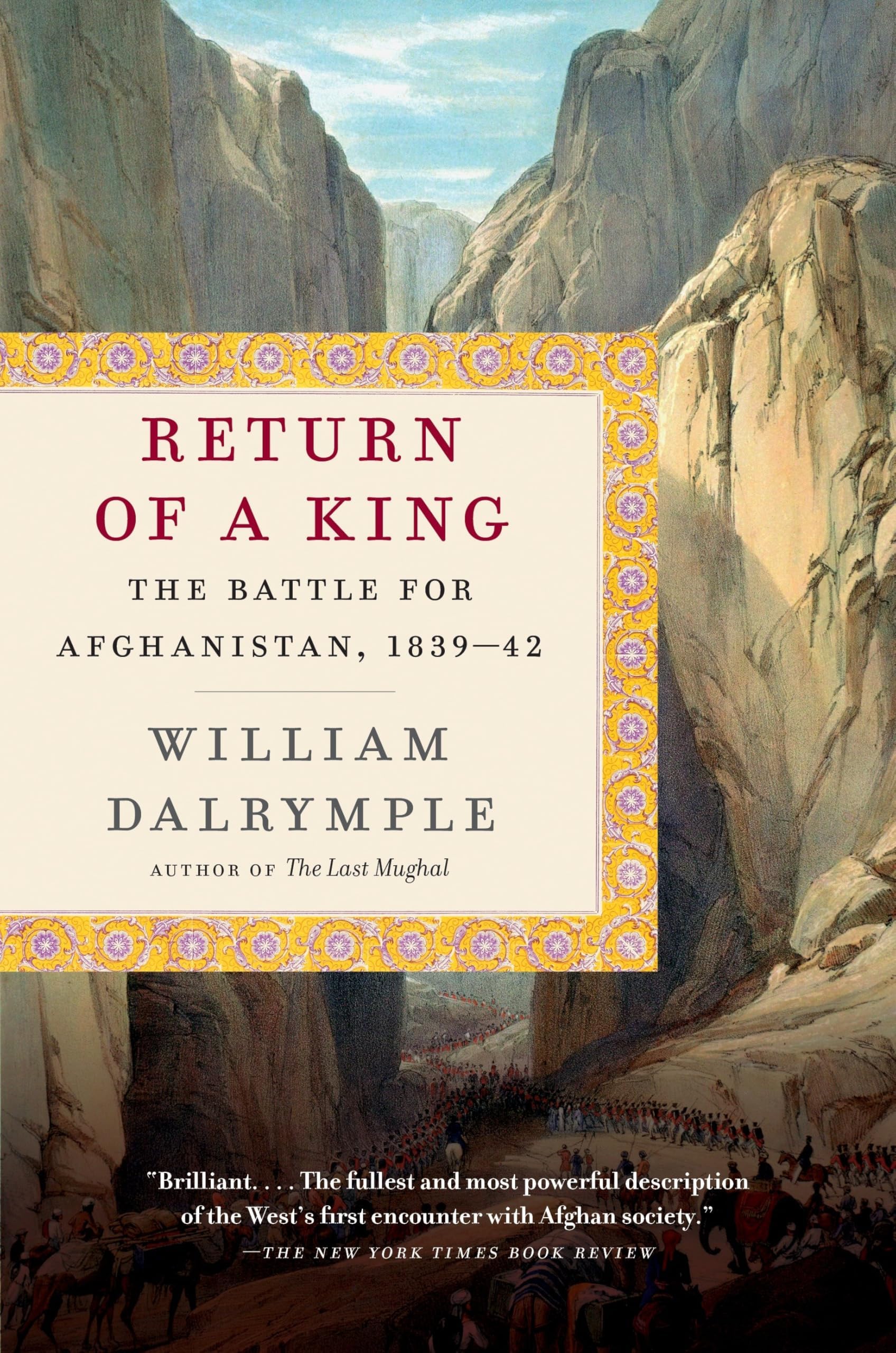
Return of a King: The Battle for Afghanistan, 1839-42
Product ID: 4422897
Desertcart purchases this item on your behalf and handles shipping, customs, and support to Croatia.
A Best Book of the Year: The Economist , Slate , Kirkus Reviews In 1839, nearly 20,000 British troops poured through the mountain passes into Afghanistan and installed the exiled Shah Shuja on the throne as their puppet. But after little more than two years, the Afghans exploded into rebellion. The British were forced to retreat—and were then ambushed in the mountains by simply-equipped Afghan tribesmen. Just one British man made it through. But Dalrymple takes us beyond the story of this colonial humiliation and illuminates the key connections between then and now. Shah Shuja and President Hamid Karzai share the same tribal heritage; the Shah’s principal opponents were the Ghilzai tribe, who today make up the bulk of the Taliban’s foot soldiers. Dalrymple explains the byzantine complexity of Afghanistan’s age-old tribal rivalries, their stranglehold on politics, and how they ensnared both the British of the nineteenth century and NATO forces today. Rich with newly discovered primary sources, this stunning narrative is the definitive account of the first battle for Afghanistan. Review: As so often in international affairs - hawkish paranoia about distant threats can create the very monster that is most feared. That sentence sums up this story nicely. William Dalrymple has written an impressive and scholarly history of the British disaster that was their first incursion into Afghanistan. This is a very complex story, involving a large cast of characters. It is exhaustive, but not exhausting, and to help the reader through this very interesting and sad story, there is a listing of the major players in about twenty pages containing a brief summary of their role, and a large group of illustrations to accompany the information. With that, you can easily see that the Afghans are split between the Sadozais, and the Barakzais and the British are themselves split between those who favor the old Shah Shuja, and those favoring the upcoming Dost Mohammad Khan. Top that off with Lord Auckland, the British Governor General, who was appointed and knew little of the region, and throw in the perceived threat of Russian interference in the region and you have the perfect martini of disaster, shaken and not stirred. The British infighting as to the political opinions given came out in favor of the spymasters and political advisors favoring the Shah Shuja, who was not the most popular candidate for the rule of the tribes of Afghanistan. He had alread attempted to regain the throne on three occasions; he was not liked by the people, and he simply had more bad luck than anyone deserved. The real power was Dost Mohammad. The short summary is that the British East India Company marched a 20,000 man army into Afghanistan and occupied Kabul (which in itself took a grueling eight months and far too encumbered with baggage) and stayed there far too long. While there never seemed to be any enthusiasm for Shah Shuja among the people, the peace was only maintained by British money which kept the uppercrust happy, but once Auckland decided to pull funds and men away from Afghanistan and use it in China, the thing started to unravel. The British in Kabul were hampered by their own incompetence (among the most glaring was their barracks being built in an untenable position and their store houses equally troublesome and across the river), and the Afghans, once smelling weaknesses pounced on it like a cat on a mouse. The locals, who were always infighting, now united against the British and by the time they left, in the dead of winter, their entire force was destroyed, save one man who made it out. Another army was raised for retribution and destroyed Kabul. There it is, and without going into a lot of politics, i have to wonder why people that are running our State Department don't read history, because today's events are nothing more than a rehash of 170 years ago. This book illustrates that in foreign diplomacy (or in this case, occupation) you cannot manage without accurate information on the ground. The British had conflicting reports from two political advisors with opposite views, and compounding that was the ultimate decision makers dealing with confounding information and the great amount of time required to correspond. Today, we don't have the time problem, but it appears that our government is a bull that brings its own china shop wherever it goes. I highly recommend this book as a scholarly work. It is very interesting and not a quick read at all. Review: Idiot Plot - In Hollywood the "idiot plot" is a story that can only progress if key characters behave like complete idiots. In this case it refers to the British invasion of Afghanistan in the 1840s, not this excellent book by William Dalrymple. Dalrymple provides plenty of background. During the Napoleonic wars the French and Russians plotted an attempt to invade India through Central Asia. While the scheme never went too far, the British lived in needless fear that Russian involvement in Afghanistan would threaten their empire. British intrigue brought about the Russian diplomatic moves that they feared. As a result, the British invaded Afghanistan to replace Dost Mohammed, an effective though despotic ruler, with Shah Shujah, the "rightful" king of Afghanistan. Shujah wasn't a bad man, he just lacked the popularity and political skill that Dost Mohammed had. Dalrymple gives Shujah more credit than he usually gets; if the British had followed his advice they would have at least survived their invasion. Problems started with the invasion. The British were unprepared for the Afghans' guerilla attacks, as well as the weather and geography. Once established in Kabul they managed things very ineptly. The military initially treated their time in Kabul as a holiday outing. They lived in cantonments that were very vulnerable to attack. Their ammunition, treasury, and provisions were located away from the army's main location. The British antagonized the population. They cut the subsidies to the various tribes. Their spending drove up prices. Their womanizing couldn't have been more calculated to antagonize the locals. There are many fascinating characters, some flat out stupid. Readers of Flashman: A Novel will recognize many. The second-in-command, Brigadier Shelton, was cantankerous and stubborn. When his unit was under attack he formed it into squares. This was a sound tactic against cavalry, but made his men easy targets for the excellent Afghan shots. The commander, General William Elphinstone, was in terrible health and probable too passive, ineffective, and indecisive to begin with. British diplomats were more competent but mismanaged the situation. The envoy, William Mcnaughten, was intelligent but arrogant and determined to ignore bad news. Alexander Burnes, the political office ignored warnings and lived away from the army. Both Mcnaughten and Burns were murdered. When the situtation deteriated the British did not move into the Bala Hissar, and excellent fortress. British sources indicate that they believed that the Afghans did not concern treachery to be a vice. There's at least some truth to this, but the British were no better. It was Mcnaughten's violation of an agreement that brought about his murder. The British abandoned the Indian sepoys to the Afghans, planting the seeds for the mutiny of 1857. While the invasion and occupation were poorly run, the retreat was a catastrophe. The British didn't consider an alternative route where they would be completely safe. In the worst possible winter weather they retreated through the passes with insufficient clothing, food, and ammunition. The coda was a disaster, too. The British "Army of Retribution" lived up to its name. It demolished impressive architecture such as the bazaar and ruined the Afghans ability to govern themselves. Before the 1840s Afghanistan was not the seemingly hopeless case it has been since. This is the best book I have read on the subject. Dalrymple's research includes Afghan sources, as well as private British collections that weren't previously available. The book is very readable. There are a few shortcomings that shouldn't discourage readers too much. For all its exhaustiveness, Dalrymple misses a few events. For example, Elphinstone shot himself in the buttocks. Also, Elphinstone formed a "united front" at the rear guard during the retreat. Reviewers make much of the similarities between the British 19th century experience and today's situation in Afghanistan. Regrettably, Dalrymple lets his biases affect this short part of the book. Dalrymple doesn't mention that the Taliban causes most civilian casualties. Dalrymple ignores the fact that unlike the British, NATO forces were not defeated militarily. NATO is withdrawing for lack of political nerve and popular support. The decision to announce a withdrawal date in advance is one worhy of Mcnaughten and Elphinstone. One slur, not typical of the rest of the book, is Dalrymple's statement that NATO's invasion was "neo-colonial." He contradicts this when he criticizes NATO for thinking it could leave after a few years and notes that it was trying to set up a democracy. Colonizers don't behave that way. Dalrymple doesn't mention that the Taliban originated in Pakistan and are alien to Afghan traditions. He questions the motivation for the invasion, ignoring the obvious: We were attacked. There is no mention of September 11, whose perpetrators were based in Afghanistan. NATO did not have the option to ignore al Qaeda's base. Afghanistan's status as a failed state made an attempt to establish democracy worth trying. In hindsight, it would have been better to follow the practice Dalrymple mentions earlier of winning support from individual tribes. In any case, the invasion of Afghanistan was honorable. Unfortunately, Afghanistan has little to look forward to. Dalrymple quotes an Afghan saying that China will be the next invader. Before then, I think a civil war is likely, with factions supported by Iran and Pakistan. The misery in Afghanistan is likely to continue. These criticisms only concern a small part of Dalrymple's story. While there is much to regret in Afghanistan's history, reading this book is a very worthwhile experience. I strongly recommend it.
| Best Sellers Rank | #520,290 in Books ( See Top 100 in Books ) #49 in Central Asia History #263 in Great Britain History (Books) #1,781 in World History (Books) |
| Customer Reviews | 4.5 out of 5 stars 2,094 Reviews |
P**L
As so often in international affairs
hawkish paranoia about distant threats can create the very monster that is most feared. That sentence sums up this story nicely. William Dalrymple has written an impressive and scholarly history of the British disaster that was their first incursion into Afghanistan. This is a very complex story, involving a large cast of characters. It is exhaustive, but not exhausting, and to help the reader through this very interesting and sad story, there is a listing of the major players in about twenty pages containing a brief summary of their role, and a large group of illustrations to accompany the information. With that, you can easily see that the Afghans are split between the Sadozais, and the Barakzais and the British are themselves split between those who favor the old Shah Shuja, and those favoring the upcoming Dost Mohammad Khan. Top that off with Lord Auckland, the British Governor General, who was appointed and knew little of the region, and throw in the perceived threat of Russian interference in the region and you have the perfect martini of disaster, shaken and not stirred. The British infighting as to the political opinions given came out in favor of the spymasters and political advisors favoring the Shah Shuja, who was not the most popular candidate for the rule of the tribes of Afghanistan. He had alread attempted to regain the throne on three occasions; he was not liked by the people, and he simply had more bad luck than anyone deserved. The real power was Dost Mohammad. The short summary is that the British East India Company marched a 20,000 man army into Afghanistan and occupied Kabul (which in itself took a grueling eight months and far too encumbered with baggage) and stayed there far too long. While there never seemed to be any enthusiasm for Shah Shuja among the people, the peace was only maintained by British money which kept the uppercrust happy, but once Auckland decided to pull funds and men away from Afghanistan and use it in China, the thing started to unravel. The British in Kabul were hampered by their own incompetence (among the most glaring was their barracks being built in an untenable position and their store houses equally troublesome and across the river), and the Afghans, once smelling weaknesses pounced on it like a cat on a mouse. The locals, who were always infighting, now united against the British and by the time they left, in the dead of winter, their entire force was destroyed, save one man who made it out. Another army was raised for retribution and destroyed Kabul. There it is, and without going into a lot of politics, i have to wonder why people that are running our State Department don't read history, because today's events are nothing more than a rehash of 170 years ago. This book illustrates that in foreign diplomacy (or in this case, occupation) you cannot manage without accurate information on the ground. The British had conflicting reports from two political advisors with opposite views, and compounding that was the ultimate decision makers dealing with confounding information and the great amount of time required to correspond. Today, we don't have the time problem, but it appears that our government is a bull that brings its own china shop wherever it goes. I highly recommend this book as a scholarly work. It is very interesting and not a quick read at all.
L**N
Idiot Plot
In Hollywood the "idiot plot" is a story that can only progress if key characters behave like complete idiots. In this case it refers to the British invasion of Afghanistan in the 1840s, not this excellent book by William Dalrymple. Dalrymple provides plenty of background. During the Napoleonic wars the French and Russians plotted an attempt to invade India through Central Asia. While the scheme never went too far, the British lived in needless fear that Russian involvement in Afghanistan would threaten their empire. British intrigue brought about the Russian diplomatic moves that they feared. As a result, the British invaded Afghanistan to replace Dost Mohammed, an effective though despotic ruler, with Shah Shujah, the "rightful" king of Afghanistan. Shujah wasn't a bad man, he just lacked the popularity and political skill that Dost Mohammed had. Dalrymple gives Shujah more credit than he usually gets; if the British had followed his advice they would have at least survived their invasion. Problems started with the invasion. The British were unprepared for the Afghans' guerilla attacks, as well as the weather and geography. Once established in Kabul they managed things very ineptly. The military initially treated their time in Kabul as a holiday outing. They lived in cantonments that were very vulnerable to attack. Their ammunition, treasury, and provisions were located away from the army's main location. The British antagonized the population. They cut the subsidies to the various tribes. Their spending drove up prices. Their womanizing couldn't have been more calculated to antagonize the locals. There are many fascinating characters, some flat out stupid. Readers of Flashman: A Novel will recognize many. The second-in-command, Brigadier Shelton, was cantankerous and stubborn. When his unit was under attack he formed it into squares. This was a sound tactic against cavalry, but made his men easy targets for the excellent Afghan shots. The commander, General William Elphinstone, was in terrible health and probable too passive, ineffective, and indecisive to begin with. British diplomats were more competent but mismanaged the situation. The envoy, William Mcnaughten, was intelligent but arrogant and determined to ignore bad news. Alexander Burnes, the political office ignored warnings and lived away from the army. Both Mcnaughten and Burns were murdered. When the situtation deteriated the British did not move into the Bala Hissar, and excellent fortress. British sources indicate that they believed that the Afghans did not concern treachery to be a vice. There's at least some truth to this, but the British were no better. It was Mcnaughten's violation of an agreement that brought about his murder. The British abandoned the Indian sepoys to the Afghans, planting the seeds for the mutiny of 1857. While the invasion and occupation were poorly run, the retreat was a catastrophe. The British didn't consider an alternative route where they would be completely safe. In the worst possible winter weather they retreated through the passes with insufficient clothing, food, and ammunition. The coda was a disaster, too. The British "Army of Retribution" lived up to its name. It demolished impressive architecture such as the bazaar and ruined the Afghans ability to govern themselves. Before the 1840s Afghanistan was not the seemingly hopeless case it has been since. This is the best book I have read on the subject. Dalrymple's research includes Afghan sources, as well as private British collections that weren't previously available. The book is very readable. There are a few shortcomings that shouldn't discourage readers too much. For all its exhaustiveness, Dalrymple misses a few events. For example, Elphinstone shot himself in the buttocks. Also, Elphinstone formed a "united front" at the rear guard during the retreat. Reviewers make much of the similarities between the British 19th century experience and today's situation in Afghanistan. Regrettably, Dalrymple lets his biases affect this short part of the book. Dalrymple doesn't mention that the Taliban causes most civilian casualties. Dalrymple ignores the fact that unlike the British, NATO forces were not defeated militarily. NATO is withdrawing for lack of political nerve and popular support. The decision to announce a withdrawal date in advance is one worhy of Mcnaughten and Elphinstone. One slur, not typical of the rest of the book, is Dalrymple's statement that NATO's invasion was "neo-colonial." He contradicts this when he criticizes NATO for thinking it could leave after a few years and notes that it was trying to set up a democracy. Colonizers don't behave that way. Dalrymple doesn't mention that the Taliban originated in Pakistan and are alien to Afghan traditions. He questions the motivation for the invasion, ignoring the obvious: We were attacked. There is no mention of September 11, whose perpetrators were based in Afghanistan. NATO did not have the option to ignore al Qaeda's base. Afghanistan's status as a failed state made an attempt to establish democracy worth trying. In hindsight, it would have been better to follow the practice Dalrymple mentions earlier of winning support from individual tribes. In any case, the invasion of Afghanistan was honorable. Unfortunately, Afghanistan has little to look forward to. Dalrymple quotes an Afghan saying that China will be the next invader. Before then, I think a civil war is likely, with factions supported by Iran and Pakistan. The misery in Afghanistan is likely to continue. These criticisms only concern a small part of Dalrymple's story. While there is much to regret in Afghanistan's history, reading this book is a very worthwhile experience. I strongly recommend it.
D**R
Graveyard of Empires
"You have brought an army into the country, but how do you propose to take it out?" - An Afghan Tribal Chief "I cannot understand why the rulers of so vast an empire should have gone across the Indus to deprive me of my poor and barren country." - Dost Mohammad Khan, Deposed and Restored Ruler of Afghanistan William Dalrymple starts this account of the First Anglo-Afghan War in 1808 as the British approach Kabul offering gifts and alliance with Shah Shuja, the ruler of Afghanistan. The dynasty was founded by his grandfather who seized Delhi's plunder from the Persian warlord Nader Shah. Britain learned of a treaty between Napoleon and the Tsar of Russia to attack India over the Hindu Kush. France had planned an invasion through Suez but it's fleet was sunk by Nelson at the Nile in 1798. The embassy was sent by Lord Wellington who would go on to defeat Napoleon at Waterloo in 1815. Shuja became a pawn in the East India Company's 'Great Game'. Persians were promised his lands by the French for passage through Iran. His rule in decline, tribal intrigues forced him to flee to British Punjab. After Napoleon's death in 1821 Russia became a concern, and spy networks were set up in central Asia. Fears of a joint Russian and Persian invasion gave a pretense to restore Shuja to the throne of Afghanistan. Britain secretly funded Shuja's army. Joined by Ranjit Singh, Maharajah of the Sikhs, he set out to retake Kabul in 1834 from Afghan usurper Dost Mohammad Khan. Shuja's plan failed and now aware of British complicity Dost prevailed. Britain and Russia vied for influence in Persia. Russian plots prompted Persia to attack Herat in 1837 with troops armed and trained by the British. Spies like Alexander Burnes and Ivan Vitkevitch competed for alliance with Dost. Lord Auckland, the new Governor General of India guided by hawkish bureaucrats, insisted Dost be deposed and replaced by Shuja, sabotaging Burnes efforts. Vitkevitch offered men and money to reclaim Kashmir from Ranjit Singh. After the events in Herat and Kabul Auckland fell into a state of panic. As British prepared to invade there were warnings from local leaders and old hands alike that the terrain was formidable and people fierce. Where diplomacy would have succeeded war was now chosen. Twenty thousand Indian soldiers and their British officers were on the march. Before starting out the siege of Herat was lifted and Vitkevitch recalled to Russia removing any purpose for the expedition. Regardless the plan commenced in 1839. Searing deserts, mountain passes, tribal ambushes, brigand gangs, dying animals, low rations and lack of water took their toll until Kandahar was reached. In Kandahar Shuja was hailed as a hero by defectors from Dost. Flowers were thrown before his elephants feet and he rained British rupees upon his subjects, yet when a soldier raped a girl opinion turned. Shuja became despised as he had come with a foreign infidel army. Ranjit Singh was to have approached Kabul with Muslim troops but reneged on his pledge. In Ghazni the British were astounded to find fifty meter high fortifications. A desperate night attack was made and the Afghan army routed. Dost sued for peace but was forced to flee before the British army approach to Kabul. Dost was imprisoned in Bukhara as Russians invaded Khiva. British alarm was raised but the Opium War of 1840 diverted troops from Afghanistan to China. Requisitions for defensive construction were denied and five thousand soldiers slept in a low cantonment with short walls. Afghans were offended by foreigners openly drinking and whoring. Seen as a figure head for British rule, the clergy excluded Shuja's name from the Friday prayers. Nobles chafed at patronage reforms and hyperinflation arose from the foreign occupation. When Dost escaped from jail he returned to raise the flag of holy war. Dost's jihad failed and he surrendered to be exiled in India. Singh's death caused civil war in Punjab, threatening supply and communication lines to Afghanistan. Herat made allies with Persia against Britain as rebellions arose in the country. Occupation was draining the East India Company treasury. Feudal protection money was reduced and nobility left the court to prepare insurrections. British forces were recalled to India to lessen the payroll as Afghan muskets fired from the cliffs above. Their infantry and cavalry weren't suitable for the guerrilla warfare the natives were accustomed to use. Jihad was sworn upon the Quran. A mob set fire to Burnes house in Kabul and cut him to pieces. Militia rode in from the mountains. Foreigners were attacked in their forts and homes, without reprisal, in a popular uprising. Sheltered in the cantonment, ringed by hostile hill stations, ammunition and provision depots were captured. Shuja refused to join the rebels and was declared an infidel. Akbar Khan, the son of Dost, became leader of the rebels. Freezing and famine followed, and a treaty was negotiated for the British retreat. Seventeen thousand soldiers and civilians left for India. For a week they marched through the snow dying from cold and shot at by Akbar's rebels. Only several reached Jalalabad and two thousand survived as hostages or slaves. As Shuja manoeuvred with Kabul nobles to retain the throne, Akbar waged a political campaign claiming he was unwilling to fight the infidels. Forced to come out of his citadel he was slain in the street. Akbar laid siege to Jalalabad but was routed by the defenders. In 1842 the Army of Retribution burned and killed their way to Kabul. Dost Mohammad Khan was restored to rule by the empire that had deposed him. All manner of military and political pitfalls are told in this tale; cold war threats, espionage, regime change, puppet rulers, leadership lapses and military quagmires. Americans and Russians would have done well to review the war before embarking on their own fiascos. Dalrymple is expansive, reflecting the deep research done. The events are clearly conveyed for the period and conflict. Afghans and English are covered well but Indian troops from Bombay and Bengal are given little notice. This is surprising as Dalrymple is a scholar, writer and long time resident of northern India.
M**.
A brilliant work with lessons for today
Return of a King is an outstanding work that is exhaustively researched, beautifully written, and lays bare the manifold colonial conceits that led the British into an epic disaster. The utter lack of risk awareness on the part of British decision makers is astounding. The principal culprits (Auckland, McNaughten, Elphinstone, others) are willfully ignorant of culture, terrain, weather and other factors, yet blunder ahead with blind arrogance against of the wise counsel of those with far more knowledge and experience. Catastrophe is inevitable, and it unfolds dramatically and inexorably in the second half of the book. Dalrymple unearthed works by Afghan poets that colorfully describe numerous events, a wonderful highlight of this book. As with every Dalrymple work, I made a list of dozens of words that I didn’t recognize, to look up later. Dalrymple is a master of his craft.
R**N
A Lesson Unlearnt
An instructive read for anyone interested in the ways of the world. A detailed and unvarnished account, drawing on both British and Afghan sources, of one blundering episode in the building of the British Empire that bloodied the British and defined the Afghans. The British poorly led were savagely defeated. It was one of those instances when the gods harshly punished mortals for their arrogance. The British shrugged off their defeat, recognized that Afghanistan would not fall under the sway of the East India Company and sensibly focused on consolidating their gains in India. But the Afghans, they did not change in significant ways. Ethnic and tribal loyalties and that fierce independence in the harshest of environments survived. And the pity is that Dalrymple's account of Britain's drubbing was published as late as it was. The Soviets would have benefited from it as surely as would the Americans who also marched bravely into the lions den. If history has lessons to teach, this is one of them. It is hard to see Afghanistan ever functioning in ways that imitate western society. And it is foolish to seek to impose alien societal models there. It is a deeply fractured society that operates at the tribal level. Afghanistan is a society of tribes. It is not a nation state as we would understand it. No government is ever going to secure the revenues necessary to develop and support a modern state. This was true in 1839. It is also true today.
R**Z
Why Afghanistan controls and absorbs its occupiers
It must be sobering for national leaders outside the region seeking influence in Central Asia to realize that the cultural divides between East and West remain basically unchanged over the centuries. The pervasive existence and importance of tribal and clan issues and codes , ethnic leadership ,multiple religious communities and ,in a modern version ,the ideological certainties of outsiders,whether driven by financial considerations or concepts of pride,honor and "national security needs" have not changed much since the 1830s. Intruders into the region over the decades have not learned much about local histories either. The British, Russians,Americans,Chinese---in the past and soon hereafter--- , Persians (Iranians) and Indians tend to repeat each other's history as they grapple with the problems they created or faced in Afghanistan. That is the message of this carefully researched book. The early chapters are somewhat difficult to read and absorb, the cast of characters is large and the background to British--Asian policies complicated and simplified in the telling, but the reader will become quickly aware that strangers to the region seeking to impose their values and programs will be eventually be manipulated by local leaders and forces ,even if they are technological superior to their "enemies" or rivals. This first-rate book should be read as a broad case study in the ignorance or hubris of foreign leaders and the many representatives of occupying powers who seek to dominate traditional societies.
V**N
A little verbose
Well documented narrative though a little verbose. I have some concerns about the narrative: 1. Judged on today's ethical standards none of the key players in this narrative, whether Afghan, British or otherwise, would be considered ethical. Everyone was playing a game to shortchange the other. However, Maharaja Ranjit Singh alone was consistently labeled "wily", not just in the Dramatis Personae but also in the text, that too repeatedly, (p 122, p159), while such negative labels were not assigned to others. Neither does the author provide any justification for the negative labeling of Ranjit Singh. Why? 2. Afghanistan was (and still is) a place where every man of any power has to be guarding his own back twenty-four hours a day. It was abnormal for anyone in the ruling class to live to experience a natural death at old age and no power transition took place without violence whether between brothers or enemies. Maintaining law and order was done by bribing the blackmailers and extortionists. Rulers ascended to their thrones by treachery and violence and stayed in power by bribery. And the method of building wealth for royal treasure was to raid into Indian territories, pillaging the farmers and merchants and kidnapping the peasantry to be sold as slaves in Central Asia. However, the author portrays Afghanistan as a place of "great Timurid culture, place of Persian elegance, highly cultured Persian speaking Safavid and Timuric civilisaction and Mughals regarded as a far more elegantly cultured place than India". It does not seem to connect unless this is a hagiography of Afghanistan which it is not.
A**R
Afghanistan: Different players, same story
An interview with the author on a morning talk show prompted me to order the Kindle version that same day. His thorough research and accessible writing style (almost as readable as David McCullough) made this lengthy book fly by quickly for me. I was frequently stunned by the number of parallels between the experiences of the British, Soviets, and the U.S in this mysterious place. Perhaps most compelling were the carefully explained nuances of Afghan internal politics that appear to have changed very little in their dynamics in the more than 170 years since the events recounted in this book. Author William Dalrymple's own British heritage, combined with a prodigious knowledge of Afghan history and culture enabled him to paint a uniquely informed picture of the futility of invading and suppressing Afghanistan. The failure of the British to adapt their approach to reflect the culture and circumstances contains many lessons no less relevant today. Among the more interesting story lines was how the British and Russian power structures were willing to ignore or refute what their envoys actually inside Afghanistan were telling them. Time after time, those governments made strategic blunders, allowing bureaucrats or aristocrats who had never set foot in the country to decide on diplomatic or military matters with profound implications for everyone involved. Even readers with strongly cynical or jaded attitudes toward politics may sometimes find it difficult to understand the amount of deceit, deception, and fragile loyalties inherent in Afghan affairs, but it was and may still be, essential to how they hold on to their own identity as a mainly tribal structure constantly under fire from some global power. Initially I found the myriad of tribal and ethnic names and references to be confusing and overwhelming, but once I stopped worrying about how to pronounce names or be absolutely clear on who was from where and which other factions they were aligned with, the reading was less arduous. If understanding Afghanistan is important to you, this book will make you much better informed.
U**P
Must read for politicians that advocate war in Afghanistan
Better be kept on the shelf on display for ready reference. Just in case politicians of the future suggest to invade Afghanistan to establish whatever will be the reasoning for military intervention then. Some of the reasons and justifications given by the British imperialists at the middle of the 19th century sound very similar to what was said in the 21st.
J**P
The Afghan Chivalry
Return of a King: The Battle for Afghanistan, 1839-1842 by William Dalrymple is a gripping and meticulously researched account of the First Anglo-Afghan War, a pivotal yet often overlooked episode in the history of Afghanistan and British imperialism. Historical Narrative Dalrymple chronicles the events leading up to the British invasion of Afghanistan in 1839 and the subsequent disastrous retreat in 1842. He draws on a wide array of primary sources, including diaries, letters, and official documents, to reconstruct the political intrigues, military campaigns, and cultural clashes that characterized this tumultuous period. His narrative provides a comprehensive and vivid portrayal of the complexities involved in British-Afghan relations during the 19th century. Characters and Perspectives Central to the book are the various key figures involved, including British political officers, Afghan rulers, tribal leaders, and ordinary soldiers. Dalrymple skillfully weaves together their perspectives, motivations, and actions, offering insights into their roles in shaping the course of the war. This multi-dimensional approach humanizes the historical narrative and enhances the reader's understanding of the individuals caught up in the conflict. Cultural and Political Context Dalrymple contextualizes the First Anglo-Afghan War within the broader geopolitical landscape of the time. He explores the British imperial ambitions in South Asia, the Great Game rivalry with Russia, and the intricate socio-cultural dynamics of Afghan society. His analysis sheds light on the complexities of foreign intervention and the challenges of governing a diverse and fiercely independent nation like Afghanistan. Military Campaigns and Strategies The book vividly describes the military campaigns, battles, and sieges that unfolded during the war. Dalrymple provides detailed accounts of the strategic decisions, tactical maneuvers, and battlefield engagements, illustrating the harsh realities faced by both British and Afghan forces. His narrative captures the brutality of warfare in rugged Afghan terrain and the human cost of imperial ambitions. Legacy and Reflection "Return of a King" also examines the lasting impact of the First Anglo-Afghan War on Afghanistan, Britain, and the wider region. Dalrymple reflects on the lessons learned from this historical episode, particularly in relation to the challenges of foreign intervention, nation-building, and the resilience of Afghan society. The book offers valuable insights into the complexities of modern Afghan history and its implications for contemporary geopolitics. Literary Style Dalrymple's writing is engaging and accessible, blending scholarly rigor with narrative flair. His ability to convey historical events with vivid detail and emotional resonance captivates readers, making the book both informative and compelling. The careful pacing and insightful analysis ensure that the complex narrative unfolds smoothly, keeping the reader invested from beginning to end. Return of a King: The Battle for Afghanistan, 1839-1842 by William Dalrymple is a masterful historical account that brings to life the dramatic events of the First Anglo-Afghan War. Through meticulous research and vivid storytelling, Dalrymple illuminates the complexities of imperial ambition, military strategy, and cultural exchange in 19th-century Afghanistan. The book is essential reading for anyone interested in Afghan history, British imperialism, and the enduring challenges of foreign intervention in the region.
J**N
Learning the lessons of history
This is a fantastic book in which William Dalrymple provides a gripping account of the first British invasion of Afghanistan in 1839 - `a war begun for no wise purpose' - and the subsequent catastrophic defeat and ignominious retreat from Kabul in 1842. A final chapter deals with the return of the relief force, the ruthlessly violent and destructive Army of Retribution, an army which, Dalrymple notes, "committed what today would be classified as war crimes". 'Return of a King' is a catalogue of military incompetence, stupidity and treachery on a monumental scale, and the story is told in simple, yet very elegant, prose. Dalrymple is not just a great story teller; he also explains complex events in an exceptionally clear, vivid and engaging way. As the lengthy bibliography and 34 pages of endnotes indicate, this book is scholarly and based upon a huge amount of archival research which includes the examination of "hundreds of tattered letters and blood-stained diaries". Dalrymple makes excellent use of all these sources to show exactly what those on the spot were thinking about what was going on. If the lessons of history - in particular that "Afghanistan is no easy place to rule" - have still not been learnt, they are all too obvious in this study.
B**M
Historic accuracy on Afghanistan
The real history of Afghanistan is obscured by propaganda and the self interests of whatever the current political lens it. Dalrymple, stripes all that out and quite simply provides us with the history of Afghanistan and it's strategic position in britain's battle to safeguard their "empire" and the jewel in particular - India. An excellent read for anyone who has an interest in non partisan history.
L**A
Histoire méconnue
Malheureusement méconnue ... L'Afghanistan du 19eme siècle, le début du "Grand Jeu" entre Anglais et Russes, et comment les anglais ont assez copieusement foiré leurs relations avec l'Aghanistan. Ou comment tant de guerres et de confrontations sont déclenchées par des erreurs bêtes, ou des informations fausses, ou des tempéraments individuels incompatibles ... On se rend compte aussi que si les "décideurs" de nos jours s'etaient donné la peine d'etudier un peu mieux l'histoire de ce pays, on aurait pas eu cette catastrophe que fut cette guerre-invasion de 2001. Bref, très bon livre, ecriture fluide, l'auteur est très informé et documenté et réussi magnifiquement à populariser (dans le bon sens du terme) l'Histoire, presque comme un roman d'aventures.
Trustpilot
1 day ago
3 days ago