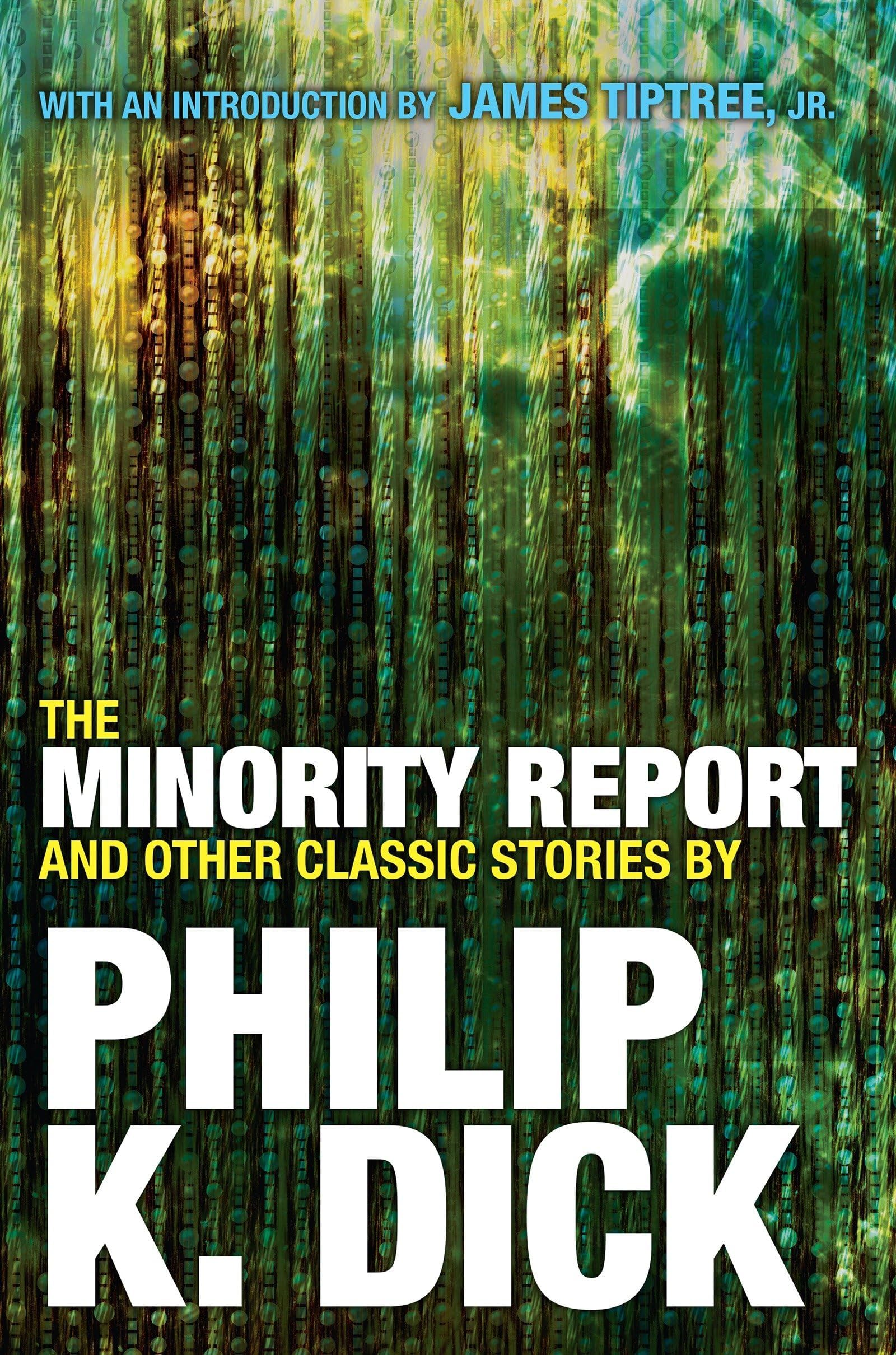
The Minority Report and Other Classic Stories By Philip K. Dick
Product ID: 46064918
Desertcart purchases this item on your behalf and handles shipping, customs, and support to Croatia.
With an Introduction by James Tiptree, Jr. "More than anyone else in the field, Mr. Dick really puts you inside people's minds." -- Wall Street Journal Many thousands of readers consider Philip K. Dick to have been the greatest science fiction writer on any planet. Since his untimely death in 1982, interest in Dick's works has continued to mount and his reputation has been enhanced by a growing body of critical attention. The Philip K. Dick Award is now presented annually to a distinguished work of science fiction, and the Philip K. Dick Society is devoted to the study and promulgation of his works. This collection includes all of the writer's earliest short and medium-length fiction covering the years 1954-1964, and featuring such fascinating tales as The Minority Report (the inspiration for Steven Spielberg's film), Service Call, Stand-By, The Days of Perky Pat , and many others. Here, readers will find Dick's initial explorations of the themes he so brilliantly brought to life in his later work. Dick won the prestigious Hugo Award for the best novel of 1963 for The Man in the High Castle . In the last year of his life, the film Blade Runner was made from his novel Do Androids Dream of Electric Sheep? The classic stories of Philip K. Dick offer an intriguing glimpse into the imagination of one of science fiction's most enduring and respected names. "A useful acquisition for any serious SF library or collection." -- Kirkus Reviews "Awe-inspiring." -- The Washington Post Review: Timely delivery & good condition - Very pleased Timely delivery & good condition. Book is better than the movie. Review: the besst - the best writer ever
| Best Sellers Rank | #97,354 in Books ( See Top 100 in Books ) #325 in Science Fiction Anthologies (Books) #331 in Censorship & Politics #878 in Science Fiction Short Stories |
| Customer Reviews | 4.7 out of 5 stars 191 Reviews |
X**3
Timely delivery & good condition
Very pleased Timely delivery & good condition. Book is better than the movie.
M**R
the besst
the best writer ever
H**S
Awesome story teller what a brilliant mind
I've been a HUGE fan of PKD for many years now. (And not just because I weigh close to 300 pounds!) I own nearly every book/story that he's ever written and this collection is just as good and not one bit worse than any of his other collected series of short stories on the market. As an amateur sci-fi writer myself it is with great pleasure and enthusiasm that I recommend any PKD body of work to the literary neophyte as well as the old hand. If you're a sci-fi enthusiast you can't go wrong with PKD. Intelligent Sci-Fi? You bet!
D**R
THE BEST OF THESE STORIES DON'T GROW STALE
For about five years of my life, from the start of puberty until thoughts of girls and college began to dominate my thoughts, I devoured science fiction. In 1953, when I was a junior in high school, I subscribed to three science fiction (Astounding, Fantasy and Science Fiction, Galaxy) and one fantasy (Beyond) magazines and every month bought a new book from the Science Fiction Book Club. I still read it buy at a more measured pace and indeed, one time, in a college honors program, taught a course on speculative fiction –in fourteen weeks, my students read twelve sci fi works plus a book on science fiction as an intellectual enterprise. Recently, I received for review, a retrospective collection of one of the giants of the field, Robert Silverberg, and was shocked to see how badly it had worn: the stories seemed dated, all too O. Henry-ish, and the science took too much space and was speculation, not science. I didn’t feel the excitement reading it that I’d felt decades earlier. Philip K. Dick was the outlier in that Golden Age of science fiction writing: an eccentric with a Puckish sense of humor, or was it irony, the master of paranoid fiction, writing of worlds that on closer examination always, always ended being what something other than they had seemed to be, and usually something much more sinister. I mean, who else do you know in that group of writers who has had numerous biographical and philosophical studies done of his work, including comment by eminent post-modernists like Jean Baudrilliard, Fredric Jameson, and Slavoj Zizek? Also, how many movies have been made from his stories, a few of them good (notably Blade Runner), most mediocre (including Total Recall and Minority Report). He’s been dead for thirty-nine years, and the medium he wrote in was pulp fiction, but four movies have been made from his stories in to the 2010s alone. Is there any other of his peers whose fans, after his death, recreated him as a simulacrum, a remote-controlled android? Dick would have loved that one. So I picked up two collections of Dick’s short fiction, The Minority Report and Second Variety, to see how they held up. This is my impression of the first of them, The Minority Report. The stories in it were all published between 1954 and 1964 and show the pressure on Dick to write fast in order to pay his bills. But a surprising number of them –twelve out of eighteen—still have punch, and the best of them --“Service Call,” “Recall Mechanism” (particularly jarring), “The Unreconstructed M” (truly jolting), and “Novelty Act”—are outstanding, a heady brew of Dick’s trademark paranoia, libertarianism and love of low humor (so low as to barely be satire). In “Novelty Act,” brothers go to the White House for the annual contest to win the approval of Nicole, the President’s Wife, who seems to run the country but doesn’t really because she’s only an actress too, the fourth in a line to play the role of Nicole in a world that doesn’t want choice any more, just entertainment. A neat twist: the brothers are a twin jug band, but their schtick is that they play only classical tunes –Bach, Schumann, etc. The next story, “Waterspider,” riffs on time travel. In a future age of great travail, scientists decide that the 1950s sci fi authors they have been observing are really precogs (they foresee the future). They send agents back in time to kidnap one of them, Poul Anderson, and bring him to their future to resolve their problems. By the end of the story, Dick has found ways to bring in mention of a slew of contemporaries –Bradbury, Van Vogt, Asimov, Leinster, Williamson, Bloch,. St. Clair, Boucher and Gunn –all names that ring bells for me. All this, in a story that includes a helpful slime mold and terms, never explained, just dropped into the text, like glinning, nilping and polpol. In “Recall Mechanism,” there is a toxic carrot and rats that spin webs to trap their prey. In “The Unreconstructed M,” a television set kills a man, then gets up on a pair of legs and runs away. In “War Game,” the people on Ganymede, having failed to undermine Earth by other means, export toys to Earth: a set of toy soldiers who attack a citadel and gradually disappear in battle, but they’re not vanished, they’ve been absorbed by the citadel and inside, are being re-assembled as a bomb; a suit which, when worn, resurrects the wearer’s pre-teen fantasies, leading him further and further away from reality; and most insidious of all, a board game, like Monopoly but it rewards the children if they lose, not win, when they give away all their possessions. Dick wrote so fast that there’s a lot of potboiler stuff in these tales but there’s something arresting too, and really, really good.
A**R
Excellent collection of Philip Duck short stories
Another nice collection of Dick’s short stories from the 50’s and 60’s. Amazingly insightful and prescient, and still relevant in today’s modern era.
J**L
I thought the movie was great until I read the story
Reading Dick's stories is addicting. Since he is the king of the sci-fi movies, it is interesting to see the differences between the story and the film. The Minority Report was an exercise in logic that Spielberg turned into a standard detective story frame-up, probably because he thought the audience would not understand it. I thought the movie was great until I read the story.
M**A
Love it!
It arrived early and in great condition! I love Philip K Dick stories!
A**S
Memories of reading PKD
I have been a lover of Science Fiction all my life, and many of the stories in this collection are ones I read as a child. In fact, I was surprised to find that many of the fondly remembered stories and situations came from the master's typewriter. It is easy to see why so many movies have been adapted from his short stories, and I am certain that many more will grace our screens in the coming years.
T**R
Four Stars
good
M**R
Buch beschaedigt, in Briefkasten gequetscht
Das Buch selbst ist sehr gut. Leider wurde es mir so zugestellt, dass es kaum aus dem Briefkasten zu bekommen war. Ruecken geknickt, Einband beschaedigt. Der Amazon-Bote meinte es sicher gut, aber gut gemeint ist halt nicht... naja. Werde meine Bestellungen bei Amazon ueberdenken...
N**6
Classique
Pour moi Philip K. Dick est le plus grand auteur de SF, et c'est avec plaisir que j'ai découvert certaines histoires qui ont inspiré des films, la différence entre le papier et la pellicule est toujours intéressante.
Trustpilot
2 months ago
3 weeks ago