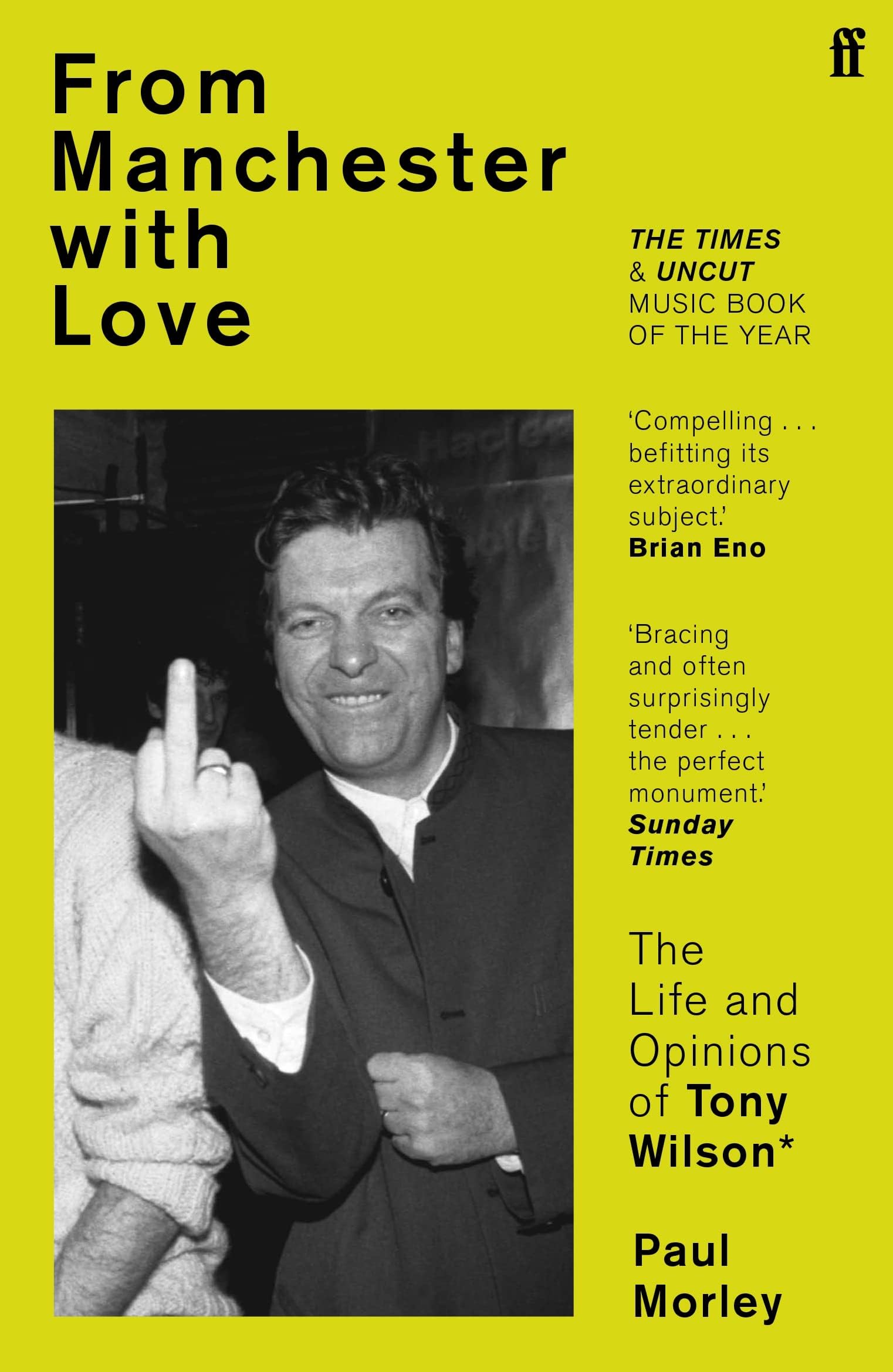
From Manchester with Love: The Life and Opinions of Tony Wilson
Product ID: 477219105
🎵Iconic Manchester music scene
📚Deep-dive biography
🕰️1970s-80s cultural chronicle
Desertcart purchases this item on your behalf and handles shipping, customs, and support to Croatia.
🎤 Own the story behind Manchester’s legendary music visionary!
From Manchester with Love is a sprawling, insightful biography by Paul Morley that chronicles the life and impact of Tony Wilson, a pivotal figure in Manchester’s 1970s-80s music and cultural scene. Blending personal anecdotes with rich historical context, this book offers a unique, intellectual exploration of Wilson’s legacy, making it a must-read for music lovers and cultural historians alike.
| Best Sellers Rank | 309,265 in Books ( See Top 100 in Books ) 22 in Music Biographies for Young Adults 196 in Music Recording & Sound 1,893 in Actors & Entertainers Biographies |
| Customer Reviews | 4.4 out of 5 stars 159 Reviews |
D**S
A love letter to the near past
Paul Morley has written a long and sprawling book about the late Tony Wilson. You will either already know who Wilson was-one of the leading personalities in Manchester's 1970s and 1980s music scene-and will want to read the book, or you never will have heard of him and pass it by. The book is a tremendous read: fascinating, insightful, and empathetic, with Morley's on-off friendship with Wilson providing some of the most informed and poignant moments here. In many ways this is the textual equivalent of the Durutti Column's beautiful 'Paean to Wilson' LP. While it starts as a more-or-less standard chronological biography this structure is soon abandoned for a Morleyesque free-form exposition on Wilson and the world. Though at times infuriating, on the whole this is what you would expect from the author and therefore shouldn't be surprised by. However, the book is far too long and apparently lacking in outside editorial intervention. It is perfect but at the same time imperfect. Many of the digressions in the first half of the book simply read like Wikipedia entries on various individuals, buildings, social movements, and philosophies. At times, this messy scaffolding obscures the landmark Wilsonian building underneath. Finally, it is astonishing to see a reference in the text to W.B. Yates (sic) in a book put out by the legendary poetry publisher Faber and Faber.
M**M
Sketch for Tony
This is a wonderful piece of writing. You may be expecting just another account of Factory Records and the Hacienda – in which case, as Anthony H. Wilson said, you really should read more books. Instead, Paul Morley pulls together all the strands that made Wilson the puckish and provocative presence he offered to national media and local politics alike: north-western pride, residual Catholic belief, the Situationists, Grenada TV, and that wired radicalism which could settle any argument with a scally-bothering quote from Boethius or a quick obscenity. In the process, he educates us in the same breezy way that the man himself so loved to do. Music gets slotted into details of urban planning theory, the Industrial Revolution, Anthony Burgess, a potted history of the Angry Brigade, Raymond Williams, Bill Grundy, and a great deal more. Somewhere, perhaps on some sleek high-flying designer cloud, one can sense Wilson’s spirit nodding with approval at the reading, the analysis, and the sheer hard work it must have taken Morley to structure and sustain this enormous text, while still pointing out what's absent. “Super job, darling. But of course, you missed –“ In fact, the missing lies with us. Morley’s book is a memorial both to an individual and to the long 20th century we’ve just left behind, and one of its themes is the dire, spectacular effect of the Internet, which has now rendered impossible a public secret like Factory and banished any such literate extravagance as Wilson from its ever-blander realm of hashtags and evaporating gossip. As a result, Morley’s opinions are superbly poised but have an undertaker’s finality: we won’t see, or hear, anything else in our lifetime that matches the impact of Joy Division and the Pistols. The same goes for Tony Wilson. Poorly played on film (Steve Coogan’s attempt was pretty much Alan Partridge meets The Lads), he’s better summed up by Morley as a never-satisfied romantic and urban visionary, who finally merged with the reborn, shining Manchester he imagined. The writing doesn’t flinch from other, unpalatable truths. There was far too much cocaine, too little stability (at work and at home), never quite enough money, and a horribly premature death: it still comes a shock to realise Wilson took up so much space and time, but was gone before he was 60. Even allowing for his subject’s failings, though, Morley’s book is a vast, elegant reminder of what was, what could have been, and what will never be again. Mind you, “l’esprit d’escalier” doesn’t mean that at all.
L**E
Not a quick read
This book is a lot! I was an expecting a biography about Anthony Wilson but what you get is a book about everything random in his lifetime and Manchester. It’s not all about him. There are 51 chapters. There’s a lot of words to describe simple things. Sometimes it almost felt like poetry. I felt the book improved half way through but that’s over 250 pages in. It’s a big commitment and at times, I found it hard to go back to it. I liked it but I’m not if I know any more about Anthony Wilson than I did before I started it.
M**O
Super detailed, feature length tribute to an amazing man.
This book is a triumph, but it’s a commitment to read and you need to understand that brevity is not its purpose. You are in for the long haul. Tony was an amazing man, someone who drove a vision and a city to new heights of profile and ambition. But he was opinionated and complex with a massive IQ that can only be discussed properly with an in depth profile. The book contains a wealth of new information and context that makes the whole Factory story so much richer. I learnt a huge amount, and I’m probably a Factory, Tony, Haç superfan. If you’re not, this might not be the book for you, but if you want to get closer to a unique character who funneled an excess of civic pride into shaping the Manchester of my teenage years and what it has become today, you should make the commitment and thank Morley for this exceptional, exhaustive study.
Z**Y
A great source for Mancunians who were part of this scene
It's a Christmas present for my son in law who was a part of the Hacienda crowd.
M**4
good but a bit long winded
Being a Lancastrian born in the fifties, I was brought up watching Granada Reports and always had an interest in Tony Wilson although when I moved down South, he wasn’t so well known but I always followed his career from a distance. However while the book is extreme long for me it didn’t flow as well as it could with many long passages being superfluous in my opinion and if the book was half as long I would have enjoyed it more. Nevertheless I learned a lot I didn’t know about the great man and for any fans I would recommend it
S**3
Popular gift
Bought as a gift, well-received by younger Mancunian fanatic...
3**1
Plenty of insight amid the Morley verbiage
There is a surfeit of barely-intelligible prose lists buried in this unevenly-edited book but if you’ve read Morley before those are par for the course and won’t put you off much and the long friendship of two flashy but sincere contrarians shines through, making it a fulfilling and illuminating read for anyone who watched 24 Hour Party People and wondered about the man it amusingly caricatured. Peter Hook’s book about ‘how not to run a nightclub’ is a fine counterpoint to the sections about Factory Records and the Hacienda but there’s plenty more of value here about Tony Wilson and his enthusiastic relationship with Manchester.
Trustpilot
1 month ago
1 month ago