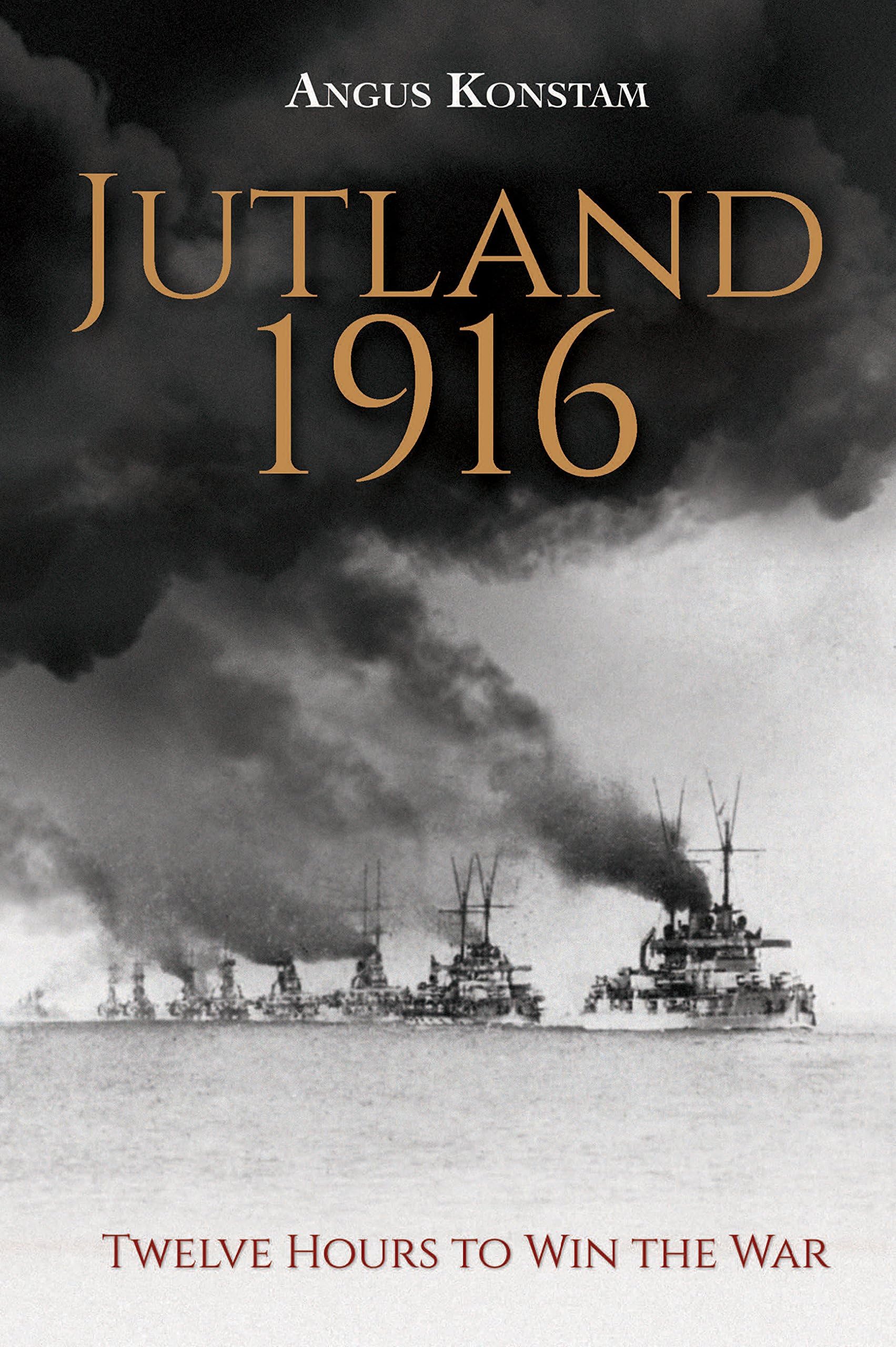
Jutland 1916: Twelve Hours to Win the War
Product ID: 50387091
Desertcart purchases this item on your behalf and handles shipping, customs, and support to Croatia.
Jutland 1916: Twelve Hours to Win the War [Konstam, Angus] on desertcart.com. *FREE* shipping on qualifying offers. Jutland 1916: Twelve Hours to Win the War Review: Balanced and well-written analysis of the battle of Jutland. - Outstanding and gripping narrative of the most famous battle of World War I at sea between the British and the Germans. The author presents a fair and objective analysis of who won and who lost using different criteria to help the reader see the “big picture” of the war at sea and the long-lasting consequences for both countries. Best book I’ve ever read on the subject! Review: Very detailed account of Jutland - This book provided a very detailed and fast pace read on the battle of Jutland. The thought process and decisions made by Admirals of both sides helped the reader understand their affect of the outcome of the battle. A highly enjoyable read.
| ASIN | 1781312885 |
| Best Sellers Rank | #834,016 in Books ( See Top 100 in Books ) #793 in World War I History (Books) #1,378 in Naval Military History |
| Customer Reviews | 4.4 4.4 out of 5 stars (129) |
| Dimensions | 6.02 x 1.38 x 9.21 inches |
| ISBN-10 | 9781781312889 |
| ISBN-13 | 978-1781312889 |
| Item Weight | 1.5 pounds |
| Language | English |
| Print length | 352 pages |
| Publication date | August 9, 2016 |
| Publisher | Aurum |
R**P
Balanced and well-written analysis of the battle of Jutland.
Outstanding and gripping narrative of the most famous battle of World War I at sea between the British and the Germans. The author presents a fair and objective analysis of who won and who lost using different criteria to help the reader see the “big picture” of the war at sea and the long-lasting consequences for both countries. Best book I’ve ever read on the subject!
K**L
Very detailed account of Jutland
This book provided a very detailed and fast pace read on the battle of Jutland. The thought process and decisions made by Admirals of both sides helped the reader understand their affect of the outcome of the battle. A highly enjoyable read.
L**N
Well written
What a monumental battle it was! It seems that since Americans weren't involved in this battle it's not as well known outside of history buffs. Those days of gigantic ships fireing 12" shells at each other are long gone thanks to airplanes and missiles. The author does a good job of making you feel like you are there to see what that type of combat was like. I was interested and involved through each hour of the battle. Very good book.
J**C
Loved It
Excellent book. Couldn't put it down after I started reading it. It is a must read for those interested in naval history.
A**H
Well written? Not so much.
No doubt doing justice to the complex Battle of Jutland, with its several fleets, violent action involving numerous ships and a thousand adventures and misadventures, requires great narrative skill. Konstam’s writing is not up to it. An editor was needed to erase the word “though” wherever found—and it’s found everywhere—a constant irritant. Flabby introductory phrases weaken sentence after sentence. Despite his best efforts, though, the story does shine through and I’m reading the book again, though this time with editorial pen in hand, though. My other complaint are the maps, which are absurdly small and virtually useless. Readers will want to have Charles London’s Osprey book, Jutland 1916, for better maps and clearer, if more limited, narrative.
J**R
Detailed
Fine book, lots of detail.
S**M
Important but chaotic
Naval battles must be a nightmare to write about. This is a great book, but it's very hard to read.
A**Y
Prompt Service
Book arrived on time and described accurately.
O**N
Gut geschrieben. Sehr packendes Buch. Alle Ereignisse und Vorkommnisse sind eindrucksvoll beschrieben. Man kann dem Schlachtverlauf sehr leicht folgen. Besser als mancher Roman.
A**N
A brilliant recreation and evaluation of a critical junction in the history of the Great War. This study establishes the battle as one of the crucial events of the conflict--a decisive British military victory which nevertheless shook confidence in the Royal Navy and Britain's imperial destiny.
P**R
I rate this book highly because it is both all that the interested reader of history needs and a splendid introduction for somebody who intends to go on to read some of the more specialised but perhaps difficult to follow authors. The writing style is brisk and entertaining with an excellent introduction by way of the earlier skirmishes and the German bombardment of British seaside towns. The detailed descriptions of the battle are supported by nearly dozen good maps, most of which are easy to understand (though at least two of them are crowded and difficult to follow). I would be happy to pay for a portfolio of larger scale charts. Following the separation of the fleets the writer turns to a through exploration the battle's supposed non-decisive nature and Beatty's very adequate reasons for not pushing his luck. It might have been a tactical victory for the German SMS in terms of casualties and ships sunk, but strategically it was a huge win for the Royal Navy, leading eventually to the starvation and collapse of Imperial Germany.
P**R
Positiv: Sehr gut zu lesen, flüssig und durchaus spannend geschrieben. Besonders fällt auf, dass auch die Aktionen und Gefechte der Kreuzer und Zerstörer, die in vielen Darstellungen nur am Rande oder zusammenfassend erwähnt werden, detailreich beschrieben werden. Auch die Einbindung und kritische Einordnung von Berichten der Teilnehmer der Schlacht ist gelungen. Die bildhaften Beschreibungen lassen ein gutes Bild der Gefechte im Kopf entstehen, wenn da nicht... negativ: ... die vielen Fehler wären. Irgendwann habe ich aufgehört zu zählen, wie oft der Autor "west" und "east" und teilweise auch "port" und "starboard" verwechselt. Teilweise mehrmals hintereinander, wenn doch die taktische Situation, die Kartendarstellung und die Logik das Gegenteil zeigen. Man zweifelt an sich selbst, ob man die dargestellte Gefechtssituation richtig verstanden hat, liest mehrmals, gleicht es mit anderen Darstellungen ab und stellt dann ein wenig fassungslos fest, dass der Autor - immerhin ehemaliger Marineoffizier! - es ein ums andere Mal falsch darstellt. Das kann mal vorkommen, aber in dieser Menge darf das nicht passieren. Hier haben Autor und Lektor ganz erheblich versagt. Eines der Beispiele (S. 185): "[...] Captain Hartog was leading his four battlecruisers towards the west. He immediately ordered a course change of four points (45°) to starboard, onto a south-easterly heading." Also entweder die Schlachtkreuzer fuhren nach Westen (was aus dem Kontext der Gefechtslage wenig Sinn macht), dann wären sie nicht mit einem Kurswechsel von 45° nach Steuerbord auf einen Süd-Ost-Kurs gekommen. Oder sie fuhren vor dem Kurswechsel nach Osten, aber dann ist der beschriebene Westkurs falsch. Nur ein Beispiel von unzähligen derartigen Fehlern, zu denen auch noch falsche oder vertauschte Namen kommen (aus "Scheer" wird auf einmal "Speer" - wohl im Weltkrieg vertan?), die hoffentlich in nachfolgenden Auflagen behoben werden (oder vielleicht bereits wurden). Durch das Buch hindurch fällt auch die ausgewogene Darstellung beider Seiten auf, die allerdings zum Ende des Buches über Bord geworfen wird: Seine Schlussfolgerungen sind in Teilen mindestens diskussionswürdig. Wenn die Briten dieses und jenes (nicht) gemacht hätten, wenn jener Torpedoangriff Erfolg gehabt hätte etc. pp., dann wäre die Schlacht ein entscheidender Sieg für die Royal Navy gewesen. Das mag sein, aber im Krieg gewinnt nicht der, der alles richtig macht, sondern der, der am wenigsten Fehler macht. Und Unzulänglichkeiten haben meist gute Gründe, die in bestimmten Schwerpunktsetzungen und den Voraussetzungen der jeweiligen militärischen Kultur zu finden sind (beispielsweise Nachtkampffähigkeiten und Kommunikation, zwei Schwächen der Royal Navy. Die kaiserliche Marine hat hier besser funktioniert, hatte aber dafür anderswo teils gravierende Schwächen). Da mutet es doch seltsam an, wenn dann mit "hätte-wäre-wenn" angefangen wird. Natürlich kann man sagen: Hätte die Royal Navy ein besseres Nachrichtenwesen gehabt und ihre Kapitäne und Admirale mehr Initiative gezeigt, hätten sie den Durchbruchsversuch Scheers vereiteln und die Hochseeflotte vernichten können. Aber genauso könnte man auch sagen: Hätte die Hochseeflotte mehr Schiffe oder größere Geschütze gehabt, wäre die Schlacht anders ausgegangen. Beides hatte seine Ursachen in Weichenstellungen der Vergangenheit und kann nicht einfach so hinweg gewischt werden. Spätestens wenn sich der Autor wünscht, die in Scapa Flow liegenden, am Ende des Krieges selbstversenkten Schiffe der kaiserlichen Marine sollten doch lieber als Ergebnis der Battle of Jutland auf dem Grund der Nordsee liegen, zieht man etwas irritiert die Augenbrauen hoch. Durch die packende Beschreibung der eigentlichen Schlacht überwiegen jedoch die positiven Aspekte des Buches, so dass man gerade noch vier Sterne geben kann.
C**O
An excellent account of the penultimate naval battle of WW1. Easy to read and follow, very detailed in its writing. Hard to put down.
Trustpilot
2 months ago
1 day ago