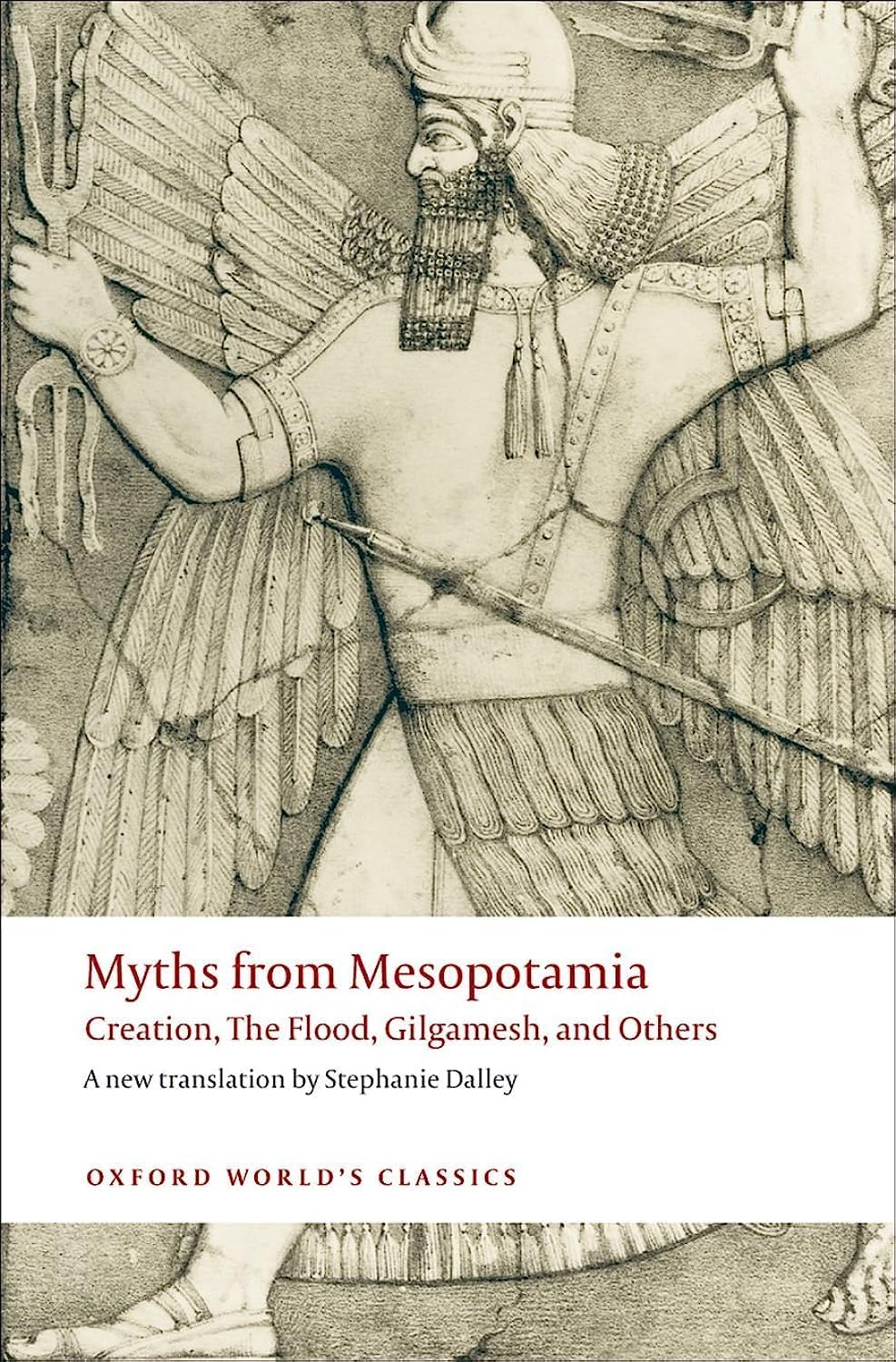
Myths from Mesopotamia Creation, The Flood, Gilgamesh, and Others
Product ID: 50780659
📜4000+ years ancient texts
🧩New Akkadian grammar insights
🗺️Detailed glossary & place-names
Desertcart purchases this item on your behalf and handles shipping, customs, and support to Croatia.
📚 Timeless myths, freshly decoded — don’t miss the stories that shaped humanity’s imagination!
This newly translated volume presents the foundational myths of ancient Mesopotamia, including the Epic of Gilgamesh and the Flood narrative, enriched with updated Akkadian grammar, detailed notes, and illustrations. It offers a rare, scholarly yet accessible window into 4,000-year-old stories that resonate with modern themes of creation, power, and mortality, making it essential reading for anyone fascinated by the roots of civilization and mythology.


| Best Sellers Rank | 12,264 in Books ( See Top 100 in Books ) 48 in Folklore (Books) 83 in Other Religions 99 in Religious Studies (Books) |
| Customer Reviews | 4.6 out of 5 stars 1,120 Reviews |
B**E
Sitchin might not be wrong after all
Having read the negative comments about Zechariah Sitchin I wanted to read the original stories on their own with a good translation. This book is brilliant although not the easiest to read as it doesn't smooth over gaps. I prefer this as it let's me make up my own mind how to fill them. The idea of extra terrestrials having visited the earth can be easily deducted from these texts, one only needs to read the first story "Atrahasis" to get the idea "When Anu had gone up to the sky, [And the gods of] the Apsu had gone below, The Anunnaki of the sky Made the Igigi bear the workload." These gods are not portrayed in a way we like to think of gods as kind of heavenly beings but remind us of greek gods, real people but from a different place, another planet. These gods are as human as we are, they are sleeping in houses, grumble over hard work, complain and start rebellions. And like us humans, who want to ease the work-burden and use workers/slaves, so did they, they created mankind to do the work for them. They " ... clear channels, the lifelines of the land, ... They were counting the years of loads, For 3,600 years they bore the excess, Hard work, night and day. They groaned and blamed each other, Grumbled over the masses of excavated soil" The stories are all very human, have even a modern feel to it sometimes. They really make you think and wonder, who are these Anunnaki, are they really gods in a sense of how we understand gods, supernatural beings, or are they simply a kind of human from a different planet who created workers in their own image but a shorter life span. Even the process of creation as described in these stories do remind one of modern genetic engineering. After reading these stories, I believe that Sitchin might really have a point, there really might have been people from another planet who visited this planet and created us. Of course there are always other interpretations possible, but considering the style these stories are written in and how there are so many other cultures with similar stories and artefacts that still puzzle science and historians today, I think we should keep an open mind. This book is a good start to get a more 'un-biased' view about ancient cultures like the Sumerian. Let the stories speak for themselves.
L**T
Carpe diem
This new translation of Akkadian myths by Stephanie Dalley contains not only the well-known 'Epic of Gilgamesh', but also astonishing fragments from 'Atrahasis', 'The Epic of Creation', the short 'Theogony of Dunnu' with its recurrent themes of incest, patricide, and matricide, and the violent poem 'Erra and Ishum'. The Epic of Gilgamesh This book presents a translation of every major excavated clay tablet about Gilgamesh's search for eternal life. Therein, the 'alewife' ridicules Gilgamesh's quest: 'Gilgamesh you will not find the eternal life you seek … the gods appointed death for mankind. Kept eternal life in their own hands. So, Gilgamesh, day and night enjoy yourself in every way'. For a modern rendition of the epic, I recommend the outstanding version by Stephen Mitchell, 'Gilgamesh' (Profile Books). Atrahasis is a raw poem with an astonishing interpretation of the flood. It was provoked by the gods to combat overpopulation ('the people too numerous … the gods grew restless'). The gods also used other brutal means like starvation, which led to cannibalism : 'they served up a daughter for a meal, served up a son for food.' The Epic of Creation is an ode about the Babylonian hero-god Marduk, the creator of the primeval man. Marduk slays the opponent of his own gods, Tiamat, ending chaos and allowing creation to proceed. Out of Tiamet he built the world: 'he opened the Euphrates and the Tigris from her eyes … he piled up clear cut mountains from her udder ...' Erra and Ishum Erra is the god of the plague and the underworld, while Ishum is his counselor, 'a pious slaughterer'. More belligerent and murderous stances are hard to find: 'his heart urged him to make war. He spoke to his weapons, 'Rub yourselves with deadly poison!' 'Like one who plunders a country, I do not distinguish just from unjust … one does not snatch a corpse from the mouth of a marauding lion.' These outspoken and explicit texts are truly remarkable. They tackle profound human themes such as war and peace (power struggles), gods and men (religion), and love and death. Of course, they don't have the polished form of the Greek masterpieces, but they are up to 2000 years older than these.
M**N
Very enlightening
It blew my mind to see that many stories from genesis are here in earlier and more detailed forms. For example, Atrahasis is basically Noah, in more detail with massive differences. There's very little in this book to imply the Anunaki were aliens though. The blanks are kept in (the book explains the tablets were damaged, which isn't surprising as they are about 6000 years old) , so if you want to fill the blanks with aliens and flying saucers you are free to do so ;) I like how the blanks have stayed, and she hasn't made guesses to fill them in.
S**D
Tantalising mythology.
For those with a genuine interest in both history and mythology. This is definitely not a book for the casual reader. The myths are translated just as they are written on the cuneiform tablets which includes indications of missing and damaged lines of words so that the stories are often fragmented in many places. You may find this frustrating but bear in mind this isn't the author trying to cheap you out of information it's just the sad reality of lost history. What remains of the text varies from the enthralling to the confusing and there were times when I would have liked Dalley to have explained a note more or some sort of detailed afterword about each myth perhaps giving more of an insight into her own interpretation of missing sections or the meaning of such abstract ideas as Gilgamesh losing his "Pukku/Mekku" which I am still unclear on. Another quibble is her decision to use the least detailed account of Ishtar's Descent despite telling us in the introduction that a much more detailed version exists but not choosing to share it, luckily it is online and it helps to explain Ishtar's motives far more clearly, Despite the criticisms I did love reading this book, I have been intoxicated by ancient Mesopotamia and its mythology which seems to be the precursor for some later Greek myths and especially biblical tales such as Noah's flood. The gods are at once diplomatic, quarrelsome, merciful and violent as any other pagan pantheon you might read of, which is to say, they are human. If you are intrigued to read some of the oldest known tales of human thought and religion and have a great deal of patience then this book will serve you well.
K**H
Interesting book, worth the read!
Great book - easy to understand and really interesting. Haven’t finished it as of yet, but enjoying it so far. Would recommend!
M**L
Sitchin poses uncomfortable questions
Whether you see him as an expert on ancient history or a type of science-fiction writer he has posed some uncomfortable questions. And whether you see him as a crackpot or not, it is still compelling reading. I don't necessarily believe everything had Freud said either, but in both "theorists" I see a grain of truth. And with both, the writing is engaging and has made me think about the nature of the human narrative. Besides, both write in the Socratic tradition of questioning. It is this kind of questioning that is in itself mesmerising. Both have angered the mainstream, and I think both have made a contribution to the Big Narrative. Besides, we cannot dismiss those we disagree with, what we can do is consider some of their ideas and then make up our own minds. I've seen some very irate experts in the field and that always makes me remember that line from Hamlet: methinks the lady doth protest too much. You don't have to buy into the theory, but you cannot but help to doubt the mainstream's sanctimonious dismissal of alternative thinkers
H**D
Hard to read
This book is taken from Akkadian and Sumarían stone tablets. Whilst much of the tablets have been translated a great proportion of the texts have been lost to history in damages meaning there are large gaps in the texts. Whilst the book is interesting and gives context to the tablets it is slightly hard to read.
Q**N
Quick and perfect!
Arrived quick, perfect condition, very happy with this
S**R
Epics, friendships, teachings and glory
A great compilation of myths that represents the world the way Sumerians and Akkadians used to live with it's fears, efforts and glory. Also a good text to comprehend things related to the old testament in the Bible.
K**3
You'll not find explanations
It's just a copy of what was found, very little comments and explanations. The author says it clearly that her role is almost absent. Most of transcripts are too similar and repeated and if the would have been referred as (idem) the book would have been with much less pages.
D**E
Interesting Read
I found this book interesting and once I started reading the notes along with the stories it made more sense and I had a broader understanding. Having said that it would have been an easier read if the notes were on the bottom of each page instead of at the end of each story. Good place to start learning our ancient heritage that was not taught to us in school.
J**S
A deep dip into ancient myth
Scholarly though very readable, is exactly as advertised, a great resource.
M**A
Produto de ótima qualidade
O produto é ótimo, qualidade de impressão, o tamanho também é bom e se acomada bem na hora da leitura. Tenho de destacar a qualidade do papel e da capa, apesar não ser capa dura da pra ver que é um bom produto. Comecei a ler e até agora vem superando minhas expectativas. Super recomendo para amantes de história e estudiosos.
Trustpilot
2 months ago
1 week ago