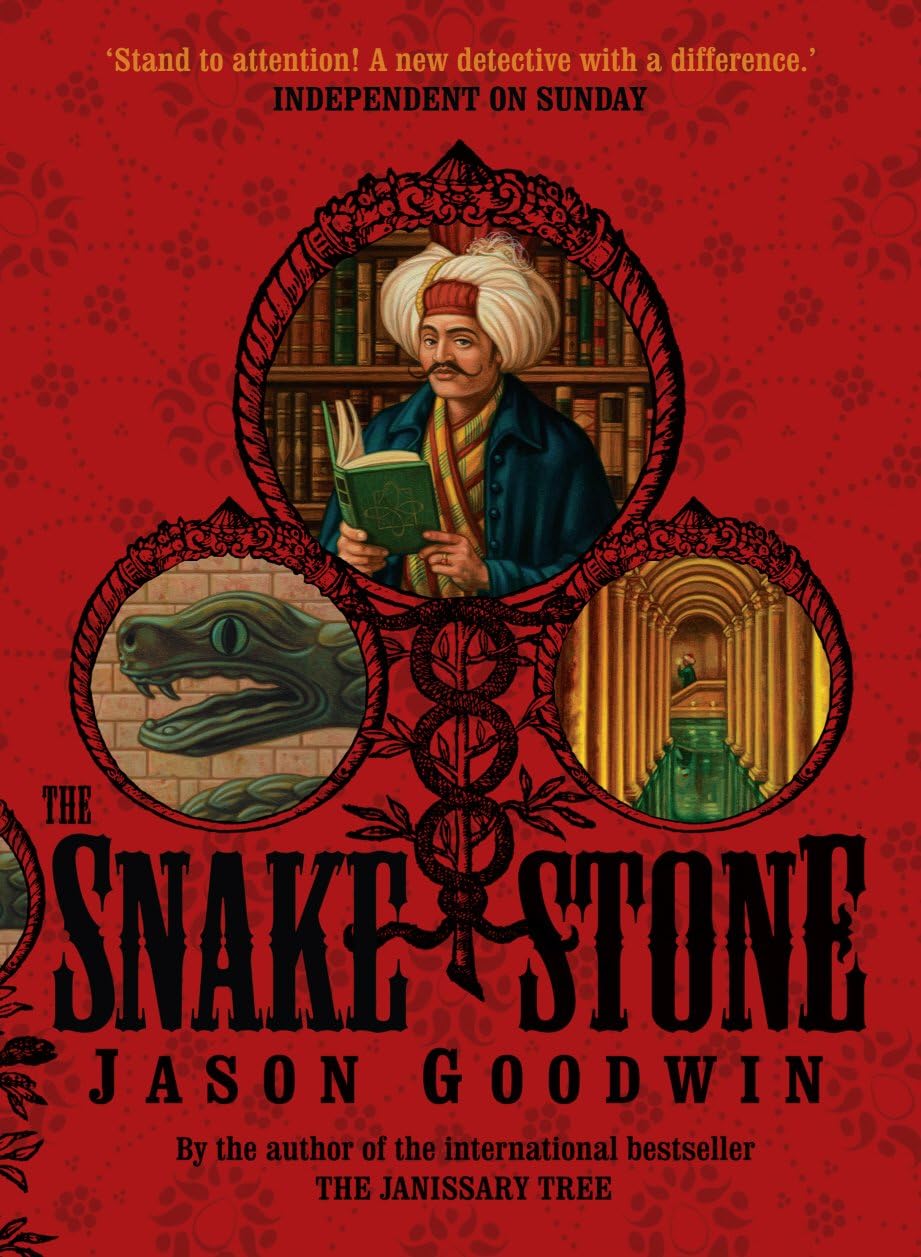
The Snake Stone (Yashim the Ottoman Detective)
Product ID: 51814132
Desertcart purchases this item on your behalf and handles shipping, customs, and support to Croatia.
The Snake Stone (Yashim the Ottoman Detective) : Goodwin, Jason: desertcart.co.uk: Books Review: Five Stars - great read Review: Delightfully moody, mesmerizing, and full of interesting detail about Ottoman Istanbul - As a Turk who has lived in Istanbul for many years, I am perhaps one of the harder readers to please for a foreign author writing about Ottoman Istanbul, but I thoroughly enjoyed The Snake Stone. This is a beautifully written novel full of incredible historical detail, which paints a city of a hundred nationalities existing side by side in a mesmerizing kaleidoscope. My only criticism would be that it tries to be Da Vinci Code towards the end and this subtracts from the charm of The Snake Stone. The Snake Stone is similar to its predecessor, The Janissary Tree, in many ways but has a better story and is more readable. However, the annoying misspellings and creative use of the Turkish language is still there: Hippodrome is "Atmeydan" on pg 23 but then becomes "Atmeidan" on pg 25, although the correct spelling would be "At meydani". "Aya Sofya" (Turkish spelling) is used a few times but then turns into "Aya Sofia" which must be the editor's personal understanding of the correct English spelling of "Hagia Sophia". One of Istanbul's districts is called "Beyazit", not "Bayezit". "Water" is "su" in Turkish and not "sou", so "water inspector" is "su naziri" and not "sou naziry", while "the inspector" would be "the nazir" and not "the naziry" as that last letter (which should have been 'i') means "of" as in "inspector of water". Even the French phrases could use editing: "Ils me connaissent", not "Ils me connaient" like on pg 46. It seems to me that Jason Goodwin needs a new editor or at least a friendly reader to take a look at the final copy of his books before publishing. I humbly offer my services :-)
| Best Sellers Rank | 137,146 in Books ( See Top 100 in Books ) 3,673 in Historical Thrillers (Books) 4,410 in Science Fiction Crime & Mystery 19,777 in Thrillers (Books) |
| Book 2 of 5 | Investigator Yashim |
| Customer reviews | 4.3 4.3 out of 5 stars (616) |
| Dimensions | 12.6 x 1.9 x 19.8 cm |
| Edition | Main |
| ISBN-10 | 0571236472 |
| ISBN-13 | 978-0571236473 |
| Item weight | 260 g |
| Language | English |
| Print length | 320 pages |
| Publication date | 1 May 2008 |
| Publisher | Faber & Faber |
K**E
Five Stars
great read
Z**C
Delightfully moody, mesmerizing, and full of interesting detail about Ottoman Istanbul
As a Turk who has lived in Istanbul for many years, I am perhaps one of the harder readers to please for a foreign author writing about Ottoman Istanbul, but I thoroughly enjoyed The Snake Stone. This is a beautifully written novel full of incredible historical detail, which paints a city of a hundred nationalities existing side by side in a mesmerizing kaleidoscope. My only criticism would be that it tries to be Da Vinci Code towards the end and this subtracts from the charm of The Snake Stone. The Snake Stone is similar to its predecessor, The Janissary Tree, in many ways but has a better story and is more readable. However, the annoying misspellings and creative use of the Turkish language is still there: Hippodrome is "Atmeydan" on pg 23 but then becomes "Atmeidan" on pg 25, although the correct spelling would be "At meydani". "Aya Sofya" (Turkish spelling) is used a few times but then turns into "Aya Sofia" which must be the editor's personal understanding of the correct English spelling of "Hagia Sophia". One of Istanbul's districts is called "Beyazit", not "Bayezit". "Water" is "su" in Turkish and not "sou", so "water inspector" is "su naziri" and not "sou naziry", while "the inspector" would be "the nazir" and not "the naziry" as that last letter (which should have been 'i') means "of" as in "inspector of water". Even the French phrases could use editing: "Ils me connaissent", not "Ils me connaient" like on pg 46. It seems to me that Jason Goodwin needs a new editor or at least a friendly reader to take a look at the final copy of his books before publishing. I humbly offer my services :-)
D**S
a very good read
love the yashim books
O**A
Entertaining but author could use a copy-editor
This is my second book by the author and it is just as entertaining and easy to read as the first book in the series. There are vivid descriptions of Istanbul, likeable characters (even the 'bad guys' are not evil - in the sense that they are not psychopaths or something like that), and the main characters are interesting. Like another reviewer had mentioned, I found the love scene between Yashim the eunuch and Amélie improbable (just as I had found a similar scene in the first book) and the whole scene of Amélie needing rescue at the Great Cistern annoying (esp. when she fainted). What grated the most, however, were the mistakes in the use of Greek words. Hetira must be Etaireia, an organization inspired by the real Philike Hetaireia (also spelled Philiki Eteria), there is no island of Samnos in the Aegean, but of Samos, etc. I had noticed that in the first book too, but in this one it was far too annoying. I admit I got the kindle edition, so maybe these mistakes are not present in the printed book...
J**N
started well, but fell short of expectations.
Godwin’s first book established his grasp of Ottoman history and introduced a vivid world of characters and events unfamiliar to many readers. Yasmin, the eunuch protagonist of his mystery stories, was a welcome addition to the genre and an original invention. That said, I felt very uncomfortable with the sex scene in that book; why did the author think it necessary that a eunuch should have more or less normal sex with a beautiful female? That would be technically possible, according to my research, but highly unlikely. Moreover, it annoys me that Goodwin found it impossible to imagine the possibility of a man who did not indulge in heterosexual sex and who could therefore relate to women (or men) in a less overt way. The potential to be less influenced and ruled by emotion would have allowed him to reason out the clues he followed, inject deeper objectivity into his observations of humanity, and so on. In this second novel, Goodwin once again demonstrates his wealth of knowledge and capabilities as a writer. Yet, once again, he (perhaps urged by a publisher’s marketeer?) forces us to believe he can attract, rise to and ravish a beautiful woman. Why? It’s nonsense. And it’s a distraction. Worse, he shows us a woman, Mme. Lefevre, who is cosmopolitan, well-traveled, independent and determined, an archaeologist who aspires to be part of what in the 19th c would have been a “man’s profession”, yet who is stupid enough to go into Istanbul’s underground waterways dressed in skirts instead of sensible breeches or pantaloons, and who wilts and faints specifically so Yasmin can look more heroic by rescuing her. Utter tosh. So much of this books felt formulaic and contrived, as if the author had lost faith in the powers of his own imagination and knuckled under to mass market, dumbed down drivel, simply in order to appease the demands of some publisher’s bean counter. And nothing about the snakestone itself was ever resolved. Shameful. My last book in this series. Good luck Jason. I hope you pull yourself together.
S**A
Excellent fun
I enjoyed this book enormously. Didn't know a eunuch could do that!!
M**.
A good read but some historical quibbles
I'm with Z de MC above - noticed all those details plus the choice of Byzantium by Constantine for his new city was AD 324 and inaugurated in AD 330; I'm not sure where AD 375 (p.20) comes from and St Helena found the relics of the True Cross in Jerusalem not Constantinople (p.21). All a bit disconcerting coming from a Byzantinist. However, the stories are a great read and great fun - just a better editor/ proof- reader needed.
F**A
El interés de esta novela negra radica en su ambientación en Estambul, Yashim no es un detective al uso, es eunuco, buen cocinero, es discreto y tiene mucho sentido común, por lo que el palacio le encomienda la resolución de casos delicados .Lo mejor de la novela es su ambientación en el Estambul de 1830, y los datos históricos que introduce el autor, que es un experto del Imperio Otomano, son fascinantes.
D**Y
Jason Goodwin is very knowledgeable and has written a very good book. It is full of very convincing descriptions of the Istanbul of the past as Yashim his Ottoman sleuth follows the clues and the mystery unfolds. Recommended.
M**Y
As posted in another review of this series about Hashim, a sort of Turkish detective of the last century, I love this series! Hashim is a wonderful character, a great mystery and problem solver, and an ex-advisor to the Sultan who calls him in from time to time for help. The stories are really interesting, particularly because you learn a great deal about the Ottoman Empire, the magnificent city of Istanbul, Topkapi Palace, etc. Jason Goodwin is a scholar who has written a wonderful history of the Ottomans, and he's a great story teller, too. I go to Istanbul quite frequently, and I have learned so much from these books, and have found out that what I did know is much more interesting than even I thought it was. Fun reading!
C**S
Amusing book. It is the fourth book of this detective that I read in a raw.
R**D
A very enjoyable historical detective story. The author made old Istanbul come to life as a character in it's own right.
Trustpilot
2 months ago
5 days ago