๐ Elevate Your Robotics Game!
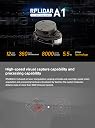
The WayPonDEVRPLIDAR A1M8 is a cutting-edge 360-degree lidar sensor designed for obstacle avoidance and educational purposes. With a high sampling rate of 8000 times/s and a maximum range of 12 meters, it provides precise environmental data. Its plug-and-play functionality makes it accessible for users of all skill levels, while its versatile applications span from home robotics to advanced mapping solutions.

| ASIN | B0BX5GP8YY |
| Best Sellers Rank | #809,947 in Electronics ( See Top 100 in Electronics ) #34,648 in Security & Surveillance Equipment |
| Brand | WayPonDEV |
| Color | White |
| Compatible Devices | Computer, Robot |
| Customer Reviews | 4.7 out of 5 stars 5 Reviews |
| Frequency | 5.5 hertz |
| Manufacturer | WayPonDEV |
| Maximum Range | 6 meters |
| Mfr Part Number | RPlidar A1M8 |
| Model Number | RPlidar A1M8 |
| Mounting Type | Flange Mount |
| Number of Items | 1 |
| Power Source | Corded Electric |
G**N
Inexpensive laser radar for robots and other experiments
This sensor is similar to what many robot vacuums use to make a map of the room. A motor spins the top round part about 8 time per second to scan 360 degrees. It sends out an invisible (safe) laser that it uses to measure distance from the sensor in all directions. This only scans horizontally, not up and down, so you get the range from the sensor to the first object it hits that's at the same height. This is a sensor commonly called A1M8 Lidar. If you do a youtube search you will find a lot of videos on projects that use it including instructions on how to use it to create an actual map of the room as you move the sensor around it. This particular sensor comes with a small interface board that lets you connect to it using USB. They also include some jumper wires you can use to connect it directly to a Raspberry PI or a microcontroller board. There is a card in the box with links to PC drivers for the board and some free test software for the Lidar. The test software is pretty simple but does give you a graphic of what the sensor sees. I've been testing it and it is having no problem seeing walls and other surfaces that are 20 feet away or more in my office. Whatever you connect it to, this is a common sensor supported by a lot of software including ROS (robot operating system) and others. Even if you are building completely from scratch the format of the data coming from the sensor is pretty straightforward and easy to read. The output of the sensor is pretty stable, there is a small amount of jitter in the points it detects, but this is normal for this sort of device. It doesn't scan fast enough for a fast moving device, but for things that move about walking speed like a robot vacuum or a self navigating RC car, it should be fine. Great for experimenters and inexpensive.
T**S
Well Built, Not cheaply built!
It is hard to review this one as I have had trouble with the project that is utilizing this unit to no fault of the unit. I have absolutely no doubt that this will work as described.
J**M
Nice entry-level lidar, SDK code compiles without fuss
This is a simple device to gather Distance+Angle point cloud data for robot positioning, obstacle detection, etc. It's not weatherproof but could be mounted under a flat shade for some protection outdoors. The manufacturer provides software called RoboStudio (not to be confused with RobotStudio) that can collect data via the USB-to-serial connection to the computer. Unless I overlooked some plugins, the software doesn't seem to offer much besides a visualization of the data to see that the device is working, but the visualization is easy to use and understand. The distance measurements appear to be accurate to a couple of centimeters. They also provide a C++ SDK called rplidar_sdk with several demo applications. One of the demo applications shows a visualization almost identical to RoboStudio, and it's all open source. It will be a lot of fun to see what I can build with this as a starting point.
J**G
Nicely engineered lidar unit
This lidar device is solidly constructed. The sensor turret is belt driven by a small motor that sits right next to it. The base of the assembly sits up on standoffs that allow room for all the wiring connections to the underside. All required connectorized wires are included. I've not yet integrated this sensor, so I can't speak to it's performance, but I will update this review after some testing.
Trustpilot
1 week ago
2 weeks ago