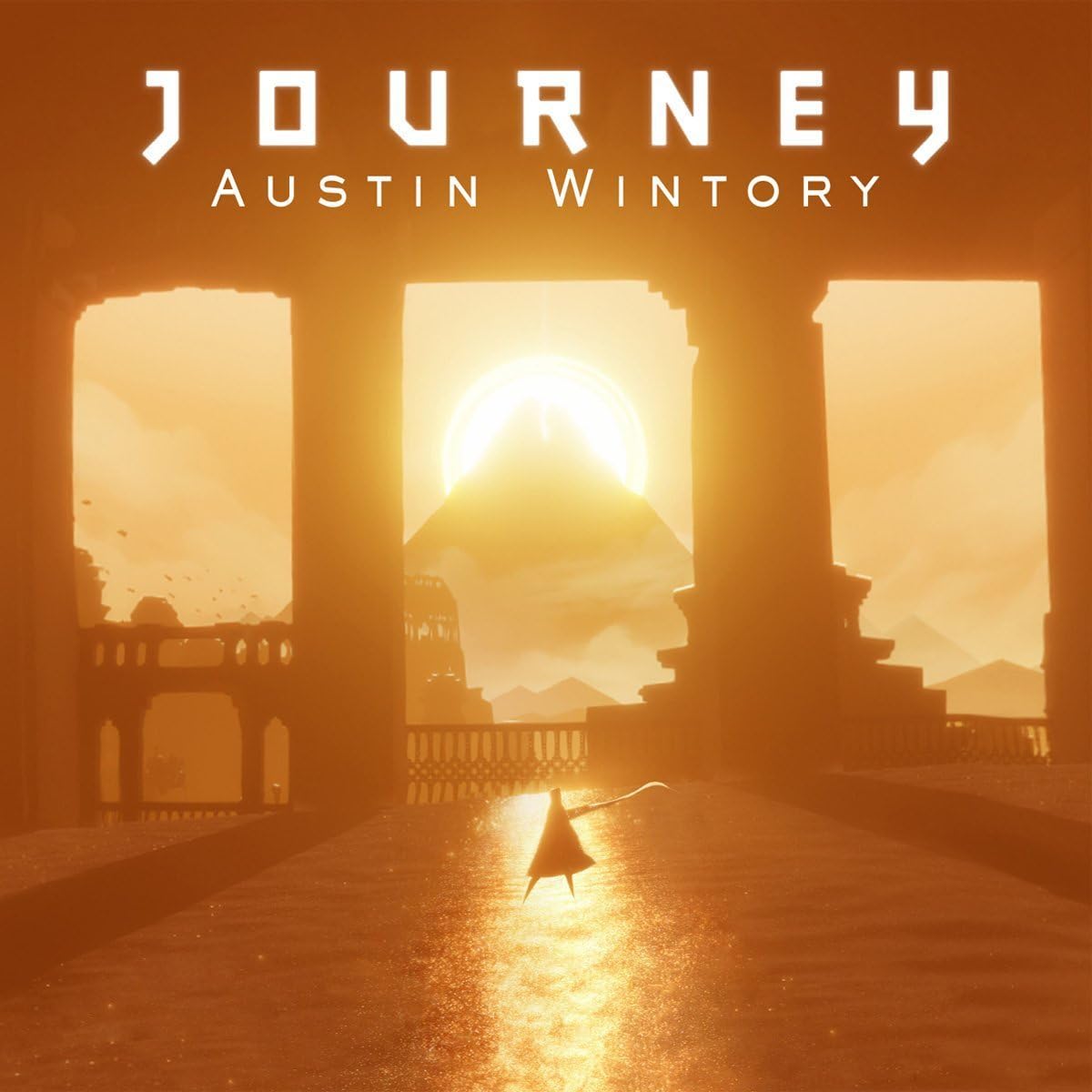

Journey
Product ID: 5468791
Desertcart purchases this item on your behalf and handles shipping, customs, and support to Croatia.
Breaking G.A.N.G. News: Austin Wintory s Soundtrack for Journey becomes the first videogame soundtrack to be nominated for a Grammy Award. In case you haven t yet heard the groundbreaking news: For the first time in history, a soundtrack album from a videogame, Austin Wintory s spellbinding soundtrack for Journey, has been nominated for the Grammy Award, Best Score Soundtrack for Visual Media. I and the other officers of G.A.N.G. offer our hearty and well-deserved congratulations to Austin on this groundbreaking achievement.. What you may not know is the tremendous amount of the behind-the-scenes work and effort that went in making it possible for a game soundtrack even to be nominated... Rewind to 1998, when composer Chance Thomas, put together a group of a dozen of the top game composers to formally lobby NARAS (which organizes the Grammys) to create a new Grammy category for videogame music. At the time, the Grammy for original score was called Best Instrumental Composition Writing for a Motion Picture or for Television. Videogame soundtracks weren t even eligible to even be nominated at the time! Chance and those of us in that group showed how game music had changed it was no longer Pacman and Donkey Kong-- but often included full orchestral scores deserving of recognition by the music industry. It was slow work, and NARAS declined to create a new category. However after continued lobbying, in 2000 NARAS agreed that videogame soundtracks warranted a closer look, and became technically eligible, as the soundtrack category was modified to become Best instrumental Composition Written for Motion Pictures, Television or Other Visual Media . Yes, 2 years of lobbying resulted in adding 4 words to the existing soundtrack category, with videogames falling under the catchall of and other visual media. While significant, this still somehow put videogames below Motion Pictures and TV. A renewed concentrated effort was orchestrated by Chance, G.A.N.G., through its founder Tommy Tallarico and President Paul Lipson as well as EA s Steve Schnur, and NARAS s Leslie Ann Jones and Greg Gordon. Fast forward, and in 2011, Videogame music made history, getting additional attention from the music industry, as a song originally recorded for Civilization IV, included on Christopher Tin s album of original music, Baba Yetu, won the Grammy for "Best Instrumental Arrangement Accompanying Vocalists. Although released on a solo album, that represented the first time a Grammy was awarded to a song that was originally written for a videogame! In 2012 recognizing the importance of the artform of videogame music, NARAS decided to place Videogames, Movies and Television on equal footing, re-naming the soundtrack category Best Score Soundtrack for Visual Media. It is in that category, along with soundtracks for films composed by John Williams, Hans Zimmer and Howard Shore that Austin s Journey soundtrack will compete for the Grammy in 2013. Once again, congratulations to Austin on this groundbreaking achievement. And we should all thank Chance Thomas and the others inside and outside of GANG who lobbied tirelessly for years to help teach the world of the importance of videogame music as an art form, making it deserving of respect and recognition through awards such as the Grammy. It is no coincidence that providing this kind of education about game audio to the broader community in this case NARAS-- is one of the core missions of G.A.N.G. --Brian Schmidt-President, Game Audio Network Guild Review: Journey - In writing reviews, I've often found that written language is better suited to those scores whose content is of low quality, shoddy workmanship, or overall bad instrumentation. It seems easier to mock and criticize a lackluster score than to highlight and extol it. With composer Austin Wintory's score for the 2012 video game Journey, however, so profound was its effect upon me that not only had I a need to find a way to glorify its lavish wonder, but also to translate into words its preternatural and somehow spiritual emotion. A more difficult review than this I have not yet written. Prior to the score for Journey, Austin Wintory's name and musical works had totally eluded me. He's been highly praised for his mostly ambient-type musical score for the video game flOw, to which Journey has drawn some comparisons, but truly, I have to believe that Wintory's magnum opus thus far is indeed Journey. The video game is really an open-ended eponymous experience centered on a nameless character traveling towards a mountain for reasons unexplained. And like the game, Wintory's musical score teases and entices one's interest to the point of rabid obsession, but in my opinion, completely eclipses the game's content in favor of slack-jawed awe. Early into opening tracks "Nascence" and "The Call," Wintory's musical and compositional gifts are easily evident. The foundation of the Journey score is rooted in cello (masterfully played by Tina Guo) and electronic ambient, and right from the start both are equally and effortlessly represented as the score begins with a heart-wrenching cello melody transitioning to gentle, brooding, electronic synth of the highest order. I'm reminded immediately of the melodies on James Newton Howard's score for The Village, as well as Bulgarian dark ambient artist Shrine's The Final Asylum. "First Confluence" begins with the "Nascence" theme buried in the background, almost as if the listener's journey already has taken them a fair distance away from where they began, when suddenly wavering synth begins to flirt with harp melodies. "Second Confluence" continues this pattern, adding a slight industrial tinge when faint electronic buzzing and feedback mingle with bubbling bass lines. "Threshold," a beautiful and lithe track where comparisons to The Village again come to mind, almost immediately also recalls the lead lines to Clint Mansell's The Fountain, when the harp creates a dominant cascade of sound giving way to slight ethnic influences. Wintory may or may not have been trying to steep the listener with emotional impression, but "Threshold"'s conclusion gives a feeling of rebirth after the primordial and serene sound of the first few tracks. "Third Confluence" greets with a foreboding yet wonderfully withdrawn and skittish melody, which quickly introduces "The Road of Trials," a much different and upbeat track than prior with a full-on ethnic drive and pulse, incorporating cello, flute, and harp in a beautiful amalgam of sounds, within a delicate framework of bleeding excess yet somehow juxtaposed with effortless structure and poise. The drums, once in the background, are more forceful and pronounced than before. "Fourth Confluence" is a short track hearkening back to the score's beginning, incorporating ambient swell leading into "Temptations," which features one of the best melody lines on the album, a mysterious harp tune being penetrated first by ambient drift and then by waves of coalescing strings. "Descent" follows, which quickly moves from blinding beauty to what its title suggests: gloomy, nonchalant percussion and low-octave horns. The pace momentarily is quickened entering into "Fifth Confluence," a song comprised of slight, low, and thunderous bass lines underneath a layer of aquatic strings and synth. "Atonement"'s sound again pays homage to Mansell's The Fountain, joined by atonal gongs and warbles of percussion seeming to interrupt the potent cello melody therein, and after two minutes the whole composition bleeds into a network of strings first emulating the cello's captivating beauty, then building and ascending their own structural tone and delving into a swirling, amorphous mass of cello, strings, and metallic percussion. "Final Confluence," the best of its similarly-named cousins, starts out displaying synth backdrop, but then transforms into colossal string collections of heart-rending beauty. Following "The Crossing," the spine-tingling and high-pitched string work of "Reclamation" funnels into "Nadir," which, as its name implies, illustrates a menacing sound akin to Hans Zimmer's work on The Ring, before spiraling into a tumultuous assembly of scratching strings and harrowing drums. It's with "Apotheosis," however, that Journey's penultimate track yet spiritual denouement begins; with a quickening pace of slight percussion and string work, the track breaks into the best melodic section on the album at around the one-minute time frame, capturing the wavering and weeping cello in parallel with a repeating skeletal string composition. Then roughly halfway through the song, the melody shatters upon itself to produce one of the most beautiful and tear-inducing sequences of music I've heard in my lifetime, lending "Apotheosis" an air of unparalleled gravitas with equal and frightening ingeniousness. Final track "I Was Born For This" is the first to incorporate vocals, courtesy of Lisbeth Scott, which otherwise portrays the prototypical sound of the entirety of the Journey score while seeming to casually pay an homage to the awesome beauty of Wintory's sound, before closing on the same level of resplendent beauty on which it all began. I hope I've begun to do justice to Austin Wintory's Journey in only the slightest; never have I heard a musical score that has such left me feeling simultaneously as if I've been infinitely inspired and yet robbed of all hope, joy, yearn, and sorrow. Journey is simply that, in summary: a musical work of drowning, almost emotionally and spiritually vampiric power whose splendor and grandeur cannot be effectively portrayed in words. Stop at nothing to obtain this musical work in any form; Austin Wintory's Journey is a score of stunning and heart-stopping majesty, zealous and indescribable aesthetics, and utterly flawless magnificence. Review: Beautiful and Captivating Masterpiece - This soundtrack for the video game "Journey" is a true marvel and achievement in all of music, and sets the bar for future video games. The game itself is about a nameless traveler who journeys across a vast desert filled with ruins of a lost civilization to a large mountain in the distance, where a light at the top of it beckons to this traveler. Without any dialogue, this video game tells a story through its visuals and the majestic score, composed by Austin Wintory. The music is phenomenal. There is not another musical score for any video game that amounts to Journey, and I'm divided in saying this because, even though i love many great scores, this one is just the best. In comparison with other video game scores, here's my conclusion. The Uncharted trilogy (mainly 2 & 3), the musical scores set the standard for all future adventure games. The Last of Us, it's musical score sets the standard for all action/horror games in the future. Mass Effect 3 set the standard for all future sci-fi related game scores. Now, with Journey, it doesn't set the standard for just a specific genre or style of game, but for all games. The way it conveys beauty with mystery is astonishing, and very prevalent in the track Temptations. But the one track that encompasses the full greatness of the score is track 17, Apotheosis. Clocking at a wee bit over 7 minutes, the track is both haunting and gorgeous, having a sort of hopeful feeling towards the end, as if the end of the journey is merely the beginning of another. Recommended for anyone who listens to video game scores, movie scores, or someone who appreciates classical/instrumental music. 5/5 Stars*****
| ASIN | B008DCOVP2 |
| Best Sellers Rank | #71,418 in CDs & Vinyl ( See Top 100 in CDs & Vinyl ) #1,594 in Movie Soundtracks (CDs & Vinyl) |
| Customer Reviews | 4.9 4.9 out of 5 stars (211) |
| Date First Available | July 3, 2012 |
| Is Discontinued By Manufacturer | No |
| Label | Sumthing Else |
| Manufacturer | Sumthing Else |
| Number of discs | 1 |
| Product Dimensions | 5.59 x 4.96 x 0.39 inches; 3.25 ounces |
C**R
Journey
In writing reviews, I've often found that written language is better suited to those scores whose content is of low quality, shoddy workmanship, or overall bad instrumentation. It seems easier to mock and criticize a lackluster score than to highlight and extol it. With composer Austin Wintory's score for the 2012 video game Journey, however, so profound was its effect upon me that not only had I a need to find a way to glorify its lavish wonder, but also to translate into words its preternatural and somehow spiritual emotion. A more difficult review than this I have not yet written. Prior to the score for Journey, Austin Wintory's name and musical works had totally eluded me. He's been highly praised for his mostly ambient-type musical score for the video game flOw, to which Journey has drawn some comparisons, but truly, I have to believe that Wintory's magnum opus thus far is indeed Journey. The video game is really an open-ended eponymous experience centered on a nameless character traveling towards a mountain for reasons unexplained. And like the game, Wintory's musical score teases and entices one's interest to the point of rabid obsession, but in my opinion, completely eclipses the game's content in favor of slack-jawed awe. Early into opening tracks "Nascence" and "The Call," Wintory's musical and compositional gifts are easily evident. The foundation of the Journey score is rooted in cello (masterfully played by Tina Guo) and electronic ambient, and right from the start both are equally and effortlessly represented as the score begins with a heart-wrenching cello melody transitioning to gentle, brooding, electronic synth of the highest order. I'm reminded immediately of the melodies on James Newton Howard's score for The Village, as well as Bulgarian dark ambient artist Shrine's The Final Asylum. "First Confluence" begins with the "Nascence" theme buried in the background, almost as if the listener's journey already has taken them a fair distance away from where they began, when suddenly wavering synth begins to flirt with harp melodies. "Second Confluence" continues this pattern, adding a slight industrial tinge when faint electronic buzzing and feedback mingle with bubbling bass lines. "Threshold," a beautiful and lithe track where comparisons to The Village again come to mind, almost immediately also recalls the lead lines to Clint Mansell's The Fountain, when the harp creates a dominant cascade of sound giving way to slight ethnic influences. Wintory may or may not have been trying to steep the listener with emotional impression, but "Threshold"'s conclusion gives a feeling of rebirth after the primordial and serene sound of the first few tracks. "Third Confluence" greets with a foreboding yet wonderfully withdrawn and skittish melody, which quickly introduces "The Road of Trials," a much different and upbeat track than prior with a full-on ethnic drive and pulse, incorporating cello, flute, and harp in a beautiful amalgam of sounds, within a delicate framework of bleeding excess yet somehow juxtaposed with effortless structure and poise. The drums, once in the background, are more forceful and pronounced than before. "Fourth Confluence" is a short track hearkening back to the score's beginning, incorporating ambient swell leading into "Temptations," which features one of the best melody lines on the album, a mysterious harp tune being penetrated first by ambient drift and then by waves of coalescing strings. "Descent" follows, which quickly moves from blinding beauty to what its title suggests: gloomy, nonchalant percussion and low-octave horns. The pace momentarily is quickened entering into "Fifth Confluence," a song comprised of slight, low, and thunderous bass lines underneath a layer of aquatic strings and synth. "Atonement"'s sound again pays homage to Mansell's The Fountain, joined by atonal gongs and warbles of percussion seeming to interrupt the potent cello melody therein, and after two minutes the whole composition bleeds into a network of strings first emulating the cello's captivating beauty, then building and ascending their own structural tone and delving into a swirling, amorphous mass of cello, strings, and metallic percussion. "Final Confluence," the best of its similarly-named cousins, starts out displaying synth backdrop, but then transforms into colossal string collections of heart-rending beauty. Following "The Crossing," the spine-tingling and high-pitched string work of "Reclamation" funnels into "Nadir," which, as its name implies, illustrates a menacing sound akin to Hans Zimmer's work on The Ring, before spiraling into a tumultuous assembly of scratching strings and harrowing drums. It's with "Apotheosis," however, that Journey's penultimate track yet spiritual denouement begins; with a quickening pace of slight percussion and string work, the track breaks into the best melodic section on the album at around the one-minute time frame, capturing the wavering and weeping cello in parallel with a repeating skeletal string composition. Then roughly halfway through the song, the melody shatters upon itself to produce one of the most beautiful and tear-inducing sequences of music I've heard in my lifetime, lending "Apotheosis" an air of unparalleled gravitas with equal and frightening ingeniousness. Final track "I Was Born For This" is the first to incorporate vocals, courtesy of Lisbeth Scott, which otherwise portrays the prototypical sound of the entirety of the Journey score while seeming to casually pay an homage to the awesome beauty of Wintory's sound, before closing on the same level of resplendent beauty on which it all began. I hope I've begun to do justice to Austin Wintory's Journey in only the slightest; never have I heard a musical score that has such left me feeling simultaneously as if I've been infinitely inspired and yet robbed of all hope, joy, yearn, and sorrow. Journey is simply that, in summary: a musical work of drowning, almost emotionally and spiritually vampiric power whose splendor and grandeur cannot be effectively portrayed in words. Stop at nothing to obtain this musical work in any form; Austin Wintory's Journey is a score of stunning and heart-stopping majesty, zealous and indescribable aesthetics, and utterly flawless magnificence.
K**D
Beautiful and Captivating Masterpiece
This soundtrack for the video game "Journey" is a true marvel and achievement in all of music, and sets the bar for future video games. The game itself is about a nameless traveler who journeys across a vast desert filled with ruins of a lost civilization to a large mountain in the distance, where a light at the top of it beckons to this traveler. Without any dialogue, this video game tells a story through its visuals and the majestic score, composed by Austin Wintory. The music is phenomenal. There is not another musical score for any video game that amounts to Journey, and I'm divided in saying this because, even though i love many great scores, this one is just the best. In comparison with other video game scores, here's my conclusion. The Uncharted trilogy (mainly 2 & 3), the musical scores set the standard for all future adventure games. The Last of Us, it's musical score sets the standard for all action/horror games in the future. Mass Effect 3 set the standard for all future sci-fi related game scores. Now, with Journey, it doesn't set the standard for just a specific genre or style of game, but for all games. The way it conveys beauty with mystery is astonishing, and very prevalent in the track Temptations. But the one track that encompasses the full greatness of the score is track 17, Apotheosis. Clocking at a wee bit over 7 minutes, the track is both haunting and gorgeous, having a sort of hopeful feeling towards the end, as if the end of the journey is merely the beginning of another. Recommended for anyone who listens to video game scores, movie scores, or someone who appreciates classical/instrumental music. 5/5 Stars*****
C**A
Haunting, evocative and atmospheric
Journey's soundtrack is one of the principal elements of the game's story. Your character begins amidst sand dunes, alone. As you walk and leap toward the distant light on the mountain peak, you see glimpses of the past: crumbling buildings, lonely, mournful creatures - pets? pieces of technology? magic? The sun shines pink in the morning as you start, and the colors change as you enter the abandoned city, pass through its great sanctum, and press desperately on into the blizzard. Along the way are shrines which tell the story of your people, guarded by a serene being who is subtle comforting presence even when hope wanes that you will ever reach your destination. And the shifting of the landscape. There is always sand, or snow, blanketing everything. Likewise, a soft flowing string orchestra is always there, offering shifting ground cover for the solists' melodies. Your character doesn't speak, and may encounter others, but the Journey isn't simply about the landscape; it's a journey of inner discovery, and you will experience in the visuals and the music loneliness, hope, despair, guilt, innocence, joy and maybe a little enlightenment too. Master solo work on cello, viola, serpent (deep woodwind), soft percussion, and from the voice of Lisbeth Scott help bring to the surface these moods. Having played the game several times, I don't know that the soundtrack would make as much sense to someone who hasn't. But for me, listening brings back those haunting images and emotions and lets me experience again Journey's power, beauty and poignancy.
M**S
Beautiful music
If you haven't played the game, I'm not sure the soundtrack will translate as well as it does when you have. That being said, I have played the game, and this soundtrack is what I put on when I want to be moved to my core yet still remain contemplative and thoughtful. It's like yoga music on steroids: it touches my heart in all the right ways, causing deep feelings and emotions, yet not overwhelming. The one negative? If you just give it a cursory listen a lot of the tracks sound the same. However, this is actually a good thing: when listening to the album as a whole, the unity caused by the similar sounds greats an unbroken ease that allows you to flow through the CD without getting put off by some weird, random song in the middle that ruins the mood. Still, buy and play the game first before listening. You'll thank me.
W**G
An absolutely fantastic and relaxing soundtrack!
This is an absolutely amazing soundtrack and I was delighted to be able to order it since it was removed from Prime Music. Hats off to the company that shipped it, they packaged it securely in a bubble mailer and sandwiched it between cardboard for additional sturdiness. It arrived safely and far faster than anticipated by Amazon and my own estimations.
A**K
If you liked the game...
This is an easy five start rating. Austin Wintory certainly creates an atmosphere for a game like Journey to develop within. The soaring moments in the final flight to the mountain peak, or the ambient rumblings of the flying serpents down below; either way this guy really connects the gamer to the games situations. Even without the game itself, if one is just listening to the music, this makes for very relaxing mood music. Also, if you've played the game enough, as each melody becomes recognizable, you can imagine the game at that moment.
R**S
Excellent OST from an Profoundly amazing game. FIVE stars
I usually don't buy CD's. I had to make this purchase though. What an absolutely superb OST. The music from this OST is part of the reason why Journey is such a such fantastic game. I also made this purchase to support the creators of Journey as well as the musician who created this beautiful music. If you're on the fence whether to purchase this album, just buy it. It's truly a masterpiece. The composer deserves some more work and I look forward to hearing more music from Austin Wintory in future video games. Climb the mountain!
R**E
Great background music
Had never played the video game. Ran across the soundtrack in a new music review list. Tried a sample track on Internet and liked it. Found a summary video on the game... of about 45 minutes; it's a great environment, the game... so peaceful and without talking or any text as it plays. The soundtrack plays during the video. Really nice to let soundtrack play in background while one does other stuff. --reviewed 03-27-2013
S**A
Maravilloso
Lo compre para un regalo de cumpleaños y fue todo un acierto. La edicion es preciosa y la banda sonora espectacular, nostalgia pura.
J**Q
simply one of the most beautiful OST
Simply perfection. I just love this OST and Im so happy I can have it on vinyl.
C**A
Copertina leggermente scheggiata
Il cd è molto bello, è stato un regalo davvero gradito, l'unica pecca è che la copertina di plastica frontale era leggermente rotta! Il cd comunque era perfettamente integro e funzionante.
T**N
Genuinely just beautiful
Stunning.
S**M
muy bueno
De esta forma puedes apreciar muchos detalles de la musica, que mientras se juega no, me gusto mucho toda la banda sonora
Trustpilot
3 days ago
3 weeks ago