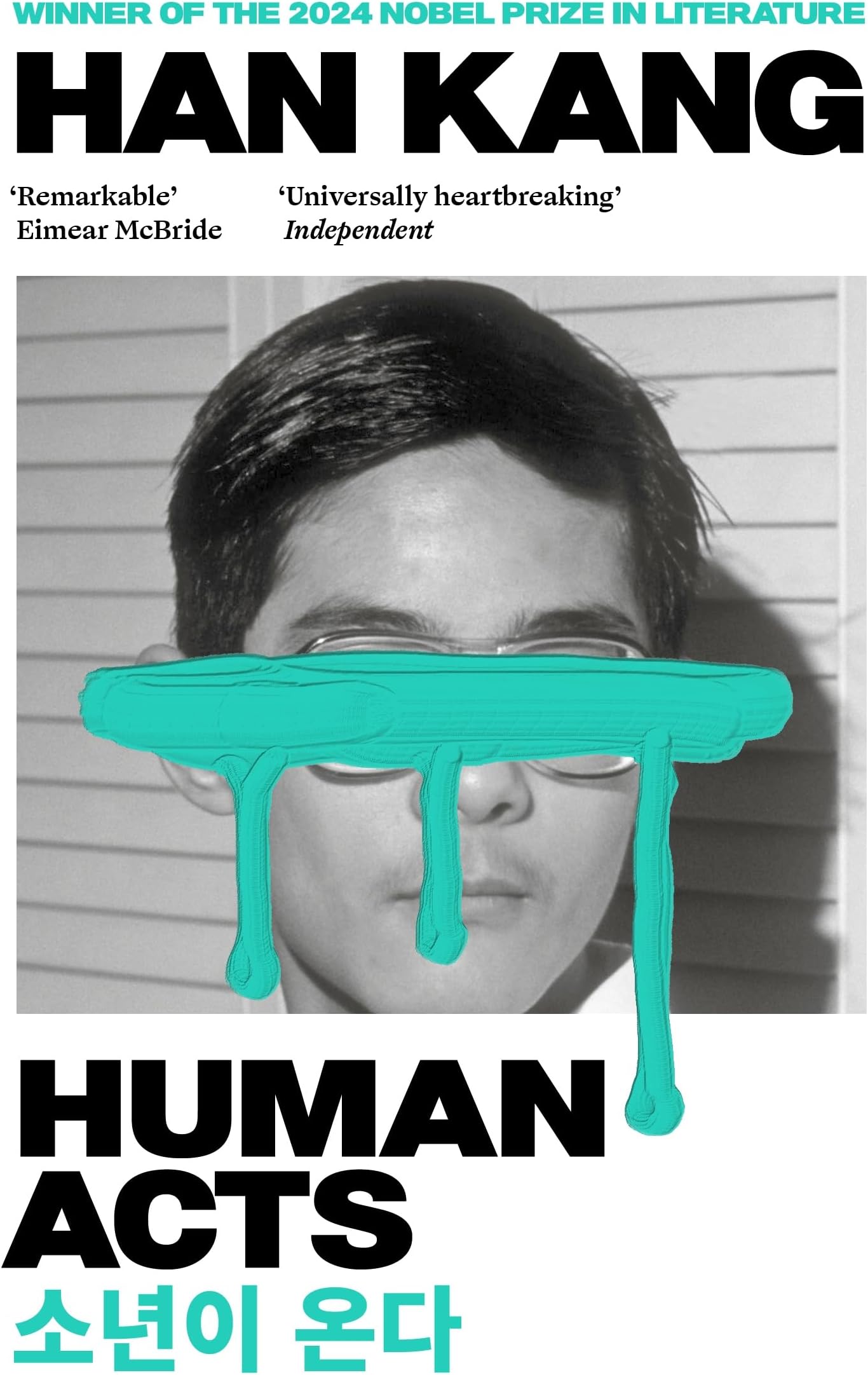
Human Acts: Winner of the 2024 Nobel Prize in Literature
Product ID: 55143087
🌏Global political & cultural insight
🏆2024 Nobel Prize Winner
📚International Booker Prize lineage
Desertcart purchases this item on your behalf and handles shipping, customs, and support to Croatia.
📖 Nobel-Winning Truths: Read the story the world can’t forget.
Human Acts is Han Kang’s 2024 Nobel Prize-winning novel that masterfully chronicles the 1980 Gwangju Uprising through interconnected personal stories. This critically acclaimed, poetically translated work blends historical trauma with resilience, offering a profound exploration of human suffering and hope. A modern classic and bestseller, it invites readers to witness a pivotal moment in Korean history with unmatched emotional depth.

| Best Sellers Rank | 10,728 in Books ( See Top 100 in Books ) 136 in Political Fiction (Books) 163 in Cultural Heritage Fiction 508 in War Story Fiction |
| Customer Reviews | 4.5 out of 5 stars 3,481 Reviews |
B**G
A heartbreaking masterpiece.
"When a living person looks at a dead person, mightn’t the person’s soul also be there by its body’s side, looking down at its own face?" As someone who has been exploring Asian Literature for a few years, and has a massive TBR physical collection, I knew of Han Kang. The Vegetarian was infamous and she became a Nobel Prize Winner. I knew I wanted to pick up one of her books. But which one? The Vegetarian is a series of short stories which will never be the first thing I pick up. Not that I’ve never read a collection of short stories because I have, and some I’ve seriously enjoyed, but it will never be a priority read for me. The White Book is supposedly high concept and probably not the best book to buy. We Do Not Part was not yet released (I now have a sprayed edged edition of that book), so that left me with Greek Lessons and Human Acts. So I went book shopping. I am a browser, and enjoyed my time in Waterstones whilst deciding on which book to pick up first (along with perhaps a few more that I didn’t go for!). I approached it the same way as I approach any decision making when it comes to deciding what I want to read next, and that is read the first paragraph or page and see whether I unconsciously keep reading. "As though the raindrops suspended in the air, held breath before the plunge, are on the cusp of trembling down, flittering like jewels." Human Acts is a historical, political and literary piece of fiction. It uses multiple points of view throughout, following different but interlinked characters to tell a version of the historical event that took the lives of many young people during a student uprising in Gwangju, South Korea, in 1980. This is not in any way a nice book, yet it is a masterpiece. Unfortunately, I have found that the most tragic narratives which are often cemented in fact, are the most phenomenal of books, maintaining the intrigue whilst blanketed in the horror of humanity. The protagonist is Dong-ho. A young boy whose life becomes intertwined with others in order for Han to present an intimate picture of the impact the 1980’s uprising had on the youth, and families of Gwangju. Most of the characters we experience are well established by the time we reach their story, bar a couple who perhaps could have been fleshed out a little more to heighten empathy (don’t get me wrong, the empathy was there, just noticeably different to the characters we had met time and time again). Through all the horror, Han manages to include complex relationships and the realities of class and gender in South Korea. The atmosphere is tense, sickening, shocking, horrifying – it’s a page turner. I wanted it to stop, but I couldn’t put it down. I was hopeful, I was championing them, I was devastated and heartbroken. The emotions were raw. Han has done an incredible job of capturing something that only a Gwangju resident could tell, and for good reason. I cannot comment on Han’s written style from a Korean point of view, simply through translation. I feel, to the most, Deborah Smith, who translated Human Acts and most of Han’s other works, has translated very well. Han is known for her intellect and writing abilities, so with that in mind I feel this is an incredible piece. I have one complaint, and for me it’s a pretty big one. Smith had the audacity to ‘smuggle in the tiniest bit of Yorkshire…’. Though she argues that for her, ‘faithfulness’ to the translation process is vital and that in context of translating a language that does not use language in the same way, when she needed to be more creative in that translation she always attempted to maintain Han’s original sentiment. And yet, with full admittance, she did indeed squeeze in a bit of Yorkshire towards the end, and it stuck out so hard it made me furious. To me it screamed disrespect. Han couldn’t be further from the Yorkshire culture if she tried. As someone born literally around the corner from Yorkshire, I did not find it quaint. For this reason, when I saw Smith did not translate We Do Not Part, I can’t say I was disappointed – though I haven’t read it yet. Overall, this book is a must read. Don’t let the political aspect of it put you off as it’s not buried under political garb, more that it is connected to the political landscape and figures of the time. The narrative follows the lives of a group of students who got caught up in the events of 1980, rather than an in depth political discourse. It is a sad one. Trigger warnings listed below. I have included very little plot or storyline because to feel the impact you just need to read the book. I now own all previous titles mentioned. I have read the short story, The Vegetarian but I have yet to finish the book, so do pop back for a review of that one later on.
S**R
Human Acts by Han Kang
Human Acts by Han Kang is a profound novel, explores human suffering, resilience, and the impact of trauma during the 1980 Gwangju Uprising in South Korea—a historical event I was unaware of until reading this book. Through intertwined stories, Han vividly depicts the brutality and humanity of this dark chapter. Structured in interconnected chapters, the book covers the period from the uprising in 1980 to 2013. The narrative begins with Dong-ho, searching for his presumed-dead friend, a mother in denial, an editor facing censorship, a prisoner seeking a reason to live, and a victim haunted by nightmares. The final chapter reflects on the author’s personal connection to Gwangju. This book left me feeling slightly broken. Han Kang’s prose, translated by Deborah Smith, balances raw emotion with poetic beauty, exploring suffering, fragility, and the struggle for justice. It questions how societies remember atrocities while highlighting resilience and compassion amid horror. The novel's portrayal of violence, balanced by tenderness and solidarity, challenges readers to confront uncomfortable truths and reflect on human cruelty and kindness. Human Acts is a powerful, evocative novel, reminding us of the human cost of political violence and the enduring power of memory. This somber and deeply moving book bears witness to the brutal suppression of the Gwangju Uprising, a crucial moment in Korean history, leaving a lasting impact.
A**E
Book Review
This book is a humanitarian lesson from the Gwanju Uprising, which I first heard about from J-hope (you should read a bit about the protests that lead to the deaths of so many Koreans.) This book is written in a way that it pulls you into the characters positions. You become a teenager who has to reveal the faces of rotting corpse to families, then you become the corpse who is searching for its soul, then you find yourself in the position of someone who is dealing with the trauma of experiencing the uprising and the death of so many loved once. The way it stays with you and become almost unable to move forward because justice was never served to the past. It explores humanity in the context of protest, silence and acceptance. Accepting and conforming to situations we hate, wish to change but rarely have the resources to. We protest, lives are lost, properties damaged in our rage. Some would say -why do it then? -Just be silent and conform and you won't get hurt -You don't have to make it so obvious -You are perverted and children shouldn't be seeing that When we try to change we are labelled barbarians. This is highlight in my favourite quote from the book "humanity's essential barbarism is exacerbated not by the especially barbaric nature of any of the individuals involved, but through the magnification which occurs naturally in crowds" When we protest, we are not evil, we protests that which makes us evil. That which dehumanizes us, don't think us barbarians when we crowd together to fight you. You started the fight by pinching and nailing us. I really loved this book. There are lots of triggers especially on death, protests, and lots more!
D**L
Extrordinary
An extraordinary of humanity
A**N
Wonderful and perfect
Must read! It is so rare to find a book that is so fullbodied in its storyline and style of writing, while also masterfully pulling the strings of our emotions. Thank you Han Kang, this was absolutely delightful - I lived this perfect book with every word and it has left me a better human being! (And I am also buying it it as gifts for my friends)
J**Y
Enlightening but Depressing
This book, which I read for a book club, was not the sort of book I would choose to read for pleasure. It did teach me about a horrendous military slaughter of young innocents in 1980, which I had not heard about. But it was horrifying to read in detail about just one example of man’s inhumanity to man.
J**G
Inhuman Acts
An unflinching account of the Guangju uprising in 1980, what sets this fact-based novel apart from other such accounts is the focus on individuals who went through what is possibly one of the most brutal blights in recent South Korean history. Each chapter is devoted to one character’s perspective in the midst of and in the aftermath of the uprising. It starts off with 15-year-old Dong-ho’s narrative, whose guilt as a somewhat hapless and bewildered teen who feels guilty for not being able to save his friend Jeong-dae when the latter is shot by the soldiers at a protest leads him to volunteer his services as a custodian of dead bodies that keep piling up at the makeshift morgue in the school gymnasium. Key people in his short life take on the following chapters until the epilogue where the author herself gives a personal account of her research as she reflects on how the uprising affected her as a young child, somewhat removed from what was happening at that time. She comes to a major realisation about the young people who stood up against the soldiers as she examined the documents: “I’ve been mistaken when I thought of them as victims. They’d stayed behind precisely to avoid such a fate.” A powerful book about the indomitable human spirit in the face of extreme injustice, yet nuanced and haunting with its calm and poetic prose.
M**S
Great quality
Great quality
S**H
Koreansk roman
Boken är i fint skick. Har inte läst den än.
Á**R
A short to read book full of meaning
I chose to read Human acts because I loved "The vegetarian" novel by Han Kang, however this one has nothing in common with the mentioned novel. It is very original in the way it is written and estructured. It doesn't focus on one character in particular as it imagine the consecuences of a massacre through time accross decades with different characters and thematic. It is a great novel in every aspect, it will leave a strange feeling with you after reading it.
N**H
Heart breaking greatness
Have you fallen out of touch with yourself? With society? Maybe you just want to feel something again? This novel will make you cry, refocus priorities and put you back in touch with your human spirit as it describes the various viewpoints of a tragic event, similar to Faulkner’s viewpoints in ‘As I Lay Dying’. And much like any Hemingway novel, you’ll want a stiff drink afterwards. I name drop these two greats because Han Kang is making their way there to the same realm. Pour a glass of whiskey and prepare your heart.
K**E
Worth the read
A story which keeps you wanting to read more. Sad, emotional and well worth the read.
R**E
Important read
This book is beautifully written from multiple perspectives about an important but often ignored atrocity
Trustpilot
5 days ago
1 day ago