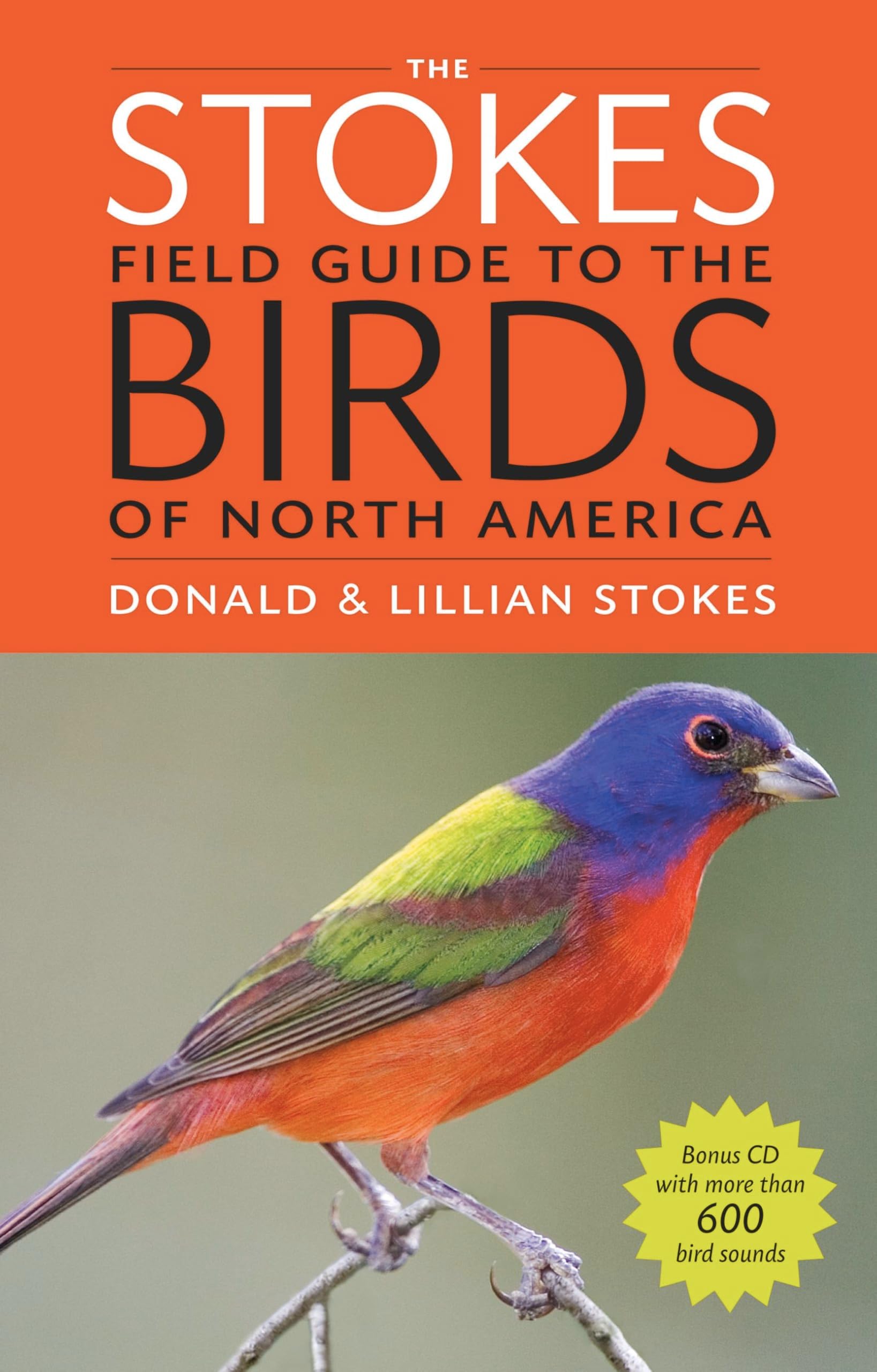
LITTLE, BROWN Stokes Field Guide to the Birds of North America
Product ID: 6031748
🎵600+ bird calls on bonus CD
📸3,400+ vivid bird photos
🗺️Detailed range & migration maps
Desertcart purchases this item on your behalf and handles shipping, customs, and support to Croatia.
🦅 Elevate your birding IQ with the ultimate North American avian bible!
The LITTLE, BROWN Stokes Field Guide to the Birds of North America is a definitive, photo-rich reference featuring 853 species, detailed range maps, behavioral notes, and a bonus audio CD with over 600 bird calls. Authored by renowned birders Don and Lillian Stokes, this guide balances comprehensive scientific accuracy with practical field usability, making it an essential tool for serious birdwatchers seeking to master identification and deepen their connection to North America's diverse birdlife.
| Best Sellers Rank | #103,453 in Patio, Lawn & Garden ( See Top 100 in Patio, Lawn & Garden ) #120 in Ornithology (Books) #308 in Biology of Wildlife #479 in Bird Watching (Books) |
| Customer Reviews | 4.8 out of 5 stars 987 Reviews |
D**P
I HAVE BEEN AND AM DELIGHTED WITH THIS BOOK...What a wonderful resource which has added much to my enjoyment of birding
I collect bird books with particular emphasis on field guides and have been doing so since the late 1950s. I have also been birding since even before the "book thing," as my wife calls it. Truth be told, I get almost as much satisfaction over my bird book collecting as I do over the actually birding...not as much mind you, but pretty close! I share this with you because like a couple of other reviewers here, it takes quite a bit to truly impress me at this point in my life. I have to tell you that the "wow factor," for me, is off the charts with this current offering from the Stokes. Now don't get me wrong. I dearly love every one of my field guides, even the old musty ones dating back to the turn of the century which were void of any illustrations and consisted of only rambling post-Victorian text. But for sheer usability this new Stokes ranks right up at the top. But read on..... Now before I go on, the old question of "if you had only one field guide, and only one, which one would you choose - which one is the best?" Oh my! This argument has been going on since as long as I can remember. I have birded with a lot of people from literally all over the world, and when asked that question, I have received dozens upon dozens of answers. Bird field guides are a lot like golf clubs. Everyone has their favorite and folks will go to the matt arguing which is best. When all is said and done though, it all depend upon the individual; what they are use to using, how he perceive birding, what their experience level is, what their dad or mom told them, and on and on and on. From my own experiences and from my own point of view, I would be hard pressed to try to identify a single "best guide." I personally use several of them in the field and even more of them as references. As an example, I grew up using the Peterson guides. I still use them as my primary source. Hey, they are what I am use to. Since those early days though I have added Sibley's guides, and of course Audubon...these are the three guides I carry in the field. I have now added this Stokes to my tote bag; or at least to my stash in my car. The Stokes Filed Guide to the Birds of North America has some of the best photographs of birds I have seen in any guide book. Each bird represented has several shots; perching or standing, flying and of course gender and in most cases, maturity. The photographs are clear and concise and the color is wonderful. Range maps, unlike the Peterson guide, are on the same page as the bird. For "difficult" birds, there are nice little side-bar notes which include identification tips. I personally found the organization of the book, once I use it and got use to it, to be quite workable. The authors have given enough text to allow identification but by necessity have kept the text to a minimum. I personally like this. If I want the life history or life cycle of the book I have plenty of reference books in by library and I have a computer which allows me to do further research once I have identified a given bird. In a field guide I simply do not want a cluttered and detailed text...too much reading in the woods causes a person to miss a lot of birds! Now much as been said and written about the size and weight of this work and rightfully so as a person needs to know what they are getting before they decide to make a purchase, i.e. is it right for me? In my personal case, yes it is right. I do a lot of my birding from fixed positions (I am old and can no longer trek 20 miles a day...bummer) and I also do a lot of "roadside" birding. Yes, I am more stationary now but if you ask me if I would have carried this guide with me when I was younger, my answer would have been yes. Weight did not mean that much to me then as it does now. As it stands, I have been blessed with the ability to take very good field notes. This is not, I can assure you, because I am particularly bright, no - it is because I have been doing it for so long that I was bound to get good at it through sheer repetition. I can use my Peterson and Sibley on difficult birds and record enough data to make a good identification later using my full resources. This book contains a bonus CD of over 600 bird calls our sounds. This is nice and is very useful. In my case it is not as useful as it would be for most folks as I have a tin ear when it comes to music - hey, I have trouble distinguishing between the music of Jimmy Hendrix and a Celtic Flutist...but it is a good CD anyway! This work was a great addition to my library and has been a great help with my birding. What a wonderful resource this book is. This one works for me. Don Blankenship The Ozarks
E**G
The best bird guide 50 years, But For Portability, the iBird2 App is Better
December 30, 2011: I still have 17 bird guides from Sibley to Nat'l Geographic, and the only one I've been using for 10 months is this one. Yes, I still have a problem that the Western Region is still given "short shrift" - even in their Western Region book - but compared to the other 16, this is by far the best guide with the best/most photographs, and I've now come to understand much more about birding behavior so I can find birds on my own. HOWEVER, my kids gave me a Kindle Fire for my birthday last week, and I found an APP, iBird Pro 2 on Amazon that is, unbelievably, EVEN BETTER THAN this Stokes and it's portable! This does not take away from the work that went into this remarkable Field Guide. But at 3 pounds, "field guide" is really a misnomer. Stokes is really a reference book, and excellent reference book. March 23, 2011: After using the book for a month, there are a couple of disturbing "findings." It may be my imagination, but I think that the Stokes pay more attention to the Eastern North American birds than those west of the Rockies (note: I didn't say "Mississippi"). Two birds which I recently photographed are not represented correctly in this book. The Oak Titmouse is NOT the Common Titmouse, and there should be two separate pages for the Oak and Juniper Titmice. And - so far - they do not present the Common Grackle or Boat-tailed Grackle as living in the West while I have photographed them in the east counties of the San Francisco Bay Area. Now, I'm beginning to wonder what other species got short shrift. Having seen many of the Stokes' TV shows, they do indeed give more emphasis to Eastern birds. I don't blame them or even fault them. If I lived in New Hampshire, the last thing on my mind would be the Acorn Woodpecker or California Quail. But they DO present these birds, and do that well. (I have 24 bird guides - going back to 1964 - and none mentions the red spot on the yellow bib of the female Acorn Woodpecker. At least Stokes give more attention to the yellow bib.) I have accumulated (not consciously collected) 28 books on birds, at least 14 of them "field guides." Well, the Stokes' Birds of North America is too large to really be a field guide unless you have a Range Rover to cover your fields and a Guide to carry this book, but IT IS in the top 3 guides. Being that thorough, however, you will have a 3 pound book (I just weighed it: 3 pounds on the button). Though I rarely leave the west coast any more, I bought this to get a better idea as to ranges and the differences between Western and Eastern North American birds. The Stokes have given us over 700 birds and from three to eight really good photos of each. The more difficult the species is to distinguish from subspecies, the more photographs. So sparrows, for instance, will rate more photos than a Band-tailed Pigeon. There are quite a few of the birds in flight which is also especially helpful with raptors. Each species has notes as to subspecies and hybrids. Now, I know that male mallards will have sex with anything that floats, but I had no idea that there are 15 hybrids! Even the wood duck could be an offshoot of the promiscuous (and ill-mannered I might add) mallard. Most "birders" like Sibley's guide, and I used that for a while for easy identification. However, there are no photographs, just phenomenal drawings. Then I switched to Smithsonian which has great photographs, and pretty good maps as well as an audio CD (as does Stokes)of bird songs. And then I switched to Stokes' Western Region Guide. To be honest, I find all of these too heavy to carry while walking, and I find all software for phones and iPads that I don't have to be less than satisfactory. Much less. Really bad in fact since even the comparisons are poor. But, since I'm only REALLY interested in birds that are either so striking that I won't forget details or birds that I've just photographed and have to download to my PC anyway, this Stokes' book is the ticket to identify the species and learn as much as I want to learn. I probably will never be able to tell the difference between a chipping sparrow and a savanna sparrow, but that's okay. Only the shipping sparrow lives around here. And there are enough critics of my nature photography web site so that somewhere down the line, somebody will tell me where I've misidentified a bird. I'm thankful for that. I'm also very patient and can wait. I was about to write that I really didn't care about the audio CD, just as I didn't care for Smithsonian's. That's not entirely true, and it brings us back to the sparrow. I CAN distinguish differences in bird songs; I just can tell which thrush or sparrow it came from. Around here, sparrows get together for socializing and maybe even a hand of bridge, and they don't mind singing up a storm regardless of the competition with others. The only one I know for sure is the Song Sparrow. So, every once in a while I will put the CD in and see if I can hear the difference between the Golden-crowned and the White-crowned. Sure, so long as I have the CD. But once out in the field... well, let's just say I've never been good with languages. Besides, almost all sparrows have a very sweet song, though none can compete with the Song Sparrow. Would I recommend this book? In a heartbeat. But I'm guess it weighs well over a pound, so keep it home. The only thing I want now is for the Stokes to come out with the same one in hardbound. Note: With Christmas coming up, I will be giving this to several friends who, though members of the local Audubon Society, will find this one of the best REFERENCE books. In fact, I'll go so far as to say that I'd buy a Kindle if this book was available WITH the songs.
M**E
Great reference for identification
I gave this field guide five stars for its species identification information and high quality photos. I highly recommend it to anyone needing help identifying difficult species. I would not recommend it as a "first field guide". There are other field guides with better information on behaviors, habitat, range, and similar species. This information is vital in an initial "carry it out to the field" reference. If you already have a good field guide and find it doesn't have sufficient identification information, this Stokes field guide is an ideal companion reference. Why I bought it - To quote my wife... "You bought another bird book." Yes, I did. It isn't that I needed a better book, I needed a different book that explored species identification at a much greater level of detail than my other field manuals. I also wanted one that wasn't big and heavy. Happily, this is the book. Some background - First, there is no one bird reference that will serve as an one-book reference. It would be too large and heavy to be practical. Different books are ideal for different purposes. I recommend starting with a solid "take to the field" field guide. This guide should be comprehensive but small enough to easily carry. Naturally, more information about each species will make the book larger and heavier. After you have a nation-wide field guide, the next level up is a field guide that covers your region or area. I have several for the eastern and western half of the country, some regional guides, and one local reference. If like me, you are not a bird expert and you need one more reference to be able to identify the more difficult species such as sparrows and hawks, this is the book you need. In summary - The Stokes Field Guide supplies the detailed information that I needed. It provides it with both great information and multiple high quality photos for each species. It is larger than my other field guides, so it stays home more than the others. While, my other field guides have better information on behaviors, habitat, range, and similar species, they don't have sufficient identification information.
K**R
Real photos not drawings
Best bird book available, real photos easy to use to look up birds I take it with me all the time Bought my Daughter a copy also
J**.
Excellent book, but not what I was looking for
I gave this 4 stars because it is a great book, but not 5 because it wasn't great FOR ME.... will it be for you?? Read to find out. PROS - There are (MANY!) beautiful photos of each of the birds throughout the book. - Book is organized clearly. - Lots of helpful information and vocabulary (in color diagrams) about how to identify birds. - Descriptions help to differentiate birds from other similar species. - Quick index in the front (and also a FULL index in the back if needed). - Extremely comprehensive. Okay, sounds amazing.... so why only 4 stars? CONS - Birds are organized by "type" (Swallow, Thrush, Wheater, Towhee, Warbler). This might be SUPER helpful to some, but not for the novice bird watcher. I have NO IDEA what bird I am looking for! I wanted to find out what kinds of birds I was seeing in my backyard, at the feeder, and during our walks around the neighborhood and to a local stream. I have no prior knowledge of birds, so when I go to look one up I'm thinking "Which one is mostly grey ,its little, has a black head, and some white on its belly?" When looking through this book it is SO BIG and includes birds from all of North America, and is divided by type of bird - I have no idea where to even start looking! - The descriptions aren't exactly what I was hoping for either. I think this book is better for someone who already knows the basics about birds and is trying to become a better expert at identifying very specific birds. The majority of the description listed is only about what the bird looks like. There is a note about the birds call or song, and if there is anything to say about how the bird flies, it will mention that as well. I was hoping to learn something interesting about the bird. Like where does it nest? Where can it mostly likely be found? Does it have any interesting habits that make it different or special? None of that is included here. This is strictly for identifying purposes and I guess you could look up the bird somewhere else to learn about it if you were interested. - EXTREMELY COMPREHENSIVE. As I mentioned above this book is so comprehensive it is overwhelming for me as a casual backyard bird watcher. I did like the book and I'm happy that I read the diagrams in the beginning to learn a little more about how to identify a bird and the correct vocabulary to describe different parts of the bird. But, ultimately, I will be returning this book in favor of something more simple. I found another book that features birds local to my region and therefore is much smaller. It is also organized by the color of the bird, which (for me) is much more user friendly. My recommendation is to seriously consider what you want this book for and how much you already know about birds. If you already have a basic knowledge about birds (will you know to go to the "starling" "towhees" or "warblers" section to find the specific bird you want?) OR if you travel around North America a lot and want ONE book that can help to identify the birds you see during your travels, this would be a good book for you. But, if you are like me and are curious about the birds you see in your own backyard and don't know the names of more than one or two birds already, you might want to find something a little simpler and more user-friendly.
G**R
superb photo guide
As noted by some other reviewers, photo guides often just don't work well for bird ID. That assessment applies to the previous Stokes regional guides. It does NOT apply to this newest guide covering North America. This guide features superb photography that comes quite close to meeting the stated purpose of showing birds "from every angle important for identification". I count up to 11-12 photos for some species (hawks and gulls, for example). The text conveys ID details quite concisely. Range maps might be a bit small, but that leaves more room for photos and text. This is a large guide and I'll be surprised to find many birders using it in the field; one reviewer noted that it will fit in a vest pocket, but even if I did cram it in to a pocket the weight would prove cumbersome. I will use it as a reference, much more than any of the other photo guides occupying space in my birding library. I think it will prove most useful for birders who have advanced beyond the novice stage, and for that reason the accompanying CD collection of bird songs and sounds (covering only 150 common birds) doesn't really add much value. The sound files are in MP3 format and can be downloaded to an MP3 player for use in the field. New and advanced birders will appreciate the "Identification Tips" found at or near the beginning of each family segment. The inclusion of the ABA code (rating the relative ease with which a bird can be observed) is a nice touch. At Amazon's price this is a great value.
K**D
Love This Book!
I've really gotten into the world of birds over the past couple of years. I love watching them, and I love photographing them. But, honestly, I didn't know much about them. I decided I needed a field guide of some sort. I was going to buy one of the Audubon field guides, but was put off by the fact that I'd have to buy a few of them just to get all of the birds that are found within the U.S. As I plan on traveling to go bird watching/photographing, I didn't want multiple books. I then found this field guide that has all of the birds of North America in it, plus the bonus bird songs CD. You honestly can't beat the price for this amount of info! I also LOVE the fact that, for many of the birds pictured, they show the differences between the male and female plumage, the differences between adults and juvenile plumage, and even the differences between a mating and non-mating bird's plumage. For instance, a couple of weeks ago, I saw a bird that I knew had to be a hawk of some sort, but I couldn't place it. It wasn't a red-tail and it wasn't a red-shouldered because the markings just didn't add up. I was perplexed. I snapped a few shots of it so that I could look it up at home. This field guide is the only source I had that showed me clearly that what I saw was a juvenile red-tailed hawk. I just love the book!
M**T
Birding best
Good book for identifying birds
M**K
Quality field guide, in depth photos
Extremely good field guide, perhaps a bit hefty for your backpack. Helpful variety of photos for many birds at various stages, thoughtful effort to broaden examples for breeds plus great quality paper, clear identifications etc. No guide can have every possible bird for any location but this is pretty close.
L**E
Excelente libro
A excelente precio
M**L
The Stokes Field Guide to the birds of North America
This is an excellent reference book for the North American birds. Each bird has good coloured pictures of it and has a good description of the plumage during various seasons of the year as well as flight, habitat and voice. The book has nearly 800 pages and is fairly heavy so i don't think it would be practical to take on a field trip. It also comes with a cd containing more than 600 bird sounds
M**D
Great book
Great pictures and easy to follow
G**N
Simply the best bird book for North America species.
One of the best bird books I've ever used. It weighs a bit but it is very hard to find a better book ror species information.,n
Trustpilot
3 days ago
3 weeks ago