Desertcart purchases this item on your behalf and handles shipping, customs, and support to Croatia.
🚀 Elevate your wireless game with Panda’s power-packed AC600 adapter!
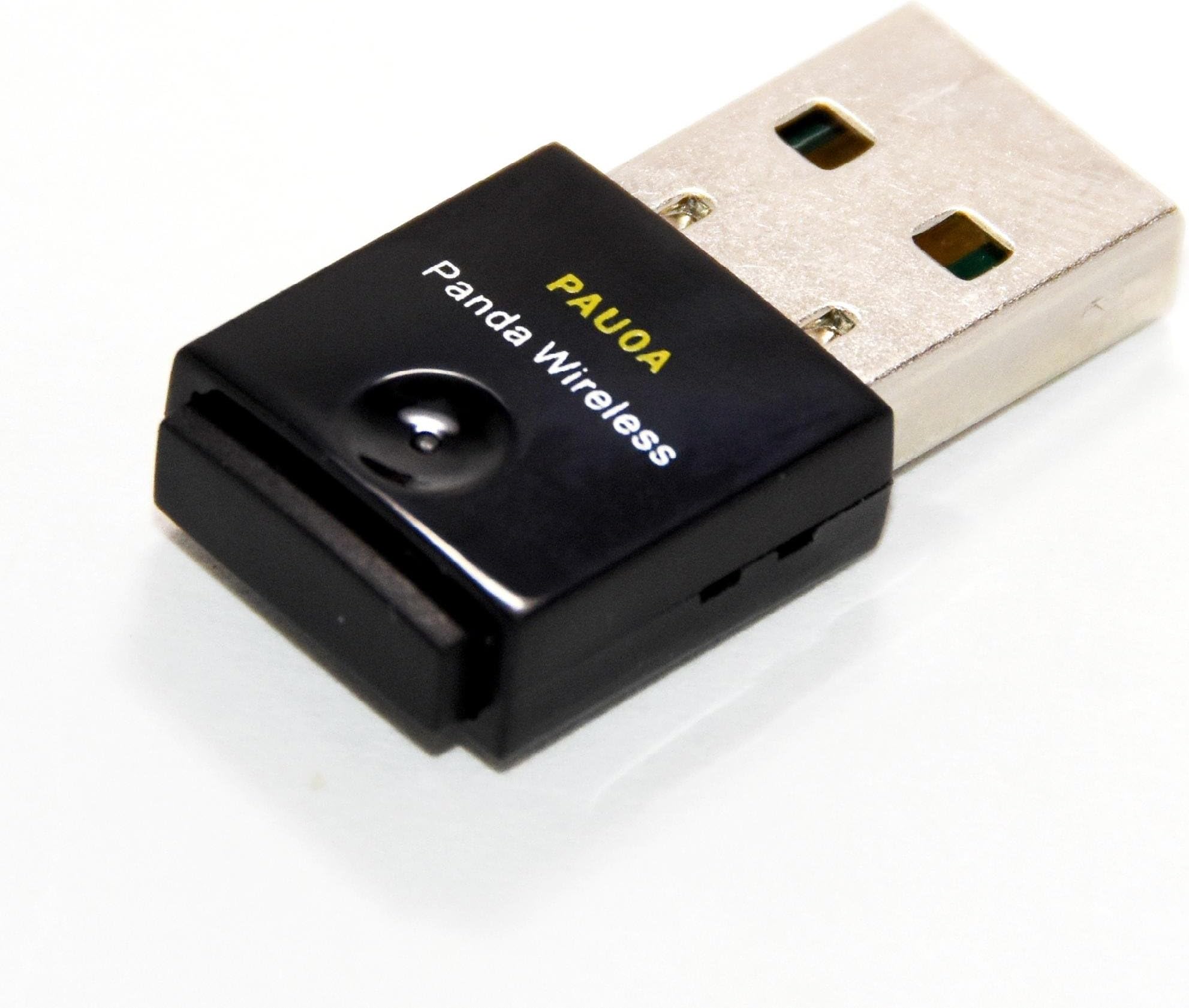
The Panda Wireless PAU0A AC600 is a compact USB adapter delivering dual-band Wi-Fi (2.4GHz & 5GHz) with speeds up to 433Mbps. It supports a broad range of Linux distros and Windows versions, ensuring versatile compatibility for Intel/AMD PCs and Raspberry Pi devices. Featuring robust security protocols and a lightweight design, it’s ideal for professionals seeking reliable, high-speed wireless connectivity across multiple platforms.


| ASIN | B07C9TYDR4 |
| Best Sellers Rank | #129 in USB Computer Network Adapters |
| Brand | Panda Wireless |
| Color | Black |
| Compatible Devices | Desktop, Laptop |
| Compatible Operating System Family | ChromeOS, Linux, MacOS, Windows |
| Customer Reviews | 4.3 out of 5 stars 204 Reviews |
| Data Link Protocol | IEEE 802.11ac |
| Data Transfer Rate | 433 megabytes_per_second |
| Hardware Interface | USB |
| Item Dimensions L x W x H | 5.6"L x 4"W x 0.75"H |
| Item Weight | 0.05 kg |
| Manufacturer | Panda Wireless |
| Minimum Required Operating System Version | Windows 7 |
| Model Number | PAU0A |
| Number of Items | 1 |
| Product Dimensions | 5.6"L x 4"W x 0.75"H |
| UPC | 851860007018 |
| Warranty Description | 1 Year Manufacturer |
R**R
Works great with piCorePlayer 11.1.0
One of my Raspberry Pi music streamers had a on-board WiFi device give up the ghost, so needed a USB replacement. This works perfectly with piCorePlayer 11.1.0, and doesn't require any external drivers with Linux kernel 6.12.67. Wireless performance is miles better with a USB dongle.
D**E
Finally a plug and play wifi adapter for my raspberry Pis
Are you tired of slow internet speeds and poor connectivity on your desktop or laptop? Look no further than the Panda Wireless® PAU0A AC600 Dual Band (2.4GHz and 5GHz) Wireless AC USB Adapter. Upon receiving the product, I was impressed with its compact size and easy-to-use design. Installation was a breeze - simply plug the adapter into your USB port and follow the quick setup guide. In just a few minutes, I was up and running with lightning-fast internet speeds and improved connectivity. The adapter's dual-band technology is a game-changer, allowing for seamless switching between the 2.4GHz and 5GHz bands depending on your internet needs. Whether you're streaming movies, gaming, or just browsing the web, the PAU0A AC600 delivers reliable and fast performance every time. In addition to its impressive performance, the adapter also boasts excellent range. Even when I was several rooms away from my router, I experienced little to no lag or drop in internet speed. This is especially impressive given the compact size of the adapter. Overall, I would highly recommend the Panda Wireless® PAU0A AC600 Dual Band (2.4GHz and 5GHz) Wireless AC USB Adapter to anyone looking to improve their internet speeds and connectivity on their desktop or laptop. Its compact size, dual-band technology, and excellent range make it a top-performing and reliable choice.
P**N
thank you
it is working with raspberry pi os trixie
D**S
Panda does not disconnect WIFI like the Lenovo does every few minutes.
Best news is, the Panda Wireless® PAU0A AC600 arrived the next day. Bad news is, no instructions on installing on a Linux system. Guess they just assume we all know what we are doing. Tried the plug and play. Maybe it worked. Let me explain. Looks like there is a light on the Panda Wireless. Don’t know. No light came on. So I searched the Internet for Instructions. Nothing much on the Panda website. Does have a download for the driver. A set of instructions but the terminal comes back with files and directories do not exist lines. Tried the CD that was no help. It refused to open. Then onto the Internet again. Found some instructions along the lines of plug and play. Instructions said lower right, choose network. Mine is on the top right. Pull down for the battery, sound, power, restart, and power down. Which also has a WIFI option that now shows (2). Clicked on that and my WIFI network is now listed twice. Went over to settings where is now shows my laptop adapter and the MediaTek WIFI which is the Panda. Now I can switch between the 2. I opened a WIFI speed test. On both it hit a 1 time high of 90Mbps and usually between 10-20Mbps. Really poor. Tried 4 different browsers. All the same results. Upload is 10-20Mbps. I also tried my phone which hit a consistent 90Mbps. So what’s the problem with the speed? Not sure. The problem I was facing is with a Lenovo IdeaPad with the AMD Ryzen™ 7 3700U with Radeon™ Vega Mobile Gfx. It kept on disconnecting and I had to open WIFI and reconnect. You can find info on WIFI driver updates for other processors, but AMD does not offer a driver for Linux. Keep that in mind when ordering a new laptop. The good news is the Panda does work. The speed on the laptop is something internal. Good enough for what I do with a few hang ups. WIFI lingers between starting fast and at times hangs up. I am sure it is the laptop. The Panda appears fine. I would buy it again. The PAU0A AC600 is compact and does not stick out of the side much more than the mouse USB. Which is nice. After a few hours the Panda is not disconnecting every few minutes like the Lenovo did. I call that a success.
S**N
Works with Redhat Linux 10
This installed easily on RHEL10. I find that it has signal limitations regarding distance connectivity, but otherwise it works fine.
M**B
Supported out of the box on Linux kernel 5.0.0
I was mainly interested in a USB WiFi dongle that would work out of the box in Linux. I don't often need a wifi dongle, but when I do I don't want to have to worry about finding, compiling, and installing a driver. The good news is that this meets that criteria with Linux kernel 5.0.0 (according to the Internet, it should be supported on 4.19 and later, but 5.0.0 is what I personally tried). The not so good news is that due to the small antenna (I'm guessing), the 802.11ac connectivity isn't great. I had trouble connecting to a 5GHz router in the next room (1 wall) and when I did the throughput was mediocre (for download) to poor (for upload) compared to a Windows machine using a Qualcomm QCA9377 802.11ac Wireless Adapter (whatever it is that came in the Dell computer). However, connecting to a 2.4GHz router with the same wall intervening got a nice clean connection with throughput that was comparable to the Qualcomm QCA9377. All in all, I'd say it was worth it for $20 to be able to plug-n-play with Linux for those times I need Wifi. Plug-n-play as long as the kernel is new enough. I'm giving it 5 stars for that. Some details in case anyone needs them: - chipset: MediaTek MT7610U - driver: mt76x0u $ uname -a Linux ubuntu 5.0.0-15-generic #16-Ubuntu SMP Mon May 6 17:41:33 UTC 2019 x86_64 x86_64 x86_64 GNU/Linux $ lsusb | grep Med Bus 001 Device 005: ID 0e8d:7610 MediaTek Inc. $ lsusb -t | grep mt |__ Port 1: Dev 5, If 0, Class=Vendor Specific Class, Driver=mt76x0u, 480M
T**N
Missing feature on Windows 10 and 11
While this device supposedly can be used for hosting a WIFI access point, on Windows 10 and 11, it is supposedly plug and play, without the need to install drivers. However, in skipping that installation step, it does not get the program needed to host an access point, and manually installing the drivers anyways prevents the device from functioning at all. Do not get if your only goal with it is to host that access point.
N**.
UISB ports are Powered Differently.
Ordered the Panda Wireless PAU0A USB adapter for an older Desktop PC that I was installing Linux (Pentium 4). I plugged the dongle in to a USB port and nothing happened. So, I figured it was the driver, per the Quick Start Guide “Please follow the instructions in the Linux Manual to compile and install the Linux Driver for the Panda adapter to run on your Debian based Linux computer” I downloaded the panda_pau0a0b_m2.tar.bz2 and the PWUsersManual4Linux_v1.0s.pdf files from the Panda Wireless website. However, the Linux Manual posted is for Fedora. However, Fedora is not the same as Debian, my operating system is MX-Linux which is Debian based. So I sent an email off to Panda Wireless Tech Support. A tech named Mark helped me out, Mark said the Panda Wireless PAU0A USB adapter should work right out of the package. It was determined that not all USB ports are powered the same, I was using the USB on the front of the machine, switching to a USB port on the back of the machine allowed the Panda Wireless PAU0A USB adapter to work flawlessly. Kudos to Mark and the Panda Wireless Technical Support Team.
T**Y
Working as described
Excellent
Q**C
Good buy
Small form factor. Compatible with linux machines for monitor and injection mode.
M**Z
Funcionamiento regular en lInux
Lo quería para redes 5G con 50 MBs y solo toma como 28 MBs, un día antes me llegó un tplink que si toma los 50MBs. Lo bueno del Panda es que es plug and play. Lo malo del tplink es que hay que instalar el driver, lo cual es algo complicado.
M**K
Works very well with RaspPi
C**N
Tel que décrit
Excellent. Fonctionne parfaitement avec min 22.1
Trustpilot
2 weeks ago
1 month ago