Introduction to Permaculture
Product ID: 64450223
🌱Comprehensive permaculture plant guides
📏8.25 x 11 inch detailed format
📚2nd Edition, 2013 update
Desertcart purchases this item on your behalf and handles shipping, customs, and support to Croatia.
🌿 Unlock the future of sustainable living—your permaculture journey starts here!
Introduction to Permaculture, 2nd Edition (2013) by Bill Mollison, is a comprehensive beginner’s guide that covers essential permaculture principles, climate-specific design strategies, and extensive plant references. This well-illustrated 8.25 x 11 inch book offers foundational knowledge for home gardeners to commercial growers, endorsed by a 4.6-star rating and a strong presence in gardening and agricultural science categories.
| Best Sellers Rank | #103,727 in Books ( See Top 100 in Books ) #91 in Gardening & Horticulture Reference (Books) #115 in Gardening Encyclopedias #352 in Agricultural Science (Books) |
| Customer Reviews | 4.6 out of 5 stars 187 Reviews |
H**A
Great intro and overview
This is a great introduction and overview of permaculture concepts. The book covers a lot of material for initiates to permaculture. It's sets the foundation for further reading and studies for those who want to get serious though one could take the principles learned just from this book alone and be quite successful in my opinion. You learn how the sun, wind and rain, all play an important role in siting structures like homes, sheds, barns, green and shade houses and also in garden and plant selection and placement. The book also covers designing for temperate, tropical and dry-land environments. It explains how interconnected relationships between the land, climate, soils, water, structures, flora and fauna can be fostered to the benefit of all. There are just so many creative ideas and diagrams in this book that it is worth it for those alone. The book is 8 1/4 X 11 inches with small print that fills the pages with valuable information. I want to live in the sub-tropics of Hawaii and enjoyed the coverage in this regard but, the book also left me day dreaming about living the permaculture lifestyle in other areas like the High Desert of New Mexico and the Pacific Northwest of Oregon. This book touches on all the possibilities, from the home garden with a few animals to commercial orchards, forests, animal farms, aquaculture, urban gardens and more. But don't get me wrong, it does not cover these topics in depth, it gives a thorough introduction to these topics and an understanding that one would likely not gain by reading just one book. Also each chapter ends with a list of references for further reading. In addition there are appendices listing useful permaculture plants, such as nitrogen fixing plants. One appendix even breaks it down into useful categories, such as fruit plants and trees for temperate, topical/sub-tropical and dry areas,pest control plants and finally appendices which list hundreds of the plants mentioned in the text by common, Latin, and by species names. The book ends with a glossary of key terms used in the book and few pages about Bill Mollison (One of the founders of permaculture) and the permaculture institute including info on their 72 hour PC Design Certificate Course. This book is highly recommended!
W**3
great simple intro book have given them as gifts
this is my third copy. I have given my others away in bringing people into the world of Permaculture - this is a great simple book covering a wide range.
A**S
Fantastic resource.
I have been looking forward to taking this course at a local Junior College. In California, the only degree/certificate program is located in Oakland at Merritt College. While I have never lived that far north, I question the safety, as Oakland is known as the Compton of Los Angeles. I am still looking into it. The book, the insight, the amazing information, it's no wonder why the term is being coined more frequently these days. Bill Mollison, like many greats, was a man with knowledge before his time, and am putting into practice almost all of his ideas. I would love to take the actual course somewhere, and become certified, and be that problem solver when repetitive destruction occurs (how to deal with rainwater runoff in desert climates, how to grow, where no man has grown before...).
K**M
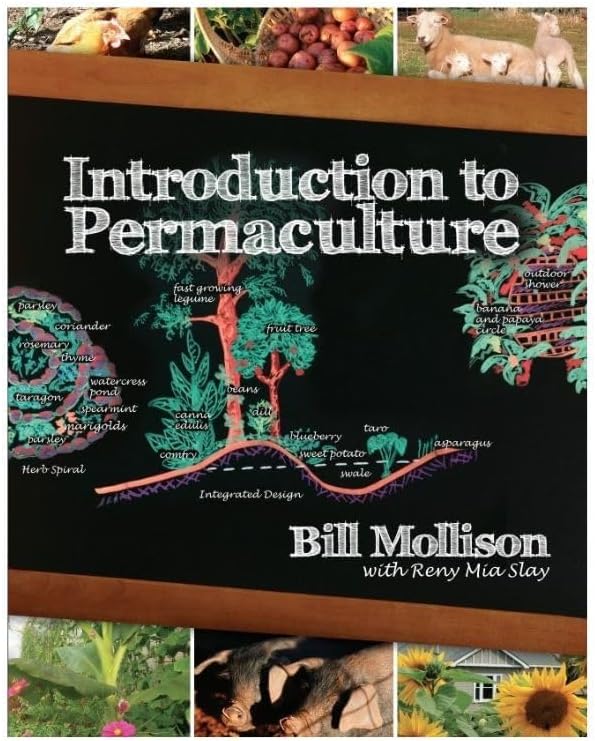
New cover, Fourth Edition.
As you can see. The cover is different. Probably should have advertised that it’s not the old version. Some people like having an original version but in this case I’m good to go because I simply want the same good content and I have no reason to believe this is any different in those terms. Quality book. Looking forward to diving in.
J**N
Avoid 2011 version of this book... it is not the same!
When I ordered this book (which is copywrited 1997) they sent me a 2011 version that had a different cover (a colored line drawing of a garden in profile and photos of animals and plants on the top and bottom). It has the same title and the same authors, so I assumed it is the newest version of this book. I gave it one star (as explained below) and sent it back. However, I have now found the 1997 version in the library and I can tell you THEY ARE NOT THE SAME! Do NOT buy the 2011 version. It does not have the same content and is not worth the money. However, I have upgraded this review from one star to four stars now that I have seen the book that was supposed to have been sent. I am a retired City Planner, and I am not new to the ideas of permaculture. I played with sustainable designs and alternative energy in the early '80s when I was just out of college (I joined a non-profit dedicated to alternative "life systems" as we called it back then). While the 2011 book reminded me of those early days when my friends and I were full of utopian (but impractical) ideas of how bathrooms could be set up inside greenhouses attached to the house so grey water humidified the room and feed the plants, and grey water could be used to flush toilets by placing the shower at a higher elevation than the toilet), the older (1997) version listed here is much more practical and detailed about permaculture and how it might be applied. So, I do recommend this book as a good introduction to permaculture, although it is lacking in examples where the ideas have actually been applied. If you really want to see these ideas put into action, take a look at "Sepp Holizer's Permaculture" and Darrel Frey's "Bioshelter Market Garden." Good Stuff!!
S**E
This book is exactly what the title states.
This is a book that leaves you wanting to know more about Permaculture. It gives general information about the subject and how it can be applied to general locations as you would expect in an introduction. It doesn't, and I didn't expect it to give, details about what I should consider doing in my particular location. It did, however, give me ideas about what might be done and clues about where to get the information I will need to do it.
B**E
Godfather of Permaculture
I just made up that title. Probably the first book you'd buy on the subject. Bill Mollison grew up in Australia (small village in Tasmania). He/family made their own shoes; grew their food; etc. He brought his 'hometown' knowledge to University. He got together with a colleague & invented (my term) Permaculture . He's credited with the coining the term permaculture also. He's been lecturing since 1976. Presently, taking a Permaculture Course. This is the recommended text. The instructor's been doing this 20 years. Book is easy to read (even for beginner). The illustrations are simple & very useful. Thanks.
M**V
Same book as the 1991 edition
When I first opened the package, I was dismayed to see the new cover after reading the reviews on how this edition was not the same as the '91 version. I'm not sure what the reviewers were talking about. Every page is exactly the same. I have the older version from the library and I checked a dozen or so different pages and they were all exactly the same--words, pictures, everything. The only difference seems to be that the few pages at the end that advertise some of his other books are missing. Everything else is the same. Happy Permaculturing!
C**C
Very good introduction
I would recommend this book for anyone who wants to get introduced with permaculture. Good explanations with good examples and illustrations.
S**A
Fantastic
Fantastic
E**H
Don't buy the kindle edition.
I've just started reading it and the typos are ridiculous. This shouldn't have been available for purchase. Here's an example of a paragraph in the intro; Public reaction to peÍTnaculture was mixed. The professional community was outraged, because \Á'e \^'ele combining architecture with biolo-er', agriculture with forestry, and forestry r,r ith anrmal husbandry, so thatalmosteverybody r,r'ho consrdered themselves to be a specialistfelt a bit oftended. But the popular response was rerv diiterent. \lanv people had been thinking along the sarne lines. They were dissatisfied u ith a_criculture rs it rs nou' practised, and were looking tou ards more natural, ecological sv ste nr s. Mollison , Bill. Introduction to Permaculture (p. 12). Ten Speed Pr. Kindle Edition.
D**L
Five Stars
sent very promptly, very pleased
N**A
indispensable
c'est LA référence en permaculture. tout y est. très complet du jardin à la maison. il n'y a pas mieux. et ce livre me suit partout. il faut déjà un bon moment avant de tout pratiquer donc cela va bien au delà du B.A. BA.
Trustpilot
3 weeks ago
1 month ago