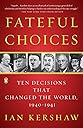
Fateful Choices: Ten Decisions That Changed the World, 1940-1941
Product ID: 6617053
Desertcart purchases this item on your behalf and handles shipping, customs, and support to Croatia.
The newest immensely original undertaking from the historian who gave us the defining two-volume portrait of Hitler, Fateful Choices puts Ian Kershaw's analytical and storytelling gifts on dazzling display. From May 1940 to December 1941, the leaders of the world's six major powers made a series of related decisions that determined the final outcome of World War II and shaped the course of human destiny. As the author examines the connected stories of these profound choices, he restores a sense of drama and contingency to this pivotal moment, producing one of the freshest, most important books on World War II in years' one with powerful contemporary relevance. Review: A careful look at the decisions of six key leaders of WWII. - If you haven't read much of WWII, this book would be an ideal place to start or to expand your understanding. If you're an experienced reader, you can still appreciate the straightforward and informative way the author has compiled this history. The author has chosen ten decisions by six of the leading commanders of the war. He carefully describes the decision and then provides a fairly comprehensive history leading up to that decision as well as the subsequent impact of the future prosecution of the war. During the discussion, you will not only learn about the progression in making that decision but also learn about the individual making that decision and the circumstances and people surrounding him that try to influence that decision. The ten Fateful Choices are: 1. Churchill's decision in May, 1940 to continue the war rather than negotiate with Hitler and Mussolini. 2. Hitler decides to attack the Soviet Union. 3. Japan decides to attack China. 4. Mussolini decides to join the war on Hitler's side. 5. Roosevelt decides to lend a helping hand to Britain. 6. Stalin decides he knows best and ignores all the clear signals that Germany is going to invade. 7. Roosevelt decides to wage undeclared war. 8. Japan decides to go to war against the US. 9. Hitler decides to declare war on the US. 0. Hitler decides to commit genocide. These ten events are laid out chronologically, starting out with the pugnacious Churchill refusing to negotiate with Mussolini and Hitler in mid 1940 and winds up with Hitler deciding on a formal program of genocide in late 1941. You will also read about Hitler's obsession to invade Russia that will blind him from alternative action or the politically savvy Roosevelt who is cautious to enter the fray. There is both Mussolini and Tojo who thought their country was destined for greater accomplishments and disregarding logic, overreach and take steps that will destroy their countries. Stalin, the supreme leader and confident manipulator who "knows" Hitler will not invade until 1942 and can't believe it when he's proven wrong. While the author covers the alternative choices each commander had before him, Mr Kershaw refuses to be drawn into the realm of alternate history. That's too bad; with the author's experience it would have been interesting to hear his views on how the war would have played out if Hitler decided to conquer North Africa and the Middle East before invading Russia. There are many alternate histories that could have been discussed but it just wasn't in the author's purview. Of the ten decisions, Churchill made one, Hitler 3, Tojo 2, Mussolini 1, Roosevelt 2 and Stalin 1. The average length of these chronicles is 42 pages, with the shortest being 33 pages and 59 pages for the longest. President Roosevelt has the honor of having both the shortest and longest chronicle. There are five maps and 28 photos. Being an academic, Mr Kershaw provides an extensive Notes Section and Bibliography of secondary sources as well as a useful Index if further study is desired. This synergistic book is comprehensive and well documented within specific spheres of the early events of the war, making a good reference for many of us and is recommended. Review: 4 Leaders Plus One Imbecile - Author Kershaw looks through a microscope at 10 key decisions that resulted in practically the whole world becoming engaged in war. The unique aspect of this book is to combine the fateful decisions made by five world leaders (and one imbecile) during the years 1940 and 1941. Other reviewers have spelled out the ten decisions so I won't repeat them. First of all I will explain what I mean by saying one member of this group is an imbecile. I'm talking about Mussolini, and at the end of a chapter on him Mr. Kershaw, in frustration, calls him that name. Indeed the chapter on Mussolini can almost be considered, tragically of course, a bit of comic relief. Mussolini was like a puppy dog trying to tag along with his master, Hitler, and get some glory for himself. What should he do in the midst of victory after victory by Germany. He decides why not invade Greece. He sits down with his marginally competent general staff, and in an hour and a half discussion they decide to invade. That's it. No long term, detailed plans, just that short chat. Italy is almost bankrupt, does not have a well trained army, lacks sophisticated equipment yet invades Greece within weeks of that meeting, and gets, well, stuck in the mud so to speak. What's interesting about the other fateful decisions is that each leader was well out on a limb when his country decided to ease or jump into war. At that time, for example, the United States had an army about the size of the Dutch army. All of the countries faced economic problems, and most of them had not learned an awful lot from their experiences in WWI. Roosevelt's task was to ease the country toward helping Britain by gradually coaxing the public and congress along toward that end. Japan's leaders vacillated about entering a war with the U.S., but felt they had to do just that following America's embargo on scrap iron and oil shipments. Stalin was deluded into thinking that Germany would not invade Russia until 1942, and tended to disregard all evidence that indicated the attack would be in 1941. When the invasion took place he was so shaken that he could not function for several days. Hitler, Tojo and Mussolini were prompted by maintaining national prestige. Roosevelt, Stalin, and Churchill were trying to keep their world from collapsing. Hitler declared war on the U.S. without consulting with any of his advisors. This is a fascinating book that ties together all of the elements that led our world leaders into the worst war of all time. I might point out that for some WWII buffs certain chapters may not provide new information to the reader. There are other books, such as biographies of Hitler, Roosevelt and Stalin, that cover one of these chapters in even greater detail, but this may be the only book that examines all the major world leaders during the time period 1940-1941. The only thing that frustrated me is that each chapter usually ends at a momentous decision point, and you think "more, more, don't stop here." Well the thing to do is just get more books that do go on from there.
| Best Sellers Rank | #1,137,169 in Books ( See Top 100 in Books ) #425 in Jewish Holocaust History #2,203 in World War II History (Books) |
| Customer Reviews | 4.4 out of 5 stars 243 Reviews |
D**K
A careful look at the decisions of six key leaders of WWII.
If you haven't read much of WWII, this book would be an ideal place to start or to expand your understanding. If you're an experienced reader, you can still appreciate the straightforward and informative way the author has compiled this history. The author has chosen ten decisions by six of the leading commanders of the war. He carefully describes the decision and then provides a fairly comprehensive history leading up to that decision as well as the subsequent impact of the future prosecution of the war. During the discussion, you will not only learn about the progression in making that decision but also learn about the individual making that decision and the circumstances and people surrounding him that try to influence that decision. The ten Fateful Choices are: 1. Churchill's decision in May, 1940 to continue the war rather than negotiate with Hitler and Mussolini. 2. Hitler decides to attack the Soviet Union. 3. Japan decides to attack China. 4. Mussolini decides to join the war on Hitler's side. 5. Roosevelt decides to lend a helping hand to Britain. 6. Stalin decides he knows best and ignores all the clear signals that Germany is going to invade. 7. Roosevelt decides to wage undeclared war. 8. Japan decides to go to war against the US. 9. Hitler decides to declare war on the US. 0. Hitler decides to commit genocide. These ten events are laid out chronologically, starting out with the pugnacious Churchill refusing to negotiate with Mussolini and Hitler in mid 1940 and winds up with Hitler deciding on a formal program of genocide in late 1941. You will also read about Hitler's obsession to invade Russia that will blind him from alternative action or the politically savvy Roosevelt who is cautious to enter the fray. There is both Mussolini and Tojo who thought their country was destined for greater accomplishments and disregarding logic, overreach and take steps that will destroy their countries. Stalin, the supreme leader and confident manipulator who "knows" Hitler will not invade until 1942 and can't believe it when he's proven wrong. While the author covers the alternative choices each commander had before him, Mr Kershaw refuses to be drawn into the realm of alternate history. That's too bad; with the author's experience it would have been interesting to hear his views on how the war would have played out if Hitler decided to conquer North Africa and the Middle East before invading Russia. There are many alternate histories that could have been discussed but it just wasn't in the author's purview. Of the ten decisions, Churchill made one, Hitler 3, Tojo 2, Mussolini 1, Roosevelt 2 and Stalin 1. The average length of these chronicles is 42 pages, with the shortest being 33 pages and 59 pages for the longest. President Roosevelt has the honor of having both the shortest and longest chronicle. There are five maps and 28 photos. Being an academic, Mr Kershaw provides an extensive Notes Section and Bibliography of secondary sources as well as a useful Index if further study is desired. This synergistic book is comprehensive and well documented within specific spheres of the early events of the war, making a good reference for many of us and is recommended.
B**M
4 Leaders Plus One Imbecile
Author Kershaw looks through a microscope at 10 key decisions that resulted in practically the whole world becoming engaged in war. The unique aspect of this book is to combine the fateful decisions made by five world leaders (and one imbecile) during the years 1940 and 1941. Other reviewers have spelled out the ten decisions so I won't repeat them. First of all I will explain what I mean by saying one member of this group is an imbecile. I'm talking about Mussolini, and at the end of a chapter on him Mr. Kershaw, in frustration, calls him that name. Indeed the chapter on Mussolini can almost be considered, tragically of course, a bit of comic relief. Mussolini was like a puppy dog trying to tag along with his master, Hitler, and get some glory for himself. What should he do in the midst of victory after victory by Germany. He decides why not invade Greece. He sits down with his marginally competent general staff, and in an hour and a half discussion they decide to invade. That's it. No long term, detailed plans, just that short chat. Italy is almost bankrupt, does not have a well trained army, lacks sophisticated equipment yet invades Greece within weeks of that meeting, and gets, well, stuck in the mud so to speak. What's interesting about the other fateful decisions is that each leader was well out on a limb when his country decided to ease or jump into war. At that time, for example, the United States had an army about the size of the Dutch army. All of the countries faced economic problems, and most of them had not learned an awful lot from their experiences in WWI. Roosevelt's task was to ease the country toward helping Britain by gradually coaxing the public and congress along toward that end. Japan's leaders vacillated about entering a war with the U.S., but felt they had to do just that following America's embargo on scrap iron and oil shipments. Stalin was deluded into thinking that Germany would not invade Russia until 1942, and tended to disregard all evidence that indicated the attack would be in 1941. When the invasion took place he was so shaken that he could not function for several days. Hitler, Tojo and Mussolini were prompted by maintaining national prestige. Roosevelt, Stalin, and Churchill were trying to keep their world from collapsing. Hitler declared war on the U.S. without consulting with any of his advisors. This is a fascinating book that ties together all of the elements that led our world leaders into the worst war of all time. I might point out that for some WWII buffs certain chapters may not provide new information to the reader. There are other books, such as biographies of Hitler, Roosevelt and Stalin, that cover one of these chapters in even greater detail, but this may be the only book that examines all the major world leaders during the time period 1940-1941. The only thing that frustrated me is that each chapter usually ends at a momentous decision point, and you think "more, more, don't stop here." Well the thing to do is just get more books that do go on from there.
J**G
Very valuable for the understanding of WW II
If you want to know what made things happen in the time before and in the beginning of WW II this is the book to read. In detail you get to know the main actors and what made them tick and are helped to understand the mechanisms in their societies. Ian Kershaw for instance explains that the western powers are skilled in discussing and come to an understanding in the end. It takes a little longer, but you will eventually see a result. In this way you are able to coordinate your efforts and be more effective. Even the dictator, Stalin had been trained by Lenin in discussing. He wanted to decide for himself, but the discussing was known to him. The dictatorships in Germany, Italy and Japan have no experience and no training in coordination with other powers. They all knew best and saw no need to tell their partners, where they were going and when. This made them very ineffective. Mussolini was very offended by the german successses in 1938/39/40 and wanted a succes of his own and attaced Greece without consulting Hitler. It went very bad, and Hitler had to send help using valuable resources. The reason why I have given 4 and not 5 stars is that reading the book on my Kindle I found it impossible to go to the notes and read more. A better solution would have been to make a link between the reference number and the note. In this way you easily could find the note and with the back-key return to where you came from. Jorgen Engberg
1**.
An interesting thesis
According to Ian Kershaw the main decisons made by the Axis and Allied powers were not planned in advance but improvised as battlefield successes and failures changed. This book needs to be read alongside Hew Strachan's new book about Clausewitz's "On War," because according to Strachan's interpretation of Clausewitz, tactical successes or failures ulitimately shape strategy. This was seen in Kershaw's view of why Hitler choose to attack the Soviet Union. Kershaw states that Hitler attacked the Soviet Union because he could not defeat Britain during the Battle of Britain, and by overthrowing the Soviet regime maybe the English would plead for a settlement. Meanwhile the Japanese attacked the United States due to the German victories in Europe and their own defeat to the Soviet Union in 1939. The Japanese military successes in Asia persuaded Hitler to declare war against the United States because he thought that the Americans would be too distracted in the Far East. Kershaw disagrees with the think tank strategist of the fifties and sixties who believed that democracy hindered the decision making process. Mussolini,Hitler,and the Japanese military leaders led their nations to defeat because they failed to hear conflicting advice. But Churchill had a unified front because he had the support of the cabinet and Roosevelt's sensitivity towards public opinion prevented him from making any rash decisions that were detrimental to the Allied effort. The only weakness of this book is that in his section about Stalin, Kersahaw ignored traditional Russian and later Soviet suspicions of England, that made Stalin ignore British intelligence warnings that Hitler was going to attack the Soviet Union. Also Kershaw does not write about how Hitler's strategic decisions reflected his Austrian upringing as mentioned by Martin Van Creveld.
N**R
MORE EFFORT THAN NECESSARY TO READ
After reading this book I went back to glance through Ian Kershaw's "Hitler: 1889-1936: Hubris" to try to recall if that classic study of Hitler was as difficult to read as "Fateful Choices". (I also have Kershaw's "Hitler: 1936 - 1945: Nemisis" but I have not read that one yet.) "Hubris" was much more readable. "Fateful Choices" seems to take the ten fateful choices -- I do not necessarily agree with his selection -- and tramble them with words and over analysis. I found myself often going back and re-reading sentences and paragraphs to try to comprehend the point he was trying to make. The chapters are uneven in that some were more interesting than others. Two chapters stood out as most informative and interesting than the other chapters. The first was the one about Mussolini decisions -- Kershaw combined two fateful choices into one chapter. The first decision was enter the war immediately before France surrendered and things were looking very positive for Germany. This despite his military's lack of preparedness that was obvious when Mussolini's second fateful choice -- the invasion of Greece -- occurred with little success. The second chapter that I like best was the Japanese decision to go to war with the United States. I had read several accounts about the internal debates within the Japanese Government and military in July and August 1945 about how to end the war but this was an excellent account about the multiple players within Japan determining the fateful step of going to war with a country that the Japanese even acknowledged could destroy them. Yet they felt duty and honor bound to roll the dice any way. Kershaw selection of fateful choices and the time period he limited himself to -- spring 1940 through winter 1941 -- could be debatable. Just within that time period I thought he could have done a chapter on why the Germans allowed well over 300 thousand British and Allied troups to escape from Dunkirk to survive to fight another day. Maybe that was an operational decision and not strategic but that failure had repercussions against Germany. Another "what if" was the decision to limit the Battle of Britain to just an air campaign and not try a land invasion in the summer or fall of 1940 when England was it its most desperate situation. Another topic -- if Kershaw had gone back to the beginning of the war in September 1939 could have been why the Western Allies choise a passive "phoney" war between September 1939 and April 1940. I understand that England may not have been totally ready and the French had confidence in the Maginot Line but somebody had to make the fateful decision not to attack Germany in the west while the German military was invading in the east. The last chapter was about the German decision to implement the "Final Solution". Again, the content was more cumbersome than I thought it should have been but the topic itself seemed out of place. The previous nine decisions had a direct impact upon the conduct of the war. This decision had an indirect impact on the war in that the Nazis eventually expended scarce resources that could have been better used in trying to survive the Soviet recovery and counter attack in the east. Over all this was a good book that could open new areas of debate about the conduct of World War II and the decisions that determined the outcome of tht war. But it is not the easiest book to read and in many places I felt words were trampling the ideas that the author was trying to convey. It is worth the effort to read but it really should not be an effort.
L**T
Puts you in the decision space of key moments in WWII
Excellent book that explains how many of the key and controversial decisions in the 2nd world war were made. Makes you realize you would probably have made the same call given the proper context.
D**E
excellent overview of the war
Kershaw is one of the best of our WW II historians -- for me, he writes at just the right level of detail and sophistication, without losing sight of the big issues. And you learn a lot -- he calmly disposes of many of the tropes of received wisdom on "grand strategy" issues, political ones and (the area I am least capable of judging) military ones.
E**E
What if.
Ian Kershaw, the British historian renowned for his authoritative biography of Adolph Hitler has, in Fateful Choices, widened his scope. He reexamines the critical decisions made in 1940 and 1941 by the major participants in World War II and asks what might have happened had they been made differently. “What if” is, of course, hardly a rare question asked by historians, amateur and professional. It is an integral part of the game. “What if Halifax rather than Churchill had been chosen wartime Prime Minister?”. “What if Hitler had stuck with his plan to invade Britain rather than turning on the Soviet Union instead?”. “What if Mussolini had not foolishly decided to invade Greece?”. “What if the paranoid Stalin had not purged his Red Army leadership in 1939 and then, in early 1940 acted on, rather than ignoring, multiple intelligence reports of an imminent German invasion?” “What if the Japanese had decided to invade Siberia rather than Indochina and attacking Pearl Harbor?. “What if Roosevelt had acted more decisively in support of Britain in 1940 and 1941?” Kershaw examines these and dozens of related questions in great detail over the course of almost 500 pages. The speculation makes for entertaining reading despite a fair amount of repetition. At the end, as is so often the case in the game of “What if?”, he concludes that the personalities of the key players and the circumstances under which they operated, made the decisions reached inevitable. In a brief “Afterthoughts” chapter at the end of the book he concedes that “what if scenarios” are “a harmless but pointless diversion from the real question of what happened and why.” His preceding chapters, he suggests “have shown in each case why … alternatives were ruled out”. So much, then, for all the “what ifs”.
G**S
Outstanding book
This was excellent, as one expects from a work written by Ian Kershaw. Fascinating, insightful, thought provoking. In short, what one hopes for from a masterful non fiction work. My only disappointment was that the copy I received, although meant to be new, had clearly been opened many times, as evidenced by the spine 'damage', although otherwise did not appear to have been read.
P**.
Wie immer höchste Qualität
Ich bin ein großer Ian Kershaw Fan. Das vorliegende Buch steht in der langen Tradition, gut recherchiert zu sein, hohen akademischen Ansprüchen zu genügen undtrotzdem auch für Laien verständlich zu sein. Klare Kaufempfehlung und 5 Sterne.
R**E
A detailed, thought-provoking, worthwhile history
Ian Kershaw takes on an ambitious project here, choosing 10 critical decisions that took place in 1940-41, before World War II had reached its turning point. Nevertheless, Kershaw proposes these decisions pretty much determined the final outcome of the conflict, even though there was much still to come. I'm not qualified to really analyze this work in a authoritative manner so I'll simply share some observations that are loosely related. Kershaw is very good at steering away from irresponsible, speculative talk about what might have been. This is not a book which draws far-reaching conclusions about what would have occurred should such and such a decision not have been made. This resistance to speculation greatly enhances the trustworthiness of his analysis when he does make suggestions about where things may have gone had a different decision been made. This is also a very good read if you want to see within the pages of a single book an authoritative look at the workings of each of the 6 major governments involved in the conflict. The strengths and weaknesses in each government's internal culture come into play to determine the capability of making a decision and also how likely the decision is to be the right one. Democracy tends to have a slower decision making process than more authoritarian structures, but that decision is more likely to make the most effective use of the available information. Hence the competition of ideas within the US and Britain ultimately led to better decisions. This is a high-level look at what happened - if you want a story of what happened in the trenches, that's not what this book is about. As a high-level book analyzing decisions, I have no complaints, hence 5 stars.
J**G
A crucial book about WW2
I can unreservedly recommend this book by Ian Kershaw about the crucial choices made by various people in the critical period 1940-1941. The book is very well researched and documented. I was maza½ded by the wealth of original documents and books that the author has consulted. It is a work of the highest scolarly level and still easily read. It is truly fascinating to have a glimpse into the deliberations and decision making among those in power in the UK, Italy, the US, the USSR, Germa½ny and Japan. What struck me most was how genious Roosevelt was in gradually edging along a policy of helping the UK and ultimately beating Germany without alienating Congress or population. Similarly, the decision making in Japan, which despite this country being authritarian, differed very significantly from the one-man-decides-all situation in Germany. If you read this book, I stringly recommend you also read "Why the Allies won" by Richard Overy + "The road to War" and "Russias War" by the same author. With these three by Overy and the book (or books) by Kershaw you get all the essentials you ever wanted about the origin and cause of WW2.
K**N
Five Stars
love this book!
Trustpilot
3 days ago
2 months ago