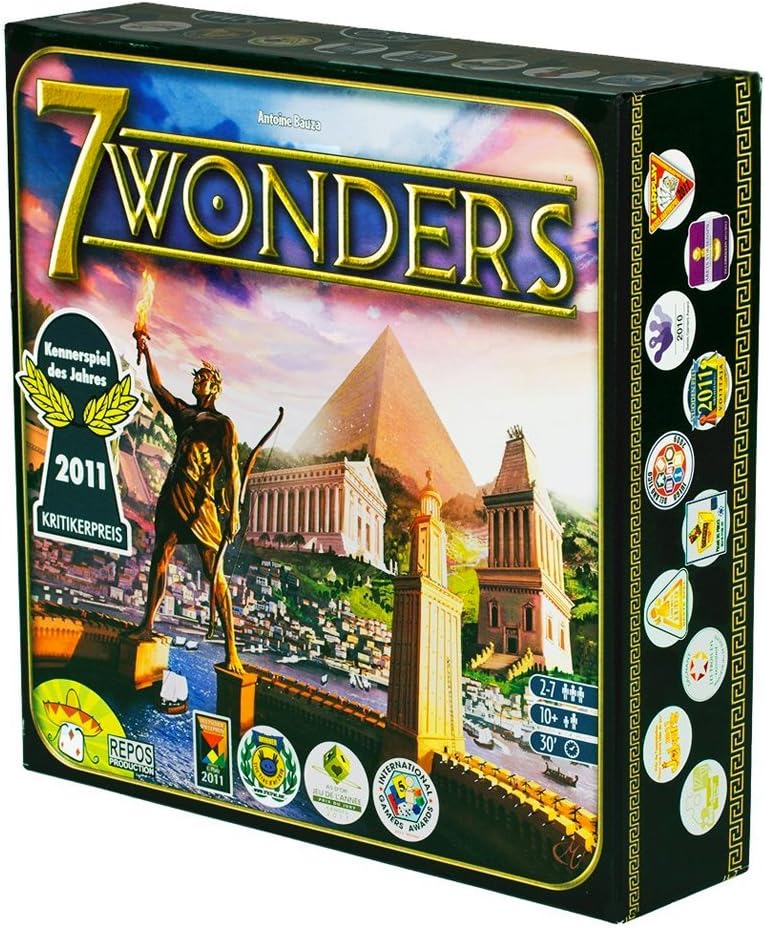
7 Wonders Board Game - Lead Your Civilization to Prosperity! Strategy Game for Kids and Adults, Ages 10+, 3-7 Players, 30 Minute Playtime, Made by Repos Production
Product ID: 668842
⏳30 min quick play
👥3-7 players
🧠Strategic depth
Desertcart purchases this item on your behalf and handles shipping, customs, and support to Croatia.
🏛️ Build your empire, outsmart your rivals, and own the ancient world!
7 Wonders is a critically acclaimed strategy board game for 3-7 players aged 10 and up, featuring 30-minute gameplay where players lead ancient civilizations by managing resources, developing trade routes, and constructing architectural wonders. Designed by Repos Production, it combines fast-paced play with deep strategic elements, making it a favorite for both casual and serious gamers.






| Age Range Description | Kid |
| Asin | B0043KJW5M |
| Best Sellers Rank | #728,851 in Toys & Games (See Top 100 in Toys & Games) #17,985 in Board Games (Toys & Games) |
| Brand Name | Repos Production |
| Color | Standart |
| Cpsia Cautionary Statement | Choking Hazard - Small Parts, No Warning Applicable |
| Customer Package Type | Standard Packaging |
| Customer Reviews | 4.8 4.8 out of 5 stars (2,816) 4.8 out of 5 stars |
| Edition | 2016 Edition |
| Educational Objective | Critical Thinking, Strategic Planning, Resource Management, Historical Learning |
| Estimated Playing Time | 30 minutes |
| Genre | Strategy |
| Global Trade Identification Number | 05425016920558, 05425016921050 |
| Item Dimensions | 11 x 11 x 3 inches |
| Item Part Number | ASMSEVUS01 |
| Item Type Name | Asmodee 7 Wonders |
| Item Weight | 2 pounds |
| Manufacturer | Asmodee |
| Manufacturer Maximum Age Months | 204 |
| Manufacturer Minimum Age Months | 156 |
| Manufacturer Part Number | SEV01 |
| Manufacturer Warranty Description | No Warranty |
| Material Type | Cardboard |
| Minimum Age Recomendation | 120 |
| Model Number | SEV01 |
| Number Of Items | 1 |
| Number Of Packs | 1 |
| Number Of Players | 3-7 |
| Operation Mode | Manual |
| Set Name | 7 Wonders |
| Size | Small |
| Supported Battery Types | No batteries required |
| Theme | Games |
| Unit Count | 1 Count |
| Upc | 756806096388 062444835914 |
User
Highly recommended for any gaming group
This is an amazing game. It's rare that I've found a game that is so easily learned, with such depth of play options and balance. The base mechanics are simple. You are card drafting - each player starts with a hand of cards, chooses one to keep, pass the rest on to the rest of the players. The card you keep can either be purchased and played (each card has a cost), discarded for money, or used to build one of your cities wonders. Victory points are the main goal, gather more than anyone else to win. How do you get them? It's all in the cards:You sit in a circle with your opponents. Your direct neighbors (the person on your left, and the person on your right) are going to be your friends and enemies, and the only people you'll interact with directly. You start the game producing a single resource. You can draft resource cards to produce more, and you can purchase any of the resources your direct neighbors produce. They can't stop you from buying them, but it doesn't limit those resources from being used by that player. There are three rounds (Ages) of drafting.- Brown cards are basic resources (many are free)- Silver cards are advanced resources (used for buying later, more advanced cards)- Blue cards are straight victory points- Red cards are war cards, allowing you to battle your direct neighbors (one battle per Age, most red card values win)- Yellow cards have special benefits such as making it cheaper to buy resources from your neighbors- Green cards have one of three symbols; you will score victory points based off of how BOTH how many of each type of symbol you have (# of cards with a specific symbol SQUARED) as well as how many sets you have (a set consists of 1 of each type of symbol, and is worth 7 points)- Purple cards are late game cards that will usually conditionally help gain victory points. For example, there's one which will give you a victory point for each brown card that you and each of your neighbors has.It might sound like a lot of information to take in (even though I'm leaving many details out), but the game is deliberately paced and allows the players to pick things up as you play. By the end of the first round of drafting (the first Age), most players will have fully grasped what's going on and will be able to develop their own strategies. I've played with a LOT of beginner to intermediate players (many who refuse to go much beyond the likes of a game of Sorry) who have easily picked up the game and now really enjoy it.I can't recommend this highly enough for your gaming group! And the expansions just add additional depth and strategies, making the game more fun.
User
My favorite game
Confession of a board game addict: I can't put 7 Wonders down.The time estimate of 30 minutes for this game is fairly accurate for a 3 player game, I can easily imagine a 7 player game stretching out to 45 minutes. Either way, that makes it a much easier choice than most of its peers, which average 2 hours and beyond. 7 Wonders has an excellent depth of strategy that should satisfy all ages, yet it can be played (once familiar with the rules) at a fairly brisk pace, which creates a good mix of fast paced excitement and deep thought.With that, let's get into the Pros and Cons:Pros:Time Requirement - As above, probably the aspect that contributes the most to this game's widespread appeal.Depth - Striking the right balance between military, commerce, science, cultural and resource development is extremely complex - and the "right" balance changes constantly as you react to your opponents' plans.Materials - I think the comments about the durability of the cards are overstated. I don't believe they are any more or less durable than a standard deck of playing cards. The wonder boards are very sturdy, and the built in card storage decks are a nice touch as well. Also appreciate the thick stack of scoring pads included.Innovation - the free building rule adds an interesting twist to the strategy that rewards players for focusing on a particular type of development (military, commerce, science, cultural) - an option that adds a certain "race to the finish" aspect and prevents the balanced approach from being the only successful one.Cons:THE RULE BOOK - is very poorly written, as attested to by the ample amount of "oops, we have been playing it wrong" threads that a quick Google search of reveals. Some will no doubt appreciate the very succint rule book, and handy reference sheets - but the fact remains that it is very easy to miss key rules of the game because they are hidden in a footnote on an illustration, or not included in the main rules at all, but only on the card description sheet. I had to re-read the rule book (and additional sheets) multiple times before I (think) corrected all the errors we were making. I for one would have appreciated a longer, but more thorough rule book that explains the rules in detail, though I'm sure this was done intentionally as there is a significant market share that finds larger rule books daunting.Add-ons - the Leaders expansion (a separate product) doesn't really add much to the game other than unnecessary complexity in my opinion. On the other hand, the game didn't need an expansion to begin with.Pick 7 Wonders up without reservation - it's a blast. Add on Leaders if you feel like it, but it's hardly necessary to enjoy the game.
User
Just Plain Fun and Easy To Learn, Surprising Depth
Intro:I had heard the hype over this game, but until I played it I wasn't sure what the big deal was. Wow, was I surprised! This game was not only easy to learn, but it had just the right mix of luck-of-the-draw and strategic choices without making it overly complicated.Gameplay Summary:In 7 wonders, players are attempting to earn victory points by completing stages of their wonder, erecting commercial and scientific buildings, gathering resources, and establishing guilds and cultural sites. At the start, players are randomly dealt a card to determine what their city will be and what wonder they will be building. The game is divided up into three ages, each of which has a corresponding deck of cards, the size of which is determined by the number of players. In each age, the deck is shuffled and dealt out to all players evenly until exhausted. The players then decide which card in their deck to use in their city and then pass the deck to the player to their left or right, depending on the age. This continues until the last two cards remain in the deck. Then the player chooses which card to use and the last card is discarded. This occurs for all three age decks.The cards the players decide to use will depend heavily on what's available to them that round, what resources they have available to be able to build the structure, and what their overall development goals are. Players can decide to build commercial structures, which give them bonuses to trade with neighboring cities, scientific buildings, which allow them to gather science icons (sets and runs earn big points), civilian structures, which directly contribute victory points, basic and advanced resource cards, military structures, and guilds. Players can also use the cards they choose to build sections of their city's wonder, usually granting them special abilities, coin, or victory points. Cards played in an earlier era can be used to build more advanced structures in later eras, which brings out the theme of city-state development and advancement.At the end of the third age, all points from the player's structures, treasury, and wonder are summed and the player with the most points wins. It's that simple.Recommendation:I've played this game three times thus far and every time is different. The randomization of the cards makes replayability high and the differences in wonders (and their bonuses) can certainly affect your overall strategy. The theme is strong and the synergy among buildings of different ages adds depth to gameplay. Your choices in the earlier ages can have a major impact on what you can do in the last age, where all the big points are made.This is one of the best civ-builders-in-a-card-game I've ever played. I highly recommend this to anyone looking for a rich, uncomplicated "empire builder" that can be played in a short period of time.
User
Quick to learn and fun to play
7 Wonders is a game that doesn't take very long to learn and playing the game takes between 30 and 50 minutes depending on the number of players and whether or not the players have played before. It's got a limited number of rounds which keeps the games relatively short and while the rules may seem somewhat overwhelming at first glance, they're really quite easy to learn. I only takes one or two times through the game to understand all the basics and begin working on strategies for winning.That's the part of this game I love the most - there are so many different strategies to win that could work you can try something different each time. Indeed the same strategy will not always work game after game so you need to learn to adapt your strategy to the game and the players at hand.One thing about this game that isn't made very clear is that it's designed for at least three players. While there is a two player variation it's considered an "advanced" game because the two players will take turns playing for a non-existent third player with some special rules as to who makes the choices for that "player", how cards are to be handled and what-not. It's not that much harder, but this is certainly a game that's more fun with at least three people. That said, you would be missing out to skip over this game simply because most of the time you'd only be playing with two players -- it's still a very fun game with two players.I have also played the Leaders expansion of this game which adds an entirely new dimension to the game and makes it a bit more complicated but also a lot more fun. One of the best things about 7 Wonders is because of the way the game is scored and won (adding up victory points collected in over half a dozen different ways) it's nearly impossible to tell who's wining at any given moment which means the competition never lets down.I would compare this game lightly to Dominion in that both are deck-building games. In Dominion you purchase cards from the market to build up your deck while in 7 Wonders you select one card from the hand of cards passed to you, play it, and pass your hand on so what's left is only the cards you've selected and played from the cards circling all the players. Both games are fairly quick and have lots of replay value. 7 Wonders does a better job of retaining the mystery of who's likely to win until the scores are tallied at the end and both games are fairly easy to learn even for older children (I played with my 12 year-old nephew and he picked up on it right away and wanted to keep playing after several games).If you enjoy strategy board games then this one should be in your collection. It plays up to 7 players and the more the merrier. If you've played 7 Wonders and enjoy the game I'd suggest you consider add the Leaders expansion to add another dimension of strategy to the game.Rating rationale:Durability - 3 stars because there are lots of small cardboard pieces (coins, home boards) and cards which probably wouldn't stand up too well if doused with water. Nylon card sleeve are appropriate for the deck of cardsEducational value - 3 stars because while it will help teach strategy it is non an educational toy per se.
User
Quick, easy to learn, and lots of fun.
While there seems to be a hundred new card games to choose from, 7 Wonders often comes up on the top of the list. That's because it is a game that can fit into many places.Perhaps the most common reason is it plays well anywhere between 2 and 7 people. I've only played with 3, but I can see how it it would. The main part of the game is choosing what cards to play from your hand. However, after you play a card, you pass your hand to a neighbor (on both sides), which creates the dilemma. You must weigh the choice of a card that helps you, or keeping a card that helps your neighbor. I found this quite fun, and if there were more people, I think it only means that there would be several 3-player games happening concurrently.The games themselves play fast, about 45 minutes for your first game, and less then 30 after you get it. The extra time isn't from describing how to play the game, its from describing the symbols on the cards and how they score. Once you understand them, they do make sense, but the first few games involve a frequent review of the symbol chart to see what each of them mean.As different sets of cards score different points at the end, I could see this part being a little frustrating for a new player in a group of veterans. You feel like others know tricks that get them more points. However, I found games ended really close, and the obvious ways to get points in the middle of the game can give people a big lead. Gambling for a special collection of cards at the end might let some catch up, but it often falls one or two cards short. I think this "one card away from winning" makes people want to play it more, and the short play time and flexibility of players handles any changes in rematches.I would highly recommend 7 Wonders. It's a quick game that's a lot of fun. It's easy to teach, and has several ways to win, which makes people want to play again and again.
User
Beautiful game!
You can't help but notice it's unique style and artwork. Miguel Coimbra is the credited artist here, and it is a nice, unique touch in the world of collectible card games or deck builders, to have something more artistic than comical. Miguel's artwork brings ancient civilizations to life in your hands and really is the center for this game.So first, this isn't a deck builder or a CCG, it really is more like a LCG, Living Card Game, if you are familiar with them. If not, think of it as this, it's a city builder, with cards, where you will draft your strategies! Sound fun? Well, it is!There is very little writing on the cards themselves. Essentially, starting in the upper left and going clockwise, you have the cost in resources to play a card, the results it provides when played at the top, any additional structures it can lead to in future "ages" in the lower right, a note for if the card is included based off the number of players in your game (2 through 7) and then the name of the card in the lower left.The game plays out in a draft format, where you build up and up to create the most wondrous civilization you can, with the ultimate goal of gaining the most victory points. There are several ways to gain victory points and win, appealing to almost anyone's fancy, be it commerce, resource control, special buildings (that provide direct points), science, or might. The wide array of possible ways to win keeps the game very fresh. That said, there is already an expansion out for it if you still feel the need for more, called Leaders.After separating the cards into ages, and then filtering out any cards not needed for your amount of players, each player will be dealt 7 cards and the fun begins. Players all play at the same time, each drafting a card to play and then passing the remaining 6 cards, and so on, with each age alternating the direction of passing. Each player reveals their card, and plays it, paying any associated costs. If you don't have all the resources in play to play the card you chose, have no fear, you can always buy it from a neighboring city, but beware, while commerce trade is an excellent way of obtaining resources not produced by your city, for each 3 gold opponent's have, they gain victory points! So, be careful who you buy from!The game can be highly strategic, as anyone familiar with Magic: The Gathering draft games go, however, that is where those similarities stop. There are so many ways to gain victory points, it can at times, be daunting, but once you get familiar with the cards in the game, you will start to build strategies based on your opening hand and first few sets passed to you.Overall, this is an extremely fun game. If you have ever played Puerto Rico, it has that type of feel. Lots of resource management and great style bring out the best in this game, and makes it one I recommend highly to obtain, play, and enjoy!
User
Beautifully designed, just awesome
7 Wonders is a beautifully designed, medium weight, fast paced civilization building game. Its design is complex yet accessible. You'll be choosing cards from hands that you pass around the table, building your civilization. You'll be making long term game decisions, but also turn by turn decisions that change depending on what others have played around you. You'll score Victory points by many different ways depending on the cards you have played.Positives7 Wonders looks fantastic. The theme is interesting; the artwork, cards, and Wonder game boards beautiful. The Age 1, 2, 3 progression is really cool, with Age 1 cards typically serving as the foundation to your civilization - resources, markets. Age 2 starts to introduce mid-game resources and more developed science/military/economic options. Age 3 introduces late game victory points as well as the purple Guilds, which give Victory points depending on the type of cards that have been played by you and your neighbors during the game.The first thing that a new player will assume is that building their Wonder is the key to winning the game. This isn't necessarily true, as the game can be won with many different strategies, often dependent on what players are doing around you. Someone stockpiling armies? Maybe build science instead. Someone flush with resources? Build up coin, markets, and buy their resources for cheap to build blue Victory points. All these different decisions are always at play every game, and they change depending on your opponent's playstyle. Fantastic.7 Wonders is light enough to play through fairly quickly. Due to the mechanics of the game, every player is doing something every turn, and it seamlessly plays with 2 to 7 players. It's a medium weight game that's more complex than, say, Ticket to Ride, but not so complex that it is unapproachable to new gamers. It's a good second or third "modern game" to introduce.NegativesAs is sometimes the case with medium weight euro-strategy games, the beginning part of the game with the same group of players can start to repeat if everyone sticks with the same strategy. You might have the science player keep going for science each time, military for military, etc. The changing Wonders from game to game help to break this up somewhat.If someone across the table from you is building up a civilization that rivals yours, there isn't really a lot you can do about it, except take a card they are looking for before they have a chance to take it. Even if they are directly next to you, the only real option you have is spending some turns to build up military power (a strategy whose worth is debatable).Sometimes, analysis paralysis takes hold of players due to the large amount of decisions available from turn to turn. The limited size of the hands (which dwindles as the Age progresses) help mitigate this, however.Final ThoughtsIt's not too often that exceptional gameplay gets paired with sharp, enticing artwork, but 7 Wonders is that game. We've played scores of games in many different groups. It's perfect for a large group that doesn't want to play a standard "party" game, but still want some strategy. Its gameplay is simple enough after it's explained and played through once. 7 Wonders is one of our group's favorite games and I don't see that changing for a long time.
User
7 wonders is a great little strategy game that doesn't take all night to play!
I recently purchased this game from amazon.com with the gift card I received from my wife for Fathers Day. What a great purchase! I sat down and played through a couple of games on my own until I was confident enough that I could teach it to my wife. (She has no patience for reading any game instructions that exceed the size of a post card, so she will only try a new game if someone can teach it to her.) She was sort of ho-hum about it the first time through, but said she was willing to give it another shot.I brought the game with us to Colorado on a recent family vacation and played it with our friends who were hosting us. We played the game every night - sometimes three rounds worth. After playing the game more than a dozen times, now, I'd have to say it has become one of my favorites. I will definitely be picking up one or more of the game expansions (7 Wonders: Leaders or 7 Wonders Cities) in the near future.The game boards and box are very nicely illustrated and sturdy. The cards are your basic card-stock material that you may want card slip cases for if you are a stickler for cleanliness and order. (These are the ones I would recommend: Mayday Games - 80 Premium 7 Wonders Sleeves 65x100mm) The game will probably take you about 45 minutes to play the first time you play it. The rules and scoring will take you a bit of time to figure out. Just make sure to reference the back page of the rule book when you aren't sure what a card does or how to score it at the end. I know I messed up on the scoring the first few times I played the game because I wasn't sure how to score certain cards! The guild cards are probably the most difficult cards to understand, but if you play them right, you can win the game with just a few of them.There are several paths to victory, and the game is well-balanced and not really based on much luck. Because you are constantly passing your hand of cards to your adjacent players, no one ends up stuck with a bad hand. As the games is played through several times, you will learn more subtle ways of suppressing your opponents. Much like the game Clue, you are - first and foremost - out to accomplish your own goals, but there are things you can do to hinder your opponents. Also, you will never quite play the same game twice, though you may develop a certain strategy that you prefer to win the game.This is a fun strategy game that doesn't take long to play and doesn't grow old, quickly. Highly recommended for those people who enjoy strategy games but don't have a lot of time to play them! Not recommended for kids! The game designer recommends this game for persons aged 10 or older, and I think that is a pretty good estimation of the mental acuity needed to play this game effectively.
User
Good fast paced game
Recommended to us, and found it very enjoyable. Will consider expansions.
User
Great family game
Bought this game for the family for Xmas and within days we had played over a dozen times. It's a bit complicated to learn so I would recommend watching some of the YouTube videos out on the internet that will get you understanding how to play in about twenty minutes. Having said that we have two boys aged 10 and 11 and neither had any trouble grasping it.Once you know how to play the complexity is well worth it - so many different strategies and game plays that no game is the same. It's a deck building game based on different wonders you select at the outset of the game. We really enjoyed that each game only takes 20 - 30 minutes, which for a game this detailed is a welcome surprise and that there are many different ways to win.
User
Once you get it, so much fun
We love this game - my brother introduced us to it. After 1 or 2 plays, you really get it and it starts to be addictive! Wish we could play with 2 players as my partner and I aren't ready to try and explain it to others lol
User
Nice game, worth a buy. A little expensive though!
The game is awesome, the product quality were as expected.Over all the game is fun for 3+ players and I would rate it as more than okay for 2 players.Just the game should have enough compartments in it to store all the components as when transporting it, both cards and the other components get mixed up
User
De los mejores juegos de mesa que existen!
7 wonders es sin duda de los mejores juegos de mesa que han sido creados hasta la fecha, y que cualquier fan de juegos de mesa debe tener. Es bastante fácil de aprender, las reglas se explican en unos 15min, la complejidad del juego es media ya que el juego presenta muchas variantes y al final es un juego de estrategia que cada decisión de cada jugador irá cambiando el rumbo de cada partida. El arte es hermoso y amarás el juego en especial si gustas de la historia antigua. Una vez te sientas cómodo con el juego base, recomiendo ampliamente comprar las expansiones para darle más variedad, complejidad y frescura al juego.
Trustpilot
4 days ago
1 month ago