


⚡ Power up your solar game with safety and style!
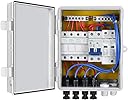
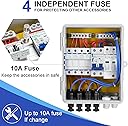
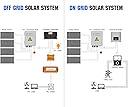
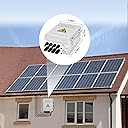
The ECO-WORTHY 4 String PV Combiner Box is a durable, weatherproof solution designed for on/off-grid solar systems. Featuring a 500V 63A DC circuit breaker, IP65 waterproof rating, and integrated lightning arrester, it safely combines up to four solar panel strings with 10A fuses each. Easy to install with a tool-free mounting buckle, this combiner box streamlines your solar setup while providing reliable protection and scalability.





| ASIN | B07F5HDP2W |
| Best Sellers Rank | #307,997 in Patio, Lawn & Garden ( See Top 100 in Patio, Lawn & Garden ) #1,695 in Solar & Wind Power Parts & Accessories |
| Brand | ECO-WORTHY |
| Color | Gray |
| Customer Reviews | 4.6 4.6 out of 5 stars (566) |
| Department | All Ages, Unisex |
| Finish Type | Matte |
| Global Trade Identification Number | 00699919851072 |
| Installation Type | Screw-In |
| Is Discontinued By Manufacturer | No |
| Item Weight | 3.6 pounds |
| Item model number | L03040401017-1 |
| Manufacturer | ECO-WORTHY |
| Material | Plastic |
| Product Dimensions | 8.66 x 6.69 x 4.33 inches |
| Style | Industrial |
| UPC | 699919851072 725621025897 |
M**N
Incredibly versatile little boxes - one warning about the master breaker
I really love these little boxes. I've got three of them now. They make messing around and reconfiguring panels incredibly easy and safe. And if the topology isn't quite what is needed, everything is on a DIN rail making it easy to adjust the bits and pieces. Please note that the PUFA 2-pole breaker in the box is polarized. It appears to be wired correctly for the current direction but generally speaking polarized breakers are a bad idea in solar systems. So just be aware of this. My only critique is that the four little metal mounting tabs rust. Not enough to remove a star, though. 5 stars. In terms of using them, you need to know the basics about putting panels in series and putting strings in parallel. The combiner box combines series strings by paralleling them. Putting solar panels in series adds voltage but leaves the current the same. Putting solar panels in parallel adds current and forces the voltage to be the same. * With a combiner box, you do not parallel your panels or strings prior to going into the box. You parallel them through the box. That is what the box does, it allows you to safely parallel panels or strings. So the 10A current limit per input is not usually a problem. The fuse is there to protect the panels from shorts. If a string shorts out, all the other parallel strings will feed their current into it and that MUST blow the fuse. So you must size the fuse properly. Typically 12A, 15A, or 20A is the proper size for this function. * IT IS VERY IMPORTANT TO SIZE THE FUSES PROPERLY SO THEY BLOW IF TWO OTHER STRINGS FEED CURRENT INTO A SHORTED STRING. It is good that the unit comes with 12A fuses, that is almost always the correct size. If you screw this up you risk catching your wiring or panels on fire if a short develops. Panels have a "maximum series fuse" specification. Make sure the fuse is around that value. * The maximum current is a specification on the solar panel. Nearly all solar panels are either 5A or 10A and they can achieve this current regardless of the latitude. Assuming your strings are in series and that is what is fed into the box, then you want the current specifications for all the panels in series to match because if it doesn't one panel will restrict the current of the others and you will not get full production. * You want the voltages of all the strings you are combining through the combiner box to be roughly similar. The currents coming from each string into the combiner box can be different. * Remember, you have to add voltages for the panels making up each string and the string is then fed into one input of the combiner box, which adds currents. The rule of thumb here is that you want the operating voltages of each string to be similar and you also want the operating voltage for each string to be LESS THAN the open-circuit voltage for any of the strings. You don't want an operating voltage that is higher than the open-circuit voltage of any of your strings due to mismatching the strings, that can cause severe problems down the road. Solar panels are not designed to take indefinite reverse voltage (which is why larger combiner boxes have blocking diodes as well. Smaller combiner boxes typically do not have blocking diodes). * Severely mismatched strings will not give you optimal generation, but if you don't have a choice then its better than nothing. That said, you have to make absolutely sure that the operating voltage for any string does not exceed the open-circuit voltage for any other string (when the strings are mismatched), as per the label on the solar panels. I'm saying this a second time because it is important. -- * The BACKHAUL wiring is the wire that goes out of the combiner box through the large breaker and goes into your charge controller or hybrid solar inverter or whatever. You have to make sure that the backhaul wiring can handle the total combined worst-case current from the combiner. Typically this is going to be in the 15-25A range. Using 10 AWG wire for your backhaul is always a good idea because you will reduce losses through the cable. High quality solar cabling is typically 6mm^2 which is actually a bit better than 10 AWG (it's more like 9 AWG). * Make sure the MC4 connectors are rated for the current being carried. This is typically not an issue for each individual string (because the current is only 5A or 10A), but it can be an issue if you are using MC4 connectors on the backhaul cabling where the total current can be far more. Once the array is operating, on a good sunny day hand-feel the MC4 connectors on the backhaul (if any) to make sure they aren't hot. * Generally more voltage and less current is better, you get far lower losses that way, but you have to make sure that the open-circuit voltage of the strings does not exceed the specifications for the charger controller that you are backhauling into. -- * Now for voltage, that is mostly a function of the charge controllers your are feeding into. Make sure that voltages, particularly the open-circuit voltage of the strings, is compatible with your charge controller. * Charge controllers are not usually limited by the input current from the combiner box because most people use panel geometries that add voltage before combining the strings in parallel. Instead, most charge controllers are limited by their output current, which is generally a function of the battery voltage they are feeding into. * I strongly recommend using Victron charge controllers, which are 97% efficient, whenever possible. Victron has two reasonably-priced charge controllers, the MPPT 75-15 (max 75V in, roughly 10-30V out) and the MPPT 100-20 (max 100V in, roughly 10-60V out). 15A or 20A output current, max. These charge controllers need BATVOLTAGE + 5V coming into it from the combiner box in order to start. This is not usually a problem since you will be putting panels in series to create higher voltage strings anyway if you are smart. * Have fun! I am! I have three of these babies.
J**N
Great enclosure
This seems like a great enclosure that is well wired and easy to mount. I mounted it outdoors at the panels so we shall see if it holds up to the outside environment. I only needed a 2 string enclosure, but this gives me room to expand. I only wish that they had included caps or plugs for entry points that were not being used. The wiring was neatly done and the external mounting tabs worked well without requiring penetrating the case's waterproof integrity. A gasket rests in the cover groove to ensure the waterproofing. I do wish that the breakers had individual switches for each solar string. There is only a master switch for the entire enclosure, but it works well for my small installation.
A**R
Well made, feels sturdy
Got this to go with the ecoworthy black friday deal from last year. I've seen a few rough stories in the reviews but so far I've been one of the lucky ones. Everything I've purchased from Eco-Worthy has been well made, well packaged, and just great construction. I only tinker with solar and dont really know much about it. But I do know what a well built item looks like, and this is it. Very happy, but if things go sideways I'll update my review.
P**R
Solid product, horrible instructions.
Not sure where negative reviews are coming from. Some as moronic as saying terminal caps aren’t tight. We’ll get some Channel Locks genius. This thing is well made and works great with my 1Kw 6 panel 24V system. Tidied up the wiring and very simple to install if your IQ is above 100. 4 stars because: (a) there are no instructions except online and they have inconsistent, conflicting pics and wording (e.g. pics showing which leads are + and - are backwards); and (b) Customer service gives super fast responses but English is clearly not their native language. Will buy a larger one for my next project which is a 5Kw system.
J**D
Good deal
Good deal, works very well, and very easy to install. Glad I bought this combiner box especially for the price.
A**R
What a nice idea, has fuses for each solar panel line in parallel and lighting arrestor
Looks nice and sturdy, should work well for my 4 - 100 watt panels in parallel.. I do wish the "out to battery connection"s were larger diameter holes,, as I plan to use a 2 awg cord from each as it needa to go like 16 feet to battery and not sure if I will have to make the end of them smaller to fit.. Also,would be nice it they recommended where to get spare fuses, or sold some separately for this box.
M**T
A must have...
Glad to have this in my set-up. It is like an insurance policy. I will admit to struggles with using the simple Y-cable combiners, other than as a short term transitional step, leading to a combiner. Like or as with anything, I might need a 6 way box... ;) OR even a second. **I have to note: My combiner box >> did not work out of the box <<, it would not pass any voltage. I traced it to the positive phase, with further continuity checks... found the culprit. The + terminal the main PV breaker wire insulation / ferrule was crimped, not making contact. *It cost me a day of productivity working to reason the problem. Never would have thought the combiner, as part of a complex series chain... This product is "of quality" and a very good value.
C**S
Junk combiner!
2 of the 4 ports have went bad. Supposed to have a 1 year warranty but manufacturer not wanting to replace unit!! Buy Elsewhere!! Update customer service finally made it right but only after one star rating!
D**D
installé depuis 2mois aucun problème
R**A
Setting up a new off grid solar power system
A**R
Tidy and easy to install
A**R
Good quality, weather right!
A**N
first off Im not a electrician, I am only showing you what works for me using the echo-worthy hardware ( I dont like mixing products since they have everything rated for their own hardware - I have the solar input at max for this 4 string combiner box). You will see 2 separate setups above (dc side is floating on 1 and grounded to a GEC on the 2nd setup) - the 1st setup uses all the echo-worthy inverter/charger/combiner and PV panels... these parts work well together and are very adorable for all the features .... but dont expect any customer service (no doubt that is how they keep the prices low). - the 2nd system shown 2 combiner boxes.... I have this echo-worthy 4 string combiner box for inputs from (2) echo-worthy trackers systems loaded with their 195W panels. this leads to the 2nd combiner box (a midnite solar disco isolator combiner, this pulls in my panasonic pv array) which leads to (2) classic 150 charge controllers (1 for each string coming in). both charging 1 battery bank at same time. again get a proper electrician to verify your installation !!!! basically keep your wire awg oversized, breakers x 1.25% and verify polarity. read equipment documents for ratings and specs. I hope I help someone understand the solar system a bit better than they did before.
Trustpilot
1 month ago
1 week ago