Buy anything from 5,000+ international stores. One checkout price. No surprise fees. Join 2M+ shoppers on Desertcart.
Desertcart purchases this item on your behalf and handles shipping, customs, and support to Croatia.
🎧 Elevate your audio game—because your visuals deserve sound as sharp as your vision.
The TASCAM DR-60DmkII is a compact, DSLR-friendly 4-channel portable audio recorder designed for videographers and content creators. It features dual combo XLR/TRS inputs with 48V phantom power, dual 3.5mm inputs, and high-definition HDDA preamps delivering up to 64dB gain. Capable of recording up to 96kHz/24-bit WAV files directly to SD cards, it offers professional-grade sound capture with physical controls and versatile mounting options, making it an essential tool for clean, reliable audio in any video production workflow.


| ASIN | B00MIXFBL0 |
| Best Sellers Rank | #28,529 in Musical Instruments ( See Top 100 in Musical Instruments ) #20 in Digital Multitrack Recorders |
| Brand | Tascam |
| Built-In Media | Audio Recorder |
| Compatible Devices | Camera, MP3 Player, Personal Computer |
| Customer Reviews | 4.5 out of 5 stars 1,082 Reviews |
| Digital Recording Time | 25.6 minutes |
| Format | WAV |
| Global Trade Identification Number | 00043774031023 |
| Hardware Interface | 3.5mm Audio, USB |
| Headphones Jack | 3.5 millimeters |
| Item Dimensions D x W x H | 3.1"D x 5.2"W x 3.7"H |
| Item Type Name | DR-60DmkII |
| Item Weight | 1.12 Pounds |
| Manufacturer | Tascam |
| Memory Storage Capacity | 64 MB |
| Mfr Part Number | DR-60DMKII |
| Microphone Form Factor | Built-In |
| Microphone Operation Mode | Stereo |
| Model Number | DR-60DMK2 |
| Number of Batteries | 4 AA batteries required. |
| Screen Size | 1.75 |
| UPC | 043774031023 |
| Unit Count | 1.0 Count |
| Warranty Description | 90 days labor. |
S**H
Professional Redundancy and Crystal Clear Audio Capture
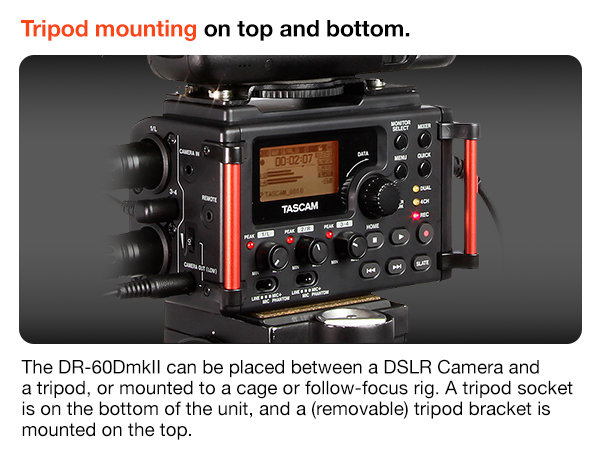
The Setup: The Tascam DR-60D MKII is the final piece of my recording chain. I feed the main outputs from my Pyle 12-Channel Mixer directly into the Tascam. This allows me to capture everything—my Rode Procaster (boosted by Triton FetHeads), my Numark Mixtrack Platinum, and live phone calls—all onto a high-speed SD card. Why It’s Essential for My Workflow: Redundancy: Even though I run my podcast through a PC, I never trust a computer alone. The DR-60D MKII gives me a dedicated hardware backup. If my PC lags or the software crashes, the Tascam keeps rolling with uncompressed, professional audio. Clean Preamps: While my FetHeads do the heavy lifting for the mics, the Tascam's HDDA preamps ensure that the line-level signal coming from the mixer remains pristine with massive headroom. Ease of Use: The physical gain knobs and "one-touch" recording make it much faster to adjust on the fly than clicking through software menus during a live show. Design & Portability: The tripod mount on the top and bottom is a great touch. It fits perfectly into my studio rig, but it’s also small enough that I could take it on the road with my Deity V-Mic D4 Minis and Canon M50 for a mobile interview setup. It’s built like a tank and handles the daily grind of podcasting and DJing without a hiccup. Final Verdict: For any serious creator, the Tascam DR-60D MKII is the best way to move from "hobbyist" to "professional." It provides the peace of mind that your audio is always being captured in the highest possible quality.
P**Y
Clean preamps, easy to use and tiny
The DR-60D MKII is optimized for DSLR video audio—lacking music extras like a tuner and metronome—but sports most of features of the DR-40 but housed in a tripod and camera friendly case. APPEARANCE & BUILD: Although small, the boxy form factor isn’t palm friendly and is at its best on a Magic Arm or tripod. The plastic body feels well made but isn’t as sturdy as the metal clad DR-100 II. Unlike most Tascam portables, there are no built-in mics. A tiny monochrome LCD displays levels, modes and menus. It’s not a touchscreen but is clearly visible in darkness and direct sunlight. And, because it’s not angled like the DR-70D LCD, it’s visible in a bag, on the floor or topside a camera. A tripod socket beneath and tripod bolt above allow connection to studio support and cameras. I use an Arca plate for fast mount/dismount. The top tripod bolt feels flimsy and I wouldn't trust it to hold anything heavier than a battery pack. CONTROLS: I choose the DR-60D MKII over the DR-70D due to the abundance of physical controls—specifically phantom power switches—and the forward facing LCD. When attached on an arm or tripod, the frontal LCD and controls are easier to see and use compared to “palm” recorders like the H6 or DR-100 MKII. The rubberized buttons and wheels operate smoothly and are easy to access. Channels 1/2 have individual gain controls but, oddly, 3/4 sports only a single global level adjustment. MIC CONNECTION: Combo XLR and TRS inputs allow recording from external mics or line level sources such as mixers or outboard mic preamps. XLR preamps have four levels of input sensitivity but, unlike the DR-100 II, sensitivity is set via menus (no switches). There’s a switch to toggle XLR inputs from mic, phantom power and line level. Mini/3.5 mm stereo mic input is also supported, defaulting to channels 3/4. Power for the 3.5mm mic input lacks a switch and must be activated from a menu. BATTERIES: Four AA batteries are housed in a backside compartment. Batteries can be swapped out while the unit is on a tripod. I use Eneloop Pro rechargeable batteries and they only last about four hours with 48v phantom power. Standard Eneloop work okay but the slightly larger size make them tough to install/remove. The short battery life is disappointing but easy to work around (see below). The mini-USB port is only for bus power or uploading to a computer. For long sessions I plug in a USB “lipstick” battery bank and it yields an additional four or five hours. For marathon sessions I strap on a USB battery bank, the Anker Astro E4 13000mAh Portable Charger : power for days with phantom power and can be attached to the top of the DR-60D with a smartphone tripod mount. SOUND QUALITY: I mainly record soft finger picked guitars and preamps have plenty of gain when set to “high” sensitivity: 25 to 50% gain for -12 dB set with KM-184 mics. Quiet passages and rests of classical guitar pieces were wonderfully clean and devoid of noise. Preamps are significantly cleaner than the DR-40 and a notch better than the DR-100 II. The DR-60 MKII and two Neumann KM-184 mics were used to record the audio of my uploaded video at 48kHz/24 bit (synced to EOS 70D video). Finally, the 60D MKII can record various combinations of stereo and mono modes, e.g., stereo plus two mono tracks, but these tracks must be recorded simultaneously. In other words, unlike the DR-40 and DR-44WL, it lacks the ability to “punch in,” while playing back a track. Normally I’d add additional audio in a DAW during post production but it seems odd to omit such features when similar units have them. LAST BLURB: I'm happy with the DR-60D: excellent recording quality, clean preamps, plenty of gain for soft instruments and easy to use form factor for "selfie" audio and video recording. Operation is straightforward and I barely needed to open the manual. Cons are short battery life, no built-in mics, small LCD and no punch-in features. All in all, the DR-60D MKII is a great choice for those needing to record live music performances and DSLR audio.
L**R
Intuitive, spectacular sound, and well-built. Astonishing value for the money.
I go back 30 years with Tascam products, and they have yet to disappoint. I'm using this with a pair of original AT 4033 condenser microphones (phantom powered) for field recordings. By field recordings, I mean, literally recording fields, and trees, and streams...birds, insects, and whatever else flies by. ...I'm a musician and music producer, and have spent decades working with professional studio gear, but I needed something to take outside that didn't cost a fortune. I figured at this price point I'd be making a serious sacrifice in sound quality, durability, or something...but after a few months of ownership, I have nothing but fondness for this little gadget. I have zero complaints. This recorder allows me to bring the world inside my studio. Record anything, pop the SD card into my Pro Tools station, and then pull the audio into my project. Quick, easy, perfect for the task. I haven't used this to record music or vocals yet, but I don't detect any digital harshness in these (very quiet) preamps, and they really get the most out of my mic pair. If insects, birds, and distant trains sound true, I think pretty much everything will. This is one of best values I've run into in a long time. Team this recorder with a nice external USB battery pack and it will run for many hours...maybe days. My 20,000mAh Anker battery pack lets me take 24 hour-straight recordings with phantom power on both channels.
L**S
No noise. Works great.
Really great recorder. There is basically no noise added by this recorder. I have used a combination of mics and they all sound as great as expected. I don't expect a digital recorder in this price range to introduce noise and this one if perfect. Lots of great features and I like that many are accessible without having to go too deep into the menus. It is well built and you will not have any issues confidently attaching your camera to the top of this unit. Battery life is horrible. If you need portability than I suggest you invest in a backup cell phone battery pack. Get the biggest one you can afford. If you are stationary while recording then just bring your cell phone charger and plug in the included cable. The cable provided is very short so one day you will be buying a longer one. No wall plug is provided but any USB plug should work. I am using the Belkin 12watt USB charger and it works perfectly. The manual warns that some USB chargers (such as laptops etc.) may not deliver enough juice for the unit to generate enough phantom power so just get a good modern USB charger. The biggest issue I have is that it seems as if the headphone amp is noisy. When setting levels etc. I have found that with the gain turned up and the headphones turned up, where I can hear clearly, there is noticeably hiss. However when I play back the recorded files on my computer there is absolutely no hiss at all. The recordings are perfect. It is hard to adjust the levels using the headphones to determine the point at which there is no noise when the headphone jack is introducing its own noise at high volume. I have learned to trust that there is no noise. My second issue is that although the unit is a 4-channel recorder there are not 4 fully independent channels. channels 1 and 2 are completely independent with separate gains, limiters, filters etc. Channels 3 and 4 however are combined together with the limit, gain, etc. controls affecting both channels equally all of the time. My final issue is that when I record on all 4 channels I get 2 stereo files. Given that channels 1 and 2 are completely independent I would have preferred to get a separate file for each channel. But any way the channels are easy enough to separate in post production.
M**H
Tascam DR-60DmkII nice enhancement over DR-60D and big jump up from DR-40, BP-6AA is essential!
The Tascam DR-60DmkII includes enhanced pre-amps that are good enough not to not introduce any measurable noise on battery power with a quiet room and a Pyle podium mic that requires High mic gain setting. However using a USB to 5v adapter (not the Tascam adapter) did introduce noise. For this reason, I am using a BP-6AA identical to the one used on a Tascam DR-40 recorder installed in a church recording system. Though we can run the DR-40 or this DR-60DmkII off external USB port power, noise levels are typically much lower using the BP-6AA which I'll review separately. With such a low noise recorder, and with the BP-6AA using tripod mounts to attach to the top or base of the recorder, no brainer upgrade from 2+ yr old Tascam DR-40! Here are our usual pros and cons: Pros: + lower noise, higher gain pre-amps than prior model DR-60D + safety track record feature is a lifesaver when initial gain settings are too high! (DR-40 has this feature, too) + consistent menus and operation to prior generations of Tascam DR series including when power or computer is externally attached via USB port + available BP-6AA external battery pack gives reasonable life for rechargeable NiMH batteries, but see below... + Broadcast Wave File (BWF) support - can be a lifesaver when merging audio and video from different recorders. To effectively use, you should keep the clock set correctly. Cons: - drains batteries rapidly compared to comparable Zoom or lower end Tascam DR series recorders - no integral MP3 compression, implying you shouldn't use compression with such a high end recorder! I'd like to make that decision!! - there should be a Li Ion external equivalent bolt-on like the BP-6AA instead of lower capacity and bulkier BP-6AA with NiMH batteries! - might want to think twice about putting a relatively heavy DSLR on top of recorder as shown in photos! This puts a lot of strain on the tripod mount in the bottom of recorder; just don't do it if a BP-6AA is used! - menus can be a bit confusing for the uninitiated and this generation manual is not as helpful as prior generations. Look for YouTube tutorials! I was going to put a small shotgun mic on top with a 1/4" to 5/8" adapter, but realized the DR-60DmkII + BP-6AA underneath + mic on top is not very stable. Better to use either a two-in-one bar tripod adapter or multiple tripods adjacent to one another. If a BP-6AA pack is mounted on top with nothing mounted on top of BP-6AA, then BP-6AA batteries may be changed without impacting setup. The DR-60DmkII batteries are accessible, but it isn't easy to pop them in the rear while the whole setup is sitting upright. Edited 07-31: Beware of open box items marketed as "new". I received one from a vendor sold as new that showed a bit of wear on the rear battery cover and underside. However, the style of packaging for this Tascam makes it difficult to tell whether this is a new, returned, or open box item! I have seen some "unboxing" videos on YouTube and this is the first Tascam DR series I've purchased that doesn't come in a sealed box with a plastic protector for the display and a sealed (at least taped) poly bag holding the recorder. I have seen this style of packaging on "professional" gear before. So how are we as consumers to tell whether an item is an "open box" or return? TEAC/Tascam saved perhaps a few pennies but it would be great to go back to providing a screen protector and tape the poly bags!
B**E
Marvelous and Best for Value
The TASCAM DR-60DmkII is just marvelous. I use it with a Sony A65 DSLR and my favorite configuration is with a Sennheiser shotgun mic in channel 1 and a Sennheiser wireless handheld mic in channel two. I consider this my perfect field documentation setup. I also use the Dual Record mode, Limiter and Bass Roll Off settings on all of my recordings. I attach it to the bottom of my camera and use a Gitzo Tripod with a Manfrotto 503 HDV fluid video head for a solid field shooting platform. Some complain that stacking the TASCAM unit and the camera together makes the configuration too tall. These people obviously haven't used older professional video cameras that are over a foot tall and two feet long, plus those dinosaurs weighed in upward 25 to 35 pounds. If placed on a solid tripod head rated for the weight of your gear you'll be perfectly fine. Some complain the unit has a plastic feel but I find the unit to be quite well made and the camera mount quite sturdy. Some complain that the menu is too complicated. They obviously haven't used a Zoom, Marantz PMD660 or a Marantz PMD670. I sat down on my stoop, fiddled with the buttons and knobs and figured out the menu in less than 5 minutes without looking at the manual. Remember it is a TASCAM, their manuals read like stereo instructions. If you have used digital audio recorders in the past, you will find the menu quite intuitive. If not good, luck with the manual. The pre-amps are absolutely wonderful, but test and know your input settings in relation to your mics before going to the field. Just make sure your audio levels peak above the -12db delta mark without hitting the 0db Clip wall. This is where your Dual Record mode can save you if audio gets too loud. When using the channel adjustment knobs be careful of stair-stepping the digital signal by turning the knob too much at one time. Only make micro adjustments while recording. If you find yourself slightly clipping just fall back on the Dual Record tracks rather than messing with the knobs. That is what the Dual Record function is for, it is your safety net. Finally, I love-love-love the Slate function. It makes post-production audio syncing a breeze. In summation this TASCAM unit turns my Sony A65 into a truly professional video production camera. I like it so much I ordered a second one. The TASCAM DR-60mkII is perfect for most of my production needs and the price tag didn't put a huge dent in my wallet.
W**R
Great Unit. Great Price.
This is an excellent recorder. I had purchased the original a while back and ended up returning it as it wasn't inherently better than my Tascam DR-100 MkII (which is also excellent). When I saw that they made a second version of the DR-60D, I had to try it out and it doesn't fail to impress. I put it to use on a client project right away and here are my points: 1. The audio is VERY clean. Their new preamps make for a nice, clean sound. I use this with a Rode NTG-3 which is a great mic anyway. If you're getting noise, maybe it's your mic. 2. I LOVE the high gain setting. I don't know if I'll ever use the Extra High Gain setting, but knowing it's there could be an asset. I also have an Azden SGM mic that doesn't have anywhere near the output of the Rode, so if I'm in a situation where I need both mics, I feel like I easily could. 3. The XLR/Phono inputs are great. I usually use XLR, but if I wanted to pull a signal from something else and needed 1/4", I could 4. The operations are easy. I like having everything in front of me with knobs. Even the DR-100 II has a lot of menu interfaces and I don't even touch my Zoom H4N anymore. I know there are a lot of questions floating around out there about the gain potentiometers. Just like the old units, the knobs operate smoothly, but you still get the electronic "stepping" with gain adjustments. Fortunately, it seems a lot more subtle on this newer unit. If you make a big jump, you will get a more significant "step" change in the audio. If you go slowly, it's hardly noticeable. All in all, I'm definitely keeping this one. Super build quality, great audio, unbelievable price.
S**S
Not For Me
Can't recommend based on the one I got. I loved the idea of this unit but was very disappointed when I received it and after testing it, had no choice but to return it. The issues. 1) Line Noise. Recording as a stand alone device it works quite well. However, when run through my Nikon D810 I had a really unacceptable level of line noise. It literally makes it unusable. I tested it with several different pro mics (Sennheiser/A.T.) and every possible setting and got the same result every time. This is the main reason for the return. 2). Pots are really crappy. Every review mentions this. Believe them. You can't really call it a field mixer if you can't adjust the gain on the fly. On my unit there is really no detectable audio until the pot is at the 50% position then it's very choppy and steppy after that. Another reason for the return. 3) No Support. Basically no support from Tascam, that I could find anyway. Nobody to call. The Tascam website FAQ for this product consists of exactly one question about the firmware and that's it. Not very helpful. 4) Build quality - horrible. I know it's only $200 but it's really flimsy. If issues #1 and #2 didn't exist I would overlook this but since they do this, along with #3, it's just going back to Amazon. Maybe I got a bad unit - that happens a lot lately - but I was not impressed. Update: 5/2015 I wanted to follow up on this review just in case anybody is looking at these Tascam recorders or shopping for field recorders. I ended up returning this and bought a Fostex DC R302 which I purchased on sale for about $600. Yes it was three times the price of this unit but guess what - it works perfectly and makes the Tascam unit look like a child's toy, which frankly, is what it is. All of the issues that I had with the Tascam do not exist with the Fostex unit. The next step up in audio field recording would be a $1600 Sound Devices 302 field recorder. I've posted bad reviews of the Tascam on numerous forums and gotten a lot of nasty comments that I don't know what I'm doing etc etc. All I can tell you is that the Fostex worked dead-on perfect the first time I plugged it in and is of vastly more robust construction. The pots on the Fostex work perfectly. There is no line noise. Etc etc etc. I've used the Fostex with Sennheiser shotguns, Sony lavs and several other random mics and never had a problem. I've used it for 6 months without incident and I'm getting broadcast/feature film quality out of it. The Tascams are kind of like the audio equivalent of cheap softboxes - they are a simulation of a professional product, not a professional product. I really don't think you can get a professional product at this price point. If you read through the various online forums you will see all these suggestions for making the Tascam work and all of these excuses and accusations for why they don't work. I'm not buying it, I think these are just sub-standard on every level. YMMV of course but I'd strongly suggest using a higher end product if you need to output a professional quality production of any type. If you're stuck at this price point, then I'd suggest buying a Sony PCM M10, which is the exact same price but with much superior quality. It has a lot less features than this and one input only, but at least you'll get a clean signal with zero line noise.
4**A
Muito bom
Recebi o produto bem antes da data anunciada. Equipamento espetacular para gravação de áudio profissional. São 4 canais de gravação, com redução de ruídos, corte de graves, é leve, pequeno, super moderno, e transformou nosso modo de gravação. Indico muito!
S**Y
Good quality
Love it, however not the best but in all honesty does the job decently, but doesn’t eliminate the hiss in non isolated rooms. Still love it though
T**S
Top Recorder zum kleinen Preis!
Der Recorder funktioniert einwandfrei und liefert absolut brauchbare Qualität ab. Bei Mikrofonen mit ordentlichem Ausgangspegel hält sich das Rauschen auch in Grenzen, bei etwas leiseren Kandidaten muss in der Nachbearbeitung mit einem Rauschfilter nochmal nachgeholfen werden. Die Einstell Möglichkeiten sind vielfältig, so kann man zum Beispiel am Anfang und Ende jeder Aufnahme einen Signalton abspielen lassen, und das aufgenommene Signal nicht nur auf der Speicherkarte speichern sondern auch direkt in die Kamera einspeisen. So fällt das synchronisieren in der Bearbeitung hinterher leichter, falls man mal vergisst den obligatorischen sync-Klatscher zu machen. Etwas nervig ist der Batterie-Verbrauch. Benutzt man ein Mikrofon mit Phantomspannung ist es durchaus möglich an einem Drehtag mit einem Satz Batterien (4 x AA) nicht hin zu kommen. Glücklicherweise nimmt das Gerät auch Akkus (auch das lässt sich im Menü einstellen!) wodurch sich der Verbrauch an Ressourcen unter Kontrolle bringen lässt. Alternativ kann man den Recorder auch per USB mit Strom versorgen, leider nur mit dem sehr überholten Mini-USB. Micro-USB oder USB-c hätte mir erheblich besser gefallen. Ein sehr praktischer Begleiter mit extrem vielfältigen Optionen und Möglichkeiten, den man zu diesem Preis eher selten bekommt. Absoloute Kaufempfehlung von mir.
C**.
Sfortunato?
L'oggetto è arrivato puntuale come sempre. Non ho avuto modo di provarlo subito, ma dopo una decina di giorni. La prova è avvenuta con vari microfoni, tra cui un Sennheiser Mk600 ed un Synco d2. La mia recensione riguarda il modello a me pervenuto, ed è relativa ad esso. Ne chiederò un altro, perchè voglio sperare che quello che è arrivato fosse difettoso. Costruzione: L'oggetto è molto bello. Un giocattolo prezioso, facilissimo da usare e con funzioni tanto essenziali quanto necessarie. Tutto si regola con facilità. Di costruzione leggera, nell'ìuso con pile si dimostra subito sensibile alle emissioni elettromagnetiche (ma questo lo dice chiaramente anche Tascam). E fin qui, nulla di grave. La costruzione è compatta, interamente in plastica e molto leggera. Le levette di blocco dei cannon non sono il massimo: quella del microfono 1, ad esempio, tende a trattenere il microfono in loco anche se la si preme. Le prese 3,5 mm sono invece molto strette. Il jack della mia AKG è entrato bene, ma esercitando una forza superiore al consueto. Insomma, la costruzione, sebbene sia ingegnerizzata bene, non ispira molta solidità ne cura per i dettagli. Uso: La prima cosa che mi è saltata all'orecchio è che il guadagno degli stadi d'ingresso dei pre è a steps. Poco male, ho pensato, il livello tra uno step e l'altro lo si fa con i due potenziometri... Ma non è così semplice. I guadagni low e mid, ancora consentono livelli di rumore accettabile (pur se gia marcatamente udibile). I due livelli successivi sono decisamente inutilizzabili. Il rapporto segnale rumore è talmente basso da non poter tenere le cuffie attaccate. Ergo, guadagno su mid e azione di fino con il potenziometro per restare nell'headroom. Faccio il primo test, e di nuovo una sorpresa. La registrazione è molto più pulita di quello che esce dall'uscita cuffie, ma è decisamente bassa... Troppo bassa per essere utilizzata in un filmato semiprofessionale senza pompare il rumore alle stelle. Questo sarebbe gia un buon motivo per rimandare indietro l'esemplare, le cui caratteristiche non corrispondono a quelle dichiarate. Ma non basta. Attaccando due microfoni con alimentazione phantom, appena dopo la conferma tramite pop up dell'uso della phantom, su uno dei canali si innesca una auto oscillazione con battimenti e colpi fortissimi. Tanto da auto saturare. Poi si interrompe da sola dopo qualche secondo ed il canale é fruibile. Inaccettabile... Attaccando il cavo usb senza pile, l'apparecchio si accende e si spegne subito dopo. Come se dalla USB 2.0 non arrivasse abbastanza corrente per tenerlo acceso. Ho quindi acquistato anche l'alimentatore consigliato. Appena lo ho attaccato, il tascam ha iniziato a ronzare pesantemente. Il ronzio aumentava tremendamente toccando le alette di blocco dei cannon e spariva toccando una delle viti che fissano il rotellone di fissaggio alla DSLR... Non è quindi l'alimentatore, ma il Dr60 che ha un qualche problema. Insomma, tanto carino quanto assolutamente inutilizzabile. Immagino che l'esemplare (usato come nuovo PRIME) fosse difettoso. Ora deciderò se comprarne un altro o passare al modello successivo...
D**E
Muy bueno
El producto llego rápido y en buen estado. Si comparas esta Tascam con la DR-70d se nota porque la diferencia de precio, ya que tiene 2 entradas XLR menos y no tiene micrófonos incluidos, sin embargo, tiene una excelente calidad y es bastante práctica. La decisión entre esta y la DR-70d se basaría entre si te sirven los micrófonos incluidos y las 2 entradas XLR extras, y a parte, que diseño te parece más práctico. Pero en general me encantó el producto y me ha servido muy bien. Ya jugando con la grabadora un poco más, la grabadora tiene realmente 3 entradas para micrófonos: 2xlr y 1 una entrada stereo para jack que con un adaptador la puedes convertir en en dos entradas mono, lo que serviría para tener dos micrófonos lavaliers o uno solo. Y las entradas y salidas destinadas a la cámara solo pueden ser usadas para enviarle señal y escuchar lo que escucha la cámara, no se pueden usar como entradas de micrófonos extras. Económico y bueno
Trustpilot
1 month ago
1 month ago