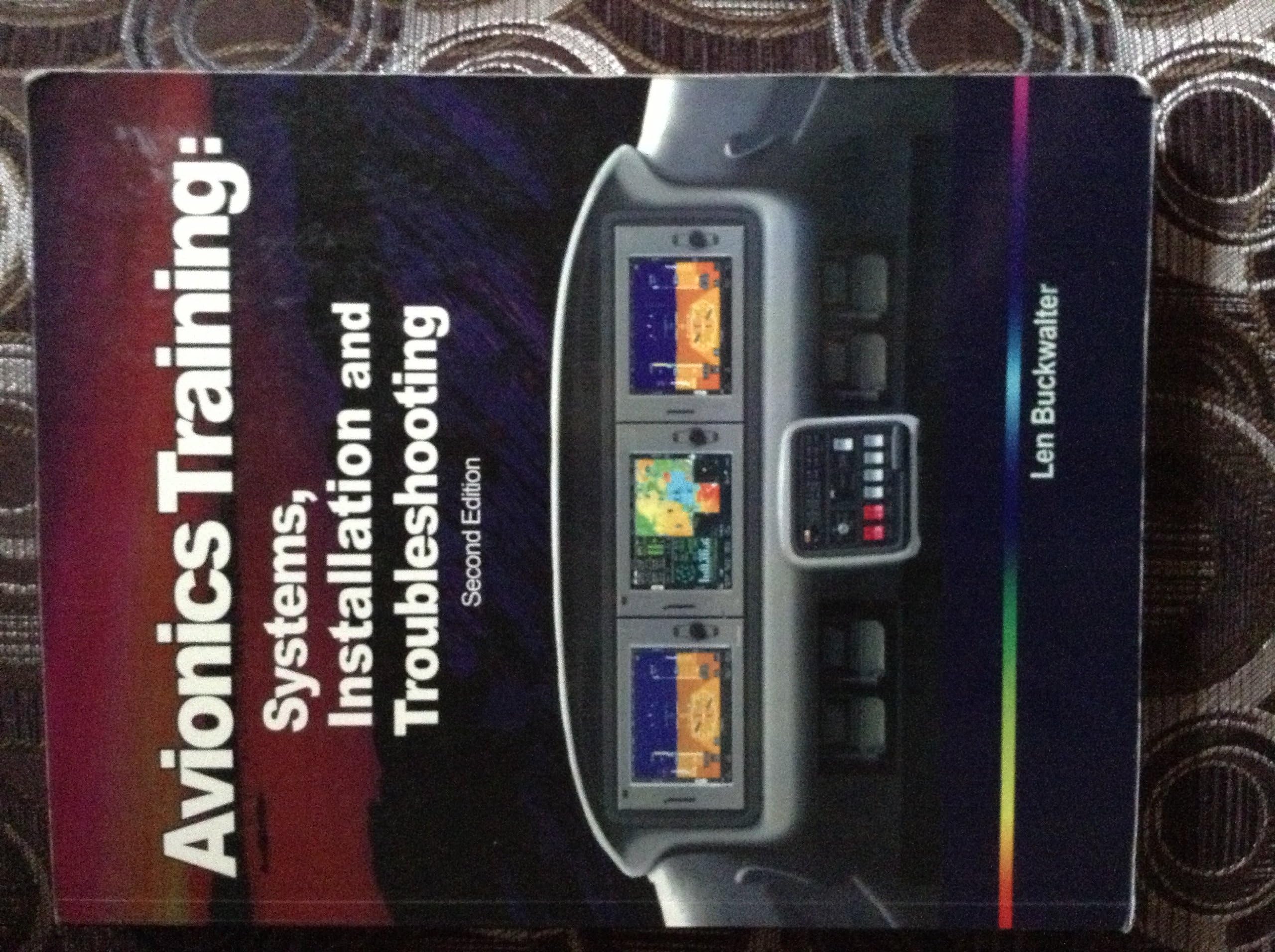
Avionics Training: Systems, Installation And Troubleshooting
Product ID: 6946809
"AVIONICS TRAINING" is the first book to respond to new directions in the avionics industry. As electronics spread through every type of aircraft, there is a rising need for technicians who understand "systems," not circuits. Such knowledge is required to identify faulty units aboard the airplane, often during a quick turn time on the ramp. The book explains systems in simple terms, with over 400 full-color photos and drawings. The book assumes no knowledge of electronics, containing neither formulas nor schematics. It describes over 30 systems and how they relate to each other. Confusing acronyms and abbreviations are avoided; they're spelled out on every page. The book deals with two major trends. First, airlines are insisting that mechanics troubleshoot avionics on the flight line. It's becoming too costly for airlines to staff outlying line stations with "radio mechanics." Many carriers already require all maintenance people to obtain an FCC license and cross-training in avionics is growing. The second trend is the disappearing "avionics bench technician." When today's computerized avionics go bad, they're sent back to the factory because shops can't afford large automatic test stations and software to repair them. The demand today is for people skilled in "R&R" (remove and replace)---which requires systems-level knowledge. The scope of "Avionics Training" includes all legacy systems---VOR, ILS and ADF, for example---because they will continue to fly for decades. The book also covers the new generation now entering flight decks; satellite navigation, data communications and electronic flight instruments (EFIS). Weather detection, collision avoidance (TCAS) and Mode S transponders are also covered. Much of the book is devoted to hands-on guidance on how to install instruments, wiring harnesses, radio trays, connectors, antennas and other practical topics related to systems. A final section describes test and troubleshooting techniques. Besides the technician, "Avionics Training" should prove of interest to the engineer and executive wanting a broader knowledge of avionics industry practices. The book has already been adopted by several colleges and other teaching institutions. "Avionics Training" is the first book to explain systems in simple terms, with over 400 full-color photos and dra wings. The book assumes no knowledge of electronics, containing neither formulas nor schematics. It describes over 30 systems and how they relate to each other. Confusing acronyms and abbreviations are avoided; they're spelled out on every page. The book responds two major trends. First, airlines are insisting that A&P mechanics troubleshoot avionics on the flight line. It's becoming too costly for airlines to staff outlying line stations with "radio mechanics." Many carriers already require A&P's to obtain an FCC license and cross-training in avionics is growing. The second trend is the disappearing "avionics bench technician." When today's computerized avionics go bad, they're sent back to the factory because shops can't afford large automatic test stations and software to repair them. The demand today is for people skilled in "R&R" (remove and replace)---which requires systems-level knowledge. The scope of "Avionics Training" includes all legacy systems---VOR, ILS and ADF, for example---because they will continue to fly for decades. The book also covers the new generation now entering flight decks; satellite navigation, data communications and electronic flight instruments (EFIS). Weather detection, collision avoidance (TCAS) and Mode S transponders are also covered. Much of the book is devoted to hands-on guidance on how to install instruments, wiring harnesses, radio trays, connectors, antennas and other practical topics related to systems. A final section describes test and troubleshooting techniques. Besides the technician, "Avionics Training" should prove of interest to the engineer and executive wanting a broader knowledge of avionics industry practices. The book has already been adopted by several colleges and other teaching institutions. The author, Len Buckwalter, has been in the avionics industry for 30 years, having written 25 books and over 2000 articles. He founded Avionics Magazine and served as Publisher and Editor for 17 years. He is an instrument-rated pilot with 3000 flight hours, and is presently publisher of the Avionics Library at www.avionics.com A 50-page sampling of the book, with Table of Contents and chapters can be browsed at: www.avionics.com/downloads/Training sample pages.pdf Title: Avionics Training: Systems, Installation and Troubleshooting ISBN 1-88-5544-21-9 Cat. No. AT-01 Size: 8-1/2 x 11 Illustrations: 400 (4-color) Pages: 320 Price: $64.00 Publication date: June, 2005 Contact: Len Buckwalter [email protected] Avionics Communications Inc.P.O. Box 2628, Leesburg, VA 20177 Tel: 703 777-9535 Fax: 703 777-9568 New Book Announcement "AVIONICS TRAINING" is the first book to respond to new directions in the avionics industry Leesburg Virginia (May 7, 2005) As electronics spread through every type of aircraft, there is a rising need for technicians who understand "systems," not circuits. Such knowledge is required to identify faulty units aboard the airplane, often during a quick turn time on the ramp. "Avionics Training" is the first book to explain systems in simple terms, with over 400 full-color photos and drawings. The book assumes no knowledge of electronics, containing neither formulas nor schematics. It describes over 30 systems and how they relate to each other. Confusing acronyms and abbreviations are avoided; they're spelled out on every page. The book responds two major trends. First, airlines are insisting that A&P mechanics troubleshoot avionics on the flight line. It's becoming too costly for airlines to staff outlying line stations with "radio mechanics." Many carriers already require A&P's to obtain an FCC license and cross-training in avionics is growing. The second trend is the disappearing "avionics bench technician." When today's computerized avionics go bad, they're sent back to the factory because shops can't afford large automatic test stations and software to repair them. The demand today is for people skilled in "R&R" (remove and replace)---which requires systems-level knowledge. Confirmation of these trends was heard at a recent ATEC (Aviation Technician Education Council) meeting held in Orlando, FL. Over 100 attendees were nearly unanimous in their plans to add avionics training to A&P mechanic programs. The scope of "Avionics Training" includes all legacy systems---VOR, ILS and ADF, for example---because they will continue to fly for decades. The book also covers the new generation now entering flight decks; satellite navigation, data communications and electronic flight instruments (EFIS). Weather detection, collision avoidance (TCAS) and Mode S transponders are also covered. Much of the book is devoted to hands-on guidance on how to install instruments, wiring harnesses, radio trays, connectors, antennas and other practical topics related to systems. A final section describes test and troubleshooting techniques. Besides the technician, "Avionics Training" should prove of interest to the engineer and executive wanting a broader knowledge of avionics industry practices. The book has already been adopted by several colleges and other teaching institutions. The author, Len Buckwalter, has been in the avionics industry for 30 years, having written 25 books and over 2000 articles. He founded Avionics Magazine and served as Publisher and Editor for 17 years. He is an instrument-rated pilot with 3000 flight hours, and is presently publisher of the Avionics Library at www.avionics.com A 50-page sampling of the book, with Table of Contents and chapters can be browsed at: www.avionics.com/downloads/Training sample pages.pdf Title: Avionics Training: Systems, Installation and Troubleshooting ISBN 1-88-5544-21-9 Cat. No. AT-01 Size: 8-1/2 x 11 Illustrations: 400 (4-color) Pages: 320 Price: $64.00 Publication date: June, 2005 Contact: Len Buckwalter [email protected] Avionics Communications Inc.P.O. Box 2628, Leesburg, VA 20177 Tel: 703 777-9535 Fax: 703 777-9568 New Book Announcement "AVIONICS TRAINING" is the first book to respond to new directions in the avionics industry Leesburg Virginia (May 7, 2005) As electronics spread through every type of aircraft, there is a rising need for technicians who understand "systems," not circuits. Such knowledge is required to identify faulty units aboard the airplane, often during a quick turn time on the ramp. "Avionics Training" is the first book to explain systems in simple terms, with over 400 full-color photos and drawings. The book assumes no knowledge of electronics, containing neither formulas nor schematics. It describes over 30 systems and how they relate to each other. Confusing acronyms and abbreviations are avoided; they're spelled out on every page. The book responds two major trends. First, airlines are insisting that A&P mechanics troubleshoot avionics on the flight line. It's becoming too costly for airlines to staff outlying line stations with "radio mechanics." Many carriers already require A&P's to obtain an FCC license and cross-training in avionics is growing. The second trend is the disappearing "avionics bench technician." When today's computerized avionics go bad, they're sent back to the factory because shops can't afford large a097668750X\\ Brace yourself as you experience how the compromised lives of four women are entangled in this powerful drama. Help Wanted is a page-turning tale that reveals sex, scandal and deceit. Review: Muy bueno - Muy bueno Review: Great help with aircraft instruments - This is a great reference for someone who doesn't work on these systems regularly. I am enjoying the read and illustrations.
| Best Sellers Rank | #1,873,986 in Books ( See Top 100 in Books ) #237 in Aviation Repair & Maintenance (Books) |
| Customer Reviews | 4.6 out of 5 stars 57 Reviews |
R**A
Muy bueno
Muy bueno
H**P
Great help with aircraft instruments
This is a great reference for someone who doesn't work on these systems regularly. I am enjoying the read and illustrations.
G**G
Solid, and an easy read
The book has some typos, but nothing major. The printing and image quality is high, and although the chapters don't go into great detail, it does cover a lot of systems. There's a lot of information that would be hard to find elsewhere (nevermind compile), and it's a good overview. This is worth reading as a pilot, homebuilder, or future technician.
T**S
Outstanding seller!!
Super fast shipping, and although the book is pre-owned, it's in very nice condition. No marks, all pages are intact and I am so happy to have found this book!
D***
Five Stars
It help me a lot with my studies. Cheap prize.
B**O
Review book Avionics Training
Received book quickly after ordering. Excellent general overall description of Avionics used in general aviation and airliners. It includes new tecnology like Satcom and Microwave systems. Recommend this book, Avionics Training: Systems, Installation, and Troubleshooting for any aircraft technician wanting to know the general basics of avionics equiptment on today's aircraft.
H**E
Five Stars
Was useful in my classes.
R**N
Five Stars
Gives good detail on avionics. It's a really good read
B**Y
geat
textbook useful for what i needed it for and it was exactly what i anticipated for a textbook with that great value
A**S
ON TIME, AS DESCRIBED
ON TIME, AS DESCRIBED
Trustpilot
1 month ago
1 month ago