
Desertcart purchases this item on your behalf and handles shipping, customs, and support to Croatia.
⚔️ Dive into the epic saga that shaped civilizations—don’t just read history, live it!
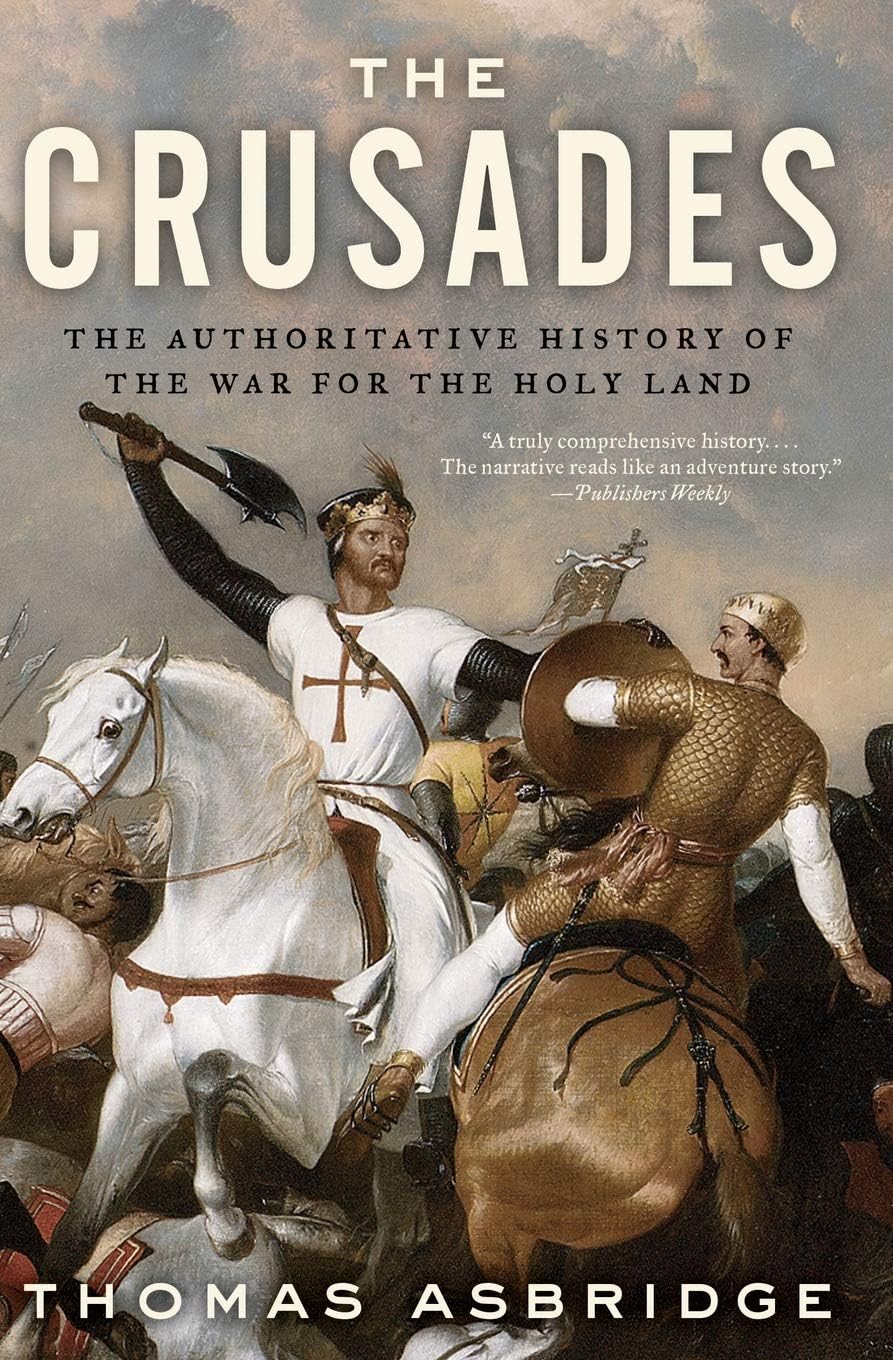
Thomas Asbridge’s 'The Crusades' is a definitive, single-volume military history that vividly recounts the 200-year struggle for the Holy Land. Combining original research with balanced perspectives from both Christian and Muslim sides, it explores iconic figures, key battles, and the intertwined religious, political, and economic dynamics. With 680+ pages, 16 detailed maps, and critical reevaluations of past scholarship, this book offers an essential, immersive experience into one of history’s most transformative eras.


| Best Sellers Rank | #12,920 in Books ( See Top 100 in Books ) #4 in History of Islam #7 in Other Eastern Religions & Sacred Texts (Books) #10 in Historical Essays (Books) |
| Customer Reviews | 4.4 out of 5 stars 1,702 Reviews |
D**N
an excellent one-volume history of the Crusades
Asbridge has written a simply magnificent work on the Crusades. Covering the first 7 Crusades (1189 - 1254), the religious, political, social, military and economic contexts of these wars are examined in detail, using an abundance of source material from both the Latin West and Islamic Near East. The emphasis of _The Crusades_ is primarily on the internal political divisions (among both Europeans and Muslims) that led to the initial success of the Crusades, and which perpetuated the struggle for the next 200 years. That both the Christian west and Islamic responses to the Crusades were presented particularly impressed me - typically either one side ( The First Crusade , The Crusades ) or the other ( The Crusades Through Arab Eyes ). Towards these ends, Asbridge presents a very clear picture of the causes (religious as well as political) behind Alexius Comnenus' request for assistance, Urban II's call to arms, and the emnity between the Fatimids and 'Abbysids in the Levant. As Asbridge repeatedly shows, doctirnal divisions between both Christians (Byzantine Orthodox and Latin Catholics) and Muslims (Shi'ii and Sunni) provided leverage for both sides in the conflict. Throughout the book, Asbridge critically reevaluates previous scholarship (most notably by historian Steven Runciman A History of The Crusades, 3 Volume Set: The First Crusade, The Kingdom of Jerusalem, The Kingdom of Acre (Deluxe Folio Society Issue) , but also by John Gillingham Richard the Lionheart and Lyons and Jackson Saladin: The Politics of the Holy War (University of Cambridge Oriental Publications No. 30) to name a few) and recent historical and archeological work in the field. His reevaluation of Richard I's ("Richard Lionheart") slaughter of 2600 Muslim prisoners was particularly interesting: the event is seen by some as evidence of western barbarism, by others as proof of Richard's bloodthirstiness - Asbridge, putting it in a strategic context, sheds new light on it. In a similar vein, Asbridge reconsders several key battles during the Crusades: the seige of Antioch, the seige and conquest of Acre and the battle of Hattin (reimagined in Kingdom Of Heaven ). His discsusion of the discovery of the Templar castle at Jacob's Ford - and what it is telling us about the constuction of fortifications, Crusader heirarchy and warfare - was riveting. The same is true of his discussion of medieval tactics and the customs of medieval warfare the 'informal rules of engagement' practiced in the 3rd Crusade. The salient feature that most non-medievalists miss (or misunderstand) about the Crusades was the role of economics. Asbridge visits and revisits the economic underpinnings of Crusades, showing how even in the midst of acrimonious combat, a thriving world of commerce continued unabated during the Crusades, developing "such close ties of commercial interdependence that (by the 13th century) the Muslims of Syria and Egypt preferred to allow Crusaders to retain their meagre footholds along the coast, rather than risk an interruption of trade and income." (546) The importance and role of econmics in the 4th Crusade are also reconsidered by Asbridge. Asbridge concludes his history with a close examination of the importance of the Crusades to the medieval world as well as to our own time. His observations are important. Essentially, he argues, there is a disjuncture of popular perception of the Crusades. Current rhetoric projects an "undying and embittered war of religion between Islam and the West" which the Crusades never were. To do so is irresponsible and a dangerous manipulation and misrepresentation of history. Along these lines, the very term 'crusade' has been misappropriated to mean "a just cause" (as in "crusade for the truth"), dissassociating it from its medieval devotional origins, exactly in the same way 'jihad' has been redefined to mean a "holy war" of arms from its devotional origin of "internal spiritual struggle." In a book this size (my hardcover edition weighs in at just over 680 pages with an additional 57 pages of notes) there is a super-abundance of detail, which can be a bit overwhelming to readers. The style is academic, but it is clearly written for the layperson. The maps (there are 16) are clear, easy to read and very helpful in understanding routes of march, trade and strategy. For those interested in further study, his bibliography is extensive. Highly recommended.
S**Y
Great read for someone new to the subject
The book is well written and is a great insight into the topic of the Crusades. The book focuses heavily on the early crusades, particularly the first, second, and third, which is understandable as they are the ones that people want to know about. While a lot people are pretty aware of the military engagements fought during the crusades, many are not aware of the political climate of the time, which the book does a great job of explaining. The book also excels in providing great analysis of the battles fought, something that a lot of books and history courses in schools, like ancient world history, don't often focus on. The book covers a lot of material while still keeping you interested in the narrative. Asbridge's work makes for a great gateway book for new or casual readers but if you are looking for a book that will go into great detail and expand your existing knowledge, I highly suggest you look somewhere else.
W**.
the single best book I have found to date on the Crusades in the Levant
“The Crusades: Th Authoritative History of the Wars for the Holy Lands” By Thomas Asbridge This is the single best book I have found to date on the Crusades in the Levant. The Crusades were not limited to the Levant. Crusades were also conducted on the Iberian Peninsula, Western Africa and in Poland. These are mentioned in this book for reference only to other events occurring at the time of the Crusades to the Levant. The Crusades (hereafter limited to the Middle East or Levant) were extremely complex series of events mixing religious, political, personal and military factors into what essentially could be called a tragedy for the Western World. No one knows how many lives were lost over the two centuries of the Crusades from 1096 to its conclusions in 1291 but it was several million. It is almost certain that historical sources on numbers of people in any event were exaggerated. The First Crusade was initiated by Pope Urban II although, clearly his predecessor, Pope Gregory VII established the beginnings of the support for it. There was no urgent cause for the Crusades: Jersalem and the Holy Lands were in the hands of the Muslims for several hundred years. The relationships between Eastern Christians and the Islamic believers of the region was in stasis. Thus the Crusades were wars of agression created by the Roman Catholic Church. In order to build support for the wars, the Church created a theory that individuals on the Crusades could receive forgiveness for their sins by vowing to “take the cross” and journeying to conduct war to retake Jerusalem from Islam. Later the Chruch would create indulgences and other constructions to propel nobles and their subjects to the Crusades. These constructions would plague the Church in later centuries and eventually lead to the schism of the Reformation. To reach the Levant, Crusaders had to march through the Balkans and Byzantium. Since the first Crusades were ill planned and lack sufficient logistics, the Crusaders and camp followers were reliant on foraging to survive. The people the Balkans, who first welcomed the Crusaders, reacted with retribution on the Crusaders. This, of course, created problems for later Crusaders. When the Crusaders reached Constantinople, the Greek Christians of Byzantium were none to happy to support the disruptive Crusades. The other way to reach the Levant was by ship and this became the preferred path in later Crusades although it was more expensive. The only Crusade that had a modicum of success was the First Crusade in that it acheived its goal of securing Jerusalem for the Western Christians. While this Crusade had multiple disasters, it did have the advantage of finding the Islamic world weakened by internecine strife between the Shia and Sunni as well as a new invasion force from the Seljak Turks. But the First Crusade was futile as the Crusaders had no where near enough Christian people willing to live their lives in the Levant and as well defend Jerusalem from the Islamic armies set against it. This was compounded by the politics of different groups within the Crusaders to support each other at critical times. In addition the Muslims gained strength thoughout the period. As a result later Crusades all ultimately failed. What is probably the best part of this book is the description of the rise of Nur al Din followed by Saladin and the Mamluks in unifying the Levant to finally drive out the crusaders. It is my belief that while many people know of the Crusades, very few know the what caused the Crusades to fail. Without understanding how the Muslim world changed in the two centuries of the Crusades, I don’t believe anyone can rationalize the Crusades. Certainly, the Europeans did not as they continued to blame Crusade failures on God’s wrath for the sinners and the sins committed during Crusades. While this book does have adequate maps supporting the text, I used Google Maps to both understand where the major battles were as well as to understand the terrain the battles were fought on. It is a tremendous asset to someone interested in military history of the Crusades to use both the terrain and the satellite views to augment the text. In the Conclusions of this book, the author warns about parallelizing the Crusades with more recent histories elsewhere. However, when one compares the events of the two centuries of the Crusades, one can find many parallel situations to current history in the Middle East. For examples, Israel has boundaries closely matching the lands held by the Christians during the Crusades. This is no accident as the topography largely dictates defendable boundaries. The Shia and Sunni split in Islam still exists and continues to influence regional politics. However, thus far, no Islamic leaders have risen in the Middle East to compare to Nur al Din, Saladin or Baybars. I highly recommend this book to anyone wishing a better understanding of the Crusades and to those who wish to know the origins of the geopolitical history of the area.
R**D
A fully accessible but scholarly-accomplished history of the Crusades
In "The Crusades..." Thomas Asbridge achieves the rare feat of compiling most of the worthwhile knowledge on the Crusades into a single, albeit hefty, volume, without boring the reader. I was initially hesitant to purchase this book because, as a medical student, I figured a 700-page, scholarly-looking tome would end up getting shelved 30 pages in, in favor of some lighter nighttime reading material. Eventually, beset by the lack of high-quality books on The Crusades available on the Kindle, I finally decided to give it a try. It was a great decision; I found "The Crusades" to be a fantastic and engrossing read. Asbridge manages to engage the reader not by presenting a mere overview of events - as is the case in God's Battalions: The Case for the Crusades ; an excellent read, but one that gives only a cursory glance towards details - but by constructing a masterfully entertaining narrative. The Crusades are a fascinating story; the quality of any book on the subject is determined by the author's skill at collating the information, not on the subject matter. And Asbridge excels at organizing this enormous corpus; he's also the rare wordsmith (why use proximity when propinquity is so... close at hand?) who is also a gifted storyteller, balancing the proper amount of detail necessary to gain an educated academic understanding of the subject with the needs of a narrative to flow smoothly. I can't emphasize this enough - in another author's hands, this level of detail might be uncomfortable and one might feel as though they are slogging through the book, and that's what makes the book so rewarding. I feel as though I've gained an extraordinary amount of knowledge without having to put up with the run-on sentences and unclear and jumbled thought processes often found in serious academic histories. Asbridge also manages to frame the subject extraordinarily well. I've read several other books on The Crusades, and listened to a full lecture course on the subject from The Great Courses. I found unanswered questions answered, and I felt that Asbridge covered everything quite well and fairly. Asbridge shows no tendency towards bias on either end of the spectrum, and equal time is devoted to both the concepts of Crusade and that of Jihad - something I found very interesting. In fact, the level of detail presented on the Muslim side surpasses anything I've seen anywhere else. There are almost no details on the non-canonical or even heretical crusades, but this is appropriate - this book is the history of the war for the holy land, not the history of Crusading. The initial evolution of the idea of crusading, the typical motives of the crusaders, and the military realities in both the Muslim and Christian world are given sufficient attention so that no portion of the core story of the Wars feels "orphaned" from reality. But there is definitely a conscious effort to keep the book within its bounds, and there is no detailed discussion of Richard's troubles on the home front, for example. Enough to keep you informed, yes - but you're not buying a biography of Eleanor of Aquitaine or John. In sum, it would be inappropriate to label this book an overview of events. While not exhaustive in its detail, you'd be hard pressed to find any better bang for your page on the entire topic of the Crusades, from start to finish. I would urge any student of history who is considering this book to give it a shot. "The Crusades" would make a both a fantastic introduction and a fitting capstone to any exploration of The Crusades.
J**.
Marvelous summary of the Crusades
This is a marvelous and very readable summary of the Crusades. It provides the historical context for the actions on both sides, what was happening in both Europe and Islam that influenced events. The book has several good maps to help those of us with a limited knowledge of Near East/Middle East geography. The author's style is concise and flows well, not "academic." As someone who knew little or nothing about the subject, the book left me with a good general understanding of the Crusades and an appreciation of how their effects continue to influence the area today, particularly among the Muslims. I was left wanting to read more detail about the Crusades, a good indication of a well written, informative book.
S**E
The best one-volume history of The Crusades I've yet read
A good, readable history of The Crusades has escaped me to this point, for whatever reason. I was very excited when Tynerman's God's War was released a few years ago, and quickly became disenchanted when I tried slogging through it and realized what a boringly-written brick it was. Couldn't finish it. Runciman's classic volumes, which have been the definitive essential reading for half a century now, are still valid, entertaining reads but have been long since over-taken by newer evidence and much fresher, more-encompassing interpretations. As a read, they're still great fun. As good history, they're quite biased and lacking today. So, when I saw a shiny new tome promising a complete revisiting of long-held assumptions, I couldn't resist. Asbridge's chronology is straightforward; starting with a quick survey of Islam's rise and subsequent takeover of the Christian Holy Land, he moves to Europe to set the scene of the medieval papacy and nascent western kingships that would bring about the concept of Crusading. In a nice touch, he continues to revisit the contemporary meanings, definitions and assumptions behind crusading as it developed from an event without even a name ("crusading" was a later appellation) to the currently-understood form. From these basics, he moves us through each of the main five Crusades, deftly describing the expected peoples, places, and battles. He strikes a good balance between talking about the most important figures and key battles versus the less-glamorous but as-important topics such as trade and societal makeup that, while harder to make exciting, are very important when trying to gain a full understanding of the events. Very crucially, he spends as much time covering the Arab viewpoint as he does the Christian. He also properly gives notice to the fact that, while western sources are fairly voluminous by the standards of the era, the Crusades just didn't have a major impact on the Muslim world at the time, and therefore sources from the Muslim POV are much less available. That said, he does an admirable job of situating the reader as best he can in the Muslim frame of mind during each crusade, giving admirable detail on outside pressures that might've existed, any internal dynastic or civil events that had bearing on their interactions with the Crusaders... other histories I've read of this era often fall flat in this particular regard. He closes with an excellent overview of how the Crusades have themselves been viewed throughout history, both in the West and in the Muslim World; this may have been my favorite part of the book as it's not a topic I've ever seen covered before, much less so well. The writing style is nice and lively as well. It reads almost like a strong historical fiction narrative, a testament not only to the author's skill but to the inherent drama of the period. BOTTOM LINE: This will be my only answer for anyone asking for a recommendation on the period for probably years to come.
K**R
Focused on the early Crusades, lacks depth in the latter stages
Entertaining popular history but has some shortcomings that deprived it of a star. The first 500 pages or so cover the first three Crusades. This is where the book really excels. It goes into great detail about these Crusades, not just the military movements but the political, social and religious factors and personalities that influenced the events. And it pays attention to both sides of the conflicts in a fair and even-handed way. If it had continued on in this fashion, it would have rated 4 to 4.5 stars but unfortunately the later Crusades and collateral conflicts aren't dealt with in the same way. The Fourth Crusade gets a few pages, the anti-heretic "Crusades" in Europe are brushed off in a paragraph or two, interesting side tales like the Children's Crusade get a sentence. The short treatment of some of these topics also derails some of the author's sweeping pronouncements. For example, he mentions several times that Pope Gregory (I forget which one) had an outsize impact on crusading and changed the way it was viewed, but after one or two pages of hearing about how this Pope would change the historic nature of the Crusades, we are told that he died before his envisioned crusade was even launched. Similar sweeping pronouncements are made about other people and events without the details to back these claims up. It reads as if the author wanted to write a comprehensive one-volume history but realized that the book would run too long so he cut the second half to make it fit.
W**T
Will continue to search out Asbridge's works!
Having taught U.S. History during my teaching career (now retired), I have long been a fan of everything historical. While I of course knew a bit of the Crusades, I had never studied it in depth. I'm so glad I found this book. From the very beginning, Asbridge gives enough historical background to set the stage for the next 150 years of christian struggle to reclaim the Holy Land, and does it in a clearly-written, easy-to-understand format, which can be enjoyed by non-Crusades scholars and those who are more acquainted with the period. As the author introduces each leading player on both sides of the struggle, he gives us ample insight as to their motivations and preparedness to enter the fight. While I'd been familiar with the name Saladin, it was quite rewarding to learn about him not only as a jihadist with a vengeance for killing Christians, but also as a person with doubts and worries. Having been familiar with the western monarchs who went to the Holy Land, I was not that familiar with the Muslim caliphs and sultans. Because of the difficulty in trying to sort through all the Muslim names and keep them straight, I simply began writing down the name of each character as he was introduced, with a small note reminding myself who he was related to or which geographical area he came from. This helped clarify (for my muddled old mind), who everyone was and made the reading more meaningful to me. I also found maps of the Crusades online and printed two of them out, so I had a good idea in my mind where the lesser-known areas were in relation to Jerusalem. More advanced scholars of this area would certainly not need to do this. And in no way does mentioning my personal "Cliff Notes" stand as an intention to demean the author. It was simply to help me keep straight characters with whom I was previously unfamiliar. I was rather stunned that after the failures of Crusades Three and Four that a Fifth one had occurred, and that apparently none of the westerners taking part in these Crusades seems to have learned from the mistakes of the previous participants. I think that many of us who know only a smattering of Crusade history think that "they went, they saw, they conquered" and only had to return because of eventual re-encroachment by Muslims. Instead, the story is quite different. I was also stunned by the numbers of men in not only the Christian armies, but in the Muslim armies, and was surprised at the great influence the Mongols had secured in the area. The one area in which I would have liked a bit more information was how in the world these Crusaders provisioned themselves on the march to the Holy Land, as they were still moving eastwards through Europe. I can't imagine how groups of thousands of people kept themselves fed during the long months of marching. What did they bring with them to eat along the way? When they came to towns, how would these towns have enough food on hand to feed these troops? Did they herd cattle or other livestock with them as they marched? Did they bring chickens? Did they have "cooks" or did each soldier fare for himself? Of course these are minor curiosities and have nothing to do with the import of the book as a whole, but it's something that made me wonder about how this was all accomplished. Thanks to Asbridge for a wonderfully authoritative account of this period in history, and for writing it in such a way as to appeal to lay persons, such as myself!
Y**A
Awesome 👌
The most admirable aspect of the book is that it reads both like a novel and a textbook. It is informative and structured like a textbook being suspenseful and thrilling like a novel at the same time. No wonder the author took 6 years to complete this book. He not only narrates history very well but also makes brilliant analysis of the versatile multiple factors involving the crusades with respect to past, present and future. In this erudite account of the crusades he adeptly compares contemporary Arabic and Latin historical resources relating to the crusades to draw the most accurate conclusions. He also provides essential criticism on modern historical accounts which could be simplistic, distorted or manipulative like in one or two instances where the author proves his point logically to negate general misconceptions or popular opinions of modern historians tainted by hindsight. I could write a lot more about the book but not without spilling details that I feel that every reader should find out by himself or herself. I strongly recommend this book to anyone interested in reading, knowing or learning about the crusades. Happy reading 📚 😊 Cheers!
C**E
Falta de objetividad
Desgraciadamente tenía muchas expectativas con este libro, pero creo q el autor, anglosajón, no parecía muy parcial. Me tuve que quedar en cuanto empezó a describir "la increíble gesta histórica" de Ricardo corazón de León de mover su ejercito de cruzados 20km por la costa de lo q hoy es palestina. Si eso es una gesta, q será lo q hizo Alexandros que cruzó desde Turquía hasta la india.. o Cortés en mexico, o César por la Galia y germania e Inglaterra. Q bien venden su producto los ingleses ... Tomen nota.
A**A
RECE BIDO
SATISFEITO
M**B
Empfehlenswert
Habe das Buch als historische Backgroundinfo zu Lessings Nathan und der Saladinbiographie Marins von 1754 gegengelesen. Ist jetzt nicht grad ein Geschichtsschmöker, den man verschlingt, aber für eine Darstellung aller Kreuzzüge sehr gut lesbar, hat auch durchaus Nachschlagewert. Und es ist doch interessant, wie sich im Laufe der Zeit die Sichtweise auf bekannte Teilnehmer der Kreuzzüge geändert hat. Eindringlich und gelungen ist die Darstellung Balduins IV., die mich angerührt hat. Man bekommt Lust, vertiefend zu einzelnen Kreuzzügen oder Persönlichkeiten zu lesen und sich die Schauplätze anzusehen. Seufz.
J**A
A Masterful and Balanced Account of a Pivotal Era!
Thomas Asbridge’s “The Crusades: The Authoritative History of the War for the Holy Land” is an outstanding, comprehensive narrative that brings the medieval world to life. Drawing on original research, Asbridge vividly details the motivations, horrors, and grandeur of the Crusades, from Pope Urban II’s call to arms to the fall of Acre, balancing Christian and Muslim perspectives with insight into jihad and crusade ideals. The fast-paced storytelling covers key figures like Richard the Lionheart and Saladin, while exploring broader impacts on history. At over 700 pages, it’s thorough yet engaging, making complex events accessible without oversimplifying. Essential reading for history enthusiasts—brilliant scholarship and a compelling read!
Trustpilot
1 month ago
2 months ago