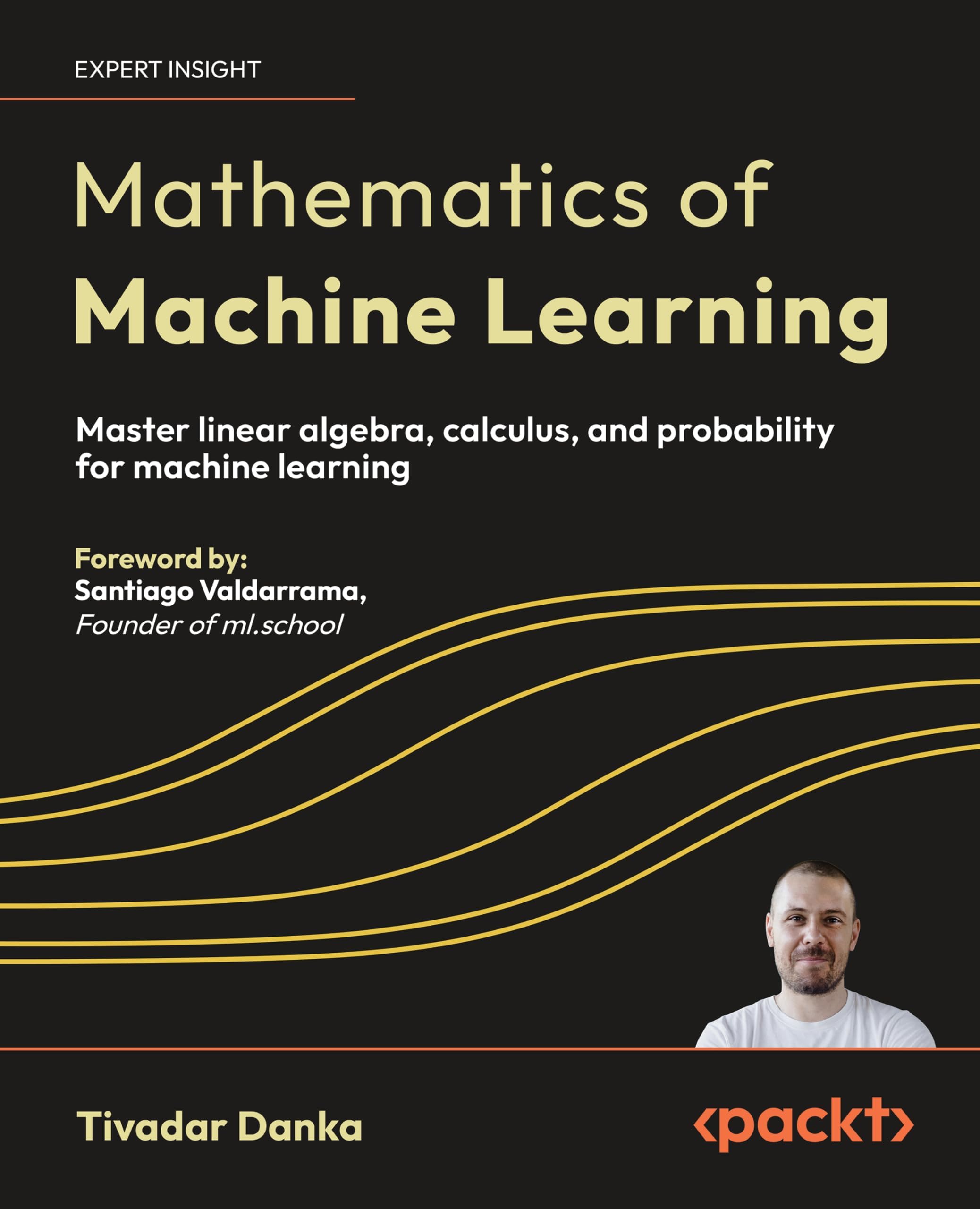
Mathematics of Machine Learning: Master linear algebra, calculus, and probability for machine learning
Product ID: 735845880
📈Advanced calculus & optimization
📊Master linear algebra & matrices
🧮Probability theory & Bayesian stats
Desertcart purchases this item on your behalf and handles shipping, customs, and support to Croatia.
📚 Unlock the math behind machine learning — don’t just code it, understand it!
Mathematics of Machine Learning is a comprehensive paperback guide published by Packt Publishing in May 2025. It rigorously covers linear algebra, calculus, and probability theory with practical Python examples, designed for engineers and data scientists aiming to deepen their theoretical and applied ML skills. The book includes a free PDF eBook and is authored by PhD mathematician Tivadar Danka, known for his clear, intuitive teaching style.



| Best Sellers Rank | #51,606 in Books ( See Top 100 in Books ) #26 in Programming Algorithms #40 in Mathematical Analysis #4,040 in Education Studies & Teaching |
| Customer Reviews | 4.3 out of 5 stars 77 Reviews |
D**T
Too complex, at points, for its intended audience.
As others have noted in different words, the issue with this book is that it seems to assume a mathematical proficiency greater than those of its intended readers, a common failing with expert authors, who take some of their knowledge for granted. Programmers or Data Scientists who haven't done a Mathematics degree might be able to get through this book, but they will need to refer externally to make sense of the book at several (too many) points. The exercises too, IMO, are more for the maths aficionado than someone who just wants a very practical applied exposition and understanding. If, however, you have a strong undergraduate math background, you may like this book over simpler ones.
G**E
remarquable et original
livre remarquablement expliqué; faisant le lien entre les mathématiques et la programmation
S**S
Needs full colour or edited charts
The content must be great - can’t comment since I’m just on Chap.1 - but the author and publisher should both either prepare to print in full colour or ensure charts are not colour-dependent. Right now there are density plots in all grey, which according to the code should have been red or blue or green. Do better, please. Also, for the softcover copy, the book’s size needs thicker binding to make it longer-lasting.
F**S
Too light on the explanations which create an intuitive understanding
Let me start with the positive: The book tries to make the mathematics of ML (Linear Algebra, Calculus and Probability Theory) more accessible by also using python programs to implement tasks. I also like the way Linear Algebra is starting from the concept of Vector Space instead of Matrices. But the author is doing not a great job in explaining the concepts. The 'explanation' very often starts with the compact mathematical definition, which you usually only understand if you already understood the concept (or if you are a mathematician, though the book adresses explicitly non-mathematicians). One of the main problems in this approach is that many terms and forms of thinking are used in these definitions which are new and would need an explaination - which is missing or hid in the appendix. Quite typically, the first important concept in the book, vector spaces, is explained by giving a definition, then more stuff follows like "The Cartesian product V x V is just a set of ordered pairs [...]. Feel free to check out the set theory appendix for more details, bur for now , the intuitive understanding is enough." (p.11) These terms (Cartesian product, set, ordered pair) are all well-defined mathematically, but they are not intuitive. And the author doesn't seem to know the difference between an intuitive understanding and writing down a sentence in mathematical lingo. If you don't already know what all these terms mean, you may want to avoid this book.
K**D
Thank you for the good work 👍
Hoping this book would change mine and others' career for the better ❤️💪
Trustpilot
2 days ago
3 weeks ago