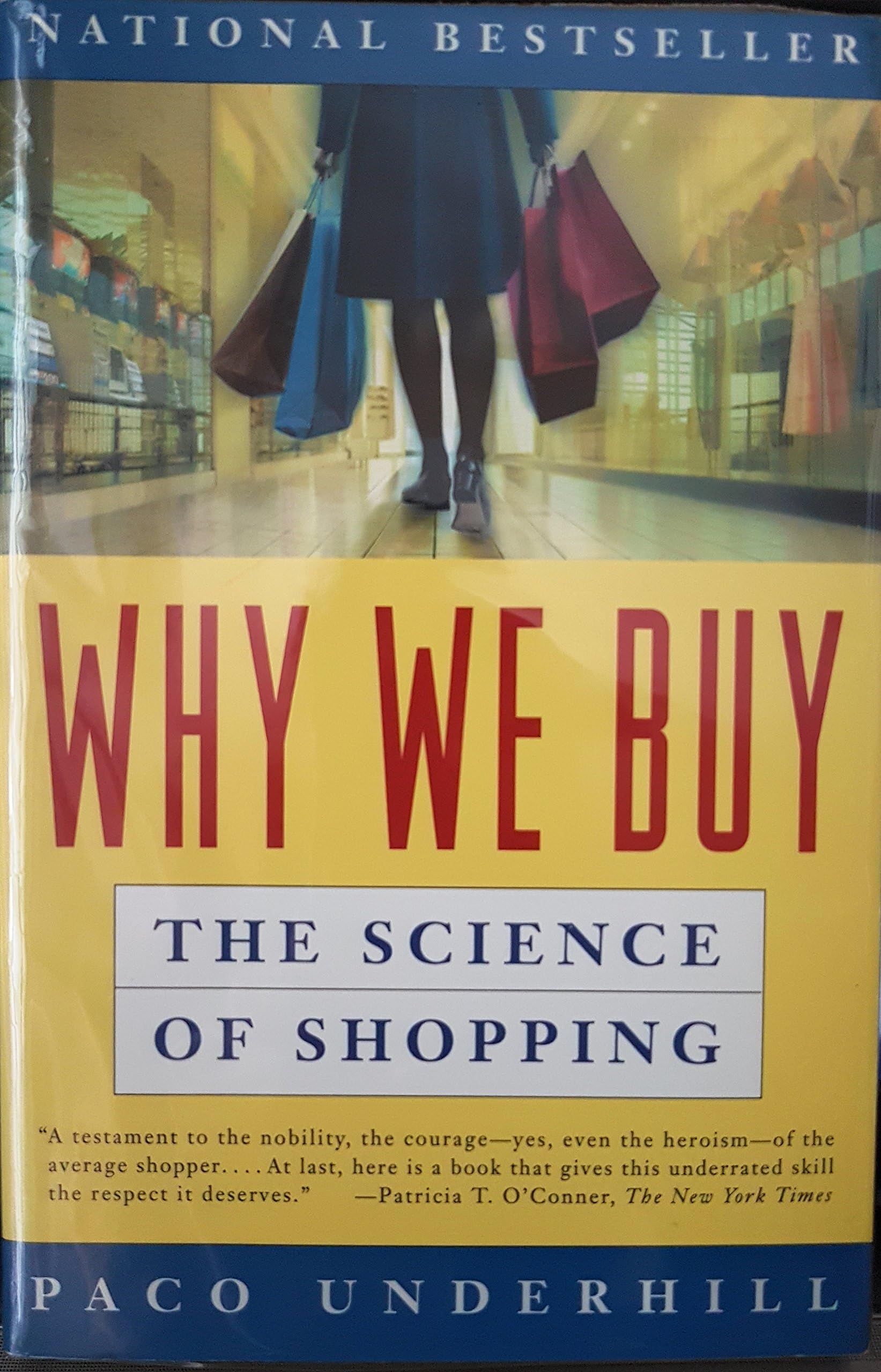
Why We Buy: The Science Of Shopping
Product ID: 75312956
📊Thousands of hours of field research
📚Top-ranked in Market Research & Marketing
🛍️In-depth consumer shopping behavior analysis
Desertcart purchases this item on your behalf and handles shipping, customs, and support to Croatia.
🛒 Crack the code of consumer minds and never shop the same way again!
Why We Buy is a compelling, research-based exploration of consumer behavior authored by Paco Underhill. Drawing on thousands of hours of fieldwork in diverse retail settings, it uncovers the subtle psychological and spatial dynamics that influence purchasing decisions. This book is a must-read for professionals aiming to elevate retail strategy and for anyone curious about the science behind shopping.
| Best Sellers Rank | #578,084 in Books ( See Top 100 in Books ) #175 in Market Research Business (Books) #266 in Marketing & Consumer Behavior #2,430 in Cultural Anthropology (Books) |
| Customer Reviews | 4.3 out of 5 stars 203 Reviews |
C**R
Why We Buy Helps Me Sell!
Since I have never been an avid shopper (usually once or twice a year besides the grocery), I found this book absolutely enlightening! I find I "shop like the guys" in the stores the few times I go each year. Usually I give my neighbor money and she buys my clothes, etc., during her very frequent shopping trips. However, about a year ago I opened a Holistic Clinic and have started carrying items to fill needs of my bodywork clients and yoga students, etc. Paco's book really made a BIG difference in how I have done the presentation of products, signs, customer checkout, etc. My sales did indeed increase significantly! I'm in a Business Networking group and have recommended the book to the other 20 people in that group and loaned it to a few. I also recommended it to 3 of our local bookstores (including a very large chain), the post office, and have given it as a gift to two friends who are starting their own businesses. My husband teases me about "Well, what does Paco say?" This book is fun to read, extremely informative, and has made a great difference in my sales - and a newfound enjoyment in shopping for me! Thanks Paco!
D**V
Very good spacial consumer behavior analysis
This book is focused on the development of a body of knowledge in how consumers shop from a physical standpoint. The main research methodology is that of general urban anthropology, meaning that the author bases his findings on thousands of observations of consumers in stores and then tries to synthesize his findings. I found the book very useful in drawing attention to the importance of observation in determining store layout, and some of the main conclusions are very enlightning, such as suggestions on how the different shopping behaviors of men, women, children and the elderly affect the optimal layout of a store. Issues such as shelf height and location, corridor width, and customer profiling are dealt with in many different examples, giving the reader a good understanding of the methodology and the main lessons learned. Overall, I recommend this book to someone who is somehow responsible for a retail environment. The lessons are good, the book is written in an engaging manner, and the method of thinking (observational) is presented in a convincing manner. The tone of the author is sometimes a little arrogant, and for that reason I took off a star, but otherwise it is a very useful book.
A**O
Paco's Life Work
Paco Underhill's Envirosell has carved out a healthy and valuable niche in retail consulting - loosely, it's the 'science of shopping,' and Paco and team do impressive legwork to round up secret shopper-based observation and hidden video analysis. But, don't expect to read 'Science of Shopping' and come out with a gameplan for your small- or medium-sized chain (although there's certainly a fair share of pointers). 'Why We Buy' is more a walk through Paco's life work, the evolution of the science. And kudos to Paco for that: he literally invented the field. My hats off to him. Coming out with the book was a brilliant piece of marketing. Want proof of that? When I pulled up 'Why We Buy' here on amazon to write this review, I was met with a sponsored link to Envirosell. Sweet.
L**N
You will say, Do I really act like that?
I have been a retail cashier for years and I thought I knew everything about shopping, especially dealing with the public, well, I can officially say, I was wrong. In this book it really breaks down all the "whys", how we act and react when shopping. It's has a ton of fun research and it's not boring stuff either. Read it with friends it's great conversation controversy that will make you look at yourself. It's really surprising the stuff we do when we shop in stores.
H**Y
He's the Malcom Gladwell of shopping
Loved this book. He's the Malcom Gladwell of shopping behavior. There are so many applications that can apply to retail businesses and other business. You will never go into a store again without noticing what needs to be changed. His stories are great--I still can't believe that if you are bumped more than twice while looking at an item--you won't buy it. It's fun stories like that and more.
P**R
Interesting, certainly, but ....
On the plus side, this book had alot of fascinating observations about a whole field of study about which I previously didn't really know even existed, much less had given any thought to. In addition, next time I go shopping, I will probably stop and consider the extent to which some of the author's recommendations have (or have not) been implemented. On the other hand, the book seemed much too long to me, and rather than hoping it wouldn't end, I more or less had the opposite reaction: after awhile, I found myself skimming over quite a few paragraphs, because I felt that the interesting points could have been stated in a more concise way. Repetitiveness was a problem too. Finally, it seemed as if the majority of the author's recommendations could be summed up as: Give the shopper lots of elbow room (e.g. for strollers, to avoid the butt-brush effect, etc.), and put all of the merchandise within easy reach (no stooping for older people, no unneeded reaching for children, etc.). This sounds fine in theory, but it would seem that, in practice, the author is effectively suggesting that in order to accomplish the above two goals, all retailers should either (1) double the size of their leasehold space, or (2) reduce the amount of their inventory in half. I doubt that either of these options would be feasible for most retailers, and that the reason that some of them don't follow the author's recommendations to the letter is not because they are unaware of them, or even disagree with them, but simply because neither of the above solutions would be considered feasible.
R**A
I truly recommend this book to anyone in retailing
I truly recommend this book to anyone in retailing. Its so easy to read and so entertaining¡¡¡¡ This is a must for anyone who has anything to do with visual merchandising or retail interior design. If you own a store do not hesitate YOU NEED TO READ THIS BOOK¡
M**A
An eye-opening read for this consumer
I would think that most retailers could learn a huge amount about maximizing profits from this book. It was an eye-opening read for me. I am almost sorry that I am not a retailer so that I can't use this information. I wonder if the author has done any writing for professional journals. As others have noted, there isn't enough information on technique for anyone to really critique his methods. Still, though, that would be important mainly for an academician. The ideas themselves are what would be important to a retailer.
K**J
This book is brilliant
While I have some reservations about the veracity of Mr. Underhill's arguments in the E-commerce section, I feel that, overall, this book is excellent. It's given me some great ideas about my own business which I can't wait to implement. It really is a study in the science of shopping. What do we do? What do we look at? How long for and why? How is a shopper's decision to buy affected by what they're already carrying, who they're with, where the product is in the store and what it's next to? Why is putting shopping baskets at the FRONT of the store a bad idea? Similarly, what do people take in about products and signage you put there? If someone has physically entered a shop, how long is it before they mentally enter? If you own or manage a retail concern, there are bound to be a few lightbulb moments in here for you.
C**N
Bé.
Bò.
V**.
Must have for every retailer!
If you want to know how to increase your sales this is the book to read. It gives you loads of information and ideas what to look for to find possible problems and it is written in an entertaining and interesting way. Very eye opening.
C**Y
How people shop and how to make the most of it
The author stumbled upon this a few decades ago and with this experience of watching people shop has helped companies and retailers improve their layouts to increase the likelihood of someone buying products. Fascinating for those of us that work in ultimately selling goods to households (not companies) and trying to optimise those sales
P**R
A must !
If you are involved or interested in retailing, in understanding just what it is that makes the difference at that critical "shall I.....shalln't I....." moment, you must read this book. It's a light read - insight into human behaviour is always amusing - but its message really strikes home. If you're in retailing, you'll look at your operation through new eyes. If you're a consumer or simply a people watcher, no shopping trip will ever be the same !
Trustpilot
3 days ago
3 weeks ago