🚀 Elevate your storage game with SanDisk Ultra – speed, durability, and versatility in your pocket!
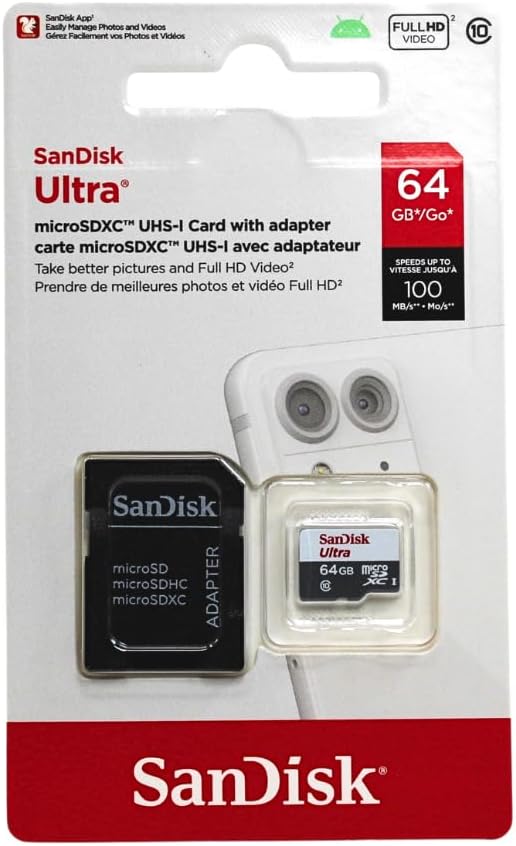
The SanDisk Ultra MicroSDXC 64GB UHS-I Class 10 Memory Card delivers fast 80MB/s transfer speeds ideal for premium Android smartphones and tablets. Engineered for durability, it’s waterproof, shockproof, temperature-proof, X-ray and magnet proof, ensuring your data stays safe in any environment. The included SD adapter expands compatibility to cameras and other devices, while the Memory Zone app helps you effortlessly manage your media. Perfect for Full HD video recording and backed by a 10-year limited warranty, this memory card is a trusted choice for professionals and tech-savvy millennials alike.


| ASIN | B010Q588D4 |
| Are Batteries Included | No |
| Best Sellers Rank | #871,380 in Electronics ( See Top 100 in Electronics ) #496 in Micro SD Cards |
| Customer Reviews | 4.1 4.1 out of 5 stars (33,230) |
| Date First Available | 13 July 2015 |
| Item Dimensions LxWxH | 1 x 15 x 11 Millimeters |
| Item Height | 0.43 Inches |
| Item Weight | 4.99 g |
| Item Width | 0.59 Inches |
| Item model number | SDSQUNC-064G-GN6MA |
| Manufacturer | SanDisk |
| Product Dimensions | 0.1 x 1.5 x 1.09 cm; 4.99 g |
| RAM Size | 64 GB |
| UPC | 619659134846 |
C**™
SanDisk flash memory products are cheap and the best !
SanDisk are pioneers of flash memory products esp. the microSD format; and a byword among buyers, sellers & reviewers !! Excellent value for money and the most reliable, with features like: - Water proof - Temperature proof - Shock proof - X-Ray proof - 10-year limited warranty - Adapter (MicroSD to SD) - for use in digital cameras/ card readers My product is an old version ""SanDisk Ultra MicroSDXC 64 GB UHS-I Class 10 Memory Card + SD Adapter"" and rated for 80MB/s read speed; write speed is lower. But there is a newer version of this product supporting 100MB/s read speed here: SanDisk 64GB Class 10 microSDXC Memory Card with Adapter (SDSQUAR-064G-GN6MA) Still faster versions of this product may be released in future but you can be sure that your SanDisk memory card is a time tested product. I have not had a single SanDisk memory card fail on me and I use several - for phones, digital cameras and also for temporary backup when when my HDDs are full ! Buy SanDisk confidently, but make sure to purchase ONLY from Amazon Fulfilled sellers to ensure easy replacements and support in the rare event of any problems! And if purchasing for devices like digital cameras, make sure to check the supported capacities, class, etc.. from your camera manufacturer.
S**8
Good
Good product
S**D
WORTH THE MONEY !!! BEST 64 GB CARD FOR LESS MONEY.
MORE THAN SATISFIED WITH IT... Just gets my work done. Worth the money ! *** Sandisk has emerged as a premium brand pretty quickly with its offerings mainly in storage solutions. This is a microSD card that would work extremely well for Pro Photographers and flagship smartphone users and clicking pictures won't be a pain even if you use a very high end DSLR. Priced at Rs.1299/- at the time I bought it, it comes with a Sandisk adapter included for use in cameras. It's a UHS-1 Class 10 card with an average read speed of upto 80 MB/s and write speed of 48 MB/s. Also as the name suggests, its an SDXC card meaning it would now be able to record videos in high end video codecs such as XAVC by Sony at upto 50 Mbps to the microSD card.This card does work well for shooting videos upto 1080p at 60fps but beyond that, it would lag or won't work well enough if you try shooting RAW footage or simply 4K. ***Here's the verdict - I bet you won't get a cheaper 64 GB card with such marvellous specs and read/write speeds. ITS A DEFINITE BUY FOR ME even though I bought it for shooting videos...GET THIS ONE, YOU WONT REGRET FOR SURE !!! ******Product link down below :- SanDisk Ultra MicroSDXC 64 GB UHS-I Class 10 Memory Card + SD Adapter
A**R
Nice
Nice
P**A
Good
Good
N**♔
Need for Speed -- A comprehensive review of the fastest microsd cards
🏆 I had the opportunity to compare the performance of the fastest microsd cards currently available from top manufacturers. All cards mentioned in this review are obtained from Amazon during the last week or two except when noted otherwise. 🏆 Test Setup: Lexar Professional workflow UR1 microsd card reader was used for all tests except when noted CrystalDiskMark 5.0.2 x64 was used to produce all the test results and was set up with 2 passes and 100MB read/write size All cards up to 32GB are formatted as FAT32 with 32KB allocation unit size, all 64GB cards are formatted exFAT with 128KB allocation unit size Test Results (Numbers are Sequential Read, Sequential Write, 4K Random Read, 4K Random Write in MB/s, speeds greater than 10MB/s were rounded to the whole numbers) 16 GB Alphabetically Lexar 633x** -- 88, 25, 8.7, 1.2 Panasonic U3** -- 93, 42, 11, 0.7 Sandisk Extreme Pro -- 95, 80, 7.6, 2.6 32 GB Alphabetically Delkin U3 -- 93, 59, 11, 0.6 Kingston 90R/80W -- 93, 58, 11, 0.6 Lexar 1000x -- 90, 57, 10, 1.4 <== the listed product Lexar 1000x with Bundled Reader* -- 148, 60, 10, 1.4 Patriot EP -- 90, 35, 10, 0.6 PNY Turbo Performance -- 91, 55, 6.9, 0.9 PNY Elite Performance Lime Green -- 94, 55, 7.4, 1.0 Samsung Pro gray -- 92, 82, 10, 3.6 Sandisk Extreme Pro -- 94, 87, 9, 3.0 Sony up to 95MB/s -- 91, 51, 4.8, 0.9 Transcend Ultimate 633x -- 93, 85, 8.1, 1.4 64 GB Alphabetically Delkin U3 -- 94, 27, 13, 0.3 Kingston 90R/80W -- 94, 25, 13, 0.3 Lexar 1000x -- 92, 56, 12, 1.5 Lexar 1000x with Bundled Reader* -- 153, 66, 11, 1.7 Patriot EP -- 81, 22, 11, 0.6 PNY Turbo Performance -- 92, 54, 6.9, 0.9 PNY Elite Performance Lime Green -- 92, 54, 7.5, 1.0 Samsung black -- 82, 20, 8.8, 2.1 Samsung Pro gray -- 90, 80, 10, 3.5 Samsung Pro+ *** -- 92, 86, 10, 5.3 Sandisk Extreme U3 -- 92, 88, 5.5, 0.5 Sandisk Extreme Plus U1 **** -- 92, 58, 10, 2.8 Sandisk Extreme Plus U3 -- 92, 88, 9.4, 2.9 Sandisk Extreme Pro - 97, 91, 10, 3.0 Sandisk Ultra ***** -- 46, 16, 7.0, 2.1 Sony up to 95MB/s -- 92, 49, 5.2, 0.9 Transcend Ultimate 633x -- 93, 83, 7.3, 1.4 128 GB Alphabetically Lexar 633x -- 78, 28, 3.3, 1.4 PNY High Performance -- 81, 22, 5.4, 0.9 Samsung EVO+ -- 82, 26, 5.9, 1,2 <== the listed product, different capacity Sandisk Ultra -- 92, 19, 6.4, 2.4 * The Lexar 1000x card is the only UHS-II card available and tested, the bundled USB reader has extra pins for reading UHS-II card ** Came bundled with a device *** Purchased from a large west coast electronics retailer. This card is a new release and not currently available on Amazon. It is different from the gray-colored Pro card **** old model tested, not the current U3 model ***** old model tested Fastest Sequential Read: All tested cards were able to accomplish > 90MB/s, with the Lexar 1000x able to take advantage of UHS-II speed when using the bundled USB reader and leading the pack Fastest Sequential Write: Sandisk Extreme Pro, Samsung Pro+, Transcend Ultimate 633x Fastest Random Read: Kingston 90R/80W. Fastest Random Write: Samsung Pro+ Best overall: Samsung Pro+ and Sandisk Extreme Pro Other observations: Performance and price are not proportional when it comes to selecting a microSD card. Some of the worst performing cards in this review also happen to be the most expensive. Not all 633x cards are created equal. The two cards reviewed from Lexar and Transcend are both marked as 633x but vary in performance greatly. 4k video recording using action cams and drone cameras have a typical bitrate of 60mbps or 100mbps, corresponding to 7.5MB/s to 12.5MB/s. All cards in this review should theoretically be able to handle this usage easily. Using microsd card as supplemental phone storage potentially could benefit from a faster card, Best Looking Card (if it matters): Sandisk Extreme Pro: Red/Gold with white print Lexar 1000x: White/Gold with Black/White print Samsung Pro+: White/Black with a red stripe and Black/White print PNY Turbo: Lime Green/Black with Black/White print ❤️ Thanks for reading my review.I hope my review provided all the information for a well-informed and wise purchase decision.Anyway If you have any queries then feel free to email me. I hope it helps ❤️ ❤️ You Can Ask Question to me if You Need Any Type Of Help .❤️
J**V
Small and Big in size
Another great product from sandisk..... with lots of space. The space available for user is 59.9 gig. That is more than enough for storing all your podcasts and music. It is also class10 card so you will get faster speeds at read and write. Full HD video recording with this baby works like a charm. You will never be disappointed because you get this amazing and incredible product for such a low price. It also comes with a bundled card that provides support for usage with camera. If you are looking to buy a new sd card or just looking for expanding your current storage, please consider to buy this. Trusted.
T**E
I purchased the SanDisk Ultra 64GB microSDXC card to expand storage on my tablet and camera, and it has worked flawlessly. The card offers fast read speeds, making file transfers quick and hassle-free. It comes with a full-size adapter, which is convenient for using it in laptops or other devices. The grey/red design is sleek, and the card itself feels durable. I’ve used it for photos, videos, and app storage, and it performs consistently without errors or slowdowns. The standard packaging was simple but secure, ensuring the card arrived safely. Overall, this is a dependable, high-quality microSD card that offers excellent value for its size and speed. Perfect for anyone looking to expand device storage without worrying about performance. Highly recommend!
G**.
Ho acquistato questa microSD poiché, avendo cambiato telefono ed essendo passato da un Samsung GALAXY S III ad un Huawei P8 (un po’ come passare da una Punto vecchio modello con un motore che arranca ad un’Audi con un motore che ha potenza da vendere) volevo una scheda di memoria che fosse non solo più capiente di quella che avevo, che era da 32GB, ma anche più veloce. Questa SanDisk Ultra ultima versione che arriva ad 80MB/s in lettura da 64GB mi è sembrata, insieme alla Samsung EVO+ (ma, come vedremo, si è rivelata migliore di quest’ultima), la scheda più adatta al P8, considerando il fatto che con tale telefono si possono riprendere video “solo” in Full HD e non in 4K, altrimenti mi sarebbe servita una scheda ancora più veloce come, ad esempio, la SanDisk Extreme. Non appena arrivata ho eseguito una serie di test per verificare le prestazioni della scheda e per metterla a confronto con la Samsung EVO+, e tali test sono stati eseguiti sia sul PC che sullo smartphone. Premetto subito che il mio PC è un portatile con 8 anni di vita, quindi i benchmark come il CrystalDiskMark o come l’H2testw non hanno potuto restituire i valori massimi effettivi di cui sono capaci le schede ma, comunque, hanno restituito dei valori di cui tenere conto. Altro discorso riguarda il benchmark eseguito sullo smartphone, e cioè l’A1 SD Bench, il quale ha restituito le velocità massime che tali schede possono realmente raggiungere su uno smartphone di ultima (ma non ultimissima) generazione come il P8. Ho, quindi, messo a confronto 2 schede, questa e la Samsung EVO+, per vedere quale delle due fosse la più veloce. Il test CrystalDiskMark 5.2.0 x64 ha dato questi risultati: All Read [MB/s] Write [MB/s] Seq Q32T1→ 19.92 - 17.83 4K Q32T1→ 3.944 - 2.143 Seq→→ 19.92 - 18.66 4K→→→3.787 - 2.028 Mentre, relativamente alla Samsung, i risultati sono stati questi: All Read [MB/s] Write [MB/s] Seq Q32T1→ 19.77 - 16.70 4K Q32T1→ 2.840 - 0.909 Seq→→ 19.71 - 9.646 4K→→→2.787 - 0.407 Sono rimasto positivamente sorpreso nel constatare come tutte le velocità (lettura e scrittura, sequenziali e casuali) siano state di ottimo livello, quasi tutte superiori a quelle della Samsung, soprattutto riguardo i piccoli blocchi di dati di 4KB, in lettura e, soprattutto, in scrittura, le quali arrivano rispettivamente a quasi 4MB/s ed a 2MB/s. Per curiosità ho voluto eseguire questo test anche su una scheda microSD Toshiba da 32GB Classe 10 comprata qualche anno fa ed i valori di lettura e scrittura di blocchi 4K sono stati rispettivamente di 3.5MB/s ed 1MB/s di velocità, quindi non male considerando che la Toshiba è una scheda non più recentissima. La Samsung, invece, in questo frangente ha un decisamente deluso, anche rispetto alla “vecchia” Toshiba, una scheda non più recentissima, e ciò mi ha stupito non poco considerando quanto bene si parli di questa scheda in varie recensioni sul web. Preciso che, riguardo all’utilizzo su uno smartphone o un tablet, i valori di lettura e scrittura di piccoli blocchi di dati sono particolarmente importanti, come spiegato in diverse recensioni di alcuni siti web, poiché in un telefono od in un tablet le applicazioni spesso salvano i dati in piccoli frammenti sparsi per la scheda, quindi una microSD deve essere veloce a leggere e scrivere piccoli bit di dati (spesso di circa 4 KB) in posizioni casuali. Le velocità sequenziali sono, invece, meno importanti delle velocità casuali 4KB su telefoni e tablet mentre lo sono di più se la scheda viene utilizzata, ad esempio, in una fotocamera o quando si tratta di trasferire dati dalla scheda al PC (lettura sequenziale) e quando si scattano foto o si girano video (scrittura sequenziale). In ogni caso, anche in lettura e scrittura sequenziali questa SanDisk Ultra fa meglio della Samsung EVO+. Il benchmark H2testw v 1.4 è un test che è consigliabile eseguire ogni volta che si acquista una nuova scheda poiché, durante la sua esecuzione, legge e scrive TUTTA LA SCHEDA (per questo motivo occorrono almeno un paio d’ore per completarne l’esecuzione su una microSD da 64GB) e si rivela, quindi, particolarmente utile per sapere se la scheda appena acquistata è integra o presenta dei settori danneggiati, od ancora se è autentica o falsa; questo test ha restituito un valore in scrittura di 16.1 MByte/s ed un valore in lettura di 18.4 MByte/s, mentre sulla Samsung la velocità in lettura è stata identica ma quella in scrittura ha raggiunto il valore di 13.2 MByte/s, quindi ancora una volta la SanDisk si rivela superiore alla Samsung: il test è stato eseguito su un computer non recentissimo però è stato utile per verificare l’integrità delle due schede e le differenze prestazionali. Adesso veniamo ai test sul Huawei P8, e cioè il test A1 SD Bench ed il test SD Insight. Per avere valori quanto più possibile precisi ho svolto gli stessi test diverse volte e poi ho calcolato una media dei valori ottenuti. Per quanto riguarda il benchmark A1 SD Bench relativo alla SanDisk Ultra ho registrato una velocità di Lettura Sequenziale media di 66.28MB/s, una velocità di Scrittura Sequenziale media di 33.62MB/s, una velocità di Lettura Casuale media di 11.41MB/s ed una velocità di Scrittura Casuale media di 3.26MB/s. Sempre facendo un confronto con la concorrente Samsung tali valori sono stati, rispettivamente, di 62.34MB/s, 27.29MB/s, 16.57MB/s e 1.57MB/s, quindi, tranne nella Lettura Casuale, dove prevale la Samsung, negli altri tre valori è risultata nettamente superiore la SanDisk. Per quanto riguarda, infine, il benchmark SD Insight, occorre precisare che questo test serve solamente per avere una conferma riguardo l’autenticità della scheda, anche se non si tratta di un test infallibile: comunque, quando l’ho eseguito sulla SanDisk Ultra l’app ha confermato che il produttore è SanDisk, che la capacità è 64 GB e che la data di produzione risale ad AGOSTO 2016, mentre sulla Samsung tale app ha confermato che il produttore è SAMSUNG ELECTRONICS, che la capacità è 64 GB e che la data di produzione è OTTOBRE 2016. L'ultimo test che ho svolto è stato un copia-incolla da PC a microSD e viceversa, per verificare rispettivamente le velocità di Scrittura e Lettura sequenziali: ho, quindi, copiato una cartella contenente diversi video dalle dimensioni di 1,66GB ed una cartella contenente oltre 250 brani musicali dalle dimensioni di 1,45GB dal PC alla microSD tramite l'adattatore SD per verificare la velocità di scrittura sequenziale della scheda ed ho ottenuto dei valori oscillanti tra 11MB/s e 16MB/s, con una velocità media, quindi, di 13.50MB/s ed un tempo medio di 1 minuto e 50 secondi. Facendo la stessa operazione con la EVO+ ho ottenuto dei valori compresi tra 6MB/s e 15MB/s, con una velocità media, di conseguenza, di 10.50MB/s ed un tempo medio di 2 minuti e 30 secondi: ancora una volta la SanDisk è stata più veloce della Samsung. Se avessi effettuato il trasferimento di una quantità molto superiore di dati avrei, quindi, risparmiato un bel po’ di tempo utilizzando la SanDisk Ultra invece della Samsung EVO+, questo è indubbio. Ho effettuato, subito dopo, l'operazione inversa, e cioè la copia delle medesime cartelle da entrambe le microSD al PC per verificare la velocità di lettura sequenziale delle due schede e, in questo caso, i valori ottenuti sono stati esattamente identici: la velocità minima è stata di 14MB/s, quella massima è stata di 18.70MB/s, con un valore medio di 16.35MB/s. Per concludere, questa microSD si è rivelata soddisfacente riguardo tutti i valori fatti registrare nei vari benchmark cui è stata sottoposta e si tratta, quindi, di una scheda veramente più che ottima, assolutamente adatta a chi fa foto o gira video in Full HD; vista la velocità media di scrittura sequenziale fatta registrare nel benchmark sul telefono, superiore a 30MB/s (come se fosse una scheda U3, pur non essendolo), potrebbe essere adatta anche a chi gira video in 4K, come si può fare con un telefono come il Samsung GALAXY S7, oppure si potrebbe optare, per una maggior sicurezza, per una scheda classificata effettivamente U3, ovvero che scrive ad un MINIMO di 30MB/s, come la SanDisk Extreme. Questa SanDisk Ultra ha ricevuto dagli acquirenti un punteggio di 4.6 stelle su 5, quindi si tratta di una scheda certamente affidabile: detto questo, però, è bene precisare che con le schede di memoria, ed ancor più con le microSD non si può essere sicuri al 100% di non avere mai problemi, ed il fatto di acquistare una scheda di una marca affidabile non è una garanzia assoluta, semmai può essere una garanzia che si avranno meno probabilità di incorrere in malfunzionamenti o che la scheda si degradi progressivamente o smetta di funzionare da un giorno all’altro, ma tutto ciò è comunque sempre possibile: è, quindi, sempre una buona cosa fare periodicamente dei backup di tutto ciò che è memorizzato sulla scheda onde evitare spiacevoli perdite di dati importanti. In conclusione: una scheda più che ottima, contraddistinta da prestazioni più che ottime e da un’ottima affidabilità proposta ad un prezzo abbastanza concorrenziale (ma non super conveniente) rispetto ad un negozio fisico (su Amazon, però, i prezzi sono soggetti a variazioni, infatti io l'ho acquistata a poco più di 23 €, ottimo prezzo quindi, mentre adesso costa intorno ai 28-29 €, quindi è meglio tenere sotto controllo il prezzo di un prodotto che interessa, magari installando nel browser qualche estensione che svolga proprio questo compito come “Keepa – Amazon Price Tracker” disponibile per Firefox e Chrome): un acquisto certamente azzeccato.
A**ー
特に問題なく普通に使えてます
T**D
Habe mir die Karte für mein Arbeitshandy "Doogee F2 Ibiza" geholt, um ein wenig mehr Musik für Unterwegs draufpacken zu können, als auf die bisherige 32GB Karte (auch SanDisk Ultra). Mit SanDisk macht man eigentlich nicht viel falsch. Schon seit Jahren schwöre ich auf diese Marke. Ob SD, Mini-SD, Micro-SD oder CF, im direkten Vergleich mit Transcend, Kingston oder Samsung, war SanDisk immer die Schnellste und Beständigste. Beim Kauf einer Speicherkarte sollte man immer überlegen und nachlesen, was das jeweilige Gerät unterstützt bzw. verarbeiten kann. Was bringt mir z.B. eine 128GB Extreme-Karte wenn das Gerät lediglich für maximal 64GB Ultra ausgelegt ist? Genauso verhält es sich mit dem tatsächlich verwendbaren Speicher. Von meinen 64GB kann ich lediglich 59,46GB verwenden, das ist bei jedem Gerät so und sollte bei der Größenwahl bedacht werden.
D**.
Ótimo produto
Trustpilot
1 month ago
1 month ago