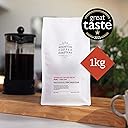
As a daily espresso drinker who also enjoys decaf for late afternoons and evening sessions, I was intrigued by Rounton’s promise of chemical-free sparkling water decaffeination and freshly roasted beans. While I found some highlights worth noting, my experience has been a mix of pros and cons, especially across different brewing methods, machines, and storage scenarios.Storage & PreservationTo preserve the flavour and structure of the beans, I followed best practices: storing them in an airtight stainless steel vacuum-sealed canister and dividing part of the bag into small resealable freezer bags. These were frozen and thawed in single-use portions to avoid moisture condensation. This method is especially important for decaf beans, which are more porous due to the decaffeination process and thus age more rapidly. The science behind this is simple: once decaf beans are exposed to oxygen and humidity, their aromatic oils degrade faster than regular beans. Keeping them sealed, dark, and dry is essential for consistent extractions.Water quality plays a critical role when brewing espresso, particularly with decaf. I used Volvic bottled water for all my testing, as it's moderately mineralised and ideal for espresso machines. Filtered water from reverse osmosis systems should be avoided unless remineralised, as it lacks the necessary calcium and magnesium to properly extract flavours and protect your equipment. On the other hand, hard water can scale your boiler quickly and alter taste, so in such cases I recommend using a known mineral-balanced bottled water or installing a bypass filter that preserves essential minerals while softening the excess.Espresso Use & Shot Timing (Lever & Pump Machines)Using a Flair 58 (manual lever) and a Sage Barista Pro (pump-based), I dialled in multiple extractions. The best-tasting results came from 18g in and 36g out in roughly 27 seconds, mirroring their suggested profile. With the Flair, I could push the pre-infusion for better saturation, which helped accentuate the cherry and brown sugar notes without bitterness. With the Barista Pro, I found the pressure curve to favour medium-fine grinds and slightly cooler brew temps (~92°C) to prevent the roast from tasting hollow or flat. For a classic semi-automatic like the Gaggia Classic Pro, similar timings apply, but a PID temperature controller would greatly help here as these beans are sensitive to small temperature fluctuations.With the lever machine, especially something like the Flair 58 or the Cafelat Robot, longer pre-infusion with light puck pressure for 8–10 seconds followed by a slow ramp-up provides the best saturation and flavour development. These beans do tend to compress quickly, so I recommend a slightly coarser grind compared to traditional medium roast beans, to avoid channelling or high resistance. Even on manual levers with spring pressure profiles like the La Pavoni or Elektra Microcasa, I found a slower decline in pressure helped retain the sweetness and avoided bitterness.Filter Coffee & French Press ResultsFor filter coffee, I ground medium-coarse and used a V60 (30g/500ml), Chemex (40g/700ml), and Aeropress (16g/250ml). The V60 produced the cleanest cup with some lingering sweetness but lacked body compared to more developed decaf roasts. The French press (50g/800ml) gave better mouthfeel but revealed some slightly sour undertones when left to sit too long, hinting at uneven roast or less dense beans post-decaffeination. Still drinkable, but not standout. For Aeropress, I preferred an inverted method with a 1:16 ratio and 2-minute steep before pressing, which brought out the chocolate notes nicely.When dialled in for filter, I noticed these beans tend to over-extract quickly, so a lower temperature between 88–90°C helped smoothen out the flavour. In Chemex, the clarity was better than French press, but the sweetness faded too quickly, suggesting the roast profile was still tuned primarily for espresso rather than lighter filter applications. For those using Moccamaster or Breville Precision Brewer, I’d suggest reducing brew temps slightly and opting for a medium grind with slightly shorter bloom times.Five Shot Profiles I TestedAcross the machines, I experimented with five main espresso ratios. 18g in and 36g out in 27 seconds gave the best balance. When I used 17g in and 34g out in 23 seconds, the cup was bright but lacked depth. At 19g in and 38g out over 31 seconds, the flavours were muted and body was lost. Tight shots like 18g in and 28g out in 24 seconds produced intense but flat results. Surprisingly, 16.5g in and 35g out in 26 seconds produced a pleasing milk-based drink, suggesting that lower doses may balance this roast better in milk.Versatility Across Brewing MethodsBesides espresso and filter methods, I tested it in moka pot (12g/180ml) and found it surprisingly robust, with a smooth body and cocoa finish. In cold brew (100g/1L, steeped for 18 hours), the acidity was well-tamed, and the coffee held its own in milk or with ice. However, for drip machines like the Braun BrewSense or Sage Precision Brewer, I had to experiment quite a bit with grind settings to get the best balance—too coarse yielded sourness; too fine gave muddiness.30 Recipes & Use Cases I TriedEspresso-based: standard double shot, cortado, flat white, iced latte, café noisette, iced Americano.Manual brews: inverted Aeropress with bypass, V60 bloom-focused pour, Chemex pulse pour, French press 4-min steep, Clever Dripper immersion.Moka pot traditional and with milk.Cold brews: concentrate and ready-to-drink.Desserts: affogato, espresso-soaked sponge, coffee-flavoured yoghurt, coffee reduction syrup.Food pairings: chocolate torte, cherry scones, cinnamon buns, fig jam toast.Alternative milks: oat milk flat white, almond cortado, soy macchiato.Seasonal drinks: winter mocha, summer iced brew, autumn maple-spiced latte.In all these, the espresso and cortado variants brought out the best from this roast, while filter-based methods struggled to showcase complexity. Cold brew had a place but lacked standout qualities when compared with more fruit-forward decafs.Pros:The beans are chemical-free, roasted freshly, and versatile enough to suit both espresso and immersion brews. They shine best in milk-based drinks and espresso-based concoctions, especially when shot timing is dialled in. The sparkling water decaf process is gentle and avoids harsh chemical aftertastes, giving peace of mind to health-conscious drinkers. Also, it offers excellent crema for a decaf, a rarity among beans in this category.Cons:This roast drinks darker than advertised, with a muted finish in filter brews. Inconsistent grind behaviour was noticeable, especially when switching between grinder types (flat burr vs conical). It lacks the punch and complexity of top-tier decafs like Swiss Water or Sugarcane Process beans from Colombia. Pricing is on the higher side, and while the ethics and sourcing are commendable, the flavour payoff may not justify the cost for all. The beans age rapidly after opening, which makes portioning into single-use freezer bags almost essential.Bonus Tip:Decaffeinated coffee beans, particularly those processed using methods like sparkling water or Swiss Water, undergo significant structural changes at the cellular level that impact their long-term stability and flavour retention. During decaffeination, the beans are repeatedly soaked in water to extract caffeine, which disrupts the cell walls and flushes out not just caffeine but also soluble aromatic compounds that define coffee's complexity. Even though these methods avoid harsh solvents, they increase the porosity of the bean's cellular matrix, leaving them more vulnerable to oxygen, moisture, and volatile compound evaporation. This porosity accelerates oxidative degradation, which is why decaf beans stale much faster than regular caffeinated beans—a fact supported by research such as Clarke & Macrae’s foundational work in Coffee: Chemistry (1987), which details how decaf beans lose up to 40% of volatile compounds in the first few weeks post-roast when stored improperly. Because of this fragility, decaf beans should never be stored in integrated hopper grinders—especially not those found in home or office bean-to-cup machines that expose the entire bean batch to light, ambient heat, air, and agitation every time the machine runs. These conditions dramatically increase oxidation and compound volatilisation. Instead, the best practice for preserving decaf bean integrity is single-dose grinding, ideally using frozen portions stored in airtight, vacuum-sealed containers. Freezing slows the diffusion and evaporation of volatile compounds and arrests oxidative reactions due to the reduced kinetic energy at lower temperatures. For those using home espresso machines like the Gaggia Classic or lever machines like the Flair 58 or La Pavoni, measuring out single doses and freezing them post-degassing (ideally 5–7 days after roast) is optimal. Importantly, for brewing, avoid distilled or over-filtered water; minerals like calcium and magnesium are critical for flavour extraction and proper TDS (Total Dissolved Solids) balance. Using lightly mineralised water like Volvic (which contains around 130–150 ppm TDS) is ideal for espresso. If you're stuck with hard tap water, use a sodium-free resin softener or third-wave-style remineralisation kits to ensure that the brewing water supports full flavour extraction without contributing to scale buildup. Overall, while decaf can be delicious, it demands much stricter handling and shorter timelines—making it a poor candidate for bulk storage in hoppers unless consumed within a week in high-traffic, commercial-grade setups with sealed burr paths and climate-controlled environments.This is a respectable decaf option, particularly for those who are serious about espresso and milk-based drinks and who have access to machines that allow for fine-tuned extractions. It's less ideal for casual filter brewers or those who value high clarity and fruity brightness in their cup. The flavour is consistent with effort but underwhelming without careful grind and brew management. If you're using a Gaggia Classic or similar, consider investing in a PID or at least using temperature surfing to manage brew temp, and stick with mineral-balanced water like Volvic or Ashbeck. Avoid soft-filtered or reverse osmosis water unless you know how to reintroduce minerals. With the right conditions, Rounton's decaf can absolutely serve as a daily driver, but it takes a bit of technique and care to extract its full potential.