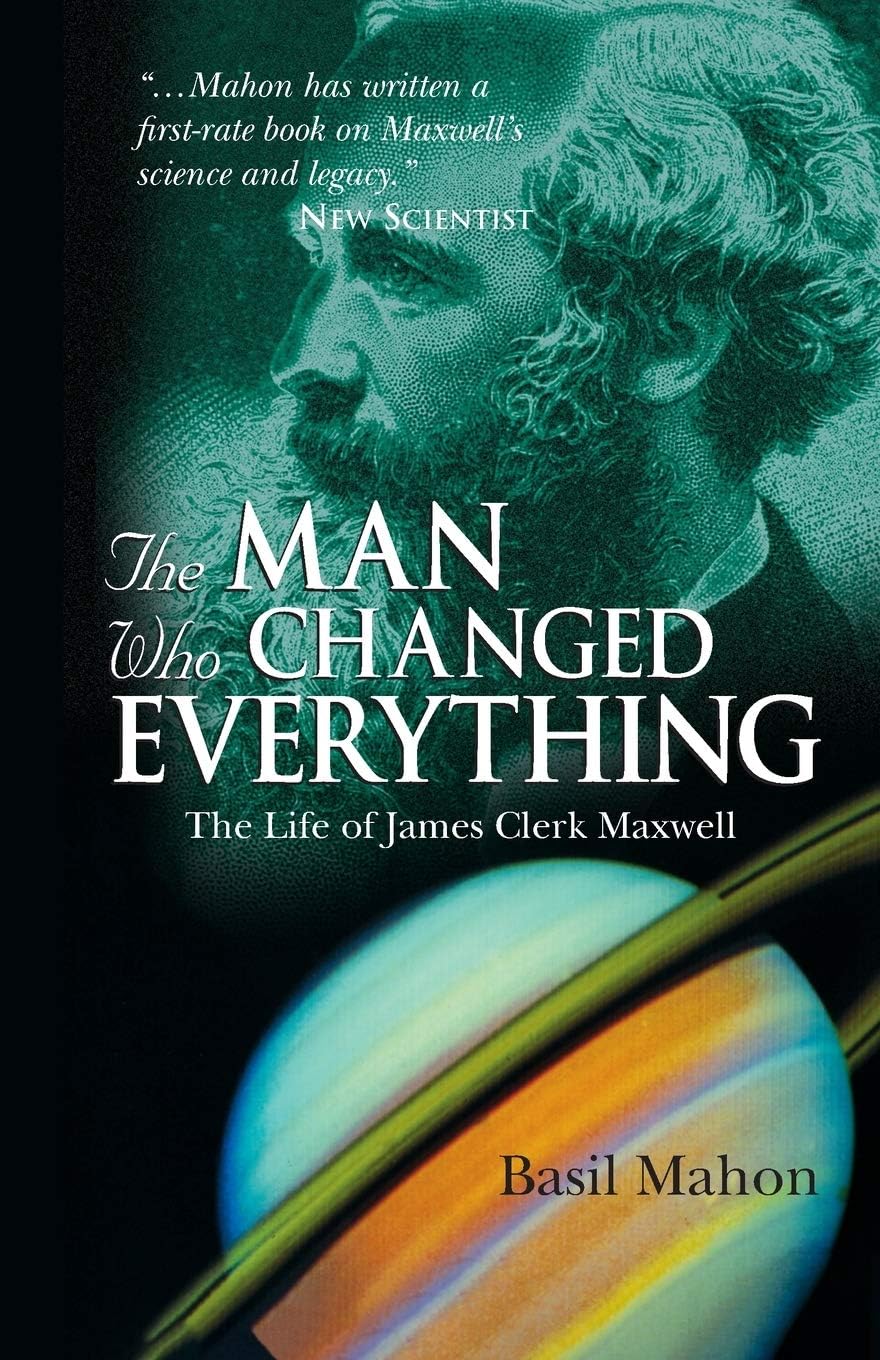
The Man Who Changed Everything: The Life of James Clerk Maxwell
Product ID: 79832522
⚡Covers electromagnetic wave discoveries
🏆Ranks #3 greatest physicist ever
📚First Maxwell biography in 20 years
Desertcart purchases this item on your behalf and handles shipping, customs, and support to Croatia.
⚡ Illuminate your intellect with the man who electrified science!
This definitive biography of James Clerk Maxwell, the third greatest physicist of all time, reveals how his groundbreaking discoveries in electromagnetism and statistical physics laid the foundation for modern technology and physics. Praised by Einstein and ranked highly among scientific greats, Maxwell’s life and work are brought to light in this compelling, highly rated book—perfect for professionals eager to connect with the roots of today’s innovations.
| Best Sellers Rank | #405,941 in Books ( See Top 100 in Books ) #2,753 in European History (Books) #15,872 in Biographies & Autobiographies (Books) |
| Customer Reviews | 4.5 out of 5 stars 493 Reviews |
P**R
Five Stars
Bought for my brother.
D**Y
The Third Greatest Physicist of All Time
The normally irascible Isaac Newton remarked in 1676 "…….. If I have seen further it is by standing on the sholders [sic] of Giants". In turn, Einstein, when told that he had done great things because he stood on Newton's shoulders; Einstein replied: "No I don't. I stand on the shoulders of Maxwell." The influence of James Clerk Maxwell runs all through our daily lives. His electromagnetic waves made possible ALL forms of wireless communication. Colour TV and mobile phone screens work on the three-colour principle that he demonstrated. Pilots and astronauts fly their craft by control systems which derive from his work. Bridges and other structures were designed using his reciprocal diagrams and photoelastic techniques. Maxwell started a revolution in the way physicists look at the world. He introduced statistical methods in physics. His droll molecule sized creature, Maxwell’s Demon, was the first example of the thought experiment so frequently used by Einstein and memorably by Schrodinger with his famously lamentable cat. At Cambridge he set up the Cavendish Lab where the electron and the atomic structure were discovered by Thomson and Rutherford later on. His discoveries helped usher in the era of modern physics, laying the foundation for such fields as special relativity and quantum mechanics. Many physicists regard Maxwell as the 19th-century scientist having the greatest influence on 20th-century physics. His contributions to the science are considered by many to be of the same magnitude as those of Isaac Newton and Albert Einstein. In the millennium poll—a survey of the 100 most prominent physicists—Maxwell was voted the third greatest physicist of all time, behind only Newton and Einstein. On the centenary of Maxwell's birthday, Einstein described Maxwell's work as "the most profound and the most fruitful that physics has experienced since the time of Newton." Maxwell's A Treatise on Electricity and Magnetism: Vol. 2 is probably, after Newton'sThe Principia: Mathematical Principles of Natural Philosophy, the most renowned book in the history of physics. It is said that if you trace every line of modern physical research to its starting point you come back to Maxwell. Maxwell achieved all this in a short span of life – he died at the age of 48. So why is he not as well-known as Newton and Einstein or even Schrodinger, Planck or Bohr? Apparently he was painfully modest (laid back in today's argot) and never strove to promote his work; nor was there anyone who did it for him. Most importantly many of his ideas were way ahead of their time. Physicists recognized his work later, once experimental proof became available. An engrossing book indeed.
M**I
The great genius, Maxwell, still doesn't get his due!
Maxwell is wellknown to students of science, but not quite a fashionable name to be dropped in social circles. This book tries to tell us how great he was and why he should be as widely name-dropped as Newton/Einstein/Hawking etc. Though the book is thoroughly enjoyable (finished reading it in 3 suitings, great!), It hasn't the mettle to become a bestseller. Let somebody write a bestseller on Maxwell! Please!
T**D
Superb biography and history of science
This book describes the life & achievements of James Clerk Maxwell, the man who first identified the relationship between electricity, magnetism & light. He was the first to demonstrate mathematically that electricity, magnetism and light are all manifestations of the same phenomenon; the electromagnetic field - with electromagnetic waves. This is regarded by many as one of the greatest scientific achievements of all time; ranking him with Newton, Faraday & Einstein. Mahon's book is extremely well written and is at times hard to put down; this despite his explanations of some very sophisticated physics & mathematics, which he achieves with clarity. Maxwell's life, personality, relationships and achievements are described chronologically; schooling in Scotland, university education in Edinburgh & Cambridge and academic posts beginning and ending at Cambridge. He was a lifelong friend of both William Thomson (Lord Kelvin) and P G Tait; the three regularly exchanging ideas. Maxwell was a gentle caring and religious man with a mischievous though never cruel sense of humour. Although the author devotes a good deal of his text to describing these endearing aspects of Maxwell's life, it is his enormous scientific and engineering achievements which shine through. In addition to his achievements in electromagnetism, Maxwell proposed the first ever statistical law in physics; that is the Maxwell distribution of molecular velocities, the first & perhaps the most inspired step towards the development of statistical thermodynamics and the Maxwell-Boltzmann distribution or molecular energies, which is so important in understanding for example the relationship between temperature and vapour pressure. This alone, without his electromagnetic theory, would be sufficient to mark him as `an all time great' of science. However, there was much more! James also determined the conditions under which Saturn's rings would be stable which won him Cambridge's Adams Prize and the accolade from the Astronomer Royal that his work was one of the most remarkable applications of mathematics to physics that he had ever seen. Maxwell demonstrated the principle by which we see colours and took the world's first colour photograph; he wrote a paper which became the basis of modern control theory; he used polarized light to reveal strain patterns in structure and invented a powerful graphical method for calculating the forces in any framework, techniques which became standard engineering practice. Perhaps most importantly, with the development of his theories on for example electromagnetic fields, perception of colour and statistical mechanics, Maxwell started a revolution in the way physicists look at the world. He began to think that the objects and forces that we see are only our limited perception of an underlying truth that we cannot understand but can describe mathematically. Our author claims that `It is sometimes said, with no more than slight overstatement that if you trace every line of modern physical research to its starting point you come back to Maxwell'. CA Coulson said of Maxwell, that `there is scarcely a single topic that he touched upon which he did not change almost beyond recognition.' Albert Einstein said `one scientific epoch ended and another began with James Clerk Maxwell'. James Clerk Maxwell really was `The man who changed everything'; at least in physics. Mahon's book is first rate as a biography, as a history of science and as a compelling read: five stars of course.
C**R
''One scientific epoch ended and another began with James Clerk Maxwell'' - Albert Einstein.
''One scientific epoch ended and another began with James Clerk Maxwell'' - Albert Einstein. Einstein's work is based on and completes what Faraday and Maxwell began. As a youth Maxwell corrected a small error in Decarte's calculations. ''He went on in later years to read the work of all pioneers in each area of science to which he turned his hand.'' (17) This is in English, French, German, etc. Also read the Bible (in Greek), Shakespeare, etc., etc.. Wow! Where did he come from? ? ? And remembered and understood everything he read! ''By also studying philosophy he gained a deeper insight into the ''process'' of scientific discoveries than any other man of his time. Set alongside this knowledge was his own extraordinary originality and intuition. Together, theses components produced what the great American physicist Robert Millikan described as 'one of the most penetrating intellects of all time' ''. (17) Preface Chronology: principle events in Maxwell's life Cast of characters: Maxwell's relations and close friends Introduction A country boy 1831-1841 Pins and string: Edinburgh academy 1841-1847 Philosophy: Edinburgh university 1847-1850 Learning to juggle: Cambridge 1850-1854 Blue and yellow make pink: Cambridge 1854-1856 Saturn and statistics: Aberdeen 1856-1860 Spinning cells: London 1860-1862 The beautiful equations: London 1862-1865 The laird at home: glenair 1865-1871 The cavendish: Cambridge 1871-1879 Last days Maxwell's legacy Notes Bibliography Index Contains twenty-one black and white photographs on glossy paper. Mahon has clear affection for Maxwell. Reprises the major phases of his life in a brief summary. Explains his scientific work in a easy to follow manner. Best explanation of displacement current I have read. Excellent description of the relationship of magnetic and electric fields which propagates light. Covers Maxwell's kind, modest Christian personality. Comments that as a youth, probably knew the Bible better than the instructor. Served as an elder in his local church. Spoke against scientific determinism. Expressed the view that Christians should be careful in adjusting their Christianity to science, since science is always changing, unlike Christianity. Fascinating, since he changed science more than Einstein or Newton. We now believe we live in a material world made from non-material energy. What a profound adjustment! Maxwell's own reflection on his life: "What is done by what I call myself is, I feel, done by something greater than myself in me. The only desire which I can have is like David to serve own generation by the will of God, and then fall asleep". P.G.Tait, fellow scientist and lifelong companion, wrote after Maxwell's death, ''I cannot adequately express in words the extent of the loss which his early death has inflicted not merely on his personal friends, on the university of Cambridge, on the whole scientific world, but also, and most especially, on the cause of common sense, of true science, and of religion itself, in theses days of much vain-babbling, pseudoscience, and materialism.'' Materialism, idea that only physical matter is possible, Maxwell totally rejected. He held a deep faith in the Bible and Christianity. Interesting that his development of electromagnetic science changed existence from material matter to invisible forces, that is 'non-material'. ''But men of his stamp never live in vain' and in one sense at least they cannot die. The spirit of Clerk Maxwell still lives with us in his imperishable writing, and will speak to the next generation.'' If Maxwell was/is so significant, why is he unknown? His modest humility? Mahon writes - ''During his lifetime Maxwell's main theories had yet to be experimentally verified and he knew from the history of science that even the greatest men had sometimes been wrong. It was not so much his modesty as his philosophical caution that held him back.'' (177) Most of the scientific world did not accept this new non-material, non-mechanical reality. It required eight years of painstaking effort for Heinrich Hertz to validate Maxwell. Einstein's work showed ''that Maxwell's equations were ''the'' basic laws of the physical world. . . . Another corollary was the celebrated equation E=mc2.'' (181) Oliver Heaviside wrote - ''There are large souls and small souls. Such men live the best part of their lives after they are dead. Maxwell is one of these men. His soul will live and grow for long to come, as one of the bright stars of the past, whose light takes ages to reach us.'' (185)
W**Y
Brilliant exposition of Maxwell's place in 19th Century Physics
The Man Who Changed Everything: the life and times of James Clerk Maxwell by Basil Mahon This is a brilliant biography of one of the great physicists of the 19th Century. The author has produced a magnificent summary of the life and times of a leading figure in English science, his interconnectedness with Michael Faraday, and the evolution of electromagnetic theory and experimental tests that led to Max Planck’s discovery of quantum mechanics. Blending Maxwell’s work with advances by colleagues at Cambridge, Helmholz, Clausius and Boltzmann in Germany, and others far afield in America, all working against concerns about the practical use of theory and experimental results, it’s no wonder that advances came slowly. It is still a greater wonder about how many brilliant minds lie buried in the dismal poverty of 19th Century England and elsewhere, a situation that Maxwell strove to offset by his efforts to establish schools for trade people, Working Men’s Colleges, institutions he took over in Aberdeen and started at Cambridge. This is a well-deserved biography that highlights the importance of imagination and proof of theory in science, a link that underscores Maxwell’s accomplishments in physics and astronomy, and one that highlights the thinking of Einstein and others that followed him. I recommend this book as a runner up to Philip Ball’s ‘Beyond Weird’, a persuasive account of the merging of classical to quantum physics and the evolution of information theory. Bill Mahaney, author of ‘Ice on the Equator’, ‘Hannibal’s Odyssey: Environmental Background to the Alpine Invasion of Italia’ and ‘Atlas of Sand Grain Surface Textures and Applications’.
P**C
O grande, pouco homenageado, Maxwell.
Resolvi adquirir o livro porque tenho a intenção de elaborar um pequeno trabalho biográfico sobre Maxwell. Ainda não concluí a leitura mas até agora considero-o satisfatório para os propósitos, embora ainda pretenda consultar outros volumes em futuro próximo. Apesar disso, sou de opinião que o autor poderia enriquecê-lo um pouco mais com figuras e ilustrações alusivas ao trabalho científico do grande físico.
K**.
改めてこの偉人を偉大と認識できた
マクスウェルの方程式で不滅の偉業を残したJ.C. Maxwellの伝記を読んでMaxwell-Boltzmannの分布関数とか熱統計物理の業績もすごかったなと改めて思い出した.私の勉強の主体が電気関係に偏っていた弊害である.マクスウェル方程式と切っても切れない電磁波,光についても家庭実験を妻と共同で行ったりしていてほほえましい.特に色覚に関するテストが彼の名前を冠してあることを知った.今度眼科に行ったとき医師に確認しようと思う.私の英語力不足から少年時代の電気部分とかやたらと時間を要し,内容も把握できていないかもしれない.それでも読んで楽しかった.一部著者の思い入れから業績が大げさに書かれているところもあるように思った.しかし,これはご愛敬である.
Trustpilot
1 month ago
1 day ago