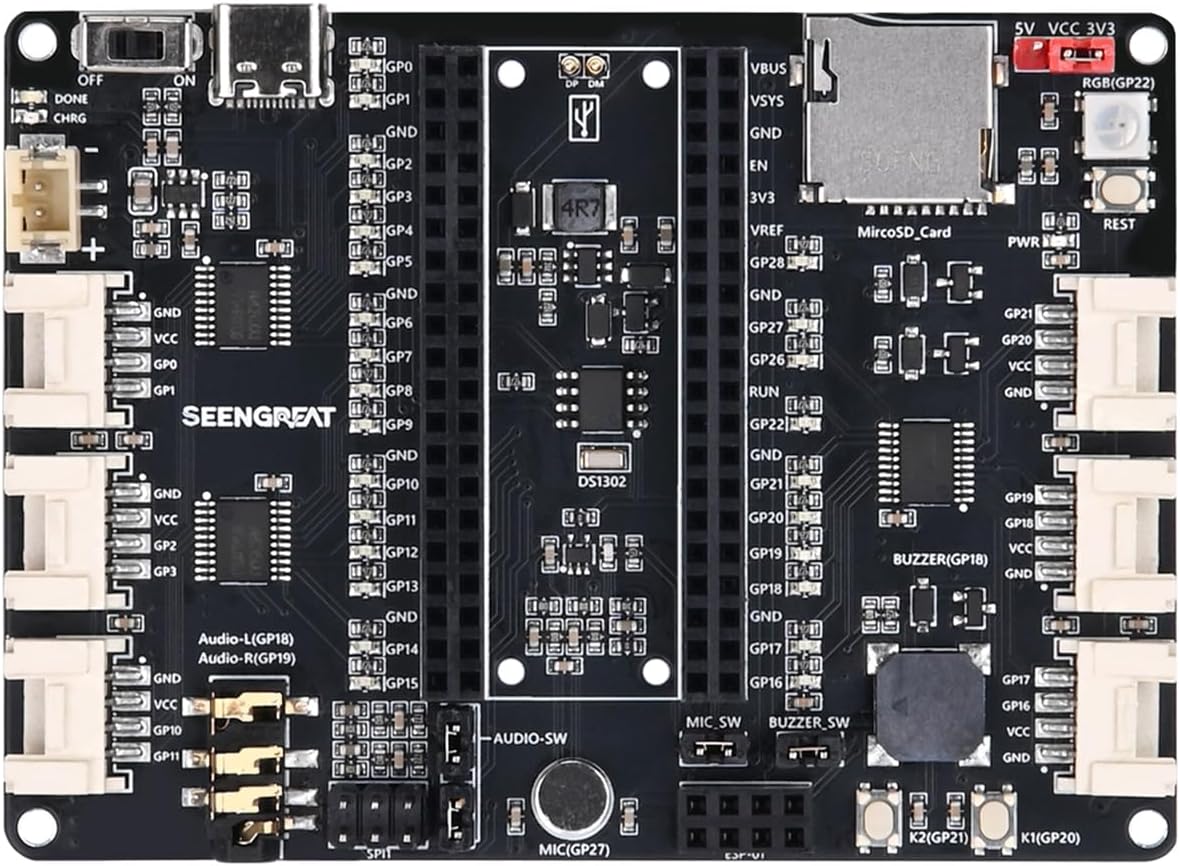
This board is a great idea - give you all the various things you'd like to try on the Pico in one nice, neat, compact package. It's pretty much a Pico dev lab on a board and would be great for learning and prototyping. The board itself also seems to be reasonably well made and the price is certainly right for such an item. Unfortunately, this is where the kudos stop and the disappointment sets in. To quote from the product description page: "To help you get started quickly, we provide example programs for all onboard modules, ensuring a smooth development experience." Instead, the reality is that the board only comes with a single printed page that pretty much re-hashes the info on the product page, plus a long list of caveats about what not to do with the board. There is no specific download URL to obtain the promised examples, although there is a URL for the seller's main page. After searching around on that I did manage to find the seller's product page for the board, which contained another link to a "wiki" for it. The wiki page had a link to download examples, but that only contained examples for a few of the board's simpler functions. For some of the more complex features such as the RTC chip, there was no example and not even a complete list of which GPIO pins were used for what. Fortunately, the board schematic is also downloadable from the wiki and yields this information, but that's really not a useful tool for the majority of users. It really would have been better to have a few more charts and explanations. There are also a number of connectors and jumpers on the board that have no information at all. For example, there is something labeled "voltage selection jumper", but what part of the board does that change the voltage to? There is a set of pins to connect a display, but no information on what kind of display it's intended for (and certainly no example software either!). The board has support for charging and using a LiPO battery, but no information on how the battery power switch affects charging. A socket is provided for an ESP-1 WiFi module, but there is no example code to show how to use it. There also does appear to be at least one functional problem with the board I received - the microphone does not work. I ran the provided example, but no amount of sound of any kind would produce a change in the analog input reading. (Yes, I checked the mic enable jumper!) So all in all I give the seller points for a good idea, but the execution of that idea is woefully incomplete.