Cicero: The Life and Times of Rome's Greatest Politician
Product ID: 8051091
Desertcart purchases this item on your behalf and handles shipping, customs, and support to Croatia.
NATIONAL BESTSELLER • “An excellent introduction to a critical period in the history of Rome. Cicero comes across much as he must have lived: reflective, charming and rather vain.”— The Wall Street Journal “All ages of the world have not produced a greater statesman and philosopher combined.”—John Adams He squared off against Caesar and was friends with young Brutus. He advised the legendary Pompey on his botched transition from military hero to politician. He lambasted Mark Antony and was master of the smear campaign, as feared for his wit as he was for his ruthless disputations. Brilliant, voluble, cranky, a genius of political manipulation but also a true patriot and idealist, Cicero was Rome’s most feared politician, one of the greatest lawyers and statesmen of all times. In this dynamic and engaging biography, Anthony Everitt plunges us into the fascinating, scandal-ridden world of ancient Rome in its most glorious heyday—when senators were endlessly filibustering legislation and exposing one another’s sexual escapades to discredit the opposition. Accessible to us through his legendary speeches but also through an unrivaled collection of unguarded letters to his close friend Atticus, Cicero comes to life as a witty and cunning political operator, the most eloquent and astute witness to the last days of Republican Rome. Praise for Cicero “ [Everitt makes] his subject—brilliant, vain, principled, opportunistic and courageous—come to life after two millennia.” — The Washington Post “ Gripping . . . Everitt combines a classical education with practical expertise. . . . He writes fluidly.” — The New York Times “In the half-century before the assassination of Julius Caesar . . . Rome endured a series of crises, assassinations, factional bloodletting, civil wars and civil strife, including at one point government by gang war. This period, when republican government slid into dictatorship, is one of history’s most fascinating, and one learns a great deal about it in this excellent and very readable biography.” — The Plain Dealer “Riveting . . . a clear-eyed biography . . . Cicero’s times . . . offer vivid lessons about the viciousness that can pervade elected government.” — Chicago Tribune “Lively and dramatic . . . By the book’s end, he’s managed to put enough flesh on Cicero’s old bones that you care when the agents of his implacable enemy, Mark Antony, kill him.” — Los Angeles Times Review: Listened on Audible. Very much enjoyed. - Really enjoyed this book. The dynamics and relationships between the major players were illustrated well. Cicero’s personal life and struggles were well told. I am definitely interested in finding out more about the works of Cicero. As a lawyer I found the descriptions of the lawsuits intriguing. As for the narrator I felt as though I was sitting with him chair to chair as he gave me the inside scoop on everything. A nice calm yet evocative voice. Sorry it was over. Review: Excellent Introduction to a Great Man - Odds are, you have heard of Cicero. Considered one of Rome's greatest orators, his writings are the main influence on how way we remember the last days of the Roman republic. The story of Cicero's life is the story of end of Republican Rome. All of the major players of the era: Caesar, Marc Antony, Cleopatra, Brutus and Octavian (soon to be Augustus) all make an appearance in his life. In his role as one of the world's first brilliant statesman and backroom player, Cicero was friends and enemies with all of them. From Everitt's book, it seems Cicero was, at times, courageous in his rhetoric and at times, he was cowardly. He always tried to see all the angels and jockeyed for a position that put him in the best place politically while betraying as few of his political convictions as possible. In the end, he wound up on the wrong side of Marc Antony and was killed. The story in getting from provincial boy to one of the most powerful men in Rome is fascinating. I am no expert on Roman history. I have read no other biography of Cicero. But to my tastes, Everitt's biography of Cicero is excellent for the reader with a casual interest in this time period in Rome. Not only does it give us insight into what a complicated person Cicero was (both arrogant and generous; brilliant in the courtroom and terrified of physical injury) but also perhaps more importantly it is an excellent primer on the death of the Roman republic. The story of Rome's decent into dictatorship, the attempt at recovering republicanism, and then the reassertion of dictatorship is the stuff that western history is made of, and Everitt's book is a good place to get a sense of who did what when and what Cicero had to say about it. Recommended.

| Best Sellers Rank | #105,823 in Books ( See Top 100 in Books ) #13 in Historical Greece Biographies #32 in Ancient Rome Biographies #33 in Historical Italy Biographies |
| Customer Reviews | 4.5 out of 5 stars 782 Reviews |
C**R
Listened on Audible. Very much enjoyed.
Really enjoyed this book. The dynamics and relationships between the major players were illustrated well. Cicero’s personal life and struggles were well told. I am definitely interested in finding out more about the works of Cicero. As a lawyer I found the descriptions of the lawsuits intriguing. As for the narrator I felt as though I was sitting with him chair to chair as he gave me the inside scoop on everything. A nice calm yet evocative voice. Sorry it was over.
S**N
Excellent Introduction to a Great Man
Odds are, you have heard of Cicero. Considered one of Rome's greatest orators, his writings are the main influence on how way we remember the last days of the Roman republic. The story of Cicero's life is the story of end of Republican Rome. All of the major players of the era: Caesar, Marc Antony, Cleopatra, Brutus and Octavian (soon to be Augustus) all make an appearance in his life. In his role as one of the world's first brilliant statesman and backroom player, Cicero was friends and enemies with all of them. From Everitt's book, it seems Cicero was, at times, courageous in his rhetoric and at times, he was cowardly. He always tried to see all the angels and jockeyed for a position that put him in the best place politically while betraying as few of his political convictions as possible. In the end, he wound up on the wrong side of Marc Antony and was killed. The story in getting from provincial boy to one of the most powerful men in Rome is fascinating. I am no expert on Roman history. I have read no other biography of Cicero. But to my tastes, Everitt's biography of Cicero is excellent for the reader with a casual interest in this time period in Rome. Not only does it give us insight into what a complicated person Cicero was (both arrogant and generous; brilliant in the courtroom and terrified of physical injury) but also perhaps more importantly it is an excellent primer on the death of the Roman republic. The story of Rome's decent into dictatorship, the attempt at recovering republicanism, and then the reassertion of dictatorship is the stuff that western history is made of, and Everitt's book is a good place to get a sense of who did what when and what Cicero had to say about it. Recommended.
J**N
Excellent description of both the man and the time in which he lived
John Adams once said of Cicero, “All ages of the world have not produced a greater statesman and philosopher combined.” His son, John Quincy, referred to Cicero as something akin to his spiritual father, a man whose writings got him through the darkest of times. I greatly admire both these men so I wanted to learn what was it about this man that stoked so much of their admiration. To this end, I purchased two books. This one, which is a biography of Cicero, gives an excellent and detailed account of the society in which he lived. Although it gives the reader a pretty good idea of the ethics and personality of the man, and does present a large amount of Cicero’s correspondence, it only gives a brief summary of his many books and did not give me a complete understanding of what provoked the Adams’s admiration. Hopefully, the second book which is a collection of his more renowned writings will provide that. What was the world in which Cicero lived? He lived from 106 – 43 BC. Although not born in Rome, he spent most of his life there. The era in which he lived was one of enormous change within the Roman Republic. It was collapsing into a dictatorship. We normally think of the collapse as occurring in 49 BC when Julius Caesar brought his troops into Rome thus violating one of the Republic’s greatest taboos. But it began before that. This taboo had already been violated in 87 BC, when the Roman General Sulla brought his soldiers inside the city limits of Rome. He did this because one of the tribunes was attempting to strip him of his command of the Eastern army. Once in the city, he killed the tribune and many of his allies. Sulla took his army and returned to the east to fight the King of Pontus. While he was in the East, Rome erupted into what was essentially a civil war. The conflict was between two groups, the optimates (those who favored patrician objectives. Sulla was the leader of this group) and the populares (those who favored the objectives of the common people). Both groups, despite their different objectives belonged to the wealthier classes. Sulla returned in 83 BC, restored order in Rome, had himself declared dictator, and began another massacre. This time those targeted were members of the populares. According to one estimate there were 9,000 victims of this purge. Sulla resigned his dictatorship in 79 BC. Where was Cicero in this chaos? Although he was a member of the gentry and not an aristocrat, he aligned himself with the objectives of the optimates. To him, they represented the rule of law that he so valued. Ideologically he supported Sulla but the memory of the dictator’s vengeance never left him. In a book published in the 40s, one senses in Cicero almost a physical shudder as he relates, ‘’the proscriptions of the rich, the destruction of the townships of Italy, the well-known ‘harvest’ of Sulla’s time.” So, as he was to do throughout his life, he retreated from the violence into his world of books. However, it was only temporary for he did have a hunger for recognition and when circumstances became more stable, he entered law and politics with an ability that very few at that time, or any time, had. The book details the many cases that he won in court. His rise to the highest levels of the government (Consul); the formation of the First Triumvirate (60-53 BC: Caesar, Crassus, Pompey). I did not realize that Caesar had repeatedly enticed Cicero to become a fourth member of this ruling group and that Cicero repeatedly refused because he believed in the rule of the Senate rather than autocratic rule. His refusal was probably one of the principal reasons why his enemies were successful in having him briefly exiled from Rome (58-57 BC). The book describes the collapse of the Triumvirate; Caesar’s defeat of Pompey and his assigning himself the role of dictator for life; Cicero’s support of the assassination of Caesar (44 BC); the formation of the Second Triumvirate (43-32 BC: Augustus, Marc Antony, Lepidus); and finally the assassination of Cicero by Marc Antony’s henchmen (43 BC). In the last chapter of the book, the author, Anthony Everitt, evaluates the character of the man and his effect on history. Some of his comments about Cicero are unflattering. He says that Cicero was insecure, nervous and boastful but he also acknowledges that “his philosophical writings are masterpieces of popularization and were one of the means by which the heritage of classical thought was handed down to posterity. . . . his writings are imbued with a humane skepticism . . . His greatest gift to European civilization was the man himself – rational, undogmatic, tolerant, law-abiding and urbane.” To support this assertion of society’s appreciation of the nobility of the man, the author at the very end of the book recounts a story involving the Emperor Augustus. Augustus had colluded in Cicero’s assassination. One day Augustus found his grandson reading one of Cicero’s books. He took the book from the boy, stood for a long time reading the entire text, handed it back to the boy and said, “An eloquent man, my child, an eloquent man, and a patriot.” I am looking forward to reading Cicero’s actual writings to give me a greater understanding of why he was so adamant for a republic and so opposed to an autocracy. It should be noted that several of Cicero’s books were written after the death of his beloved daughter Tullia (45 BC). He essentially had a mental breakdown and for several months withdrew from society, only able to deal with his overwhelming sadness by relentlessly reading and writing.
R**N
A lucid and enjoyable work about the life of Cicero
This book combines clear and lucid writing with a fascinating subject -- the life of Marcus Tullius Cicero, probably the greatest of all Roman Senators. Cicero lived through the end of the Republican stage of Rome and died just as Augustus would transform Rome into an authoritarian Empire. Cicero has been portrayed by different authors in different ways -- as a vain and somewhat childish man, or, as here, as an imperfect human being but essentially a ruthlessly intelligent and tough-minded man, harsh in judgment of folly and dedicated to Rome's Republican principles. In this book the author captures the various famous nuances of Cicero's career, including his vanity after the Catiline affair, and his intelligence and ruthlessness during and after the reign of Julius Caesar. I have only read a few biographies of Cicero, but I found this one to easily be the most readable of them. The author does an excellent job of explaining how Rome's system of government worked, its essential nature as an oligarchy dominated by a few noble families, which goes to the extraordinary ability of Cicero that was required to enable him, a New Man, to ascend to Rome's highest office, Consul, through sheer ability. This singular fact about Cicero should erase any doubt about the superlative ability as a lawyer, a politician, and a scholar that enabled Cicero to do what very few Romans ever did -- advance above his class by ability alone. Readers who are looking for a highly readable but still scholarly work dealing with Cicero and his times will enjoy this excellent book. RJB.
H**S
An outstanding and masterful rendition by Mr. Everitt
Before starting to read this book, I had already read another book by Mr. Everitt (The rise of Rome). To be honest, I was relying more on the subject itself (Cicero) than on Mr. Everitt's style when I decided to buy this biography. Mr. Everitt quickly disabused me while I was still reading the first few pages; Mr. Everitt came through as being thoroughly knowledgeable regarding Cicero and, besides, his writing was concise, elegant and, sober. Splendid work, Mr. Everitt ! As for Cicero, I learned that he had an uncompromising zeal for defending and strengthening Democracy, Roman style. Cicero was an all star politician that, sadly, brought about his own downfall because of his penchant for scheming. Posterity is indebted to him mainly because of his prodigious literary output which was, indeed, first rate literature. I think that if Mr. Everitt were to devote his great talent into a Caesar's biography, we would see him duplicate the outstanding achievement he attained with this book (Cicero's biography).
P**O
The Constancy of Political Life
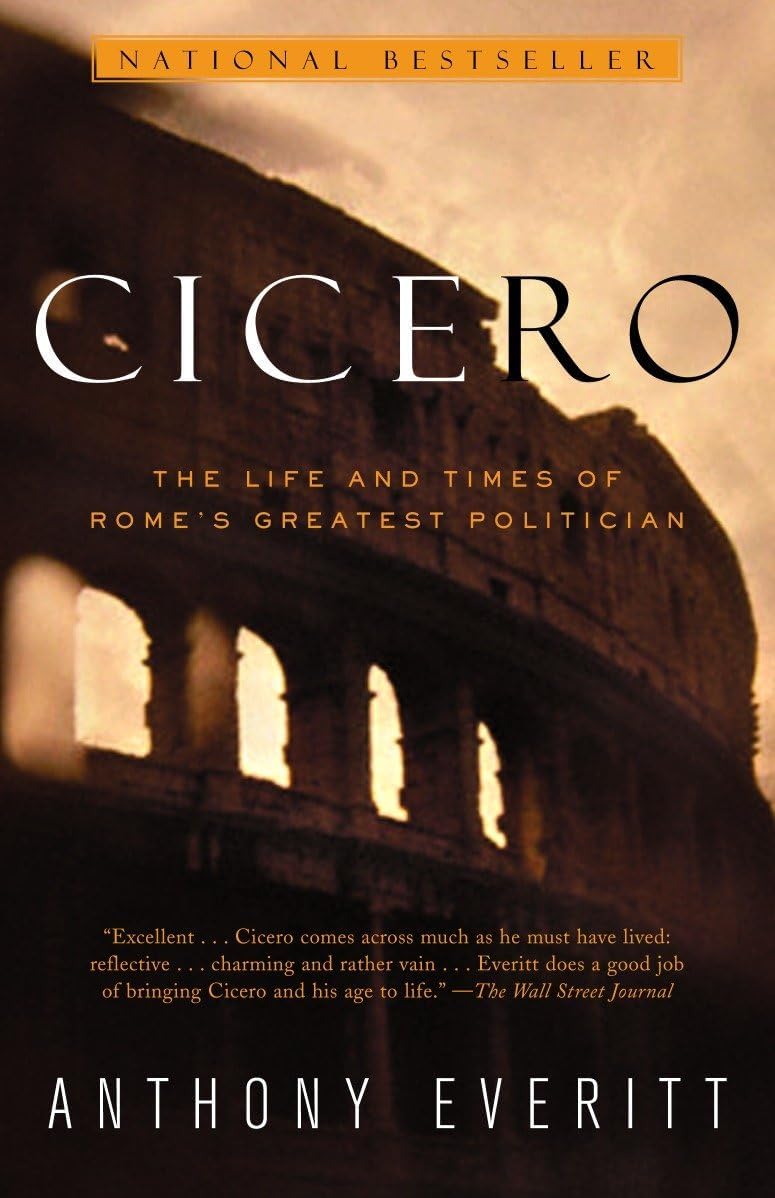
The dust jacket of Everitt's attractive biography quotes a perceptive English reviewer, who observes, "Of all the arts, that of politics has advanced least since the days of Greece and Rome." Upon closing the book, my overwhelming sense was that Franklin Roosevelt, Richard Nixon, Lyndon Johnson and, yes, Bill Clinton would have done perfectly well in Julian Rome. The broad contours of the political game have, in the intervening two millennia, acquired several strips of veneer and a few layers of varnish, but they are immediately recognizable in this briskly paced work. Pompey's political ponderousness, Caesar's bright dexterity, and Cicero's conservative deliberateness all find ready parallels in this and every other age. Gain, glory, and fear are here the prime motivators--generalize to politics Thucydides' famous observation that men will go to war for any of these three reasons and you will have neatly summarized all political motive--and Everitt nicely sifts through the ample historical record to relate how the great men of the late Republic clambered for the pinnacle as the challenge of Julius Caesar loomed. For readers not particularly well versed in Roman history, Everitt does particularly well in quickly situating Cicero's life in the great events of his day, the context of an expanding empire, and the daily life of a Rome that had no city government as we would know it--little public security (private guards for the wealthy, nothing for the rest), sanitation, services, or urban administration. An accretion of checks and balances (so admired by our own founders) caused politics to deadlock, with each of the major protagonists offering solutions that either restored, or circumvented, the formal primacy of the Senate and Rome's great families. Throughout, Everitt renders intelligible a bewildering tangle of events and human interactions. He shows Cicero standing at the center of these great events--with the exception of the plot to kill Caesar, of which he knew nothing (but you who know your Shakespeare will have known this as well...)--or, less charitably, desperately working the Roman public relations apparatus to "seem to stand," on firm Republican principals. At those times when when his cause fails--perhaps as a result of words or long harbored grudges that return to haunt him--Everitt's statesman retires to one of his well-appointed villas and the life of the mind, turning to his beloved philosophy and the composition of the writings that comprise his greatest legacy. I dock this commendable biography a star for an insufficiency of documentation and the generally cursory handling of Cicero's ideas. Yes, yes, I recognize this is popular biography, but some particularly quirky looking passages beg for sourcing and don't get it, while other, better known material gets copious sourcing (and with endnotes, by page and passage, rather than with numbered end- or footnotes). As for Cicero's rich store of written ideas, the major works are dutifully listed, their contents for the most part cursorily described. I for one would have appreciated a broader, deeper discussion, but concluded that Everitt viewed his chapters on the works as necessary drudgery required by the life and legacy and as impediments to his narrative design. (He does in fact refer to the authoritive scholarly studies in a bibliographic appendix.) The author seems too eager to gallop off--perhaps to the cheers of most readers--on his thrilling, often bloody, tale. And so he does. (And why didn't someone at Random House point out to the design people that the Coliseum, which graces the dustjacket, was erected more than a century after Cicero's death? A particularly shameless attempt to cash in on the Russell Crowe picture.) This is nevertheless a very worthy book and a solid--and solidly entertaining--introduction to the life and significance of a great man and to the timeless world of Roman politics. Highly recommended.
N**O
Brilliant
First, I must say that this was my first Roman history book that I've read. So all the names places times and ideas were new to me and, quite honestly, very complex. The first hundred pages I was lost off and on. I had trouble weaving my way through Cicero's world and finding out what I should and should not care about Cicero. I put the book down for a week or two and came back to it and after the story had settled in my mind a bit it was much easier. The point being, this is a rough read for a guy just taking a glance at some Roman history. The book is elegant though. And it's absolutely astonishing that we know so much about Cicero and his time. For most of the book the pace was very brisk and often very exciting. The last 1/4 of the book seems to be intermittently dominated by the duel between Caesar and Pompey. But what a duel! The book is a great read and I've been very impressive in my literature classes due to having read this book on Cicero. Hefty for a first timer but a hell of a book. The author seems brilliant beyond comprehension to be honest. The complexity of creating this story is just unfathomable to me. 5 stars. Great, great history book.
M**N
Gets Right What It Gets, but Doesn't Get It All
Though trained as a historian, Anthony Everitt writes like a novelist--this is both the greatest strength and the greatest weakness of his biography of Cicero. I would rate the first half of the book as excellent. It gives us a good understanding of Cicero's youth, his rise to power, and his early string of political offices, culminating in his Consulship in 63 BCE, during which he put down the Catiline Conspiracy and generally acquitted himself as a competent administrator and ethical civil servant. Everitt draws on a deep knowledge of Cicero's surviving letters and a broad knowledge of Ancient Roman culture to draw a compelling picture of a not-inconsiderable politician. Like Cicero himself, however, the biography peaks too soon. In the second half of the book, Everitt tells the exciting, but generally well-known story of the end of the Roman Republic: the rise of Caesar, the First Triumvirate, the civil war, the assassination of Caesar, and, finally, the formation Second Triumvirate (which sentenced Cicero to death). This is a fascinating history, and Everitt knows it extremely well. But, really, Cicero was a bit player in most of these events (well, except for his own death), so, as the narrative focuses more and more on the Late Republic, the author seems to forget about the subject of his own biography. Cicero becomes kind of a Nick Carraway figure to Julius Caesar's Great Gatsby. The most disappointing thing about this choice of narrative is that, in order to fit in a lot of important events that Cicero-the-Poltiician had only a small role in, Everitt all but ignores Cicero-the-philosopher. He has only passing things to say about the writer who would later be seen as the greatest prose stylist of the Latin language, the greatest popularizer of ancient philosophy, and one of the two most important figures (the other being Quintillian) in the development of rhetorical theory in the Roman world. Everitt glosses over, or fails even to mention, the major philosophical and rhetorical treatises upon which Cicero's reputation actually rests. As a result, it is difficult to understand why exactly Cicero was considered such a big deal. Everitt gives us an excellent biography of a minor politician. A better book, I think, would have told the story of a major writer. It would have told us, not just what Cicero did, but why he mattered.
A**S
Five Stars
This is an exciting account of a highly regarded politician and writer.
G**O
Um indivíduo excepcional nos estertores da República Romana
O autor fornece, em boa prosa, relatos históricos excelentes de Cícero, self made man romano, incluindo seus debates, as defesas que patrocinou e o recolhimento à filosofia após sofrer uma série de tragédias, familiares e políticas. Mesmo com seus defeitos e fracassos, o homem Cícero serve de inspiração moral para os mais atentos, incluindo o momento de sua morte, enfrentado com coragem.
D**S
Ciceron vivant !
Une description vivante et stylée de la vie de Ciceron et de ses contemporains. L'oeuvre permet de mieux comprendre la magistrature romaine, les intrigues politiques, l'évolution de la république vers l'empire et l'impact des grands politiciens dans cet avènement. Une deuxième lecture est tout aussi enrichissante tant l'auteur appporte des détails vivants. On peut se demander pourquoi cet ouvrage n'a pas encore été traduit en français.
T**R
Cicero: Rome's Greatest Politician
Anthony Everitt writes very accessible Roman history; his book on Augustus was very readable, and offers many opportunities for further study by anyone interested in following through on the themes raised in the book. Cicero is a fascinating character by anyone's standards; he pops up in all the Roman historical novels set in the late Republic, and everyone seems to have their own take on what he would have been like. So it is good to be able to get some historical non-fiction perspective on this intriguing man. Extricating Cicero's life, and his personal politics, from the broader (unresolved) discussion on the end of the Roman Republic is quite a challenge in itself, so I was eager to see how the author approached the life and times of Cicero. Beginning with a prologue word picture of Caesar's assassination in 44 BC, the first chapter then outlines briefly and very clearly the political status of Rome at the time of Cicero's youth. The burgeoning political class struggles, the growing problem of land and wealth distribution, the unwieldy and increasingly violent political differences, and the external threats that built up towards the end of the Republic are well, though quickly, reviewed here. And then we are in to Cicero's life itself. Around and through Cicero's life move many other well-known figures of Roman history - Sulla, Crassus, Pompey, Caesar, Catilina. Cicero also seems to have retained close ties with his family and friends, and we are lucky to have so much of his correspondence, including letters with his friend Atticus, and his writings on his cases and Senatorial involvement. Cicero seems to have firmly believed in the Republic, and that the glory of the past years of that institution could be recovered and reclaimed, if only the optimates and the populares would find common ground (without really taking much notice of the new class of men rising from the equites). He dedicated much of his public life to that end, or so he felt. He does not seem, realistically, to have taken into account some of the `new' men who moved into the political and military arena, particularly those who banded together to thwart him in many of his endeavours: Caesar, Pompey, Crassus, even Clodius. Perhaps in that respect at least, Cicero's `glory days' lay firmly in the past of Rome, a past that was quickly being lost forever. The continual ebbing and flowing in late Republican Rome of political groupings, cemented by familial alliances, makes for fascinating and engrossing reading. Cicero's strength, and his ultimate and final weakness, was his inability to accept that the Republic as he believed in it could be gone; his ultimate aim was always "to restore traditional political values" and for this he lived, and died. A wonderful book, beautifully written and so readable that I found it hard to put it down; Cicero's life and times are treated empathetically and compassionately. To finish the book is to feel that you have come to the end of a great story told of a great man. Totally recommended.
I**H
Great read
This an excellent read, very well researched and well-written. It brings to life not just the subject of the book, but the rancorous political times in which he lived. Everitt makes great use of the treasure that is Cicero's surviving letters to tell the story from the inside out, as it were. The letters are a rare survival indeed from antiquity, so it is great that the author has made such good use of them. If you want an entree into Roman history - and at one of the most fascinating times within Rome's history - this is a very good way to do it. He does not presuppose any particular knowledge of Rome but explains in clear language what you need to know about the Roman constitution, so that his story of its destruction is clear and compelling.
Trustpilot
1 month ago
1 month ago