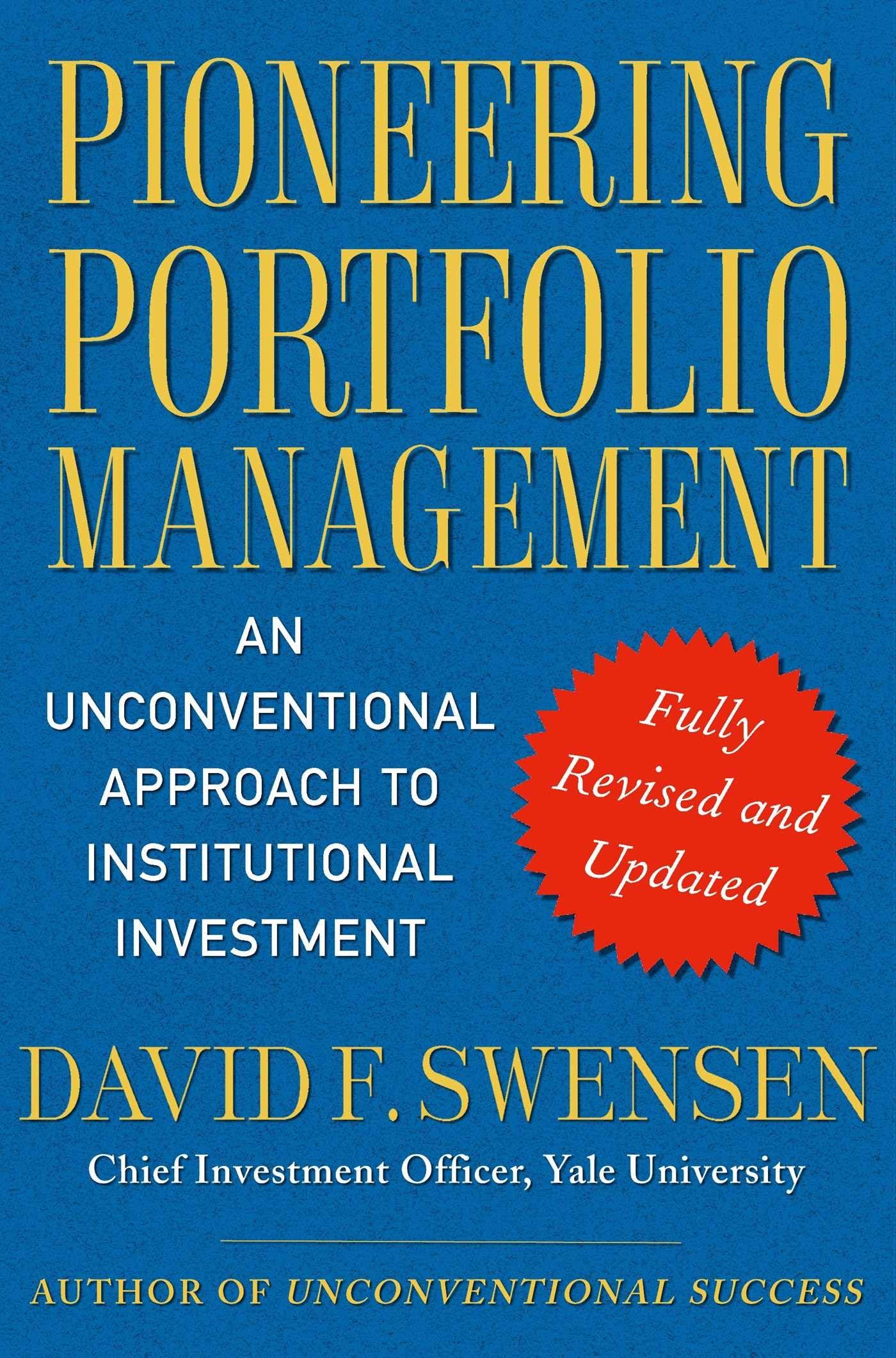
Pioneering Portfolio Management: An Unconventional Approach to Institutional Investment, Fully Revised and Updated
Product ID: 8368246
Desertcart purchases this item on your behalf and handles shipping, customs, and support to Croatia.
An indispensable roadmap for creating a successful investment program from Yale’s chief investment officer, David F. Swensen. In the years since the now-classic Pioneering Portfolio Management was first published, the global investment landscape has changed dramatically -- but the results of David Swensen's investment strategy for the Yale University endowment have remained as impressive as ever. Year after year, Yale's portfolio has trumped the marketplace by a wide margin, and, with over $20 billion added to the endowment under his twenty-three-year tenure, Swensen has contributed more to Yale's finances than anyone ever has to any university in the country. What may have seemed like one among many success stories in the era before the Internet bubble burst emerges now as a completely unprecedented institutional investment achievement. In this fully revised and updated edition, Swensen, author of the bestselling personal finance guide Unconventional Success, describes the investment process that underpins Yale's endowment. He provides lucid and penetrating insight into the world of institutional funds management, illuminating topics ranging from asset-allocation structures to active fund management. Swensen employs an array of vivid real-world examples, many drawn from his own formidable experience, to address critical concepts such as handling risk, selecting advisors, and weathering market pitfalls. Swensen offers clear and incisive advice, especially when describing a counterintuitive path. Conventional investing too often leads to buying high and selling low. Trust is more important than flash-in-the-pan success. Expertise, fortitude, and the long view produce positive results where gimmicks and trend following do not. The original Pioneering Portfolio Management outlined a commonsense template for structuring a well-diversified equity-oriented portfolio. This new edition provides fund managers and students of the market an up-to-date guide for actively managed investment portfolios. Review: Truly unique insight into institutional portfolio management - Swensen's book is a must-read for endowment managers and other institutional investors, particularly those who take a fund-of-funds approach (as does Yale, where Swensen is Chief Investment Officer). Swensen aptly lays out the investment policy that has enabled Yale to consistently outperform other U.S. endowments. As Yale's CIO, Swensen has set a target portfolio allocation that departs significantly from the still heavily U.S. equity and debt-focused strategy of most endowments. Swensen's approach includes a large allocation to asset classes that are not highly correlated to the U.S. public equity market. He outlines these "alternative" classes in his book, giving the reader an excellent view of how alternative investments can increase risk-adjusted portfolio returns. Perhaps the biggest contribution of Swensen's book, however, is the debunking of myths that still lull fiducaries into making the wrong decisions, for example when it comes to picking investment managers. Swensen advises against chasing managers who have performed well simply because of their past performance. If attributes such as personal integrity and the right fee structure are lacking, solid past performance can become a liability, not an asset. Swensen describes the example of private equity firm KKR-- after tremendous early successes, the flood of investor capital into KKR enabled the firm's partners to set up a fee structure that ensured big payoffs for themselves even if their funds underperformed. This is just one of many valuable lessons the reader will draw from Swensen's book. Review: Excellent Resource; Error in Table 4.4 in Kindle Version - This is an excellent resource. In the Kindle version, I believe there is an error in table 4.4. It appears the data in the columns "Third Quartile" and "Range" are switched. For example, in the row U.S. fixed income, the data for Third Quartile is 0.5% and the data under Range is 6.9%. I believe this data is switched, and should read Third Quartile = 6.9% and Range = 0.5%. I believe the same is true for the rest of the data for these two columns. My opinion is supported by the subsequent discussion in the text, where the author indicates the range between first and third quartile returns for fixed income managers is 0.5%. I could not find a forum to provide this feedback, hence it is here. I hope this information is useful.
| Best Sellers Rank | #41,046 in Books ( See Top 100 in Books ) #20 in Investment Portfolio Management #51 in Retirement Planning (Books) |
| Customer Reviews | 4.6 out of 5 stars 439 Reviews |
J**C
Truly unique insight into institutional portfolio management
Swensen's book is a must-read for endowment managers and other institutional investors, particularly those who take a fund-of-funds approach (as does Yale, where Swensen is Chief Investment Officer). Swensen aptly lays out the investment policy that has enabled Yale to consistently outperform other U.S. endowments. As Yale's CIO, Swensen has set a target portfolio allocation that departs significantly from the still heavily U.S. equity and debt-focused strategy of most endowments. Swensen's approach includes a large allocation to asset classes that are not highly correlated to the U.S. public equity market. He outlines these "alternative" classes in his book, giving the reader an excellent view of how alternative investments can increase risk-adjusted portfolio returns. Perhaps the biggest contribution of Swensen's book, however, is the debunking of myths that still lull fiducaries into making the wrong decisions, for example when it comes to picking investment managers. Swensen advises against chasing managers who have performed well simply because of their past performance. If attributes such as personal integrity and the right fee structure are lacking, solid past performance can become a liability, not an asset. Swensen describes the example of private equity firm KKR-- after tremendous early successes, the flood of investor capital into KKR enabled the firm's partners to set up a fee structure that ensured big payoffs for themselves even if their funds underperformed. This is just one of many valuable lessons the reader will draw from Swensen's book.
T**3
Excellent Resource; Error in Table 4.4 in Kindle Version
This is an excellent resource. In the Kindle version, I believe there is an error in table 4.4. It appears the data in the columns "Third Quartile" and "Range" are switched. For example, in the row U.S. fixed income, the data for Third Quartile is 0.5% and the data under Range is 6.9%. I believe this data is switched, and should read Third Quartile = 6.9% and Range = 0.5%. I believe the same is true for the rest of the data for these two columns. My opinion is supported by the subsequent discussion in the text, where the author indicates the range between first and third quartile returns for fixed income managers is 0.5%. I could not find a forum to provide this feedback, hence it is here. I hope this information is useful.
F**.
Good insights; Perhaps DS cannot see his own hubris though
This is an excellent book about the workings of an institutional portfolio and the various influences pulling at investment decisions. Lots of good anecdotal stories of mis-steps by *other* institutions. I would love to hear about some mistakes that DS has made during his tenure. He deals implicitly w/ agency issues that exist in most money management situations. For a more detailed explication of agency conflicts, read, "Unconventional Success". He attributes a lot of manager success to luck. However, how much of DS's and Yale's success is due to luck? He does not subject his own performance (that of managing the managers) to any sort of benchmark. Finally, he gives very short shrift to the back-office and operational issues (1 page at the end of the book). This is the achilles heel of 80% of management firms. They cannot scale, control, and maintain quality as they grow. This is the same, "Its all in the front office" mentality that presages so many other stumbles into mediocrity (not blow ups - just a benign drift downwards in rankings). I hope this same fate does not befall DS and Yale.
D**L
Must Read Investment Book
Swensen made a mark in investing by investing long term in illiquid alternative assets. He shows that long term investors can do very well as long as they do their homework and be patient. I agree with Swensen's model, which is adopted by many endowments and family offices. However, one caveat of his model is the consideration of cost. When Swensen started the portfolio, alternative investments were not so many and the fees were not so high. Now we have lots and lots of alternative investments, charging quite high fees. Hence, it is important to remember that Swensen's model works given a reasonable fee structure.
P**I
a must
Swensen was one of the investing geniuses that left us way too soon. This book is a pillar for the Investment professionals. I cannot recommended enough to read it and go back often to it.
J**S
1 Billion to 24 Billion
Do yourself a huge favor and purchase either this or "Unconventional Success." Swensen lays out a winning gameplan while informing you of the obstacles and risks in current market strategies. Please note it is not necessary to buy both as massive amounts are the same. Also, I have to add that I find him awfully funny. He has some sections where he is very sarcastic and they are laugh out loud funny.
K**K
Must read even for those not in endowment management
Pioneering Portfolio theory is a must read. As other reviewers have said it's essential for any endowment manager. However, it's also a great read for those not interested in asset management. Besides being a fantastic overview of different asset classes and how to think about them, Swensen talks at length about alignment of incentives, how to balance the qualitative and quantitative, and how differing timeframes influence your decisions. All of which are huge components of the decisions anyone makes that often aren't thought about rigorously.
E**E
Still relevant 20 years later
Swensen's framework for Endowment Managment remains a thoughtful and clearly articulated look at institutional best practices. A key lesson of his is often overlooked. Each institution is unique, and should not attempt to copy what has been at Yale or other successful investment programs. I would love Swenson to write another book, but my best guess is it would be very similar to the original masterpiece.
M**.
The best book on endowment and foundation investing
A must-read for long-term institutional investors. Clearly explains the bias towards equities and alternatives at the Yale endowment, while emphasizing that the focus on alternatives is only appropriate for the largest, most skilful and resolute investors. Provides a masterful exposition of how institutions seek to balance investment policy (increasing long-term purchasing power) against spending policy (supporting short- to intermediate-term operational needs). Offers unparalleled insight into the qualitative aspects of investment management, including how to structure investment committee meetings and how to build successful relationships with external investment managers. The appendix (Impure Fixed Income) on why investors should prefer government bonds over corporate bonds - because of the former's superior credit, liquidity, non-callability and alignment of interest with investors - will help many institutions reflect on why they invest in bonds in the first place. Required reading for institutional investors of all sizes and strongly recommended for the serious individual investor.
J**N
Excellent choice to learn
We can learn a lot on portfolio management from basics to expert level.
L**A
Pioneering portfolio management
Fantastic lecture to all investor!!! Even the personal investor who should behave like caring of his family’s endowment. Great book
E**E
Correspond à mes attentes
Must have in Asset Management
R**A
Five Stars
Very reliable. Everything as promised.
Trustpilot
3 weeks ago
3 weeks ago