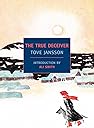
The True Deceiver (New York Review Books Classics)
Product ID: 8470345
Desertcart purchases this item on your behalf and handles shipping, customs, and support to Croatia.
A New York Review Books Original Winner of the Best Translated Book Award Deception—the lies we tell ourselves and the lies we tell others—is the subject of this, Tove Jansson’s most unnerving and unpredictable novel. Here Jansson takes a darker look at the subjects that animate the best of her work, from her sensitive tale of island life, The Summer Book , to her famous Moomin stories: solitude and community, art and life, love and hate. Snow has been falling on the village all winter long. It covers windows and piles up in front of doors. The sun rises late and sets early, and even during the day there is little to do but trade tales. This year everybody’s talking about Katri Kling and Anna Aemelin. Katri is a yellow-eyed outcast who lives with her simpleminded brother and a dog she refuses to name. She has no use for the white lies that smooth social intercourse, and she can see straight to the core of any problem. Anna, an elderly children’s book illustrator, appears to be Katri’s opposite: a respected member of the village, if an aloof one. Anna lives in a large empty house, venturing out in the spring to paint exquisitely detailed forest scenes. But Anna has something Katri wants, and to get it Katri will take control of Anna’s life and livelihood. By the time spring arrives, the two women are caught in a conflict of ideals that threatens to strip them of their most cherished illusions. Review: Creativity vs. Pragmatism - A few weeks ago, the cover of this novel caught my attention as I was browsing here on desertcart. You could say, then, than I judged--and bought--this book based on the cover. The beautiful illustration is by none other than the novel’s author, Tove Jansson, who is famous for her series of children books about the Moomins. Jansson, a Finnish woman who wrote in Swedish, also penned a few novels, five of which are available in English. Before buying _The True Deceiver_ (1982), I checked out a copy of _The Summer Book_ (1972) from my local library, to sample the author’s prose. I was charmed by the impressionistic, episodic, and poetic musings of a young girl who spends a summer with her grandmother. I wanted more, and so I ordered _The True Deceiver_. Jansson allows us to witness the daily life of a small community. The portrayal is quite vivid for such a brief novel, so much so that, cliché as it may sound, I feel as if I had visited this town in person. The specific characters we follow closely are Katri Kling, Anna Aemeling, and Katri’s brother Mats. As the novel begins, Katri and Mats live in an attic over a store. She’s 25 and he’s 15. She’s perceived as a cynic; he’s described as “a bit simple.” (I couldn’t help thinking of Tarjei Vesaas’ _The Birds_, which I read and reviewed a few weeks ago.) Things change for the siblings when they become close to the older Anna, an illustrator of children’s books. Katri offers to help Anna manage her affairs, and the siblings soon move to Anna’s house. The novel might have been titled “Parasite,” as Katri takes over Anna’s life for her own purposes. Anna is the artist; Katri, the pragmatist. We witness the clash between the creative and the practical principles. Perhaps the best example of this occurs when Katri suggests answering the children’s letters with a generic response. Anna would take the time to answer each letter individually. To Katri, this is just a waste of time. She believes everything can be categorized, organized, simplified, and expedited. She destroys the beautiful spontaneity of life. To the pragmatist, “All art is quite useless,” though not exactly in the sense that Oscar Wilde meant it. Katri is good with numbers and seems to know everything there is to know about people. That doesn’t help her to function in society: she is an outcast. An understanding of human nature would lead one to compassion or to misanthropy; Katri is inclined towards the latter. She excels at turning people against each other. She’s the predator who observes life from a distance and is ready to pounce. “As far back as I can remember,” she says, “I’ve done nothing but wait, wait to finally act, to wager all my insight and foresight and daring, wait for the big decisive change that will set everything right” (137). Anna thinks more along these lines: “I would much rather be cheated than to go around distrusting everyone” (128). The meeting of these two seems like the perfect recipe for disaster. What, then, is Mats’ role? He seems to me like a type of synthesis. Like Anna, he draws, but he draws blueprints of boats. He is thus both artistic and pragmatic, and so he can move comfortably between the two women’s perspectives. _The True Deceiver_ is a beautiful, quiet novel. The ending is masterfully understated, open but satisfying. This is not a novella, though. _The Summer Book_ is, by virtue of its episodic, repetitive structure. There is development in _The True Deceiver_, and this makes it a novel, though Jansson incorporates to it elements of the novella, to great advantage. _The Summer Book_ seems to have a wider audience, but I’ll admit I enjoyed _The True Deceiver_ more. Both books were good enough for me to be interested in reading more by Jansson. Next on my list, by the same author: the novel _Fair Play_ (1989) or the short story collection _The Woman Who Borrowed Memories_. Thanks for reading, and enjoy the book! Review: Small Psychological Gem - If you're a fan of psychological studies, you owe THE TRUE DECEIVER a look. Set in Sweden in the first half of the 20th century, the book offers a battle of wills that you don't even realize is happening at times, it's so subtle. Katri Kling becomes a care-taker for the famous children's book illustrator, Anna Aemilin, and it sets the small-town tongues wagging. "They make an odd couple, after all, so what's afoot?" seems to be the question of the moment. Katri is logical to a fault and has little patience for the "games people play." She plays ice to emotional Anna's fire. In fact, not only is Anna well-versed in the games people play, she has practically written her own game. Throw into this face-off two wildcards: Katri's "simple-minded" brother, Mats, and her dog with no-name (which Anna initially fears and then wins over) and you have the cast for a mimimalist drama set against a relentless background of snow, ice, and winter. Spring does come, however, and it plays a decided role in the denouement. When you reach it, you'll wonder how Tove Jansson pulls it off. It sure SEEMS like not much is happening -- and yet, all along, something is. A metaphorical chess match, in fact, one you have to sit back and admire because it could have come across as so melodramatic and treacly in the wrong hands. Best of all? The matter of who the "true deceiver" is remains subject to debate, even after the end. I love books like that, because they leave you thinking, engaging in your own internal debates. Good literature -- even smaller examples like this -- should do just that, no?
| Best Sellers Rank | #166,113 in Books ( See Top 100 in Books ) #1,639 in Women's Friendship Fiction #1,766 in Small Town & Rural Fiction (Books) #1,846 in Psychological Fiction (Books) |
| Customer Reviews | 4.3 out of 5 stars 465 Reviews |
D**E
Creativity vs. Pragmatism
A few weeks ago, the cover of this novel caught my attention as I was browsing here on Amazon. You could say, then, than I judged--and bought--this book based on the cover. The beautiful illustration is by none other than the novel’s author, Tove Jansson, who is famous for her series of children books about the Moomins. Jansson, a Finnish woman who wrote in Swedish, also penned a few novels, five of which are available in English. Before buying _The True Deceiver_ (1982), I checked out a copy of _The Summer Book_ (1972) from my local library, to sample the author’s prose. I was charmed by the impressionistic, episodic, and poetic musings of a young girl who spends a summer with her grandmother. I wanted more, and so I ordered _The True Deceiver_. Jansson allows us to witness the daily life of a small community. The portrayal is quite vivid for such a brief novel, so much so that, cliché as it may sound, I feel as if I had visited this town in person. The specific characters we follow closely are Katri Kling, Anna Aemeling, and Katri’s brother Mats. As the novel begins, Katri and Mats live in an attic over a store. She’s 25 and he’s 15. She’s perceived as a cynic; he’s described as “a bit simple.” (I couldn’t help thinking of Tarjei Vesaas’ _The Birds_, which I read and reviewed a few weeks ago.) Things change for the siblings when they become close to the older Anna, an illustrator of children’s books. Katri offers to help Anna manage her affairs, and the siblings soon move to Anna’s house. The novel might have been titled “Parasite,” as Katri takes over Anna’s life for her own purposes. Anna is the artist; Katri, the pragmatist. We witness the clash between the creative and the practical principles. Perhaps the best example of this occurs when Katri suggests answering the children’s letters with a generic response. Anna would take the time to answer each letter individually. To Katri, this is just a waste of time. She believes everything can be categorized, organized, simplified, and expedited. She destroys the beautiful spontaneity of life. To the pragmatist, “All art is quite useless,” though not exactly in the sense that Oscar Wilde meant it. Katri is good with numbers and seems to know everything there is to know about people. That doesn’t help her to function in society: she is an outcast. An understanding of human nature would lead one to compassion or to misanthropy; Katri is inclined towards the latter. She excels at turning people against each other. She’s the predator who observes life from a distance and is ready to pounce. “As far back as I can remember,” she says, “I’ve done nothing but wait, wait to finally act, to wager all my insight and foresight and daring, wait for the big decisive change that will set everything right” (137). Anna thinks more along these lines: “I would much rather be cheated than to go around distrusting everyone” (128). The meeting of these two seems like the perfect recipe for disaster. What, then, is Mats’ role? He seems to me like a type of synthesis. Like Anna, he draws, but he draws blueprints of boats. He is thus both artistic and pragmatic, and so he can move comfortably between the two women’s perspectives. _The True Deceiver_ is a beautiful, quiet novel. The ending is masterfully understated, open but satisfying. This is not a novella, though. _The Summer Book_ is, by virtue of its episodic, repetitive structure. There is development in _The True Deceiver_, and this makes it a novel, though Jansson incorporates to it elements of the novella, to great advantage. _The Summer Book_ seems to have a wider audience, but I’ll admit I enjoyed _The True Deceiver_ more. Both books were good enough for me to be interested in reading more by Jansson. Next on my list, by the same author: the novel _Fair Play_ (1989) or the short story collection _The Woman Who Borrowed Memories_. Thanks for reading, and enjoy the book!
K**C
Small Psychological Gem
If you're a fan of psychological studies, you owe THE TRUE DECEIVER a look. Set in Sweden in the first half of the 20th century, the book offers a battle of wills that you don't even realize is happening at times, it's so subtle. Katri Kling becomes a care-taker for the famous children's book illustrator, Anna Aemilin, and it sets the small-town tongues wagging. "They make an odd couple, after all, so what's afoot?" seems to be the question of the moment. Katri is logical to a fault and has little patience for the "games people play." She plays ice to emotional Anna's fire. In fact, not only is Anna well-versed in the games people play, she has practically written her own game. Throw into this face-off two wildcards: Katri's "simple-minded" brother, Mats, and her dog with no-name (which Anna initially fears and then wins over) and you have the cast for a mimimalist drama set against a relentless background of snow, ice, and winter. Spring does come, however, and it plays a decided role in the denouement. When you reach it, you'll wonder how Tove Jansson pulls it off. It sure SEEMS like not much is happening -- and yet, all along, something is. A metaphorical chess match, in fact, one you have to sit back and admire because it could have come across as so melodramatic and treacly in the wrong hands. Best of all? The matter of who the "true deceiver" is remains subject to debate, even after the end. I love books like that, because they leave you thinking, engaging in your own internal debates. Good literature -- even smaller examples like this -- should do just that, no?
D**S
Is it a nice beach read or something much more?
Isn't interesting how small books can pack as much punch and cause as much "trouble" or provocation any mega book that aspires to that? Tove Jansson's "The True Deceiver" puts us physically and psychologically into the minds and bodies of villagers in Scandanavia during a typically bleak winter. She brings us into all the small minded ambitions, misunderstandings and presumptions and judgements that preoccupy the main characters and their neighbors. She writes with sparing use of adjectives, relying on the relentless themes of winter, darkness, objectivity and it's counter part; self deception. "The True Deceiver" is often said to be the dark rejoinder to "The Summer Book". I think that's right. In "The Summer Book" a wonderful grandmother treats her granddaughter with love and respect while introducing her to art and nature. Here we have the elderly children's illustrator Anna Amelin. I loved Janssen description that expose Anna perhaps more detached that friendly. "PERHAPS THE REASON PEOPLE called Anna Aemelin nice was because nothing had ever forced her to exhibit malice, and because she had an uncommon ability to forget unpleasant things" In one quick snapshot doubt is raised about her character and know at best she is untested. And in comes Katri. A young woman viewed equally with respect and suspicion in town. She is driven to protect her younger brother and sees a potential means out of her poverty by working herself into Anna's life and household. But Katri views herself as honest and obsessed with seeing the world objectively. Such are the constraints as she moves to manipulate the situation for her benefit. Will she win or be outwitted? In the end will there be a winner? It's a fascinating set up. One can dwell on deeper meanings, motive and justifications. Or one can sit deep in a chair a read a story about a cold winter in a small taken and be transported to that very isolated spot. Either way it well worth the ride on the back of originality in plot, location, writing and characters. 'Anna continued. "Now don't take this the wrong way, Miss Kling, but I find your way of never saying what a person expects you to say, I find it somehow appealing. In you there's no, if you'll pardon my saying so, no trace of what people call politeness ... And politeness can sometimes be almost a kind of deceit, can it not? Do you know what I mean?" "Yes," said Katri. "I do."'
D**T
Book club found it interesting.
Interesting style of writing but it gives an interesting study of the three main characters. Really conveys the isolation and cold of the area.
J**N
The Wolf and The Rabbit
The True Deceiver may well be a perfect book. Not a word is wasted and nothing is dumbed down: it is, in turns, complex and subtle, psychologically astute, unsettling, and controlled. The language can only be described as spare: taut, minimalistic, precise. Take the opening lines: "It was an ordinary dark winter morning, and snow was still falling. No window in the village showed a light." In a mere two sentences, Tove Jansson sets up an entire mood and introduces a sense of danger as well as contrasts (dark/light); this author will toy with contrasts throughout the length of the book. The two key characters are "the wolf", Katri Kling, a yellow-eyed, wolfish young woman who stands on the outskirts of her Finnish village due to her bluntness and lack of social amenities. Katri cares for her gentle and slow-witted brother, Mats, and a nameless dog who obeys her every command. She revels in her superiority to others: "My dog and I despise them. We're hidden in our own secret life, concealed in our own innermost wilderness." Her opponent - and that is what she becomes - is Anna Aemalin, an illustrator of children's books, who has achieved a degree of fame with her charming bunnies. At first meeting, she is trusting, truthful, and, like Katri, very solitary. As Katri gains her trust - and breaks down her sense of security - many themes come into play. Among them: "How many different truths are there, and what justifies them? What a person believes? What a person accomplishes? Self-deception? Is it only the result that counts?" Is it indeed safe and reassuring to believe in only one thing? And ultimately...who is the wolf and who is the rabbit? As readers, we stand by rapt as we watch the caustic and subtle effects of deception on innocence and integrity. The "prize" may be nothing less than personal identity. My hat's off to translator Thomas Teal, who expertly and precisely translated this 1982 Finnish masterwork with all its nuances intact.
M**E
good read
I leave the plot up to others. I can say the writing has captured the essence of a cold Swedish Winter by a writer who grew up in a Swedish-speaking part of Finland. The translation is especially well done. The writer has written some marvelous children's stories and several adult stories. I suspect the children's story experience has led to a wonderful ability to paint scenes and give characters life. I am a fan of Nordic crime/mysteries and consider this one of the best.
A**B
great prose-a curious novel
I love Tove Jansson's work. I discovered her late(r) in life and so glad I did. Read The Summer Book, and now this one. She's such a fantastic writer. Prose is tight, spare, and flowing. Nothing extra to it. It feels like such an interesting, contained world. I look forward to the next book of hers I read. The True Deceiver is one of those special books that seems to come out of nowhere, with no links to other tales or plots. Grateful for Tove.
A**L
Read slow, makes it sweeter
A short story may be a quick read but the mental dive is deep and will linger a long time.
H**E
a great read
Lovely story and so beautifully written. I was enchanted by the characters and the setting. A clever plot and well described
A**S
Ignorance vs. Realism
I loved this work for it's exploration of the idea of someone is completely naive to the failings of our species and the other completely jaded about it being in the same space. It really got me thinking about the superficial society that we live in and how we construct acceptable norms which so often hide the truth and reality of a situation. I thought that it read well in English and found that I couldn't put it down. Great book!
L**A
Intense and intriguing.
I was actually looking for something whimsical and or light when I chose this book. But it was (to me) a very intense and dark book. Nonetheless I found it very intriguing. I felt Tove built these characters up in a true manner, to the point of being almost disturbing.
E**W
"The wind's assault on the trees produced voices, music, distant cries..."
This is, as Ali Smith says in her introduction, an "unassuming, unexpected, powerful piece of work." Within this novel Jansson tackles, in a mood of dark existentialism, the Scandinavian winter. The novel is set in a tiny hamlet bounded by a vast lake and a deep, dark forest. Anna Armelin lives in the forest in what is known as "The Rabbit House", inside the walls have washed to a faded blue, outside the children build tunnels in the snow that only they can traverse. In a sense, every house is under siege to the children, but in particular they target Katri and her brother Mats, who, along with Anna Armelin, are at the core of this story. The village is a hotbed of vicious gossip, the main subject being Katri, who is clever and sharp, who rarely smiles and never laughs and who is accompanied everywhere by her huge Alsatian dog. The events of this novel are not earth-shaking, but one becomes embroiled in the negotiations between brother and sister and selected members of the tiny community, as Katri struggles to fulfil her dream. The writing is brilliantly stark and cool (in both senses of the word) as relationships are forged and broken apart in this beautifully crafted and compulsively readable novel.
S**E
Cold and intriguing
This is an unusual story written in sparse prose that brilliantly conveys the snowy cold of a Swedish winter. It's atmospheric and compelling, but I wouldn't go so far as to describe it as a psychological thriller. The main characters are two women whose lives, apart from the isolation which affects them both, are as different as a Swedish winter from an African summer. Katya is young and clever, and lives in the village with her simple-minded but creative brother and an unhappy dog. Anna is older and wealthier, an illustrator of children's books, who lives in her family home, a place the locals have nicknamed the Rabbit House, away out of the village at the edge of the woods. From the moment Katya decides she wants to live in the Rabbit House, there develops an intriguing build-up of lies and deception. I can't say that I particularly liked the book, nor did I really warm to the characters. Katya, in particular, is someone it's hard to like and impossible to know, but despite all this it's a five-star read. If that sounds too paradoxical to be true read it and see what you think. It won't take you long as it's quite a short book. And the title is more subtly clever than at first it seems ... You'll still be thinking about it long after you've finished reading the book.
Trustpilot
2 months ago
3 weeks ago