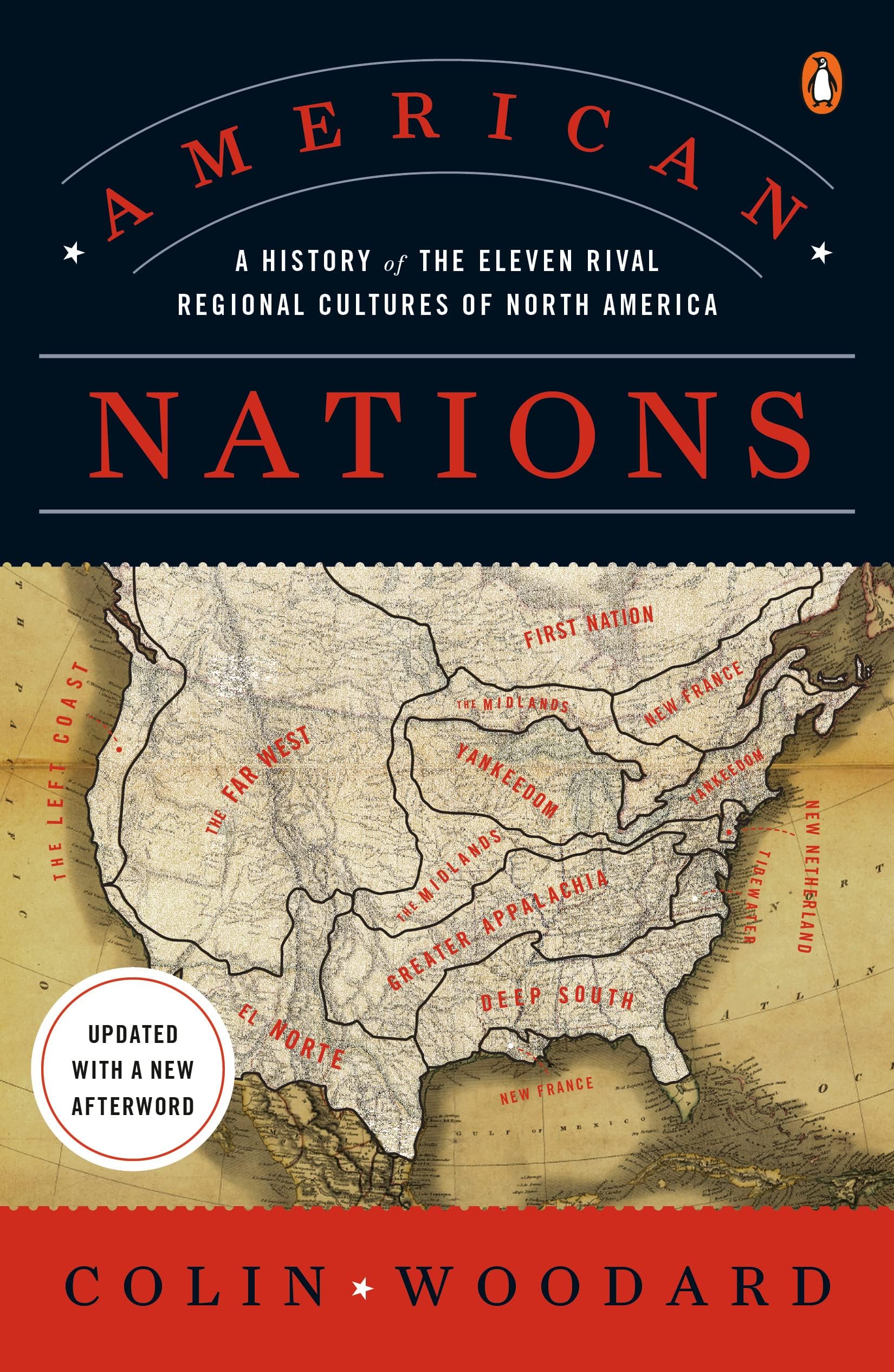

American Nations: A History of the Eleven Rival Regional Cultures of North America - Kindle edition by Woodard, Colin. Download it once and read it on your Kindle device, PC, phones or tablets. Use features like bookmarks, note taking and highlighting while reading American Nations: A History of the Eleven Rival Regional Cultures of North America. Review: intriguing historical and sociological thesis might explain a lot - Pursues for this generation the same themes as "Albion's Seed" did for the last ...although with considerably different details. Where "Albion's Seed" was largely about the pre-revolutionary period, a much longer span of years including the Civil War era as well as the present day is analyzed here. A book not of new research through primary sources, but rather of synthesis of other carefully chosen works of history around a theme few even imagined and almost none expressed quite this way. Specifically, the themes here are that the several cultures within the U.S. are more different from each other than quite a few nation-states, and that although the "Borderlanders" were a majority of the population, they were egregiously excluded from political power until the time of Andrew Jackson, and are still often thought of derogatorily. He tries pretty hard -and fairly successfully- to be even-handed. Nevertheless I managed to form the impression his personal tendencies were toward progressive causes and away from the Deep South. And he does say explicitly at one point "Since 1877 the driving force of American politics hasn't primarily been a class struggle or tension between agrarian and commercial interests, or even between competing partisan ideologies, although each has played a role. Ultimately the determinative political struggle has been a clash between shifting coalitions of ethnoregional nations, one invariably headed by the Deep South, the other by Yankeedom." Among other things, this history explains why Ohio is such an important swing state in presidential elections (different land ownership resulted in _three_ different "nations" settling inside a single state ...and in dis-contiguous areas). Although he doesn't explicitly cover it at all, it seemed clear to me from reading that both a large and growing population and economic might are keys to a culture being influential. He very briefly covers the apparently uncontroversial historical maxim that the original settling (or resettling) of an area often determines its culture for hundreds of years, even after both the original people and the original economy have largely vanished. Since there are currently very few pursuing this unfamiliar line of historical inquiry, he perforce paints with quite a broad brush. As a result, some of his details feel "half-baked", and once in a while at the edges there's a whopper that has trouble standing up to a few moments deep thought. U.S. history has become mostly New England history (can you imagine relating the mythology of the U.S. without mentioning Plymouth Rock?). What happened to all the other colonies, including the older one at Jamestown? He explains how the Tidewater culture centered on Virginia was very large and enormously influential through the early decades of the union, but ultimately was hemmed in by geography and ecology and shrank to not a whole lot more than an appendage to the Deep South. He explains how the original Georgia colony was overwhelmed by the economy of the Deep South (which was founded by immigrants from Barbados rather than from Europe) and disappeared into it. And he very briefly explains that the Florida explorations and colonies were originally tied to the Spanish empire and so largely lost to the U.S. He makes a convincing case that the odds were heavily stacked _against_ the very dissimilar "New England", "New Netherland", "Tidewater", and "Deep South" colonies allying to fight for independence and federate under the constitution; splintering of the union was a very real threat for much of the next century. He shows how the settling of the coastal areas of the west coast by immigrants who came by ship (many from New England) produced a culture quite different from the more interior areas of those same states that were settled by different immigrants who came overland. Genesis of "The Left Coast" cultural nation is one of the sketchiest parts of his book, and as one who lived in California for quite a while, I found it maddeningly oversimplified. Still, he's put forward a seemingly reasonable novel point of view that brings order to a lot of loose ends. He opines that although the cultures in the U.S. had to fit reasonably well into their local ecologies, most of them were not really determined by it. (I sometimes felt he actually underplayed some obvious ecological constraints.) The one glaring exception to U.S. cultures not being determined by ecology is the "Far West", whose dryness and vastness completely stymied all the cultures that attempted to expand into it. It ultimately was settled only by following the lead of large corporatist frameworks that could organize thousands of people and support them with pinpoint application of large amounts of capital, and is still dependent on the largesse of the federal government. He's young (not long out of grad school) and he makes his living writing books and articles, rather than as an academic historian, so he has a very fresh approach to everything. For example he explains that in the backcountry folks used "whiskey" as currency (coins were almost completely absent); the tax that prompted the "Whiskey Rebellion" was essentially a blow by the coastal elites against backcountry currency! He explicitly covers every bit of background, not assuming anything at all, so readers never feel like "something's missing". He unabashedly take firm sides on current controveries, for example stating the Civil War was clearly about slavery rather than states' rights. And he's not constrained by either the "conventional wisdom" or the need to publish only defensible interpretations. Without any qualification he refers to the "Far West" as an "internal colony". Often where an academician would remain silent in the face of ambiguous or conflicting primary sources, he'll say frankly what he reads "between the lines". For example he plainly states that the scheme of Robert Morris, Alexander Hamilton, and others after the revolution to redeem federal debt certificates at full face value really was an outrageous and corrupt scheme, with much in common with the financial meltdown of 2008. He even opines (with some supporting evidence) that the "Founding Fathers" were slanted toward carefully circumscribed democracy and economic exploitation by elites. The emphasis here is on empirical description of the U.S., not on theory or polemics. There's almost nothing allowing comparison to other countries. So we're left with the vague notion the countries of North America are "atypical", but without any specifics or quantification or context. His speculations about possible future trends for the North American countries are restricted to a few pages in the last chapter and the Epilogue. Several things he says implicitly lead to the conclusion that the U.S. would have been better off if the South had been allowed to leave the Union quietly without a Civil War. On the other hand he explicitly states -using Canada as his example- that even without the South, encompassing several very different cultures would still be problematic, and the Union might ultimately shrink back in power and authority to little more than a federation of semi-independent states like the original confederation of 1781. Review: Must read - I think anyone who is interested in the public life of North America needs to read this book. It is extremely well-written, engrossing, and important to public debate. The first part traces the historical roots of the eleven nations of the northern 2/3 our continent. The argument is well-buttressed with historical observations, and ultimately is persuasive that there are indeed eleven nations within our country (12 if you count Miami, the capital of the Caribbean), it is persuasive about the characteristics of the nations and why they developed and spread the way they did. I accept pretty much everything in the first half of the book and consider it a great addition to my understanding of American history. The second half of the book traces modern developments and looks a bit into the future. It less persuasive but still worth the read, as it applies the eleven-nation concept to more modern times. Disclosure: I view myself as somewhat liberal in outlook with a somewhat libertarian flavor to it. I am an independent but I currently dislike the Republican party more than I dislike the Democratic party. I was born and raised in DC (which, as the author admits, is somewhat unique) and lived in the nation of Tidewater for 30 years. I moved to Pittsburgh in the nation of Midlands and have lived here for 30 years. Perhaps this explains the nagging feeling throughout the book that, despite the historical facts that buttress the arguments, there is a Yankee national bias to the book. Perhaps the frequent representation of the nation of Deep South as the fount of all evil tends to create this expression. Is there nothing about the Deep South that is good? I will leave that to others to answer. I will instead concentrate on some differences between Tidewater and Midlands that I have experienced, which makes me long for some aspects of Tidewater. Perhaps having attending the University of Virginia has warped my outlook, but so be it. The highway departments in both Pennsylvania (mostly Midlands) and Virginia (mostly Tidewater) are both known for their past corruption (though things may be better now). In the Pittsburgh area, while I was living here, Route 51 was paved by a corrupt contractor who not only got the bid through fraud but also used substandard paving so that the entire highway had to be repaved a year or so later. I don't think this kind of corruption happens in Virginia. A different kind of corruption happens (or happened) there. Contracts were awarded to those who had connections, and perhaps offered certain inducements to officials of the highway department. But paving with substandard materials? Simply not done. And, I remember once when I took a crew of folks visiting from Roanoke Virginia (in Tidewater) walking from the University of Pittsburgh to a restaurant in the student-slum area near the University. They were commenting on the amount of trash on the streets and sidewalks, and had to resist the urge to start picking it all up. Perhaps some of this is due to the Appalachian influence in Pittsburgh. In Tidewater, as a middle class developed, some of the principles of the old aristocracy took hold with the middle and even the lower classes, and even regardless of race. Despite being seen by some as a Yankee virtue, neatness, pride in one's houses and village and cities, a sense of responsibility for the land and the people is a core value in Tidewater and indeed in some of the Deep South. It's a sense of noblesse oblige handed down from the originally English aristocracy who originally ruled the land -- people like James Madison, George Washington, and Thomas Jefferson. If you hike the Appalachian Trail, you can see this in the care that goes into trail and shelter maintenance as you hike through Tidewater Virginia. Given these sorts of observations, I wish the MR. Woodard had expanded the work a bit, dealing a bit more with counterexamples to his arguments, accepting some and dismissing others. It would ultimately have been a bit more persuasive and enlightening. Regardless, is is a must-read. I will have my wife and 14-year-old daughter read it and then we will have a family book club discussing it.

| ASIN | B0052RDIZA |
| Accessibility | Learn more |
| Best Sellers Rank | #19,992 in Kindle Store ( See Top 100 in Kindle Store ) #1 in Cultural & Ethnic Studies Social Science eBooks #2 in Human Geography (Kindle Store) #3 in Historical Study Reference (Kindle Store) |
| Customer Reviews | 4.6 4.6 out of 5 stars (5,251) |
| Enhanced typesetting | Enabled |
| File size | 7.4 MB |
| ISBN-13 | 978-1101544457 |
| Language | English |
| Page Flip | Enabled |
| Print length | 395 pages |
| Publication date | September 29, 2011 |
| Publisher | Penguin Books |
| Screen Reader | Supported |
| Word Wise | Enabled |
| X-Ray | Enabled |
C**S
intriguing historical and sociological thesis might explain a lot
Pursues for this generation the same themes as "Albion's Seed" did for the last ...although with considerably different details. Where "Albion's Seed" was largely about the pre-revolutionary period, a much longer span of years including the Civil War era as well as the present day is analyzed here. A book not of new research through primary sources, but rather of synthesis of other carefully chosen works of history around a theme few even imagined and almost none expressed quite this way. Specifically, the themes here are that the several cultures within the U.S. are more different from each other than quite a few nation-states, and that although the "Borderlanders" were a majority of the population, they were egregiously excluded from political power until the time of Andrew Jackson, and are still often thought of derogatorily. He tries pretty hard -and fairly successfully- to be even-handed. Nevertheless I managed to form the impression his personal tendencies were toward progressive causes and away from the Deep South. And he does say explicitly at one point "Since 1877 the driving force of American politics hasn't primarily been a class struggle or tension between agrarian and commercial interests, or even between competing partisan ideologies, although each has played a role. Ultimately the determinative political struggle has been a clash between shifting coalitions of ethnoregional nations, one invariably headed by the Deep South, the other by Yankeedom." Among other things, this history explains why Ohio is such an important swing state in presidential elections (different land ownership resulted in _three_ different "nations" settling inside a single state ...and in dis-contiguous areas). Although he doesn't explicitly cover it at all, it seemed clear to me from reading that both a large and growing population and economic might are keys to a culture being influential. He very briefly covers the apparently uncontroversial historical maxim that the original settling (or resettling) of an area often determines its culture for hundreds of years, even after both the original people and the original economy have largely vanished. Since there are currently very few pursuing this unfamiliar line of historical inquiry, he perforce paints with quite a broad brush. As a result, some of his details feel "half-baked", and once in a while at the edges there's a whopper that has trouble standing up to a few moments deep thought. U.S. history has become mostly New England history (can you imagine relating the mythology of the U.S. without mentioning Plymouth Rock?). What happened to all the other colonies, including the older one at Jamestown? He explains how the Tidewater culture centered on Virginia was very large and enormously influential through the early decades of the union, but ultimately was hemmed in by geography and ecology and shrank to not a whole lot more than an appendage to the Deep South. He explains how the original Georgia colony was overwhelmed by the economy of the Deep South (which was founded by immigrants from Barbados rather than from Europe) and disappeared into it. And he very briefly explains that the Florida explorations and colonies were originally tied to the Spanish empire and so largely lost to the U.S. He makes a convincing case that the odds were heavily stacked _against_ the very dissimilar "New England", "New Netherland", "Tidewater", and "Deep South" colonies allying to fight for independence and federate under the constitution; splintering of the union was a very real threat for much of the next century. He shows how the settling of the coastal areas of the west coast by immigrants who came by ship (many from New England) produced a culture quite different from the more interior areas of those same states that were settled by different immigrants who came overland. Genesis of "The Left Coast" cultural nation is one of the sketchiest parts of his book, and as one who lived in California for quite a while, I found it maddeningly oversimplified. Still, he's put forward a seemingly reasonable novel point of view that brings order to a lot of loose ends. He opines that although the cultures in the U.S. had to fit reasonably well into their local ecologies, most of them were not really determined by it. (I sometimes felt he actually underplayed some obvious ecological constraints.) The one glaring exception to U.S. cultures not being determined by ecology is the "Far West", whose dryness and vastness completely stymied all the cultures that attempted to expand into it. It ultimately was settled only by following the lead of large corporatist frameworks that could organize thousands of people and support them with pinpoint application of large amounts of capital, and is still dependent on the largesse of the federal government. He's young (not long out of grad school) and he makes his living writing books and articles, rather than as an academic historian, so he has a very fresh approach to everything. For example he explains that in the backcountry folks used "whiskey" as currency (coins were almost completely absent); the tax that prompted the "Whiskey Rebellion" was essentially a blow by the coastal elites against backcountry currency! He explicitly covers every bit of background, not assuming anything at all, so readers never feel like "something's missing". He unabashedly take firm sides on current controveries, for example stating the Civil War was clearly about slavery rather than states' rights. And he's not constrained by either the "conventional wisdom" or the need to publish only defensible interpretations. Without any qualification he refers to the "Far West" as an "internal colony". Often where an academician would remain silent in the face of ambiguous or conflicting primary sources, he'll say frankly what he reads "between the lines". For example he plainly states that the scheme of Robert Morris, Alexander Hamilton, and others after the revolution to redeem federal debt certificates at full face value really was an outrageous and corrupt scheme, with much in common with the financial meltdown of 2008. He even opines (with some supporting evidence) that the "Founding Fathers" were slanted toward carefully circumscribed democracy and economic exploitation by elites. The emphasis here is on empirical description of the U.S., not on theory or polemics. There's almost nothing allowing comparison to other countries. So we're left with the vague notion the countries of North America are "atypical", but without any specifics or quantification or context. His speculations about possible future trends for the North American countries are restricted to a few pages in the last chapter and the Epilogue. Several things he says implicitly lead to the conclusion that the U.S. would have been better off if the South had been allowed to leave the Union quietly without a Civil War. On the other hand he explicitly states -using Canada as his example- that even without the South, encompassing several very different cultures would still be problematic, and the Union might ultimately shrink back in power and authority to little more than a federation of semi-independent states like the original confederation of 1781.
K**R
Must read
I think anyone who is interested in the public life of North America needs to read this book. It is extremely well-written, engrossing, and important to public debate. The first part traces the historical roots of the eleven nations of the northern 2/3 our continent. The argument is well-buttressed with historical observations, and ultimately is persuasive that there are indeed eleven nations within our country (12 if you count Miami, the capital of the Caribbean), it is persuasive about the characteristics of the nations and why they developed and spread the way they did. I accept pretty much everything in the first half of the book and consider it a great addition to my understanding of American history. The second half of the book traces modern developments and looks a bit into the future. It less persuasive but still worth the read, as it applies the eleven-nation concept to more modern times. Disclosure: I view myself as somewhat liberal in outlook with a somewhat libertarian flavor to it. I am an independent but I currently dislike the Republican party more than I dislike the Democratic party. I was born and raised in DC (which, as the author admits, is somewhat unique) and lived in the nation of Tidewater for 30 years. I moved to Pittsburgh in the nation of Midlands and have lived here for 30 years. Perhaps this explains the nagging feeling throughout the book that, despite the historical facts that buttress the arguments, there is a Yankee national bias to the book. Perhaps the frequent representation of the nation of Deep South as the fount of all evil tends to create this expression. Is there nothing about the Deep South that is good? I will leave that to others to answer. I will instead concentrate on some differences between Tidewater and Midlands that I have experienced, which makes me long for some aspects of Tidewater. Perhaps having attending the University of Virginia has warped my outlook, but so be it. The highway departments in both Pennsylvania (mostly Midlands) and Virginia (mostly Tidewater) are both known for their past corruption (though things may be better now). In the Pittsburgh area, while I was living here, Route 51 was paved by a corrupt contractor who not only got the bid through fraud but also used substandard paving so that the entire highway had to be repaved a year or so later. I don't think this kind of corruption happens in Virginia. A different kind of corruption happens (or happened) there. Contracts were awarded to those who had connections, and perhaps offered certain inducements to officials of the highway department. But paving with substandard materials? Simply not done. And, I remember once when I took a crew of folks visiting from Roanoke Virginia (in Tidewater) walking from the University of Pittsburgh to a restaurant in the student-slum area near the University. They were commenting on the amount of trash on the streets and sidewalks, and had to resist the urge to start picking it all up. Perhaps some of this is due to the Appalachian influence in Pittsburgh. In Tidewater, as a middle class developed, some of the principles of the old aristocracy took hold with the middle and even the lower classes, and even regardless of race. Despite being seen by some as a Yankee virtue, neatness, pride in one's houses and village and cities, a sense of responsibility for the land and the people is a core value in Tidewater and indeed in some of the Deep South. It's a sense of noblesse oblige handed down from the originally English aristocracy who originally ruled the land -- people like James Madison, George Washington, and Thomas Jefferson. If you hike the Appalachian Trail, you can see this in the care that goes into trail and shelter maintenance as you hike through Tidewater Virginia. Given these sorts of observations, I wish the MR. Woodard had expanded the work a bit, dealing a bit more with counterexamples to his arguments, accepting some and dismissing others. It would ultimately have been a bit more persuasive and enlightening. Regardless, is is a must-read. I will have my wife and 14-year-old daughter read it and then we will have a family book club discussing it.
V**�
Very interesting book
C**N
.... and how their different visions create the current political dysfunction. A remarkable insight into why we are where we are and why different regions of the US see things so differently. A must read.
D**W
Provides a well researched an written history of the foundation colonies which after the War of independence became the United States. It links the foundation ethos of individual colonies to contemporary events and in doing so helps an outsider appreciate some of the forces that are ripping the nation apart. Based on this analysis it is hard to imagine a future in which the country can survive in its present form.
R**E
Se si ha voglia di tentare di capire qualcosa degli Stati Uniti di oggi, questo è un testo imprescindibile. E di piacevolissima lettura.
A**N
Colin Woodard has written an interesting book. His basic thesis is very straightforward: that it is possible to have nations that don't have their own states. Using this thesis, he explores the idea that in North American there are multiple nations spread across north Mexico, the USA, and Canada. Woodard traces the origins of these nations from their founding through the various key historical events, such as the American Revolution, the framing of the Constitution, and the Civil War. Along the way he explains the culture of each nation and discusses how it relates to where the original settlers that constituted each nation came from. Later settlers sought out and settled in areas with a similar background and thus reinforced the original culture. An almost subterranean thread running through the book is an understanding that nations without states aspire, either overtly or instinctively, to become nation states. If there are indeed, as Woodard postulates (and one should note that he is not alone in advancing this idea) multiple stateless nations in North America, then some sort of a redrawing of boundaries is going to take place sooner or later. Woodard admits as much in his epilogue, but is - correctly in my view - unwilling to speculate on how, when or where. If you accept his initial thesis, and I'm inclined to, then Woodard makes a very persuasive case for there being 11 stateless nations, each with its own ideology and culture, spread across the continent of North America. Whether you agree with the idea or not, and many won't, I'm sure you will find in this well written book much food for thought. Recommended.
Trustpilot
1 week ago
2 weeks ago